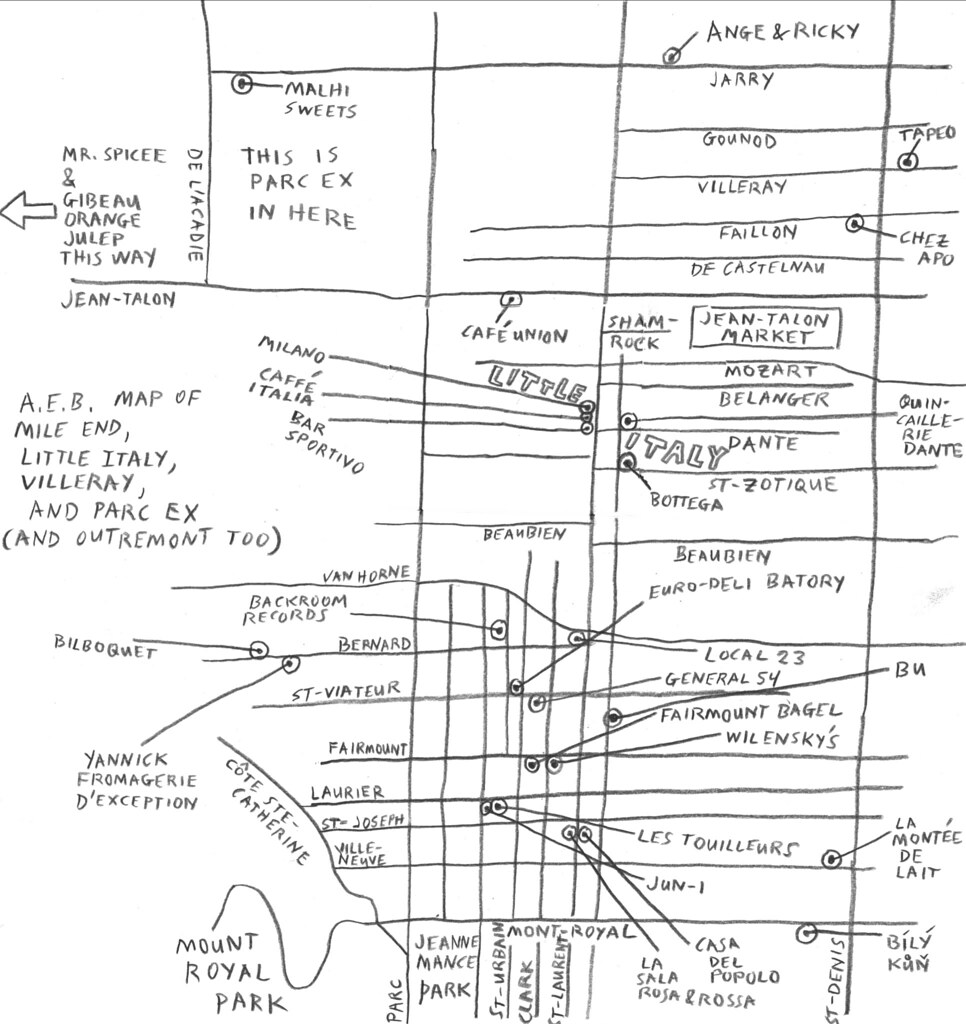
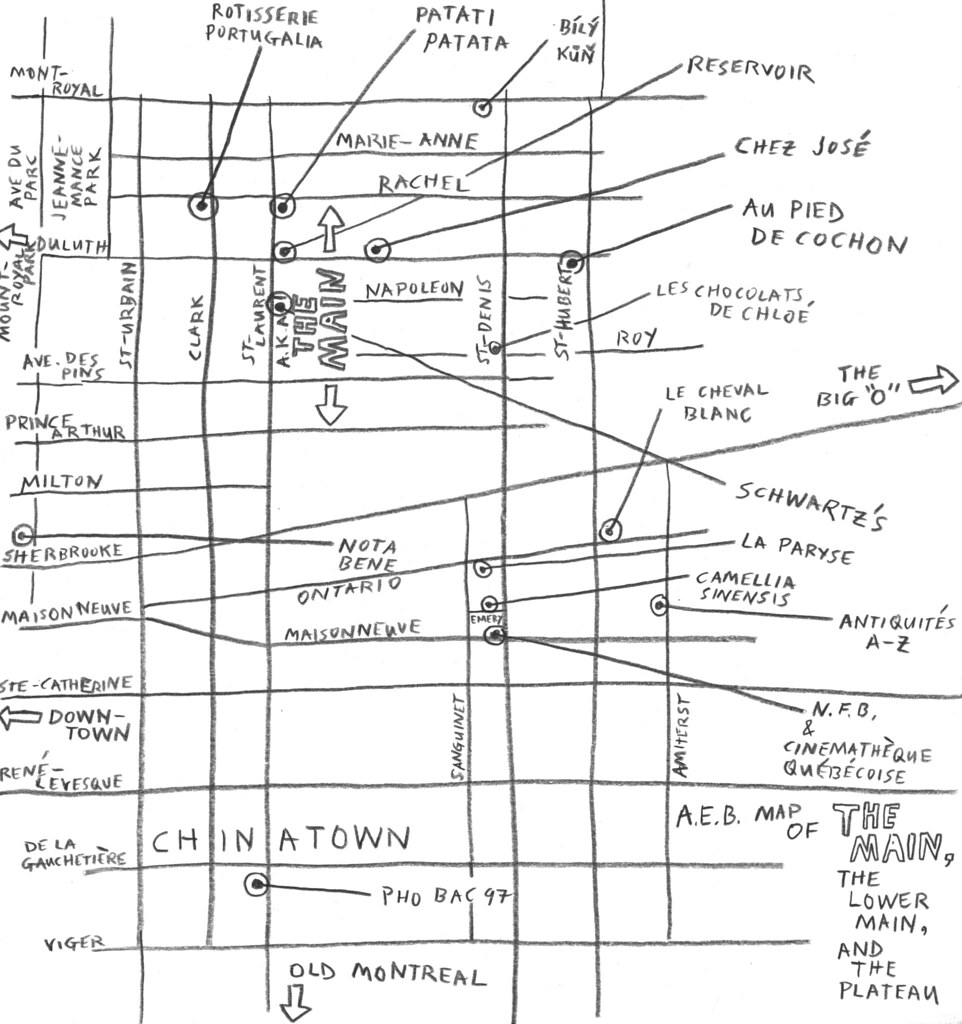
Tuesday, March 15, 2011

Coke is it!

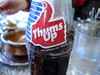
it girl fig. a: Coca-Cola girl

We're not the biggest consumers of soft drinks--in fact, we barely drink any at all--but we certainly can appreciate the tonic qualities of an ice-cold Coca-Cola on occasion, and Michelle has been known to contemplate the mysteries of its fabled secret formula. So I was pretty excited to tell her that our good friends at This American Life had cracked the code. That's right. While conducting research into Coke's original recipe and the carefully rehearsed myth of secrecy that the Coca-Cola Corporation has cultivated for well over a century, This American Life discovered a photograph that appeared to contain the legendary 7X formula. A published photograph! As in: it had been published in a newspaper! In Atlanta! In 1979!

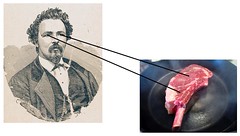
fig. b: 7X?

They then took pains to validate the authenticity of their discovery. And if that wasn't enough, they enlisted some high-powered soda industry help to make a batch from scratch.

This is a tale of intrigue and shocking surprises. It's a tale of trial, error, persistence, and triumph. And it makes for great radio. It's also the best piece of food & drink-related sleuthing we've come across since Matt & Ted Lee's New York Times piece on Marilyn Monroe's stuffing recipe. But let's face it: this is big. It's like discovering the Holy Grail by comparison.

I wasn't the only one who was excited. Michelle was thrilled (just look at that smile). And I don't think I've ever heard Ira Glass this excited about anything ever before. He was positively beside himself. And with good reason. Talk about a Coke high.

Want to hear the episode for yourself? Want to try your hand at making your very own batch of John Pemberton's original recipe 1886 (or thereabouts) Coca-Cola from scratch? You'll find everything you need right here.

aj

Friday, March 04, 2011

Taste of the Nation

It's funny how things happen.

One minute you're hosting a top chef from Chicago for a culinary event here in Montreal, and the next you're in Chicago at the invitation of the aforementioned top chef attending another culinary event and having the time of your life.

And about another minute and a half after that, you're back in Montreal.  You're not even really sure if any of it actually happened, and the fact that you kind of forgot to take pictures doesn't really help, but you did manage to take a few...

Like this photo,

chicago? fig. a: my kind of town?

which may or may not be Chicago,* but it does seem to indicate that I've been airborne recently, and it certainly captures the dizzying pace of the last week.

And you did make it home with a few artifacts...

Like this menu.

6 years, 6 beers, 6 chefs fig. b: 6 years, 6 beers, 6 chefs

Sure, it got soaked by a beverage accidentally, making it all but impossible to read, but it does seem to suggest that a good time was had.

And this toque,

3 Floyds and 1 Boris fig. c: Three Floyds and one Boris

worn back at home by the world's handsomest cat.

Sketchy evidence, you say?  You're just going to have to take my word for it that I attended an astounding anniversary dinner at Hot Chocolate.  A 6th anniversary dinner, mind you, featuring 6 women chefs from coast to coast (our very own Taste of the Nation!), and 6 craft beers paired by the very talented Lauren Salazar from New Belgium Brewing Co.  Some of the pairings were jaw-droppingly good, and the food was amazingly well balanced considering 6 different chefs put the menu together.  And I'd like to send a big shout out to the legion of sous chefs, assistants, and volunteers that filled the kitchen.  I have to admit it was fun to just sit there, watch from the outside, and enjoy myself.

In case you can't read the beer-splattered menu, it went like this:

Koren Grieveson from Avec (Chicago) made an amazing shaved fennel and white asparagus salad with ubriaco prosecco cheese, walnuts, and black truffle toast.  Not truffle oil, but buttered baguette covered in sliced, fresh black truffle.  Paired with Jolly Pumpkin's Oro de Calabaza, a light and sour beer.  Summer on the patio.

Missy Robbins from A Voce (New York) made rye flour ravioli, filled with potato, served with smoked ricotta, guanciale, trotters, and jus.  I loved this course because it had echoes of perogies and because of its pairing with Three Floyds' Ham on Rye beer, whose flavours melded perfectly with the pasta.  Not exactly a quaffer, but a deliciously savoury beer that's perfect for, well, savouring.

Celina Tio from JULIAN (Kansas City) did a crispy skin loup de mer, with garbanzo bean puree, pine nuts and lemon.  Firestone Walkers' Pale 31 was served with this course.  Another great pairing which was greater than the sum of its parts.  This beer was easy drinking.

Naomi Pomeroy from Beast (Portland, OR) did lamb côtelettes with whipped potatoes, sauteed winter greens and sour cherry chutney.  By this time I was getting full, but the meat was so perfectly cooked that I couldn't help but finish the plate.  Oops.  Served with Goose Island's Madame Rose.  Delicious.

Stephanie Izard from Girl and the Goat (Chicago) took on the cheese course.  The cheese, Willies Bandaged Cheddar, blew me away.  It also made me laugh with its accompanying fries and sauce. Sound like poutine?  Well, that's because that's basically what it was.  But done very, very well.  And with apples.  Served with North Coast Brewing Company's Old Stock Ale.

Last but not least, our host Mindy Segal (Hot Chocolate) served dessert.  First up, a wortsicle: think of a frozen chocolate bonbon on a stick flavoured with beer wort--in other words, the best chocolate malted taste ever.  Then a delicious milk chocolate and halva frozen nougat, with ginger snaps, coffee tapioca and caramelized bananas.  This course came with a beer brewed specifically for it: Smoked Chocolate Porter from Piece Brewery, which provided some more of the aforementioned wort.

We rolled out of there and hit The Map Room, a must-visit stop in Chicago, and had, yes, more beer.  This is a great bar which also opens early and serves coffee.  Very convenient.  We ended the night there, and then started the next morning there, too.  There's something almost poetic about book-ending an evening like that.

An enormous thank you to Mindy for inviting me and hosting me, and to Dan for showing me around, and to all the great people I met on my brief sojourn.  I will be back!

m

Hot Chocolate, 1747 North Damen Ave, Chicago, IL

The Map Room, 1949 North Hoyne, Chicago, IL

Big Star, 1531 North Damen, Chicago, IL (tacos and a dizzying array of tequilas)

Quimby's, 1854 W. North Ave, Chicago, IL (best alternative bookstore ever)

Myopic Books, 1563 North Milkwaukee Ave, Chicago, IL (huge used bookstore I couldn't even begin to browse through)

Wormhole Coffee, 1462 North Milkwaukee Ave, Chicago, IL (great coffee)

* Come to think of it, it's not Chicago at all--it's New York!

p.s. Stephanie Izard's The Girl and the Goat just got named one of America's best new restaurants by Saveur! Check it out!

Friday, February 25, 2011

JB and the Upstate Gang

JB + Fleisher's fig. a: good god!

It's true! Joshua "the MooRu" Applestone and the gang from Fleisher's will be here in Montreal joining forces with the JBs--Dave McMillan, Fred Morin, and the rest of the Joe Beef crew--to turn up the meat and bring you a night of grass-fed mayhem. Never had the considerable pleasure of visiting Fleisher's or trying their phenomenal line of pastured meats? I can't think of a better time or place.

who: Joe Beef + Fleisher's
what: feeding frenzy
where: Joe Beef, 2491 Notre Dame W.
when: Friday, March 4, 9:30 pm
why: imagine the possibilities

For more information or reservations, email joe beef at gmail dot com.

aj

Friday, February 18, 2011

HotChocolate City

chicago + montreal fig. a: chicago + montreal

The 2011 edition of Festival Montréal en Lumière is officially underway, and we've decided to overlook the patronizing tone of this year's theme ("Celebrating Women"--"a food event with feminine flair!") because, quite frankly, we're excited. We've been griping about the shortage of women chefs at Montréal en Lumière for years, so it's kind of nice to see the tables turned for a change. But more importantly, the festival has managed to bring in some real superstars, like the festival's Honorary President, Anne-Sophie Pic, the 3-star chef of the legendary Maison Pic in the town Valence, in France's Northern Rhône region; Boston's Barbara Lynch (No. 9 Park, B & G Oysters, The Butcher Shop); New York's Anita Lo (Annisa); and San Francisco's Elizabeth Falkner (Orson, Citizen Cake).

Here at AEB, we're all fired-up because Restaurant Laloux is going to be hosting yet another hotshot: Chicago's Mindy Segal. Mindy has made her name first and foremost in the world of pastry. She worked in the pastry kitchens of some of America's top kitchens, including Wolfgang Puck's Spago, Michael Kornick's MK, and Charlie Trotter's namesake restaurant, and she's won numerous awards and accolades for her pastry expertise and has been a James Beard Award Oustanding Pastry Chef nominee four years running (!). But she also owns and operates her very own restaurant/dessert bar, HotChocolate, and there she directs the entire menu and has won nearly as much praise for her savory delights as for her now-legendary desserts. This is what you call a win-win situation. Michelle's thrilled because she'll be working with one of the very top pastry chefs in America. Seth is thrilled because he'll be working with one of Chicago's outstanding chefs. Actually, come to think of it, it's more like a win-win-win situation, because a whole slew of us will get a chance to experience this combo live and in-person next Monday and Tuesday.

I can't tell you much about the menu Mindy has devised for this special occasion--I'm sworn to secrecy--but I can tell you that she's coming to Montreal with a full bag of tricks and she's planning on using them.

Montréal en lumière, February 17-27

Mindy Segal @ Laloux, Monday, February 21 & Tuesday, February 22

HotChocolate, 1747 North Damen Ave., Chicago, IL, (773) 489-1747

 fig. b: Monago

Restaurant Laloux, 250 ave. des Pins E., 287-9127

aj

p.s. Want to know more about Mindy Segal? Check out Ève Dumas' recent profile in La Presse.  Want to watch Mindy making monkey bread for Martha?*  Check it out.

* Say that five times fast.

Monday, February 14, 2011

Winterlong

winterlong fig. a: winter, long

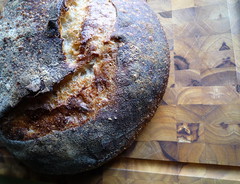
We were already pretty ecstatic about our experiments with baking bread à la Chad Robertson's Tartine Bread. Actually, I should rephrase that: we were completely ecstatic and our experiments quickly developed into a full-fledged practice. We honestly didn't think we could be any happier with Robertson's no-knead sourdough bread, and then, all of a sudden, it happened: our loaves got even better.

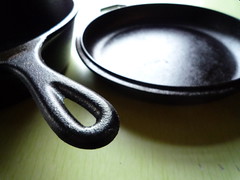
This shift corresponded with a change in technology. Instead of baking our loaves exclusively in our trusty orange enameled Dutch oven, we took Robertson's advice and picked up a Lodge combo cooker, a 100% cast-iron combination Dutch oven & skillet. Not only does the combo cooker have a little more volume than our enameled Dutch oven (allowing your loaf to rise and expand fully without cooking against the wall), but it's designed so that either element--the shallow skillet or the deep pan--can act as the lid for the other. This means that you can gently place your shaped loaf into the shallow skillet without dropping it, or risk burning yourself in the process, and scoring your loaves immediately prior to baking them becomes a whole lot easier because the rim of the skillet is so much lower.

If you can't picture what I'm talking about, the Lodge combo cooker looks something like this:

lodge combo cooker 1 fig. b: combo cooker 1

lodge combo cooker 2 fig. c: combo cooker 2

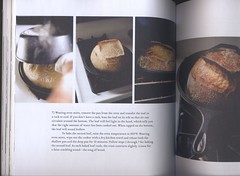
And this is the way it appears in Tartine Bread:

combo cooker fig. d: combo cooker 3

Now, it's true that our loaves got better around the time that we started using the combo cooker, but they didn't get better because of the combo cooker. Over and over again in the pages of Tartine Bread, Robertson insists that it's not technology that makes the bread. You don't need a fancy oven. You don't need a professional mixer. Et cetera. A Dutch oven helps one simulate the conditions one finds in a professional bread-baking oven--it creates what Robertson calls "the two main characteristics of a professional brick oven: a sealed moist chamber and strong radiant heat"--but, ultimately, the secret to making great sourdough lies in two things: the baker's hands and the baker's skill in managing the fermentation process.

So, yes, the combo cooker made it a little easier to bake our loaves, it gave them a bit more room to grow when we did, and it helped produce an awful nice crust, but the sudden improvement in the quality of our loaves had more to do with other matters. It had to do with the fact that we'd gotten a little better at handling our dough and forming our loaves, but, more than anything, it had to do with our increased level of patience. As mentioned earlier, Robertson is terribly insistent that one take one's time with his process, that one give one's sourdough all the time it needs to ferment, mature, and build structure--and rightfully so. And we were patient--we generally took our time and didn't rush things. We learned to work the Tartine method into our schedules in such a way that we didn't cut corners.

But what only dawned on us slowly--a full 2 to 2 1/2 months into our love affair with Tartine Bread--was that it still wasn't enough, for one simple reason: we were baking our loaves in Montreal, not San Francisco, and it was mid-winter. Robertson describes the ideal environment for his bulk fermentation as being 78º - 82º F. He describes the ideal environment for his final rise as being 75º - 80º F. Well, you know what? It was nowhere near those conditions in our chilly Montreal apartment. I know there are probably plenty of Montreal homes out there that are overheated to semi-tropical, perhaps even tropical, extremes--where the room temperature, even in the depths of winter, might actually approach (or even surpass) 75º - 82º F--but AEB HQ ain't one of them. We try to shovel as little of our money into Hydro Québec's coffers as possible--and, besides, we like wearing sweaters and slippers during the winter.

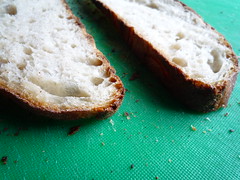
Anyway, what we suddenly realized was that we weren't being patient enough. The conditions in our apartment weren't anything like those described by Robertson--therefore, we needed to give our poor sourdough loaves even more time to reach maturity. What was already a slow process--the very definition of "slow food"--needed to be slowed down further. Ironically, we found that this new super-slo-mo version of the Tartine Bread process was easier to fit into our schedules. Taking it easy--stretching the process our over a couple of days--actually made bread-making easier to manage. More importantly, our loaves seemed lighter, happier, more alive--just look at them:

new country 2 fig. e: new country 1

new country 2.2 fig. f: new country 2

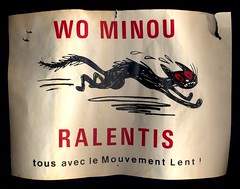
As mentioned before, one of the chief strengths of Tartine Bread is the way it teaches you to really study the sourdough process, to be attentive, and to learn to think on one's feet and make necessary adjustments. The moral of the story? Who knows what challenges the other seasons will hold, but when it comes to baking sourdough at home in a nordic climate like Montreal's, winter = long.

wo, minou! fig. g: wo, minou!

Take your time. Brew a pot of tea. Read a book. Listen to some music. Enjoy the process.

aj

p.s. Interested in getting your very own Lodge combo cooker? They're hard to find in Canada, but readily available in the United States. They're not very expensive, and they've got plenty of uses beyond baking bread. You can even find them on Amazon. For more information, check out the Lodge website.

p.s. 2: So far we've tackled: Basic Country Bread, Olive, Walnut, Polenta, Whole Wheat, Semolina, Country Rye, and Pizza. Next up: Baguettes and Enriched Breads.

p.s. 3: If you missed our original dissertation on Chad Robertson's Tartine Bread, you can find it here.

Thursday, February 10, 2011

Top Ten #39

1. Kaffeeklatsch #1


2. Destroyer, Kaputt (Merge) + "Kaputt"

3. tasting menu @ Lawrence + Domaine de la Roche Buissière Côtes du Rhône 2007 "Flonflons"

4. David Tanis, Heart of the Artichoke and Other Kitchen Journeys + DIY pho


5. Metal Mountains, Golden Trees (Amish)

6. Les Plages d'Agnès, dir. Agnès Varda


7. Mr. Deeds Goes to Town, dir. Frank Capra

8. Philip Roth, American Pastoral + Sherwood Anderson, Winesburg, Ohio

9. Lapierre Morgon 2009 w/ David Tanis' roast pork menu (Saveur #88, November 2005)


10. Beat the Devil, dir. John Huston

aj

Tuesday, February 08, 2011

Trans-Europe Express

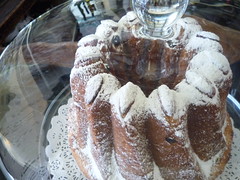
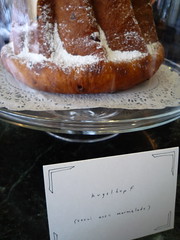
kugelhopf 2 fig. a: kugelhopf 1

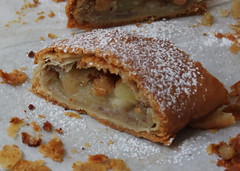
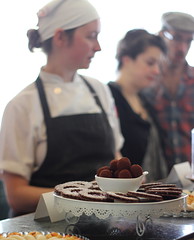
It's been two days since the Kaffeeklatsch event at Laloux and we're still buzzing. We had a good feeling going into this--there seemed to be a lot of enthusiasm in the air leading up to Sunday. And with fresh snow on the ground, a bright sun in the sky, mild temperatures, and a star-studded lineup of Central European pastries ready to go, it really seemed like everything was falling into place. The Linzer cookies were finalized. The strudel dough was stretched, brushed with butter, gently folded over apples, rum-soaked raisins, and walnuts, and baked. Cookies and cakes were placed on display. Team Myriade fine-tuned their equipment and prepped their coffees. Team Laloux readied themselves for service. And by 1:45 (!), people started to show up--in numbers (!!). What was billed as a 2:00 - 5:00 affair turned into a 1:45 - 5:45 affair, but, more importantly, the atmosphere was positively electric. No one spontaneously burst into poetry the way Michelle had imagined, but she was treated to an impromptu poetry reading as she made the rounds (and she received another poem via email), and everywhere you looked people were klatsching it up and partaking in kaffee und kuchen as if they'd been doing it their entire lives.

kugelhopf 1 fig. b: kugelhopf 2

I was maybe not the most objective observer, but the combination of Michelle's cookies and pastries + Team Myriade's amazing brews + the charm and ambiance of Laloux's dining room on a bright winter's day was something to behold. And a lot of people I talked to seemed to feel similarly.

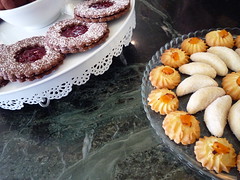
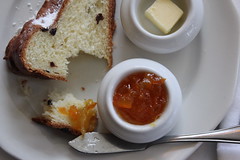
If you couldn't make it out on Sunday and you're having a hard time imagining what Kaffeeklatsch looked like, this should give you an idea:

petit fours fig. c: petit fours*

kugelhopf plate fig. d: kugelhopf plate**

strudel fig. e: strudel**

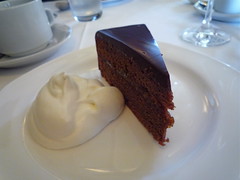
sachertorte fig. f: sachertorte mit schlag

michelle & co. fig. g: Michelle & co.**

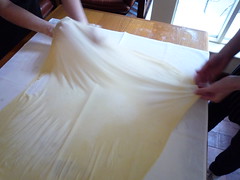
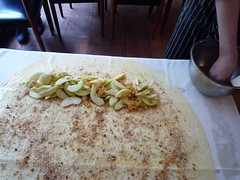
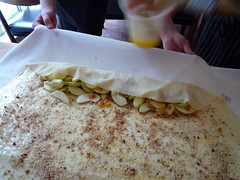
And even if you did get a chance to attend, you might be curious to see what was going on behind the scenes. If you've never made a strudel, this is what the process looks like as the dough is stretched to the point of translucency, stuffed with the apple/raisin/nut filling, and folded.

strudel 1
strudel 2
strudel 3 figs. h, i, j: strudel 101

If all this sounds/looks like fun and you weren't able to make it, I can say with some degree of certainty that there will be repeat performances of Kaffeeklatsch in the future. We had too much fun for it to be otherwise--it would be a shame not to throw another one. Plus, we've got all kinds of ideas for future ones: readings, live music, films, etc. So stay tuned to "...an endless banquet" for news of future Kaffeeklatsch events (or, if you can prefer, you can join our new Kaffeeklatsch Mtl page on Facebook). We just need to figure out a schedule (monthly? bi-monthly? quarterly?).

I can also say that if you're interested in trying Michelle's sachertorte, she'll be offering this chocolate-apricot delicacy as the dessert du jour at Laloux all this week.

Lastly, thanks to Laloux for hosting, Team Myriade for kicking out the jams, and extra-special thanks to all of you who graced Kaffeeklatsch #1 with your presence and made the event a smash hit.

aj

P.S. After all that coffee, after all the excitement, after listening to DJ Der Kommisar's Kaffeeklatsch Klub Mix for hours on end, we were jonesing for a classic Central European meal of some kind. Thing is, we were also exhausted, so when we got an invitation to a Super Bowl tacos night with some friends, we jumped at the opportunity, and it was just what the doctor ordered: overstuffed tacos, ice-cold beers, chips, football, Glee, and good times.

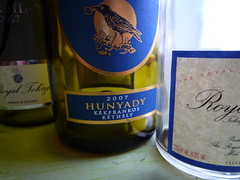
The next day that hankering hadn't subsided, though, and we still had a few pieces of Michelle's kugelhopf left over, so we did the only sensible thing: we baked some sourdough rye, whipped up some goulash, and invited some people over for a collaborative Hungarian feast, complete with cucumber salad, körözött júhtúró (an enchantingly umami-rich cheese spread), Hungarian freak-folk (Félix Lajkó!), Hungarian folk-metal (Vágtázó Halottkémek!), some simultaneous translation, and a trio of impressive Hungarian wines: a dry 2007 Tokaji Furmint, a 2007 Hunyadi Kéthely, made with the pinot noir-like kékfrankos (blaufrankish) grape, and 1996 Tokaji Aszú 5 Puttonyos dessert wine.

après le déluge fig. k: après le déluge

Want to make your own goulash? You can find our AEB recipe here.

Curious about that cheese spread? Here's a recipe:

Körözött Júhtúró, a.k.a. Liptó Cheese Spread

1/2 pound Liptó sheep's milk cheese [this cheese is known as Liptauer in Austria, and Romanian/Slovak Brindza is an acceptable substitute--in Montreal, you can find it at select Central- and Eastern-Europe specialty food stores, like Slovenia (6424, rue Clark)]
1/4 pound lightly salted butter, softened
1 tsp Hungarian paprika [you can use either sweet or hot paprika--we opted for hot]
1/2 tsp prepared mustard [think Central European/German mustard]
1/2 tsp pounded caraway seeds
1 small onion, grated
1/2 tsp anchovy paste [we made our own using salt-packed anchovies]

garnishes: radish slices, green chiles, scallions

Sieve the cheese and mix it with softened butter and all other ingredients until the spread is light red in color and evenly mixed. Refrigerate.

Serve with slices of good, crusty bread, such as freshly baked sourdough rye, accompanied with garnishes.

Mystified by the anchovies? I was. Especially when our friend A. described this dish as something you might get served in the Hungarian countryside. When I asked him about the anchovies he had one word in reply: "Trieste." Of course.

Never tried a Hungarian wine? You can find all three of the wines mentioned above at the SAQ.

* l-r: rum balls, Linzer cookies, vanilla spritz cookies, hazelnut crescents

** very special thanks to EM for the additional photographs

Friday, February 04, 2011

Kaffeekultur

Prague cupboard fig. a: cupboard, Prague

Those of you who've been reading "...an endless banquet" for a while know that our Czechoslovak roots run deep, which is one of the reasons Michelle's been busy organizing a real Central European kaffeeklatsch at Laloux, one inspired in large part by the cafés, coffeehouses, and kavárnas of Prague. You'll also know that we have a certain fascination with serendipity, so if it takes me a while to get to the 411, you'll excuse me.

So, let's see... Where to begin?

Well, I guess we'd have to start in California, last August.

Vladimir's fig. b: Vladimir's

We'd spent a particularly delightful day in western Marin County, north of San Francisco, swimming, eating oysters, daydreaming, and generally having a good time. Late that afternoon, we chanced upon a Czech pub in Inverness, CA called Vladimir's, and we decided that the only sensible thing to do was to stop in and have a pint. We figured that, at the very least, it was a great excuse to write some postcards to our Czech friends and family. So that's exactly what we did.

book barn fig. c: book barn

Five months later, we were visiting our friends in Upstate New York, and they, knowing our weaknesses all too well, took us to a truly fantastic second-hand bookstore. A book barn, actually. The Rodgers Book Barn of Hillsdale, NY. There, among numerous other treasures, Michelle came across a book titled Manka's Czech Cookbook and Memoirs by one Milan Prokupek, Sr.

Manka's fig. d: Manka's

She began to read the back cover and learned that the book recounts the story of Milan and Maria Prokupek, who left Czechoslovakia in 1948, moved to North America, and got involved in the restaurant business, first in Victoria, BC, and then in Inverness, CA. There they opened their second Manka's restaurant (the first had been in Victoria) and quickly became fixtures of the community. They eventually took over a second restaurant in Inverness--a pub called Drake's Arms--and when their daughter, Alena, and her Czech husband, Vladimir, decided they too wanted to get into the hospitality business, the spot was rechristened--you guessed it!--Vladimir's.

Milan fig. e: Milan

Anyway, this coincidence aside, Manka's Czech Cookbook and Memoirs is a classic of self-publishing (or, at least, a classic of the Central-European emigré memoirs/cookbooks sub-genre of self-publishing*). It's got a lot of heart and soul, and it's replete with authentic Czech recipes and a healthy dose of folk wisdom. Michelle instantly recognized it as a "must-have," and snapped it up. Among other things, she figured the book might come in handy as a source of inspiration for her upcoming Kaffeeklatsch event.

So when we got back to AEB HQ, here in Montreal, Michelle cracked her book open and instinctively turned to Chapter 13: "Manka's Desserts." And there, in the chapter's introduction, she found Mr. Prokupek's vivid reminiscences of café culture in his native land:

Vienna and Prague were always well known for their desserts--cakes filled with rich butter creams, pastry heaped and decorated with real whipped cream!

Also, Vienna and Prague were known for their beautiful ladies and girls living there. Their figures were attractive but a little thickish--they liked those Czech and Viennese pastries! Between 3 p.m. and 5 p.m., you would find them, very nicely dressed, at small marble topped tables at the confectionaries gossiping with their female friends, and, with coffee, eating not one but two and three pieces of beautiful pastries.

The male white collar workers stopped in cafes after the end of work at 4:30 p.m., on the way home from their offices for dinner (which was usually served at 8 p.m.). They were large coffee houses on the main streets the size and luxury of large restaurants but serving only excellent coffee and pastries. The homeward bound people met their male friends there for light talk, a few new peppery anecdotes or a game of cards ("maryash")--and coffee and also the pastry. To those sitting alone, the waiter brought a pile of the daily papers or magazines from all over the world to read.

By 7 p.m., everybody had gone home for dinner. And after dinner time, the cafes again filled with young people singing and dancing to large orchestras.

Such were the places where the famous Vienna pastries were served and enjoyed...

Now, if that doesn't get you in the mood for Sunday's Kaffeeklatsch, maybe this profile in this week's Hour will.

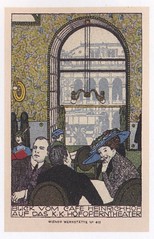
café heinrich hof interior fig. f: strike a pose

Kaffeeklatsch
Sunday, February 6
2:00 p.m - 5:00 p.m.
Restaurant Laloux
250, ave des Pins East
287-9127

Michelle Marek, pastries
Anthony Benda, coffees

"Putting the Vienne back in Viennoiseries."

Hope to see you there! Don't forget to bring your peppery anecdotes!

aj

p.s. Yes, we know Sunday is Super Bowl Sunday. Don't worry--2:00 p.m.-5:00 p.m. is plenty of time to get your klatsch on** before kickoff.

* I mean, just check out the full title: Manka's Czech Cookbook and Memoirs, My Own Story and How My Mother Cooked in Prague and How We Cook Now in Inverness, California.

** TY, MS!

Friday, January 28, 2011

WTP, or DIY Pho

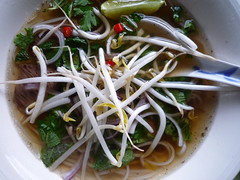
pho by Tanis fig. a: 1/2 photo

Those of us who've never been might find this hard to imagine, but, as David Tanis points out in Heart of the Artichoke (Artisan, 2010), "In Vietnam, pho is street food, basic, hearty, and filling, sold from a cart with a few little stools in front."* In the United States, on the other hand, pho is generally available from "little bare-bones sit-down restaurants," Tanis continues, places where you can grab a quick but satisfying lunch or dinner. Many of us have never had the pleasure of having pho as street food, but we're well-acquainted with the kind of no-frills pho joints he describes, because you can find them in many places around the world these days.** Montreal, for one. Paris, for another. And, in fact, that's exactly where Tanis first became fully enamored of Vietnamese cuisine--not in the United States, not in Vietnam, even, but in Paris.

He writes:

Though I'd often eaten Vietnamese food in California, oddly, it took a bowl of soup in Paris to hook me. After shopping the early morning market at the Place Maubert, we discovered a noodle shop nearby. It happened to be one of those damp, chill spring days the French specialize in, so we sat outside on the sidewalk terrace across from the busy market to seek warmth in a big, brothy bowl of pho.

Tanis doesn't elaborate, but there was something about that bowl of soup on that particular day that really clicked with him. So much so, that, years later, he'd devote an entire menu to Vietnamese cuisine in one of his cookbooks. And, sure enough, the central attraction in Tanis' homage to Vietnam in Heart of the Artichoke is his take on pho bo, the classic Vietnamese beef and noodle soup.

Now, the funny thing is, we first became enamored of David Tanis back in 2005, when he was featured in an article in Saveur ("An American Cooks in Paris" by Dorothy Kalins, #88). The concept was simple. Tanis was introduced as one of the chefs at Berkeley's legendary Chez Panisse (which he was and continues to be), albeit one who spent six months of the year in Paris, during which time he and his partner ran an underground restaurant, Aux Chiens Lunatiques. Who better to give Saveur's readers a tour of Paris's markets and a crash-course in how to make use of the bounty? The resultant spread was beautiful (photos by Christopher Hirsheimer!), highly informative, and utterly seductive (foie gras pâté! sautéed wild mushrooms! roast pork with fennel, garlic, and herbs!), and one of his dishes, his wonderful swiss chard gratin, became an AEB standard. But one of the things we liked best about Tanis, was that he began his Parisian shopping excursion by taking the author out for a "restorative bowl of beef pho at his favorite neighborhood Vietnamese place." This was a man we could totally relate to, a man after our own hearts. But the important thing here is that Tanis didn't make his bowl of beef pho, he went out to his favorite pho joint and bought it, and the article focused on French recipes made with French ingredients.

It took us a while to get around to making our own bowl of homemade pho. It took Tanis's Heart of the Artichoke + a trip to visit our friends S & T in Upstate New York. It's not that it had never occurred to us. We love Vietnamese food, and we've made our fair share of Vietnamese food at home, including a few soups. But we live in a city where pho joints abound, and many of them are quite good, so when we cooked Vietnamese, we often made things that were less readily available. Plus, we, like Tanis, really like going to pho joints, especially when we're out on one of our shopping excursions. Hell, that's exactly how "...an endless banquet" got started, way back when.

But there are times when you're not in Montreal or Paris, or anyone of a number of other places where Vietnamese restaurants are plentiful (Berkeley, New York, Chicago, Arlington, Toronto--take your pick).
feeling winter fig. b: time for pho

There are times when you're in the countryside--in Upstate New York, perhaps--hundreds of miles from the nearest pho joint, and you've been traipsing around in the snow all day, and a restorative bowl of pho sure would taste good.*** There are times when your curiosity gets the best of you ("How do they make that broth?"). And there are times when you want a lot of pho--enough for leftovers, enough to stock your freezer, enough that you might actually be able to try it for breakfast (like you're supposed to) sometime. For all those times, it's nice to have a pho bo recipe you can really trust. Plus, as Andrea Nguyen puts it in Into the Vietnamese Kitchen, "Despite the fun and convenience of eating pho at a local noodle soup spot, nothing beats a homemade bowl." Why? Because it's all about the broth, and at home you can put all the care and attention you want into making your pho especially rich and tasty.
feeling vietnamese 2 fig. c: photo #2

So that's exactly what we did. We broke out Tanis's Heart of the Artichoke, flipped it to his "Feeling Vietnamese" menu, and got to work. S & T had taken care of getting all the ingredients ahead of time, back in the Big City, so we were good to go.

There's nothing particularly challenging about making your own pho, you just need to give the beef broth the love it deserves, which means taking your time and not cutting corners. Doing so "[makes] the difference between a pho that sings and one that just sits there," according to Tanis.

So there aren't really any tricks, but there are a few secrets, things that might not be obvious when you taste the finished product, but give a true pho bo its depth. Like using leg bones in your broth to get an extra-rich flavor.**** And lightly charring an onion and some ginger root at the outset. And getting the mix of spices just right.***** And fish sauce--don't forget the fish sauce.

Tanis isn't particularly prescriptive--he encourages his readers to become "pho fanatics" (pho-natics?), if they aren't already, and develop their own "house pho"--but he offers a very handy blueprint, one that's quite a bit more subtle than Nguyen's version (fewer bones, less star anise), but one that's got all the grace of a true homemade pho.
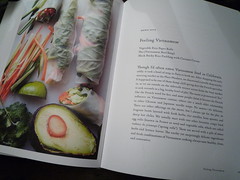
feeling vietnamese 1 fig. d: spring rolls

We took our time, followed all the steps in Tanis's recipe, made some spring rolls to tide us over, and relaxed. Three hours later, our big bowls of steaming homemade pho bo before us, we dug in and let that magical Vietnamese elixir do its work.

straight-up

all-dressed figs. e & f: straight-up & all-dressed

Pho Bo

the soup:

1 1/2 lbs short ribs
1 1/2 lbs oxtails or beef shank
1 large onion, halved
1 3-inch piece unpeeled ginger, thickly sliced
6 quarts water
1 star anise
1 small piece cinnamon stick
1/2 tsp coriander seeds
1/2 tsp fennel seeds
1/4 tsp whole cloves
6 cardamom pods
2 tbsp soy sauce
1 tbsp fish sauce
2 tsp sugar
salt and pepper
1 lb dried rice noodles
1/2 lb fresh bean sprouts
1 sweet red onion, thinly sliced
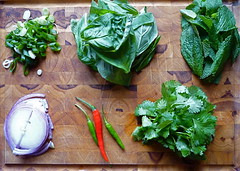
toppings fig. g: garnishes

the garnishes:

mint sprigs
cilantro sprigs
basil sprigs
6 scallions, slivered
2 serrano or 6 small Asian chiles, finely slivered
lime wedges

Bring a large pot of water to a boil. Add the short ribs and oxtails and boil for 10 minutes, then drain, rinse the meat, and discard the water. This step rids the meat and bones of impurities and results in a cleaner-tasting broth. It's a step that's common in many Asian cuisines, including Chinese.

Set a large heavy-bottomed soup pot over medium-high heat, add the onion, cut side down, and ginger, and lightly char for about 10 minutes, until the halves are charred but not quite burnt. Add the short ribs, oxtails, and the 6 quarts of water and bring to a hard boil, then turn down to a simmer. Add the spices. Then add the soy sauce, fish sauce, sugar, and salt and pepper and let simmer, uncovered. Skim off any rising foam, fat, and debris from time to time.

Check the tenderness of the meat after about an hour. It will probably take an hour and a half for the meat to get really fork-tender, but it's better to be safe than sorry.

When the meat is done, remove it from the pot, take the meat off the bones, and reserve. Put the bones bak in the pot to simmer in the broth for another hour and a half.

When the broth is done, taste it for salt and add more if necessary. Strain it through a fine-mesh strainer. Chop the cooked meat and add it to the broth. At this point, you can either cool and refrigerate the broth for later use, or proceed.

When you're ready to serve the pho, put the rice noodles in a large bowl and pour boiling water over them. Let them sit for about 15 minutes (possibly longer) to soften, then drain.

Heat the soup until it's piping hot. Prepare a large platter of the garnishes. We're especially fond of mint, cilantro, scallions, and lime wedges, but here's your opportunity to customize.

Line up the soup bowls (Tanis recommends "deep, giant Chinatown-style bowls"). Put a handful of noodles in each soup bowl and scatter some bean sprouts on top. Add a few raw onion slices. Ladle the broth and a bit of boiled meat into each bowl. Pass the platter of garnishes and let everyone add their own herbs, scallions, chiles, squeezes of lime, etc., as they see fit.

Oh, yeah: and don't forget the Sriracha.

Serves 4 to 6 generously.

[based very, very closely on David Tanis's "Pho (Vietnamese Beef Soup)" recipe in Heart of the Artichoke]

That pho--and the whole process that went into it--really left an impression on us. So much so, that a few days later, back in Montreal, Michelle and I made it again. The whole thing. Start to finish.

lunchtime fig. h: photo #3

And it was just good as ever. Basic, hearty, and filling, and available in our very own kitchen. Not street food, not diner food, but true homemade comfort food.

aj

* For a truly magnificent account of the ins and outs of eating in Vietnam, check out "Saigon Seductions" @ The Traveler's Lunchbox.

** The Vietnamese food explosion of the last 35 years has been nothing if not phenomenal.

*** If pho hits the spot on "one of those damp, chill spring days in Paris," imagine just how soothing it must be on a bone-cold winter day in Upstate.

**** Meat + bones + marrow = extra-rich flavor.

***** You're basically replicating the contents of this bag,
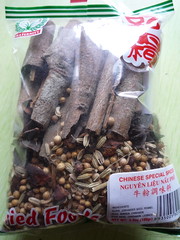
"chinese special spice" fig. i: "chinese special spice"

but with fresher, better-quality spices (hopefully). We highly recommend getting your fennel, in particular, from our good friends the De Viennes at Épices de Cru.

p.s. Extra-special thanks to S & T (and V too).

Wednesday, January 19, 2011

Kaffeeklatsch!

café heinrich hof interior fig. a: picture yourself here

Michelle ended 2010 on a high note. Actually, her whole month of December was pretty stellar. There was her candied fruits class at Dépanneur Le Pick Up. There was her appearance on the CBC's All in a Weekend. And then, on December 31st, one of her desserts--her strawberry verrine from the summer of 2010--led the "best dessert" category on Lesley Chesterman's list of standout dishes for 2010 in the Gazette. Michelle's combination of fresh strawberries, camomile foam, verbena-basil-mint granité, and strawberry sorbet was simply "divine," according to Chesterman (check it out), and, frankly, I'd have to agree. It was one of my favorites of the year, too, but then I'm just a little bit partial.
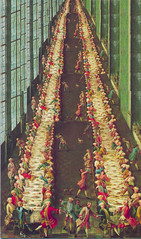
The new year is still young, but 2011 is already off to a good start. For one thing, this year marks Restaurant Laloux's 25th anniversary. How many fine-dining restaurants here in Montreal can claim that? To celebrate, Laloux will be hosting a series of events all year long, featuring guest chefs and other guest collaborators, theme nights, promotions, etc. Michelle is leading the charge with event #1 and she's asked her good friend Anthony Benda of Café Myriade to team up with her. The concept? A real, old-fashioned afternoon kaffeklatsch (a.k.a., coffee klatch)*, complete with an array of frothy coffee drinks by Herr Benda and a full assortment of traditional Central and Eastern European pastries and petits fours by Michelle. Sachertorte? Check. Strudel? Check. Kugelhopf? Check. Linzer cookies? Check.

Sound good? Thought so.

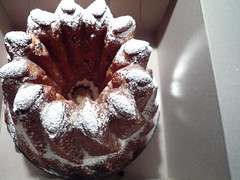
kugelhopf! fig. b: kugelhopf, aerial view

Kaffeeklatsch #1 takes place at Laloux on February 6, 2011, from 2 p.m. till 5 p.m.

For more information, check out their Facebook page.

Restaurant Laloux, 250 ave. des Pins E., 287-9127 (Plateau Mont-Royal)

aj

* Still not clear about the concept? Well, if I had to break it down it would go something like this Coffee + Conversation + Sweets = A Good Time, or, as Michelle puts it, "You provide the gossip, the laughs, the witty repartee, we'll provide the coffee, the sweets, the ambiance."