Showing posts with label Pied de Cochon. Show all posts

Tuesday, April 28, 2009

sugar shock 2

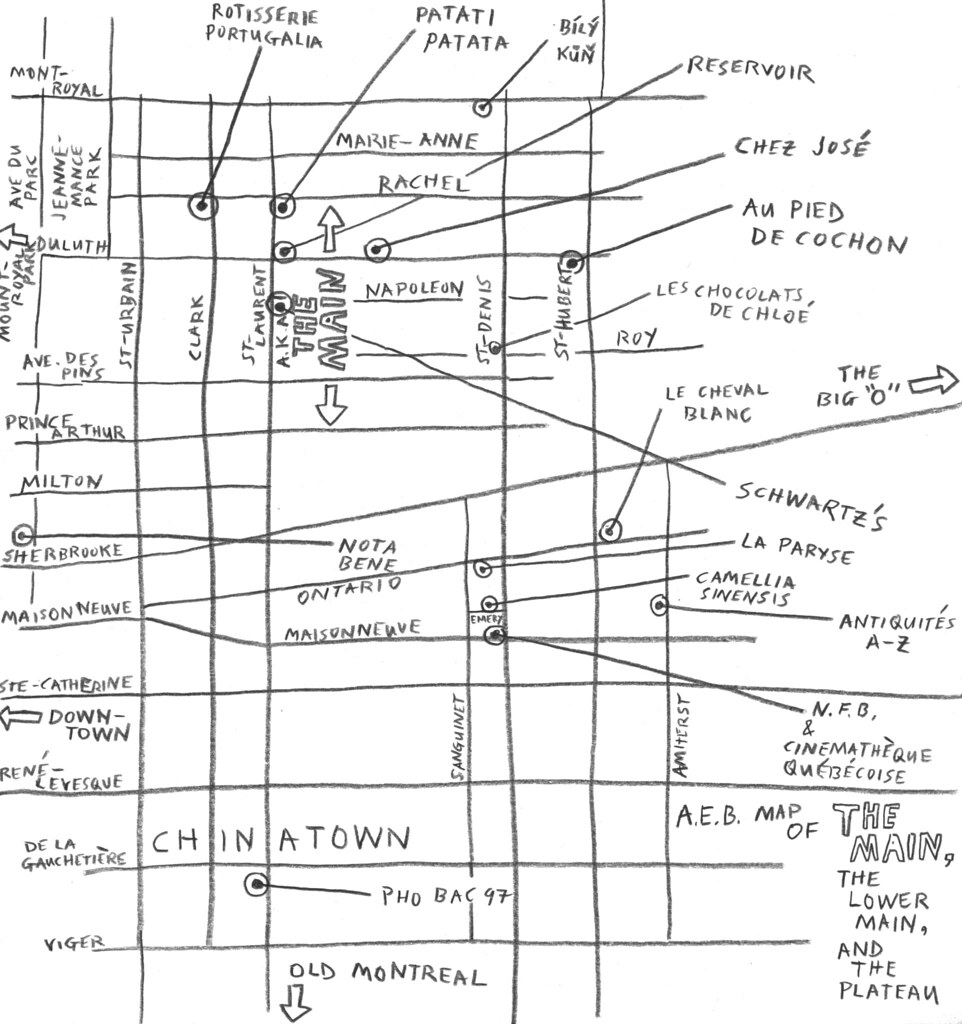
sugar shack map fig. a: actual map used to get to PDC Sugar Shack

By now, if you've been keeping up with the sugar shacking scene here in Quebec, as I'm sure you have been, the basic outline of this story is probably familiar to you:

1. Earlier this year, Martin Picard & the rest of the gang at Montreal's Restaurant Au Pied de Cochon took the next logical step in their 10-year plan and bought a nice chunk of land outside of Mirabel that came complete with an extensive sugar bush and a sugar shack.
2. There they went ahead and opened their latest venture, Cabane à Sucre Au Pied de Cochon.
3. In typical fashion, they took the classic cabane à sucre menu, and turned it on its porky little ear.
4. Crowds have come flocking and Cabane à Sucre Au Pied de Cochon, which was originally meant to be something of a lark, a respite for Au Pied de Cochon's weary équipe and their loved ones, has been fully booked for weeks now.


Sensing that Quebec was more than ready for an upstart sugar shack (we certainly were), "...an endless banquet" went ahead and made a reservation for opening night, way back in March. The thing is, opening night got bumped. That's right, a couple of days before we got a polite phone call informing us that they'd had to roll back the opening by a night, and, unfortunately, the next night was out of the question for us. And by the time we got around to calling back and trying to rebook, they were totally complet--right into May. So we put ourselves on the waiting list and said our prayers.

And--wouldn't you know it--a few weeks later we actually got a call back. Some poor suckers had bowed out and suddenly we found ourselves with a reservation for three at the bar, which just happens to be our preferred way of dining at Restaurant Au Pied de Cochon.

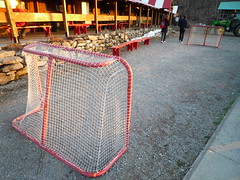
From the moment we got to Cabane à Sucre Au Pied de Cochon's location in St-Benoît de Mirabel, we loved the look of the place. No sleigh rides, no petting zoo, no period costumes, and, this being a rather balmy late-April evening, no snow. Just a simple sugar shack, a street hockey court, and some tractors.

hockey night in canada fig. b: Hockey Night in Canada

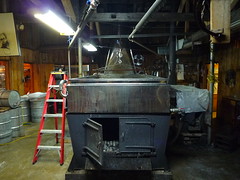
And this ain't no vanity project either. Cabane à Sucre Au Pied de Cochon is an honest-to-goodness sugar shack sitting on a heavily forested parcel of land. Why buy gallons and gallons of maple syrup if you can make almost 550 gallons of your own? Why buy firewood for your famous wood-burning oven if you can chop your own? And wouldn't it be nice to raise 50 free-range pigs that actually lived free-range lives? Yes, it would. That's the idea, anyway. In the meantime, the team at Au Pied de Cochon has a big ole wood-burning evaporator, and they know how to use it.

the evaporator fig. c: the evaporator

And the food? Well, the rumors are true. The meal is stupendous. Three massive courses, and all three are totally mental. Three and a half, if you order an extra tourtière with real ketchup aux fruits, and our advice to you is that you'd be a fool to miss out.

Highlights:

1. omelet with scallops and sea bass
2. tourtière with real ketchup aux fruits
3. buckwheat ployes with cretons and house-cured gravlax
4. salad with oreilles de crisse, ham, hazelnuts and a mustard vinaigrette
5. tempura-fried lobster maki with foie gras
6. maple-glazed magret de canard with a luscious polenta and brussels sprouts
7. and the house banana split with maple barbe à papa, maple sponge toffee, maple-glazed peanuts, and maple ice cream was certainly the most dramatic of the three (!) desserts, but our favorite was the somewhat more subdued maple baked Alaska.


And that's only about 60% of the set menu. And that's their toned-down menu. They started off serving five totally mental courses (!).

Like I said, the rumors are true. This time the sugar shock lasted two days.

Cabane à Sucre Au Pied de Cochon, 11382 rang de la Fresnière, St-Benoît de Mirabel, (450) 258-1732

prices are $45 for adults, $15 for kids under the age of 12, and little piggies under the age of 2 EAT FREE.

aj

Monday, December 15, 2008

Menu for Hope 5, rev. ed.

menu for hope 5

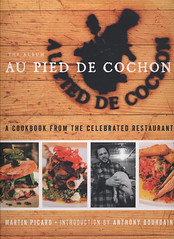
In honor of Menu for Hope's fifth anniversary, as well as the 2008 release of Au Pied de Cochon: The Album in paperback (the original hardback edition was published in 2006 to celebrate Au Pied de Cochon's fifth anniversary), "...an endless banquet" would like to present its DIY Sugar Shack Special for this year's Menu for Hope.

PDC sugar shack fig. a: PDC Sugar Shack

Of course, sugaring off season is still a few months off, but this do-it-yourself sugar shack kit will allow you to brave the winter of 2009 with plenty of genuine Québécois joie de vivre wherever you live, from Kitchener to Kathmandu.

Au Pied de Cochon:  The Album (Paperback Edition) fig. b: The Album

You'll get one copy of Martin Picard & Co.'s indie cookbook sensation, Au Pied de Cochon: The Album (now published in paperback by the venerable firm of Douglas & McIntyre), plus all the basics to throw your own DIY Sugar Shack Party. It's fun, it's heart-warming, it's seasonal, and it'll stick to your bones!

the greatest fig. c: find out why they call him The Greatest

What exactly is in AEB's DIY Sugar Shack Special? Well, here's an itemized list of the contents:

1 x copy Au Pied de Cochon: The Album, paperback edition ($40 CAN)

1 x can real Quebec maple syrup ($7)

1 x jar AEB ketchup aux fruits ($6)

1 x maple candy lollipop ($1)

1 x Sugar Shack/Shock Party mix CD, by DJ Oreilles de Crisse (priceless)

estimated retail value: you do the math.

AND we will ship anywhere in the world.

Interested? The prize code for our DIY Sugar Shack Special is: CA03


Remember, it only costs $10 to enter the draw, and all proceeds go to the UN World Food Programme.

Want to see all the other Canadian prizes? Visit Meena at Hooked on Heat.

Want to see the complete list of Menu for Hope prize packs from around the world? Not familiar with Menu for Hope and how it works? See Chez Pim for all the details.

Once you've selected the prize or prizes you want to bid on, just go to the First Giving's webpage and it's easy as 1-2-3.

Still don't get it? Here are the official donation Instructions:

1. Choose a prize or prizes of your choice from our Menu for Hope at Chez Pim.

2. Go to the donation site at http://www.firstgiving.com/menuforhope5 and make a donation.

3. Each $10 you donate will give you one raffle ticket toward a prize of your choice. Please specify which prize you'd like in the 'Personal Message' section in the donation form when confirming your donation. You must write-in how many tickets per prize, and please use the prize code.

For example, a donation of $50 can be 2 tickets for EU01 and 3 tickets for EU02. Please write 2xEU01, 3xEU02

4. If your company matches your charity donation, please check the box and fill in the information so we could claim the corporate match.

5. Please allow us to see your email address so that we could contact you in case you win. Your email address will not be shared with anyone.


Happy holidays and give giving a chance.

am/km

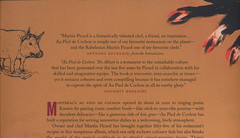
ps--Additional bonus: Sure, you get a back cover blurb by my namesake, Anthony Bourdain, but you also get one by Yours Truly, from my 2006 Gourmet Magazine (online edition) review. Check it out!

PDC back cover blurbs fig. d: PDC: The Album back cover blurbs

Saturday, June 21, 2008

les plateaux Mont-Royal

Just a few weeks ago it seemed like Au Pied de Cochon's summer seafood extravaganza was still just getting off the ground. There were lobsters and shellfish of all sorts, but they and an outrageous roasted mahi-mahi* with fiddleheads and ramps combo were on offer strictly as off-menu specials.

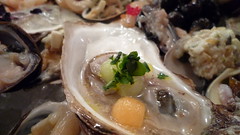
PDC seafood platter fig. 1: Le Plateau PDC

Just last week, though, Au Pied de Cochon's seafood was back in full effect, as evidenced by the platter of coquillage you see above.

That's the "small," the "Plateau PDC." It runs just under $50. This year Au Pied de Cochon offers four more seafood platters, and each one gets more plentiful, and more intricate. They also get kinda tall--we passed one on our way in that looked like the Eiffel Tower. There was talk of lobsters and seared fish with some of the bigger platters. I can't even imagine what the biggest and baddest of the lot--"Le Gros Verrat"--entails. Its price tag? $350. Our "Plateau PDC" made for a very substantial appetizer for three (along with some cromesquis, of course), so I guess "Le Gros Verrat" would make a very substantial appetizer for you and twenty of your friends? Who knows? All I know is that the quality is unbeatable. So is the creativity.

Au Pied de Cochon has its novelty dishes, of course (Duck in a Can, Foie Gras Poutine), but it's not really a place you associate with molecular gastronomy. That said, the most pleasant surprise of the night came with one of our massive oysters (but not the one you see in the picture). This is one had a mysterious pale translucent cube nestled next to the oyster. I really had no idea what to expect. Could have been lychee jelly for all I knew. Turns out it was something way better, and way more clever: sea water. Eaten together, the sea water jelly just melted in your mouth and mingled with the oyster, taking the natural brininess of that lovely Atlantic oyster to a whole other delectable level.

Sure, we live along a Seaway, but sometimes the Atlantic seems awfully distant. If you've gotta be landlocked, this is definitely the way to do it.

aj

* Apparently it was Atlantic mahi-mahi and the Novia Scotia fishermen who landed it had never seen one before (they don't generally make it this far north [!]), so Picard & Co. got it for a good price.

ps--TY, Jr.!

Wednesday, March 26, 2008

DIY cabane à sucre

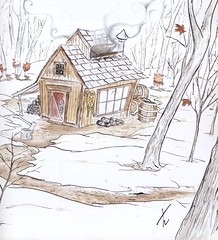
maple sugaring 2 fig. a: maple sugaring in the northern woods again

Those of you who've been reading AEB over the last few years will know that we've long had an affection for scenes such as the one above: old prints of homesteaders practicing the alchemy of turning maple sap into maple syrup and maple sugar. You'll also know that we're big fans of the cuisine--yes, cuisine--of the traditional Québécois cabane à sucre: the beans, the ham, the cretons, and all the other assorted pork dishes, the ketchup aux fruits, the tire d'érable, and so on. You might also have noticed that Michelle's birthday is around this time of year, right in the thick of sugaring-off season. What you might not know, however--especially if you don't live in this region--is that if you wanted to take a sugar shack fanatic out to celebrate her birthday with a group of people at a traditional cabane à sucre, you'd have literally dozens upon dozens of establishments to choose from within a 100-150 km radius, but you'd be hard-pressed to find one of exceptional quality (top-notch ingredients + top-notch technique). Believe me, we've tried, and though we've found some good cabanes à sucre, ones worthy of a casual, slightly kitschy weekend outing, we've yet to find one that's worthy of a birthday party. Which means that as much as the idea of taking a group of people out to a traditional, rustic, intimate, backwoods sugar shack for Michelle's birthday appeals to us, it's never really been in the cards.

Now, rewind, if you will, for just a moment or two, to about three weeks ago. We were strolling down Ste-Catherine W. on our way to a movie when we looked in the window at Westcott Books and saw this handsome book:
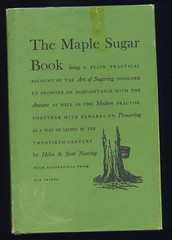
The Maple Sugar Book fig. b: The Maple Sugar Book

The store was closed at the time, but the cover left such an impression on us that the very next day we made a special trip back to that part of town to take a closer look. And when we did, we liked what we saw, so we took that first edition of Helen & Scott Nearing's The Maple Sugar Book (1950) up to the front counter, chatted up the owner about his numerous bookstore cats, paid for the book, and took it home with us.

The Nearings' book is divided into three parts--roughly, the history of maple sugaring, the practice of maple sugaring, and the philosophy of life that goes along with maple sugaring--plus an appendix on maple recipes of all sorts (from candied sweet potatoes to maple divinity fudge), and it starts off with the kind of bang you might expect from the people who more or less pioneered the 20th century back-to-the-land movement:

FOREWORD

We had three things in mind when we set ourselves to write this book. The first was to describe in detail the process of maple sugaring. The second was to present some interesting aspects of maple history. The third was to relate our experiments in homesteading and making a living from maple to the larger problem faced by so many people nowadays: how should one live?

[...]

What we have been developing here in the Green Mountains is a source of livelihood that leaves us time and room to live life simply and surely and worthily. Henry Thoreau wrote in his journal on February 18, 1850: "There is little or nothing to be remembered written on the subject of getting an honest living. Neither the New Testament nor Poor Richard speaks to our condition. I cannot think of a single page which entertains, much less answers, the questions which I put to myself on this subject. How to make the getting our living poetic! for if it is not poetic, it is not life but death that we get." Sugaring can bring one an honest living. And anyone who has ever sugared remembers the poesy of it to the end of his days...


We haven't exactly packed up our city-living ways, found ourselves a tract of hardscrabble land, and started homesteading (yet), but the Nearings' The Maple Sugar Book is definitely a great read for a book that devotes so much type to discussions of buckets, pipes, and evaporators, and we've been talking about it off and on for weeks.

In fact, it became such an important of our lives that when we started thinking about our annual sugar shack pilgrimage this year, perversely, the book actually inspired us to stay in the city and stage a full-blown cabane à sucre extravaganza ourselves. We'd be missing out on the fresh air and the woods, of course, but we'd be saving on car rental fees and gas, there'd be little risk of kitsch, we'd be able to guarantee that our food would be both tasty and of a high quality, we'd be able to control the stereo (i.e. we'd be able to play our La Bolduc records if we so desired, but we could just as easily play a Brigitte Fontaine & Areski record) and therefore the ambiance, and, who knows, maybe we'd be able to create some small-scale poesy right at home. We got so excited about the idea, that we decided to throw this sugar shack party for Michelle's birthday.

Now, before you get all hot and bothered because we left out the pea soup, the oreilles de crisse, and the pets de soeur, you should know that our menu was our own personal Dream Team: a few classics, like baked beans and ketchup aux fruits, alongside some dishes that you'd probably never find at a cabane à sucre but you'd be happier if you did (or, rather, we'd be happier if we did). The spread went as follows: two tourtières, two maple-braised pork shanks, two batches of baked beans (one with yellow eye beans, the other with soldier beans), a massive batch of cole slaw, ketchup aux fruits, cornichons, cheddar cheese with crackers and jerusalem artichoke relish, and a can of maple syrup for all those willing to add a little magic to the mix, plus apple crumble with maple frappé for dessert. The tablecloth was of the red & white checked variety, and Michelle had decorated the table with hay to give things a countrified feel (okay, so we threw in a little kitsch). The view from our specially designed AEB tablecam looked like this:
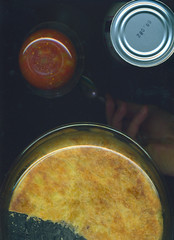
tourtière, ketchup aux fruits, maple syrup, spoon, hand fig. c: tourtière de ville, ketchup aux fruits, sirop d'érable

Tourtière, of course, is the classic French-Canadian meat pie. It might even be the classic French-Canadian dish. Its roots stretch back to the days before the settlement of New France, but this is a dish which, in all of its varieties, became as French-Canadian as they come. The version we've been making since the fall of 2006 is a variation on the one found in Martin Picard & Co.'s Au Pied de Cochon: The Album, and it's the best tourtière recipe I've ever encountered. If you've ever had your typical modern, disappointing, bone-dry tourtière, this is not one of them. The PDC recipe is unorthodox but ingenious, using mushrooms, white wine, and a grated potato to keep the filling moist and flavorful. The PDC original calls for braised pork shank meat and 1 braised pig's knuckle because when they make them at the restaurant they've got a lot of braised pork shanks and braised pigs' knuckles on-hand and available. We've replaced the 200 g / 7 oz of braised pork shank meat with the same amount of ground veal for simplicity's sake, and it turns out famously every time. However, you could use some of the braised pork shank meat from the maple pigs' feet / maple pork shanks recipe you see below, if you so desired, and I'm sure your tourtière would turn out even more hallucinant. Note: when it comes to the ground pork, don't get it too lean--no need to go overboard, but you want a bit of extra fat content for tourtière. If that kind of thing concerns you, just go for a long walk or chop a little wood beforehand, but don't sell your tourtière short. Note #2: the added nutmeg is my touch. Again, this is very unorthodox, so go ahead and leave it out if you like, but I think it really makes a difference. Just remember to go easy on the spices. They should definitely be present, but you don't want to overpower the filling with either clove or cinnamon (or nutmeg, for that matter).

tourtière de ville

1 pie dough recipe
500 g / 1 lb ground pork
250 g / 1/2 lb ground veal
1 medium onion, diced
3 cloves garlic, chopped
100 g / 4 oz mushrooms, chopped
100 ml / 1/2 cup white wine
1 egg yolk
1 tbsp butter
1 small potato, grated
1 small pinch ground cloves
1 small pinch ground cinnamon
1 small pinch ground nutmeg
salt and freshly ground pepper

In a large pot, sweat the onions and the garlic in the butter over medium-high heat. Add the mushrooms and continue cooking until the liquid released by the vegetables has evaporated. Add the white wine and continue cooking until the wine has evaporated as well. Add the ground pork, the ground veal, and the spices to the pot. Cook for 5 minutes, stirring to break up the chunks of meat. Add the grated potato and cook for another 10 minutes. Correct the seasoning, remove from the heat, and allow the mixture to cool.

Preheat your oven to 230º C / 450º F.

Roll out the pie dough and line a pie plate with half of it. Fill this with the ground meat mixture. Cover with the top half of the pie crust, brush it with the egg yolk, and poke or cut some holes in the top crust to allow the steam to escape during cooking.

Bake the pie in the oven for 15 minutes, then lower the heat to 175º C / 350º F and bake for another 20-25 minutes.

Serve with ketchup aux fruits.


Two pork shanks from our friends at Porc Meilleur came in at under $5 and they looked and tasted great. This recipe is straight out of the PDC cookbook and it's typical of PDC's genius: take one of the lowliest cuts off one of the lowliest meats and redeem it with a cup of maple syrup and a lot of love.

maple pigs' feet / pork shanks

2 pigs' trotters or pork shanks
2 carrots, peeled
1 head of garlic, whole
1 sprig thyme
6 boiler onions
2 l / 8 cups pork stock
250 ml / 1 cup maple syrup
100 ml / 7 tbsp vinaigrette
15 g / 1/4 cup fresh Italian parsley
salt and freshly ground black pepper

brine: 2 cups of salt dissolved in 4.5 l / 1.2 gallons of water

Soak the pigs' feet or pork shanks in the brine for 4-6 hours.

Put the meat, the onions, the carrots, the garlic and the thyme in an ovenproof casserole. Pour the stock and the maple syrup over the meat (ideally, the liquid should come about halfway up the sides of the feet/shanks). Bake uncovered in the oven at 160º C / 325º F, basting the meat with the broth every 30 minutes until they are well-glazed and have developed a nice crust. Bake for a total of four hours; the meat should be extremely tender and come easilly off the bone. Remove the meat, the carrots, and the onions from the broth and set aside.

Strain the stock and drippings into a saucepan; you should have approximately 2 cups total. Dice the carrots finely and add them and the onions to the pan. Bring to a boil over high heat and reduce by half. Remove from the heat and whisk in the vinaigrette. Add the parsley and correct the seasoning as needed.

Serve the meat with a generous amount of the sauce poured overtop.

Vinaigrette:

1 cup vegetable oil
50 ml Dijon mustard
50 ml red wine vinegar

Whisk together the mustard, the vinegar, and a pinch of salt in a mixing bowl. Gradually whisk in the oil, stirring constantly to create a proper emulsion.


If you're all out of last summer's homemade canned ketchup aux fruits, here's a quick and easy off-season version.

ketchup aux fruits (winter version)

1 28-oz / 786 ml can of whole tomatoes & their liquid
1 onion, diced
3 cloves garlic, minced
2 stalks celery, diced
2 apples, peeled, cored, and diced
1/2 cup maple syrup
1/4 cup white vinegar
1/2 tsp dry mustard
1 pinch of ground cloves
1 small pinch cayenne pepper
salt and freshly ground pepper to taste

In a saucepan, bring the whole tomatoes, the onion, the garlic, and the celery to a boil and then simmer them gently for about 15-20 minutes, and gently break up the tomatoes with a wooden spoon. Remove the saucepan from the heat and using an immersion blender or a conventional blender, blend half the mixture, then return it to the saucepan. Add the apples, the maple syrup, the vinegar and the spices and simmer for another 30-45 minutes. Makes plenty enough for a DIY sugar shack bash, and you'll be happy to have the leftovers.


This last recipe is of the WWMD variety: "what would Maurice do." We considered a whole host of maple syrup-laden desserts--backwoods-style crêpes, pouding chômeur, etc.--before settling on something we'd never ever had before because a) we have a lot of faith in Maurice and b) how can you argue with a recipe that gets this kind of write-up?

Once in a while Hettie [the Brockways' Irish "hired girl"] would make what she called Maple Frappe. I was delighted to help chop the ice which Tommy, the handyman, would get out of the big icehouse located out beyond the vegetable garden under a huge maple tree. Every winter, when the river was frozen, Grandfather hired a local man and his son to cut the large blocks of ice and haul them on a sleigh up the long hill to the icehouse. They were packed in sawdust from the lumber mill, and there they lasted all through the long hot summer. Each morning a large piece was dug out of the sawdust--which served as perfect insulation--washed with the hose, then put into the icebox in the summer kitchen. We were extremely advanced as we had a drain from the ice chest instead of the large pan everyone else seemed to use to catch the drippings.

I was delighted also to turn the freezer crank for the privilege of "licking" the ladle. Try this, and soon: 6 eggs beaten until creamy, 1 cup of pure maple syrup, 1 can of condensed milk, 1 can of evaporated milk, 1 pint of heavy cream whipped, and 1/2 teaspoon of salt. Mix together and freeze in an old-fashioned ice-cream freezer--not in the refrigerator ice trays. This makes 3 pints of frappe which, by itself is pure nectar, but atop warm apple pie is a delicacy that must be tasted to be believed.


We made an apple crumble instead of the apple pie recommended by Maurice, but it still ranked as "a delicacy that must be tasted to be believed." I don't know if I'm ready to wax poetic about maple frappé the way Maurice does--of course, we don't have an icehouse or a "hired girl" name Hettie, so maybe we didn't get the full experience--but it's got a really lovely, mellow maple flavor to it and I definitely have never had anything like it.

All in all: A+

aj
Friday, June 08, 2007

Top Ten #19

1. Clare & Carl's, Plattsburgh, NY

2. Black Narcissus, dir. Powell

blonde redhead, 23

3. Blonde Redhead, 23

4. Little Dieter Needs to Fly + My Best Fiend + Of Walking in Ice, all by Werner Herzog + Herzog's cameo in Wenders' Tokyo-Ga

dynamic duo

5. A Postillion Struck By Lightning, Dirk Bogarde

6. rewatching The Sopranos from scratch

7. Feist, "Sealion"

8. Nick Tosches, "If You Knew Sushi," Vanity Fair, June 2007

9. seafood platter, Au Pied de Cochon

10. A Passage to India, E.M. Forster

Thursday, November 02, 2006

Au Pied de Cochon: The Launch

Neglecting you? Yes, dear readers, that we're guilty of. But all rumors that our silence over the last ten days has been some kind of cheap “Paul is dead”-style publicity stunt (“My God, that explains Michelle’s bare feet peeking out from underneath that check tablecloth on October 12th!”) are grossly exaggerated. In fact, not only has “…an endless banquet” been living up to its name (“It don’t stop!”), we’ve been busier than ever. Conducting interviews, attending events, traveling great distances, giving interviews, taste testing, receiving nominations—it’s been one wild week. There’s hardly a shortage of material kicking around the editorial offices of Endless Banquet Inc. Quite the opposite. We’re dealing with a bumper crop!

It all got started a week ago last Monday at the launch for this handsome looking tome:

au pied de cochon: the album fig. a: Au Pied de Cochon: The Album

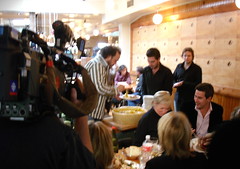
Somehow I’d managed to get myself invited (plus one!) to the journalists’ session for Martin Picard’s new book, Au Pied de Cochon: The Album, the book that commemorates his restaurant’s fifth anniversary. We’d been excited about the release of this book for weeks. The word around town was that it wasn’t just a cookbook, it was something of a multimedia extravaganza. Typically that kind of hype might have had us worried, but we had faith in Martin Picard and his team at Au Pied de Cochon—in the three years we’d been going there they’d never let us down yet. So it was with eager anticipation that I opened my copy of Au Pied de Cochon: The Album (not a cookbook, an album) there at the table and started to leaf through it and read—and what I found, I loved. Recipes, photographs, declarations, diagrams, artworks, comics (the French edition, Au Pied de Cochon: l’Album, comes complete with a 40-page comic book), testimonials, and even an impressive DVD (!) which contains over two hours of behind-the-scenes segments, homages to the Québécois terroir, and recipes inspired by Au Pied de Cochon as proposed by friends of the restaurant. Instead of some kind of typical celebrity chef vanity project, you get something that’s much more openly collaborative. Few restaurateurs have been as successful at cultivating a tight, talented équipe as Picard has been. Few restaurateurs have been as dedicated to cultivating a network of artisanal producers from which to draw his high-quality staples. And this book is clearly dedicated to both of these immediate and extended families. Hell, Picard even takes the time to tip his hat to Au Pied de Cochon’s plongeurs. The overall package is irreverent, even anarchic at times, but it is cohesive and even compelling because it has somehow managed to capture the majesty of Au Pied de Cochon’s spirit in all its earthy glory.

the greatest fig. b: the greatest

It’s also terribly funny. Take page 133, for instance. While other cookbooks engage in involuntary surrealism by pairing recipes with photographs that bear little resemblance to them, or offer up all kinds of other cul-de-sacs and misdirections, Au Pied de Cochon revels in its inconsistencies (although, truth be told, it's very well edited). The recipe here—“PDC Petits Cornichons Salés (Pickles)”—is a simple one that includes only six ingredients: baby cucumbers, white vinegar, black peppercorns, a bay leaf, 7 coriander seeds, and coarse salt. The photograph that accompanies it features medium-sized Kirby cukes and lots of garlic. The caption reads: “You’ll no doubt notice here that the photo shows dill and garlic pickles rather than the petit cornichons. At Au Pied de Cochon, we like to make sure our readers are paying attention!” Later, when I asked Picard about the sens d’humour that permeates the book and indeed the restaurant (like its hilarious “backwoods butch” men’s room), he insisted that while not taking themselves too seriously was key to the Au Pied de Cochon experience, being “very, very professional” was job one. As if anyone could possibly take anything Picard and Au Pied de Cochon did lightly!

Crack open your copy of Au Pied de Cochon: The Album and you’ll find virtually every recipe that has made Picard and the restaurant renowned internationally—and justly so, I might add. Foie Gras Poutine, Stuffed Pigs’ Feet, Duck in a Can, PDC Monster Lobster—they’re all there. You’ll also find a typically lively introduction by none other than Anthony Bourdain, the man who made Au Pied de Cochon the subject of one of the more memorable episodes of No Reservations. And you’ll find that all the extras are worthwhile. The photographs have a keen eye to them and are lushly reproduced, the DVD is very well shot and crisply edited and you come away from it thinking that, in spite of his no-nonsense, “Bullshit-Free” demeanor (to paraphrase Bourdain), Picard is a hugely telegenic presence.

If all this wasn’t enough, Picard decided to throw in a multi-course meal to further show off the remarkable generosity that has come to define the restaurant. Living in Montreal, you catch wind of these elaborate affairs at Au Pied de Cochon with some frequency. The measures taken to create their annual Hunter’s Banquet, a phantasmagoria of feather and flesh that Martin Picard describes as being the ultimate expression of his culinary imagination. The magnanimity (sometimes to the point of cruelty) with which friends and fellow travelers (like Bourdain) are treated when they pay Au Pied de Cochon a visit. That kind of thing. It’s a whole other thing to actually find yourself actually taking part in one. Get this:

• heaping portions of wild sturgeon caviar from Abitibi
• tripe gratin with a rich wine sauce
• a monumental club sandwich à la PDC, complete with lobster, foie gras au sel, and smoked mackerel, and smothered in a creamy foie gras-based sauce,
• roasted heirloom Chanteclaire chickens served with an autumn medley of chanterelles, confited garlic, Brussels sprouts, winter artichokes, and hazelnuts
• Savoy cabbage stuffed with quail and guinea hens and mounted ominously with a raised hen’s foot

martin picard serves risotto fig. c: Martin Picard serves his risotto

• a saffron squash risotto with foie gras that was served out of an emptied-out wheel of Parmigiano Reggiano, the very one it had been cooked in
• and copious amounts of wine, including a particularly puckish Jurassien red

Only after you’ve experienced a feast of this magnitude do you begin to understand the process of letting go and leaving yourself at the mercy of the talented kitchen staff here that everyone from Anthony Bourdain to Marc Séguin, the restaurant’s artist-in-residence, describes as being the secret towards fully understanding Au Pied de Cochon’s genius loci. Afterwards, I asked Picard what inspired this particular menu and he told me it was a combination of season and circumstances, and what I came to realize was that Picard wasn’t being cute with me. So much of what has made Au Pied de Cochon’s first five years so memorable has to do with introducing talent and vision into an environment that is open and full of possibility, with paring the trappings of the modern restaurant back to its essentials and then unleashing inspired improvisations. Even its hearth, its brick oven that has become such an essential part of Au Pied de Cochon’s elemental cuisine, its heart and soul, was only adapted into the restaurant’s vision after it had been determined that it was too expensive to have it dismantled. Picard tells you in his colorful manner that he placed no restrictions on the making of his adventurous book, that you bring together the ingredients you have on-hand jusqu’à la mayonnaise prennent—until the combination takes hold—but he might as well be talking about his magnificent restaurant.

Anyway, we were having such a good time it took us an hour or so to realize that we were sitting just a chair or two away from Shelagh Rogers, the legendary CBC radio host. Through the haze of the wine and the club sandwich I suddenly picked up on that voice. You see, we hadn’t been introduced at that point, but, having been a radio personality myself for a number of years (albeit, a minor one),* I’m good at placing voices. Anyway, from that point on things livened up further, due in no small part to the champagne that started to pour when Picard sat down for an interview with Rogers.

By the time we left we were walking on air (quite the feat, considering the meal we'd just finished eating). We said goodbye to all our new friends and stepped out into the drizzle that was falling on Duluth. On his new, improved website, Picard describes the essence of Au Pied de Cochon’s philosophy as being bound up with the “intense pleasure… which lingers in the mouth when a morsel of meat, cooked to perfection, exudes its fats and juices over the palate, penetrating the entire body with immediate warmth and well-being.” We knew exactly what he was talking about. We had that sensation in spades.

aj

Au Pied de Cochon: The Album is self-published by Martin Picard/Au Pied de Cochon. It is available directly from the restaurant as well as at Quincaillerie Dante and a number of select local bookstores.

For much more concise thoughts on Martin Picard's new cookbook, check out the following review.

* I never encountered listeners in fancy restaurants, however—more typically I’d get the question, “Hey, are you A.J.?” from cab drivers.

Sunday, February 19, 2006

Hot off the presses!

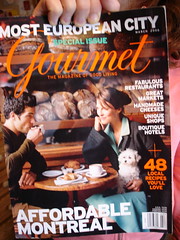
Gourmet, March 2006

Well, last year, "we" (Montreal, that is) were the darlings of the music world, with highly sensationalistic, attention-grabbing dispatches on the "Montreal music scene" showing up everywhere from Spin, to The New York Times, to CBC television's "The National"*. Is this our year to be the darlings of the culinary world? For only the sixth time in their history, Gourmet has devoted an issue to a single city, and that city, dear readers, is Montreal. While last year's music scene stories, by and large, were ridiculous (riddled with mistakes, misrepresentations, and even bald-faced lies), I'm happy to report that Gourmet's special issue is a well-balanced and thorough, if a bit glowing, portrait of Montreal and its food culture ca. 2006.**

What prompted this issue? Well, as Ruth Reichl explains, while devoting issues to Paris, Rome, San Francisco, New York, and London (the past laureates) was a great experience for all involved (how could it not be?), there was a sense of excitement to exploring Montreal that the staff at Gourmet hadn't felt before, much of which had to do with exploring a city on the move that was peripheral to the Grand Tour. "Everybody knows that those other cities are great places to visit," she writes, "you have a good idea what you'll find there. But Montreal... feels like a discovery. You won't be surprised to learn that each of us returned determined to convince our friends they had to go to Montreal."

What can you expect inside? Among other things, you'll find...
• write-ups on Jewish Montreal, Mile End, Old Montreal, Atwater and Jean-Talon Market, the Plateau, and, yes, even Montreal's music scene.
• an overview of the French-ness that underlies so many of the city's finest restaurants
• a nice story on Elena Faita, of Quincaillerie Dante fame
• and a very well-deserved feature on Martin Picard and his truly exceptional Au Pied de Cochon, for (as we've mentioned here before) no other restaurant captures what's exciting and unique about Montreal's contemporary food culture more effortlessly

Anything we would have done differently? Well, you'll just have to compare Gourmet's account of Montreal with ours and draw your own conclusions...

aj


*True to form, the CBC had the nerve to turn on the unconverted to the dynamism and energy of Montreal's Anglo music-making youthquake at the same time that they were busily slashing support for Montreal-based English-language music programming.

**I'm also happy to report that "...an endless banquet" received a very generous mention.

Friday, March 25, 2005

An Early End to Lent

Well, any motions we’d made towards following Lent this year got utterly destroyed early this week. OK, let’s face it, anyone who’s been reading “...an endless banquet” over the last several weeks knows full well that we haven’t really been making too many gastronomical sacrifices over the past month and a half, so there wasn’t much of a fall involved, but nevertheless, this week was about as far removed from Lenten abstinence as you can imagine. Between Sunday night’s surprise birthday party, a fantastic meal of Endives au Jambon and other delicacies at Hermine’s on Wednesday, and the meal I’m about to describe, this was definitely a week of feasting not fasting.

There’s a scene in Denys Arcand’s Les Invasions Barbares where an aging, defeated-looking priest ushers a woman working for a London-based auction house through a veritable graveyard of Roman Catholic antiquities in the basement of a Montreal cathedral. As he leads her through the assorted relics—a particularly Québecois cinematic nod to the closing moments of Citizen Kane—he explains to her that this pile of Catholic cast-offs was a product of that moment in the mid-1960s when, as the Quiet Revolution reached fruition, Quebeckers quite suddenly stopped going to church. As we found out on Tuesday, a trip to Au Pied de Cochon (536 Duluth East) during Lent provides just as telling an allegory of Quebec since the Quiet Revolution. Martin Picard’s restaurant is emphatically Québecois, reveling in the energy and the flavors of the terroir, but with its copious portions of rich, meaty fare and its irreverence, Au Pied de Cochon has very little to do with moderation, with propriety, or with rigid traditionalism, and just days before Good Friday and Easter, this place was packed to the gills, absolutely bustling.

Michelle had been to Au Pied de Cochon a couple of times before, but I had yet to experience its magic. We’d been discussing where we might go for a birthday dinner à deux for Michelle’s birthday (you see, Tuesday was her actually birthday), and Au Pied de Cochon had come up as a possibility, but after having listened to some of her colleagues at Les Chèvres wax poetic on its merits last weekend, Michelle made up her mind. She knew just how good it was, but that conversation made her mouth water afresh. Then we picked up the most recent issue of Gourmet magazine. Au Pied de Cochon has received a great deal of press since it opened a few years back, but in this month’s issue it receives the stamp of approval from none other than Anthony Bourdain, who ranks it at the very top of his list of new North American restaurants who’ve rejected the icy formality and the pedantry of the high-end dining room and embraced something a bit more down-to-earth, something that has less to do with attitude and more to do with food, something that’s actually fun.

We started off with two pints of the house blonde and two orders of the cromesquis. Au Pied de Cochon serves foie gras about a dozen different ways, but the simplest and least expensive way they serve it is deep-fried, as cromesquis. We were asked by the waitress if we knew how to eat these little gems when she brought them, and she explained that you’re meant to pop the whole thing in your mouth, shut your lips tight, then crack the cromesquis with your teeth, letting the whole thing explode in your mouth. And explode it does… Next up we had the beet and chèvre salad, which sandwiched a crumbled fresh Quebec chèvre between slices of marinated beets, then threw in a puree of roasted beets on the side to round things out and give the salad depth.

Things got somewhat more extravagant when we got to our mains. Michelle was having a hard time making a decision, so she asked our waitress a few questions about some of the menu’s items. Her first question had to do with their Potée du PDC, and she apparently hit the nail on the head. This was our waitress’ favorite dish on the menu, and though she made a point of emphasizing the fact that it was an “indelicate” dish, her description was more than either of us could handle. Michelle asked about a few other dishes on the menu, but we both knew her decision had been cinched. I mean, how can you go wrong with the house puree de pomme de terre—made with garlic, cheese, and lots of olive oil—layered with a link of sausage, a link of saucisson, a link of boudin noir, and a hunk of pork roast? If that wasn’t enough, when the waiter took Michelle’s order, he casually asked her if she’d like a piece of foie gras added to the mix, and without missing a beat Michelle took him up on his suggestion. I was the foil to Michelle’s full-on PDC “sugar-shack-style indulgence” experience (as Bourdain puts it), ordering the deer steak & frites in order to see how Picard & co. handle “the basics.” Michelle’s Potée was wild. This was comfort food pushed to the limits. The boudin noir was maybe just a bit more than she could handle, so she sent most of it my way, but otherwise she mastered her potée quite handily. The saucisson was expert but unexpectedly kielbasa-like; the sausage was like a high-grade knockwurst; the roast was flaky and full of flavor; the puree was sheer decadence, dripping in garlic, fromage en grains, and olive oil; and that extra slab of seared foie gras put an exclamation mark on it all. The steak was a healthy cut of rare deer meat, dripping in jus, and topped with a small mountain of sautéed mushrooms, which came with a lovely paper cone full of perfect frites, with just enough skin on them to give them real flavor.

We contemplated having dessert—Michelle swears that the pouding chaumeur is the best she’s ever come across, and the best dessert on the menu, and Au Pied de Cochon is also famous for its tarte au sucre, which is one of my all-time favorites—but by that time, a brisk walk was what we really needed. And, after all, it was Lent—we had to show some restraint, right?

I can’t wait to go back, but I think the next time we’ll be more strategic: we’ll take one, maybe two entrees, share a main course, and try to save room for dessert.

aj