Showing posts with label Fleisher's. Show all posts

Monday, November 04, 2013

Divinyles

Vin vignerous vinyles fig. a:  VVV

Will "Vin Vignerons Vinyles" be the blowout of the year (possibly even the decade), as some are predicting?

What happens when you bottle a talent pool that includes Catherine Breton, The Four Horseman of the Oenocalypse, Foodlab, Joe Beef, Joshua Applestone, Café Myriade, and Walshy Fire & Jillionaire in the confines of the Sociéte des Arts Technologiques and agitate vigorously?

Will the bottle explode?

There's only one way to find out.

Tonight!
Monday, November 4
SAT
1201, boul. St-Laurent
from 7pm until...
$45 ("admission et bouffe")

Brought to you by the good, good people at Vinnovation.

aj


Sunday, January 29, 2012

Take a Vow

taking a vow fig. a: taking a vow

While others were still trying to get over their New Year's Eve hangovers, I spent New Year's Day trying to get over my New Year's Eve hangover and taking a solemn vow.

It went something like this:

My Beautiful Dry-Aged Steak

I make this vow to you.

I will do almost nothing to you. I will not get fancy. You are not the canvas for my ideas about how Cambodian and Croatian cuisines relate to one another. You, like very few ingredients in the world--gray pearls of beluga caviar, Domaine de la Romanée-Conti, Oreos--do not need my help to be delicious. I will do everything in my power to avoid fucking you up. I will not get in the way of your magnificence. I shall season you well. I will brown you deeply. I will cook you rare, and let you rest as long as you need. When I slice you, I will slice against your grain, and season you again. I will adorn you only in pan drippings, and perhaps a simple compound butter. I will consume all that you are, and leave nothing uneaten.

"My Beautiful Dry-Aged Steak" appeared in Issue #2 of Lucky Peach, of course, and it followed up "another transmission from Harold McGee's Orbital Desk in Outré Space" about enzymes and their role in the dry-aging process. As McGee explains, by harnessing the powers of enzymes, "we can get our food to make itself more delicious," which is why he refers to them as "nanocooks--the true molecular cooks." Examples of this enzymatic process in action? Ripening, fermentation, and, yes, dry-aging.

For those who haven't had the pleasure of experiencing the joy of dry-aging, it involves keeping parts of the carcass in a carefully controlled environment (one with cool temperatures, and fairly high humidity) for a period of several weeks. Doing so allows enzymes to work their magic--"[breaking] down the meat's proteins, fats, and glycogen... into amino acids [including glutamate], fatty acids, and sugars," as well as causing the meat to lose some of its moisture (hence the name) and thereby concentrating its flavours--and the result is beef that has an extraordinary complexity and depth to it.

Sounds great, right? It is. Astounding, actually. The problem is, dry-aging is a costly, time-consuming process, one that doesn't jibe with the economic logic of our supermarket culture. Consequently, it's hard to find dry-aged beef. It's also a process that's hard to duplicate at home because of the smells and flavours that occupy your basic household refrigerator, but also because your basic household refrigerator isn't particularly well temperature-controlled (think of how many times per day your refrigerator door gets opened and closed). As McGee puts it: "Dry-aging is very difficult to do well at home."

What's the answer? Get more butchers to take their beef more seriously.

Start by frequenting a local butcher shop. Ask if their beef is dry-aged. If it is, great--consider yourself lucky. If it isn't, ask them to consider doing so. Then, while you're at it, ask them where their beef comes from. Are they able to give you a straight answer?  If not, move on to another butcher, one who's more willing to make an effort, or just keep asking.  The more people ask, the greater the likelihood that things might improve.*

As it turns out, we'd just paid another pilgrimage to our friends at Fleisher's. Not only do they dry-age their steaks at Fleisher's, but their beef is local, grass-fed, organic, and sustainably raised. The combination is pretty much impossible to beat.

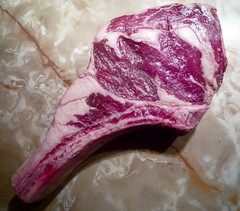
dry aged beauty fig. b: our beautiful dry-aged steak

Our beautiful dry-aged steak was pricey (understandably), but it was one-and-a-half inches thick, and it wasn't just beautiful, it was gorgeous. It was also a hell of a lot cheaper than a comparable steak from a reputable steak house.

We took the vow seriously. We kept things very simple and we didn't fuck it up. Just the steak, the jus, some sautéed mushrooms, a Caesar salad, and a killer bottle of wine. We browned the steak deeply, finished it in the oven, and gave it plenty of time to rest.**  We did those enzymes proud. It was a glorious affair.

Taking a vow, committing to dry-aged beef may sound silly, but it's actually a pretty great idea. It'll probably mean that you eat a lot less beef, but it'll definitely mean that you enjoy it a lot more when you do.***

aj

* In Montreal, things are a little difficult when it comes to sourcing high-quality beef, a fact made all too clear in the pages of The Art of Living According to Joe Beef.  There are a few establishments that dry-age their meat (Boucherie de Tours and Queue de Cheval come to mind), but locating beef that's dry-aged, locally and sustainably raised, grass-fed, and organic is another matter.  Customers need to be more demanding.  Restaurants need to be more demanding.

** Not sure how to prepare your beautiful dry-aged steak? We've been following the Fleisher's Method for the last couple of years. You can find directions here. Given the size and thickness of the steak, our oven time was about 14 minutes.

*** Those familiar with the work of Michael Pollan will recognize this basic argument.  Pollan has argued time and time again that we, as a culture (North American culture), should be eating a lot less meat, but he's not vegetarian.

This is the way he responded to the vegetarian question in an interview with Democracy Now!:

SHARIF ABDEL KOUDDOUS: Are you vegetarian?

MICHAEL POLLAN: No, I’m not. I eat meat. I eat much less meat than I used to. And I don’t think the answer is necessarily, you know, giving up meat. There are kinds of meat that have much less of a carbon footprint. I mean, we’ve been describing grain-fed beef. But what if you feed cattle on grass? When you feed cattle on grass, they’re not competing with humans for food, because we can’t digest grass. They’re geniuses; they can digest grass, because they have a rumen. And that — and well run, rotationally grazed cattle, on grass, actually build carbon in the soil. They can be used to sequester carbon. So there is a way to organize meat production that would reduce its carbon footprint dramatically. Now, it must be said, that meat is much more expensive and harder to find, with the result that I eat very little of it. But that’s the kind of meat I eat.

What he leaves out here, but discusses elsewhere, is the all-important taste factor.

Friday, February 25, 2011

JB and the Upstate Gang

JB + Fleisher's fig. a: good god!

It's true! Joshua "the MooRu" Applestone and the gang from Fleisher's will be here in Montreal joining forces with the JBs--Dave McMillan, Fred Morin, and the rest of the Joe Beef crew--to turn up the meat and bring you a night of grass-fed mayhem. Never had the considerable pleasure of visiting Fleisher's or trying their phenomenal line of pastured meats? I can't think of a better time or place.

who: Joe Beef + Fleisher's
what: feeding frenzy
where: Joe Beef, 2491 Notre Dame W.
when: Friday, March 4, 9:30 pm
why: imagine the possibilities

For more information or reservations, email joe beef at gmail dot com.

aj

Friday, August 27, 2010

BBQ Breakdown


figs. a & b: a postcard from Cornwallville

Way back in June, we found ourselves back in Upstate catering our favorite young summer bonanza. The Caretakers were pretty happy with the job we did the year before, so they signed us up for a repeat performance and we were all too happy to oblige.

The menu was pretty much the same as it had been the year before, except that with the number of prospective attendees having swollen to 70+, the quantities were substantially bigger.

How much bigger? I'll give you an example. As you'll recall, we smoked 2 x 10-12 lb pork shoulders slow & low for last year's bash. This year, however, we smoked 3 pork shoulders slow & low, and they were all in the 17-20 lb range (!). This took more kettle barbecues. It also took more time, more applewood, and more attention. You may also recall that we were pretty enthusiastic about last year's shoulders. This year they came from our friends at Fleisher's and they were the very nicest pork shoulders we'd ever seen. Real blue-ribbon specimens. So nice, in fact, that all that smoking turned 'em into candy.

Anyway, aside from the quantities, the menu looked very similar to last year's:

3 x 17-20 lb pork shoulders, applewood-smoked and pulled
6 x full racks of MO-style Ribs
Down East Baked Beans
Smokehouse Potato Salad
Tidewater Coleslaw
Sweet tea


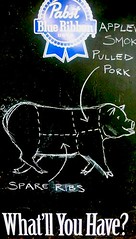
pbr fig. c: "what'll you have?

We even dusted off the same PBR sign we used last year to add a little bbq shack-charm to the proceedings, although this year T. upped the bbq shack-charm with a lovely chalk rendering of a happy pig.

dough rollers 3 fig. d: mystery band

One thing that entirely new about the young summer bbq 2.0 was that it came with real, live musical entertainment.

The rumor that circulated prior to bbq day was that the mystery band was a "bluegrass outfit," possibly from New York City.

When two dapper young gentleman in suits and slicked-back hair arrived, looking not unlike The Stanley Brothers in their youth, we thought the rumor had been confirmed.

But then they laid into their first number, and the lead singer began a-hollerin' the blues Charley Patton-style, and we knew we were in for something altogether different.

I, for one, was fully mesmerized. The well-chosen selections, the bare-bones arrangements, the full-throated vocals, the tangled woods, and the warm, humid weather all added up to a performance quite unlike I'd ever seen. I don't remember them performing any Dock Boggs tunes, but for some reason I was left thinking about the lives of itinerant musicians like Boggs who played a wide variety of occasions (weddings, parties, anything) all through the mountains and hollers of western Virginia and eastern Kentucky. Again, it might have had something to do with those vocals. Greil Marcus once wrote of Boggs that he "sounded as if his bones were coming through his skin every time he opened his mouth." I'm not sure the exact same analogy applies here, but, like I said, these were full-throated vocals and these two gents were obviously well-schooled in the sounds of the "old, weird America" that produced Boggs.

Anyway, when they finished their set, I went up and asked them what they called themselves and whether they were regularly gigging. Malcolm, the singer, told me they went by the name of The Dough Rollers and that, yes, they played regularly in New York.

The other night, I looked The Dough Rollers up again for the first time since late June/early July and found that, sure enough, they had been doing quite a bit of gigging. As a matter of fact, on that very night they were playing a gig in Oakland, CA. I looked up the venue they were playing and it was the venerable Fox Theater.

"Jeez, The Fox," I thought. "They must be opening for someone pretty big."

Ready for this? Bob Dylan.


Looking for barbecue recipes of all kinds? You can find a whole mess of them here, here, here, and here to throw your very own bbq breakdown.* Good things happen when you do. Be forewarned, though, your guests may be moved to acts of reverence.

p.s. Many thanks to the Caretakers for having us, and to all our NY area crew for showing the love.

aj

* Musical act not included.

Monday, February 15, 2010

Top Ten #33

the big sur bakery cookbook

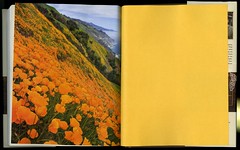
1. Michelle and Philip Wojtowicz and Michael Gilson with Catherine Price, The Big Sur Bakery Cookbook: A Year in the Life of a Restaurant

2. Steve Earle, Townes

3. The AEB Burger


4. Fitzcarraldo, dir. Herzog + My Best Fiend, dir. Herzog (again)


5. Pylon, Chomp More

6. Lièvre à la royale + smoked suckling pig dinner for two, Joe Beef

7. Rosanne Cash, "Girl From the North Country," The List + Bob Dylan, "Girl From the North Country," The Freewheelin' Bob Dylan + Bob Dylan & Johnny Cash, "Girl From the North Country," 1969

8. Fleisher's Grass-Fed and Organic Meats, Kingston, NY

9. Strongtree Organic Coffee Roasters, Hudson, NY


10. Top Hat (a.k.a. Sombrero de Copa), dir. Sandrich

aj

Tuesday, January 12, 2010

Fleisher's Follow-up, or Down to the Bone

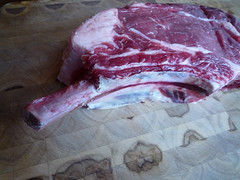
this is our steak fig. a: on the cutting board

Without question, the finest steak either of us has ever tasted. We only got one because we knew we wanted to eat it relatively soon, and because Fleisher's dry-aged rib steaks were the biggest, meatiest rib steaks we'd ever had the pleasure of purchasing. We knew one of those honking steaks would be more than enough for the two of us, and we were right. We ate and ate well, and we still had enough for leftovers (yes!) the next day.

And, the thing is, buying, cooking, and eating grass-fed beef from a place like Fleisher's is not only ethically and environmentally sound, it's also a game-changer. Once you get that taste, why would you want to eat anything else? I'm happy to hold out until the next time we get a chance to visit Fleisher's. Why would I want to settle for less? Hell, I can still taste that steak right now as I write.

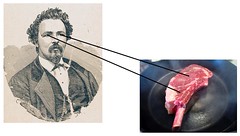
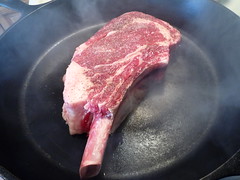
this is our steak in our searing-hot frying pan fig. b: in the pan*

We cooked our rib steak exactly the same way we always cook our rib steaks: first in a searing-hot cast-iron pan, then in the oven, followed by a good 5 minutes of rest. This is an excellent way to prepare perfect steaks at home and it happens to be exactly the way Fleisher's recommends preparing their beef. Once again:

1. Oven preheat 300º [10 minutes]
2. Heat pan on stovetop to smoking point
3. Pre-salt each side [5-10 minutes ahead of time]
4. Put into pan / sear for 2 minutes each side
5. Put steak into oven w/ pan
6. Steak > 4-8 minutes in oven [120º]
7. Take out of oven--let sit [rest] for 5 minutes


That steak was so tender, so tasty, so good, there wasn't a scrap left.

aj

* Just to give you some perspective: that's an oversized 13 1/4" Lodge cast-iron pan.

Wednesday, December 30, 2009

Hudson River School, rev. ed.

ornaments fig. a: self-portrait w/ xmas ornaments

The holidays found us back in the Catskills, taking pictures of ourselves reflected in Christmas ornaments,
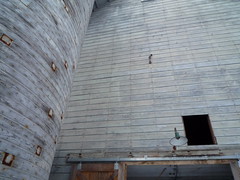
barn fig. b: barn, Cornwallville, NY

exploring big, old barns,
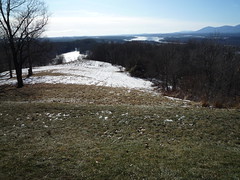
hudson river valley fig. c: view of the Hudson River Valley

and studying the landscape. This view is from Olana,
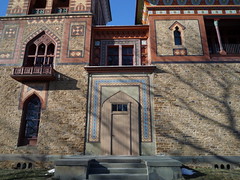
Olana fig. d: Olana

the outlandish Orientalist fantasy home built by the Hudson River School's Frederic Edwin Church on a site that affords spectacular views of the Hudson River, the Catskills, and the Taconic hills, a site Church called "the center of the world."
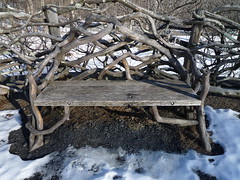
olana 3 fig. e: gnarly!

Church fetish for all things Persian may have been somewhat incongruous, but Michelle approved of Olana's views and its sense of whimsy (including its heart-shaped pond), and she was especially fond of Church's taste in outdoor furnishings.

Hudson

hudson, NY fig. f: Hudson Gothic

The town of Hudson is a handsome Hudson River Valley town with a handsome Amtrak station that also happens to be one of the town's most important landmarks. Not only is Hudson's train station a stately, subdued example of American Gothic, not only is it the oldest continuously operational train station in the entire state of New York, but it happens to be across the street from one of New York's very best cafés.
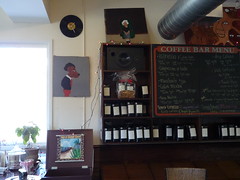
strongtree fig. g: inside Strongtree

That's right, directly across the street you'll find the good people at Strongtree Organic Coffee Roasters, purveyors of the "finest quality organic heirloom coffees." In many ways, 2009 was the Year of Coffee for us, the year that we had 4 or 5 of the most momentous coffee experiences of our entire lives. Strongtree was the final coffee discovery of the year (TY, S & T!), but it vaulted right into our Top 3. We loved this place from the moment we set foot in the joint. The fact that they were playing the dubbed -out sounds of This is Reggae Music, vol. 3, an album that, by all reasonable measures (longest history, most listens, etc.), is my #1 reggae album of all time, certainly didn't hurt.

santa's little helpers fig. h: Santa's little helpers

The display of loopy holiday art didn't hurt either. But what really caught our attention was that first cappuccino. This was not your average espresso shot. It left a tremendously memorable impression. So memorable, in fact, that two days later we remembered to make a special detour back to Strongtree to pick up some beans and have an even more impressive espresso shot. This time time made with their Conquering Lion blend (irie!), this time served up as a latte. But what sealed the deal was when we got back home and brewed up our first batch of their Ethiopian Lekempti Viennese Roast. "Strong dark fruit and deep chocolate flavor," indeed. Again, easily one of our Top 3 coffees of the year.
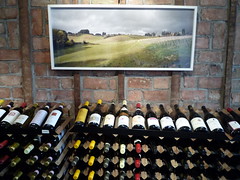
hudson wine merchants fig. i: inside Hudson Wine Merchants

Hudson is also blessed with an awfully impressive wine shop: Hudson Wine Merchants. Not only do the folks at HWM share our passion for landscape, but they stock a great selection of Italian wines, including an awfully tasty Campo di Sasso Insoglio del Cinghiale 2006.
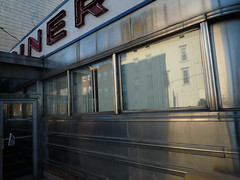
diner fig. j: Hudson diner

And, if you're interested, Hudson also has a beautifully streamlined vintage diner, which is currently FOR SALE. Takers?

Kingston
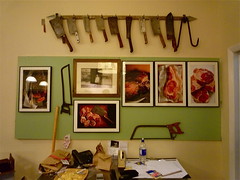
tools of the trade fig. k: inside Fleisher's

If Strongtree was one of the highlights of our trip, the other major highlight was found not in Hudson, but about an hour south along the NY Thruway in Kingston. Fleisher's Grass-Fed & Organic Meats is a new school butcher shop run by Joshua & Jessica Applestone that has very deservedly received an enormous amount of attention in the five years since they opened. Fleisher's is the epitome of principled: not only is all their meat organic, but it's all grass-fed, pasture-fed, and ethically raised. In fact, Joshua & Jessica established a set of tenets when they opened up shop, principles that guide the way they run their operation and the way they do business. They look something like this:

-All farms are multigenerational with a long history of ethical practices.
-Farmers are proponents of proper animal husbandry for all animal reproduction.
-Animals always have access to grass and open pastures and are not kept in pens.
-Animals are rotated through pastures to ensure they have exercise and fresh grass to eat.
-Animals are not given antibiotics or hormones.
-Animals live in closed herds.
-All feed and grains must come from local mills and farms. Store bought grain is never acceptable.
-Animals travel less than an hour to the slaughterhouse.


Where does this commitment to sourcing and carving the very best, most humanely raised meat come from? Well, interestingly, it comes from a shared history of vegetarianism. Joshua & Jessica were both vegetarians when they first met. Hell, Joshua was a vegan. For 17 years (!). Obviously, they left their vegetarian ways behind years ago, but their food ethics remained, and they've made a business out of supporting and promoting a humane and human-scale approach to animal husbandry.

The Fleisher's story is a nice story, too. Not only is it founded on a love story, but there's some real history to it. You might think that the Fleisher's name is just a clever play on the word "butcher," but you'd be wrong. The store is named after Wolf Fleisher, a kosher butcher who came to America in 1901 and set up his own shop--the original Fleisher's--in Brooklyn. The business became a success, known for the high quality of its beef and poultry, as well as the high standards by which it was run. Joshua is Wolf Fleisher's great-grandson, and the Fleisher's tradition lives on.

Now, we'd read about Fleisher's a while back, but it all seemed so faraway and exotic (perhaps because no butcher shop in Montreal is even remotely as progressive) until we happened to meet Joshua & Jessica at Joe Beef on a balmy summer night back in August (TY, AG, TY, JB!). We got to talking and when they graciously invited us to come down and pay them a visit, we pledged to do just that at the soonest opportunity.

It's one thing to hear or read about an all-organic, grass- and pasture-fed meat shop, but it's a whole other thing to see one in operation, especially when it takes the shape of a good, old-fashioned neighborhood butcher shop (albeit one that does a healthy trade with several of New York's finest restaurants, 90 miles down the Hudson), especially when the run-up to Christmas is very much on. This joint was jumping. Fleisher's had a full team in full swing, carving up sides of beef, putting together special orders, tending to customers. Somehow Joshua & Jessica still found the time to give us a tour and chat with us.
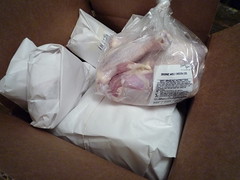
the haul fig. l: the haul

When we got back home, we had a box full of Fleisher's organics meats purchases in tow:

6 organic whole chicken legs
2 huge, organic beef short ribs
1 organic bone-in pork shoulder
1 massive, organic, dry-aged rib steak
4 lamb loin chops


As soon as we made our first Fleisher's meal we started to have regrets about not buying more. Four meals later and still batting 1.000 (actually, these meals have been so good, it feels like we're batting over 1.000), we're kicking ourselves (hard!).

Here are the first two:

AEB Chicken & Dumplings

1 tbsp olive oil
1 small organic chicken, cut into parts, or 6 organic whole chicken legs
1 medium onion, finely chopped
2 ribs of celery, finely chopped
2 medium carrots, finely chopped
1/4 cup parsley, minced
4 tbsp flour
1 cup dry white wine
2 cups chicken or vegetable stock
salt & freshly ground pepper

dumplings:
2 cups sifted all-purpose flour
1/4 tsp salt
2 rounded tsp baking powder
1 tsp brown sugar
2 tbsp butter
2/3 cup buttermilk

Heat the oil in a large stove- and ovenproof casserole over medium heat. Salt and pepper your chicken liberally. When the oil begins to smoke, brown your chicken parts or legs, roughly 5 minutes per side. You might need to do this in batches. I did. When the chicken parts have been browned, remove them from the casserole and set them aside. Add the onion to the casserole and sauté until the onion has turned translucent. Add the celery and the carrots and continue sautéing, 2 to 3 minutes. Add the parsley, sauté another minute, then add the flour and sauté for another 1-2 minutes, stirring constantly, until the vegetable have turned a pale golden hue. Add the white wine and the chicken/vegetable stock. Add the browned chicken pieces. Bring to a boil, then turn the heat way down and simmer ever so gently for 45 minutes.

Meanwhile, prepare the dumplings. Sift the flour, salt, baking powder, and sugar into a mixing bowl. Add the butter, blending with your fingertips. Add the buttermilk and mix well. Spoon the dough onto a floured surface and roll it evenly 1/4 inch in diameter. Cut into 1-inch rounds or diamond shapes.

When the chicken has cooked for 45 minutes, taste and adjust the seasonings. Add the dumplings. Cover and cook for another 20 minutes at a gentle simmer. Test the dumplings--they should be light, airy, and fully cooked through. Serve the chicken and dumplings in wide, shallow bowls. Devour.

[the dumplings part of this recipe is based on Edna Lewis' recipe in The Taste of Country Cooking, although her recipe uses 2/3 cup of milk instead of buttermilk]

Chicken & Dumplings is one of my absolute favorite meals, but it was even better with Fleisher's plump, organic, pastured chicken. The rich gravy--always a thing of beauty--was noticeably richer, noticeably more beautiful. The chicken meat was so thoroughly delicious that we found ourselves literally gnawing at the bones, ravenously, trying to make sure we got each and every last morsel.

Equally phenomenal was this lamb chops dish that combined the Fleisher's method for cooking and savoring their grass-fed and pastured meats with elements of a Mario Batali recipe for scottaditi (one that called for the use of New Zealand lamb [!], not Hudson River Valley lamb*). Now, our lamb chops were loin chops, not the neck-end lamb chops (or frenched lamb chops) that one usually uses for scottaditi, but they were equally finger-scorching-good. Fleisher's method was very familiar to us--it's basically the exact same method we use for making our steaks--but Jessica insisted that this was a fool-proof method for preparing virtually all of their meats.*

Lamb Chops with Confited Garlic and Mint

4 lamb loin chops
1/4 cup extra-virgin olive oil
10-12 whole cloves of garlic
1 cup dry wine
1/2 cup sweet wine
salt and freshly ground black pepper
4 sprigs mint, leaves only

Heat the oil in a 10-inch sauté pan over medium heat. Add the garlic cloves and sauté slowly, shaking the pan frequently to keep the garlic moving, until they are lightly browned on all sides, about 10 minutes. Add the wines, bring to a slow boil, and cook until the liquid is reduced to 1/4 cup, at which point the garlic should be very soft, indeed. Remove from the heat and set aside.

Preheat your oven to 300º F.

Season the lamb chops liberally with salt and pepper.

Heat a stovetop-to-oven-ready pan (like a cast-iron) over medium-high heat until it reaches the smoking point. Add the lamb chops and sear for 2 minutes on each side. Remove the pan from the stovetop and place it in the oven. Cook for an additional 4-8 minutes, until your lamb chops reach your desired level of doneness (our lamb loin chops took about 6 minutes in the oven). Take the pan out of the oven. Remove the lamb chops, place them on a cutting board, and allow them to rest 5 minutes.

While the lamb is resting, season the garlic mixture with salt and pepper and add the mint leaves. Serve each lamb chop with a few confited garlic cloves and drizzle the sauce overtop.

[confited garlic and mint sauce based on a recipe in Mario Batali's Molto Italiano]


Getting schooled rarely tasted so great.

New Year's Resolution: Go back to Hudson & Kingston at the earliest opportunity.

Strongtree Organic Coffee Roasters, 60 South Front Street ("at the train depot"), Hudson, NY, (518) 828-8778

Fleisher's Grass-Fed and Organic Meats, 307 Wall Street, Kingston, NY, (845) 338-6666

aj

* That was a few years ago, I'd be surprised if Mario hasn't changed his tune by now. For one thing, Fleisher's meats are featured at Batali's Casa Mono & Bar Jamón.

** Fleisher's "cooking instructions from the MooRu***" read as follows:

1. Oven preheat 300º [10 minutes]
2. Heat pan on stovetop to smoking point
3. Pre-salt each side [5-10 minutes ahead of time]
4. Put into pan / sear for 2 minutes each side
5. Put pork/lamb/chicken/beef into oven w/ pan
6. Pork > 6 minutes up to 10 minutes in oven [125º]
Lamb > 4-8 minutes in oven [120º]
Chicken > 10-15 minutes in oven [135-140º]
Beef > 4-8 minutes in oven [120º]
7. Take out of oven--let sit [rest] for 5 minutes


*** MooRu = meat + guru