Showing posts with label Quebec. Show all posts

Tuesday, April 23, 2013

¡Ándele! ¡Ándele! ¡Jaiba! ¡Jaiba!

Spring used to come in like a lion 'round these parts, but mostly it just arrives in fits and starts these days, feinting and dodging, teasing and mocking.  Sure, you'll get some warm, toasty days every now and then, but there's sure to be a few bitterly cold days (and nights), too.  And like our friend at the dépanneur down the street says, "You can't be sure of anything until May 15."  And even then...

maple spring fig. a:  printemps québécois

Anyway, signs of spring usually begin sometime in March in Montreal (like most places in the Northern Hemisphere), but, foodwise, it takes a while to see a whole lot of rebirth going on.  With the exception of maple syrup, most of our spring flavours tend to show up in May and June.

Which is why snow crab is of such importance to people like us.  Not only are we enormous fans of crabmeat, but snow crabs are one of the earliest spring arrivals, and snow crab season is really the only time of the year we can get fresh, live, and regional crab here in Montreal.  Officially, the season is said to last from April to November, but our experience has been that in actual fact it's a very short season, lasting no more than about 6-8 weeks.  But, oh, is it ever sweet.  Or, at least, it can be.  And it's going on now.

Just how excited about snow crab are we?

Well, Michelle and Seth have been preparing a lovely snow crab pasta dish as part of their Quebec Spring/Printemps québécois menu at the Foodlab.  It features handmade/housemade tagliatelle cooked to perfection and tossed with a medley of spring vegetables (string beans, peas, shallots, and the first of the cherry tomatoes from our friends at Birri Brothers), herbs (chives and parsley), a generous helping of snow crab meat, and a beautiful crab cream.

And here at home we've been going to town on our very favourite tacos in the entire world:  tacos stuffed with salpicón de jaiba.

salpicon 1

salpicon 2 fig. b & c:  crab tacos!

We've featured this recipe before, but it's an absolutely essential one, and a great way to stretch your crabmeat a little further, because, god knows, those snow crabs are tasty, but they can also be quite costly.  Here it is again, revised and updated:

Salpicón de Jaiba 
1 tbsp vegetable oil
1/4 cup finely chopped white onion
1/3 cup finely chopped celery
2 serrano or jalapeño chiles, seeded and finely chopped
1 cup cooked, shredded crabmeat
1 tbsp finely chopped cilantro
1/8-1/4 tsp crushed chili pepper blend (some combination of ancho, pasilla, arbol, chipotle, and/or New Mexico grande chiles)
salt to taste
Heat the oil in a skillet and cook the onion gently until translucent.  
Add the celery and sauté for about one minute.  Add the fresh chiles and sauté for 30-60 seconds.   
Add the crabmeat and fry until it is warmed through and begins to brown ever so slightly.  The mixture should be rather dry--remember, you're going to be placing it in a taco. 
Lastly, take the mixture off the heat, add the cilantro, salt, and chili blend, and toss, allowing the flavours to mingle for a minute or two before serving.
Serve with hot tortillas and plenty of fixings, like pico de gallo, sour cream or crema, hot sauce, and limes.
Makes enough to fill at least 8-10 corn tortillas. 
[based on a recipe from Diana Kennedy's The Essential Cuisines of Mexico]
Might seem a little strange to make Mexican tacos with Quebec crab, but, trust me, a little cultural exchange can be a good thing.

juan carlos mexican crab fig. d:  Juan Carlos, the Mexican crab

jean-charles QC snow crab fig. e:  Jean-Charles, the Quebec snow crab

Go, Crabs, go!

aj

Tuesday, May 22, 2012

This is what quincaillerie sounds like, 2nd rev.ed.


Stay safe & strong, brothers and sisters--and keep putting your kitchenware to good use.

AEB

p.s.: thanks to nitavideo1 for the footage

p.s. 2: the scene in Montreal on May 22nd

p.s. 3: the scene in Montreal by evening time: "May 22 update #3:  Mile End and perhaps the whole city is banging on pots and pans right now!"

p.s. 4: vive les casseroleux!

p.s. 5:  this is just how big (and beautiful) the casserole movement has become.

Monday, June 27, 2011

AEB @ CBC, Summer Strawberries Edition

quebec strawberries fig. a: Quebec strawberries

Michelle was back on the CBC with Jeanette Kelly again today, this time on Homerun, and this time the topic was strawberries. She had all kinds of things in mind to talk about (like where to go strawberry picking, helpful hints for preparing your strawberries simply, strawberry socials, strawberry gazpacho, and strawberry smackdowns), but these radio interviews go rather quickly sometimes, so, really, mostly what she talked about was pairing strawberries with herbs (plus a really sweet childhood memory of strawberry picking with her Mom and her sister).

Michelle & Jeanette fig. b: Michelle @ CBC

That was because she'd shown up with a sour cream panna cotta that she'd topped with strawberries and a herb granité, and Jeanette and the rest of the Homerun crew were understandably transfixed. It's a pretty delicious combo, and it's pretty too. But, best of all, it's pretty easy--especially the strawberries and the herb & lime granité.

Want to try it for yourself? Here's Michelle's recipe:

Sour Cream Panna Cotta with Strawberries and a Herb and Lime Granité

For the sour cream panna cotta:

150 ml cream
40 g sugar (2 ½ Tbsp)
1/2 vanilla bean, seeds scraped and added to sugar
1 1/2 sheets gelatin, soaked in cold water
250 g sour cream

Heat cream, sugar, and vanilla in a small saucepan. Turn off heat, wring out extra water from gelatin and add it to the cream. Stir to dissolve and pour over the sour cream. Whisk together to combine. Pour into glasses or small bowl and place in fridge to set at least 3 hours.

For the herb and lime granité:

2 sprigs basil
1 sprig mint
1 sprig lemon balm
1 sprig parsley
lime juice to taste
light simple syrup (one part sugar, two parts water) to taste

Place all ingredients in a blender and blend until quite green. Adjust sweetness by adding more syrup or water. Add more lime juice if needed. Strain into a container and freeze until hard. Scrape with a fork until fluffy and soft.

For the vinaigrette:

2 Tbsp olive oil
1 Tbsp honey
1 Tbsp lime juice
black pepper

Mix all ingredients together.

To serve:

1 pint strawberries, hulled and quartered

Toss strawberries in the vinaigrette and divide between the panna cottas, arranging the berries on top. Add granité and serve immediately.

The resultant panna cotta has a pleasant tang and a silky texture; the herb and lime granité brings out all the depth and natural sweetness of your farm-fresh strawberries; and the vinaigrette makes the whole ensemble sing.

Want to see a "Hallway Interview" with Michelle on the topic of strawberries? Check out Homerun's post on Michelle's visit here.

Want to see photo documentation of Michelle's visit? Check out Homerun's Facebook page here.

Want to make the most of Quebec strawberry season? Head on down to your nearest outdoor market, or, better yet, pick a nice day after we've had 2-3 straight days of sun, and make your way to a local u-pick.

Never had the pleasure of attending a strawberry social? Most of the Quebec strawberry socials have already passed, but you can catch a combination strawberry social/horse & buggy parade (!) in Vankleek Hill, ON, this Sunday, July 3, beginning at 1 p.m. You can find more information here.

aj

Friday, March 25, 2011

Northern Rites

curling scene, Mtl fig. a: curling scene, Montreal

We, here at "...an endless banquet," have been spouting off about the affinities between Québécois culture and Nordic culture, and especially about the notion of Québécois cuisine as Nordic cuisine, since at least 2006. In fact, that's one of the very reasons that René Redzepi and Claus Meyer's New Nordic Cuisine struck such a chord with us--it seemed to provide a model for how chefs here in Quebec might reinvent the local cuisine, pushing it in a direction that was more seasonal, more sustainable, less dependent on imports, and truer to the terroir. But Quebec remains a culture of Nordiques turned Snowbirds, a culture that in many ways has lost sight of its essential Nordic-ness. A people that had once proclaimed "mon pays c'est l'hiver," took to proclaiming "mon pays c'est la Floride/le Cuba/le Mexique/le Las Vegas" a long time ago. And, thus, in spite of our agitating, the New Nordic Cuisine has yet to take hold. Montreal is still a city of open-air hockey rinks and tobogganing, of Montréal en Lumière, Nuit blanche, and La Fête des neiges, but it's also the home of the Underground City, and it could definitely use some more Northern rites.

that was then fig. b: old-school

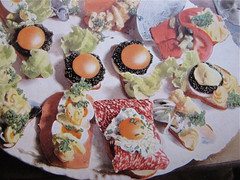
With this in mind, Team Laloux--namely chef Seth Gabrielse and AEB's very own Michelle--has devised a night of Nordic cuisine at Pop!: a good, old-fashioned Scandinavian-style smörgåsbord, complete with all the trimmings. Think open-faced sandwiches and Scandinavian sweets.

this is now fig. c: new-school

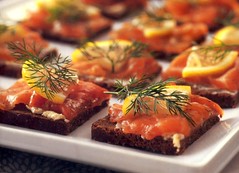
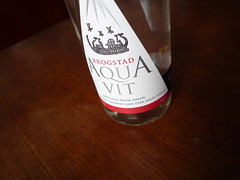
Think gravlax, Danish teak, and aquavit.

krogstad aqua vit fig. d: Krogstad Aquavit

Starting to get the picture?

Michelle's been so excited about this event that her birthday turned into an extended Scandinavian food- and fact-finding mission (alas, not east to Copenhagen or Stockholm, but south [?] to New York City). And, let me tell you, she found plenty.

And when we returned she also found Scandinavian prezzies sent by a psychic friend (!).

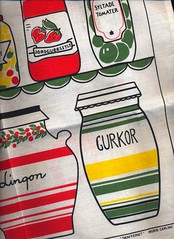
swedish tea towel fig. e: proof of E.S.P.

So Team Laloux is ready for you, and they'll be serving up Nordic delicacies both "new" and "classic" in the Danish Modern splendor of Pop! one night only (!), this Monday, March 28th.

Smörgåsbord!
Monday, March 28th
6:00 PM - 11:00 PM
Pop!
250, avenue des Pins E.
RSVP: (514) 287-1648
Facebook page

Skål!

aj

Thursday, October 14, 2010

Spys Like Us (and we love them)

Of course, for those of us who live in Quebec, another aspect of the trouble with Vermont, during the apple harvest or at any other time of year, is that you can go down and sample their apple crop, but you're not supposed to haul quantities of apples across the border. It doesn't matter if they're heirloom varieties that are hard/impossible to find in Quebec. It just ain't allowed. NAFTA or no NAFTA.

fig. a: into the orchard

Luckily for us, Quebec still has plenty of small- to mid-size orchards that cultivate some of your lesser-known and harder-to-find varieties of apple. Luckily for us, there are still orchardists like M. Safian producing top-notch Northern Spys, Ida Reds, Russets, Empires, Spartans, and Cortlands, in addition to his excellent McIntoshs.

fig. b: banana box

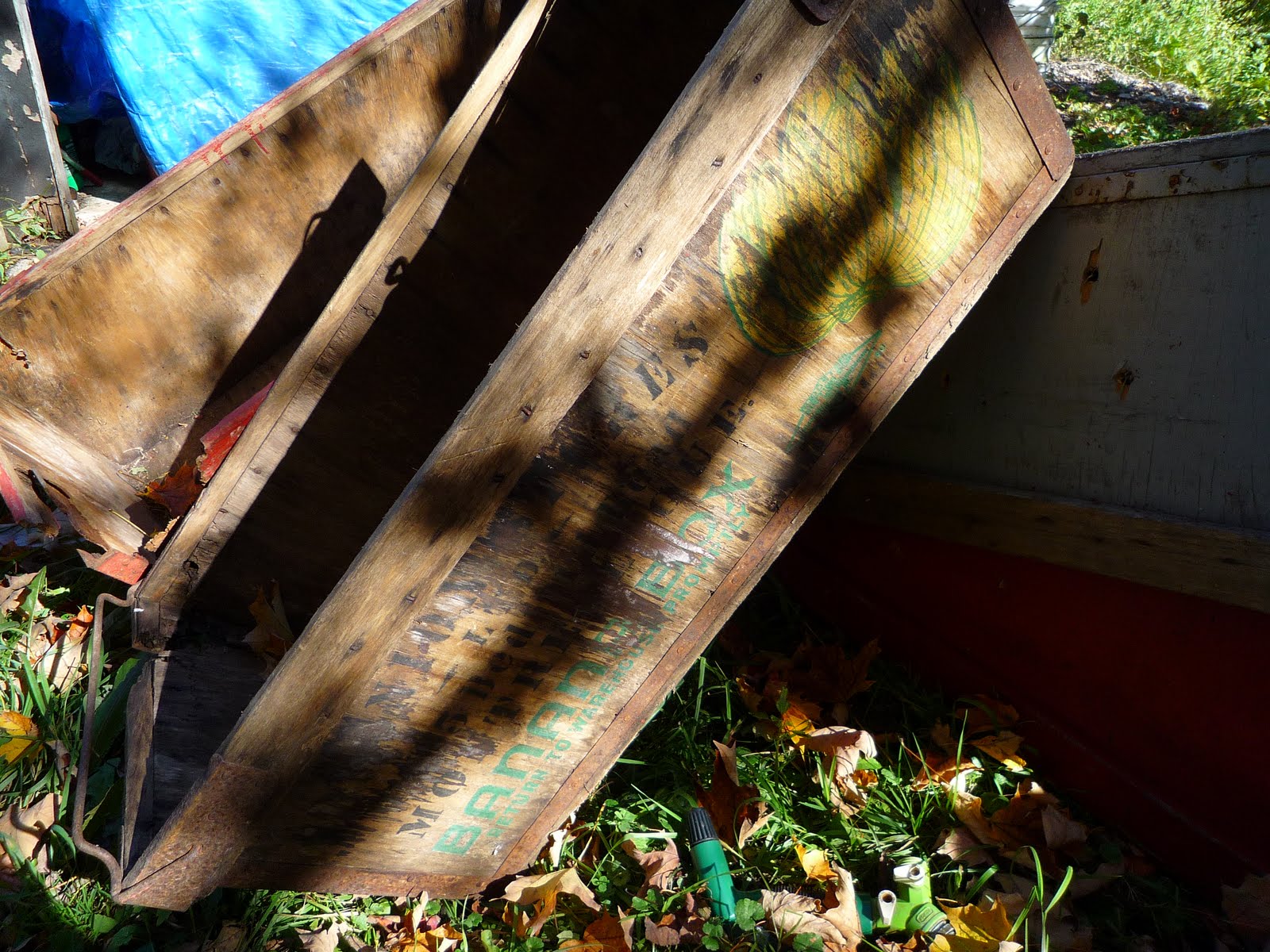
Visit M. Safian, and past the beaten-up old banana crates (?)

fig. c: this old barn

and the decrepit old barn

fig. d: Ida Reds, ripe for the picking

you'll find that his trees are still chock-full of perfectly formed, unusually sweet apples (it's been a good year).

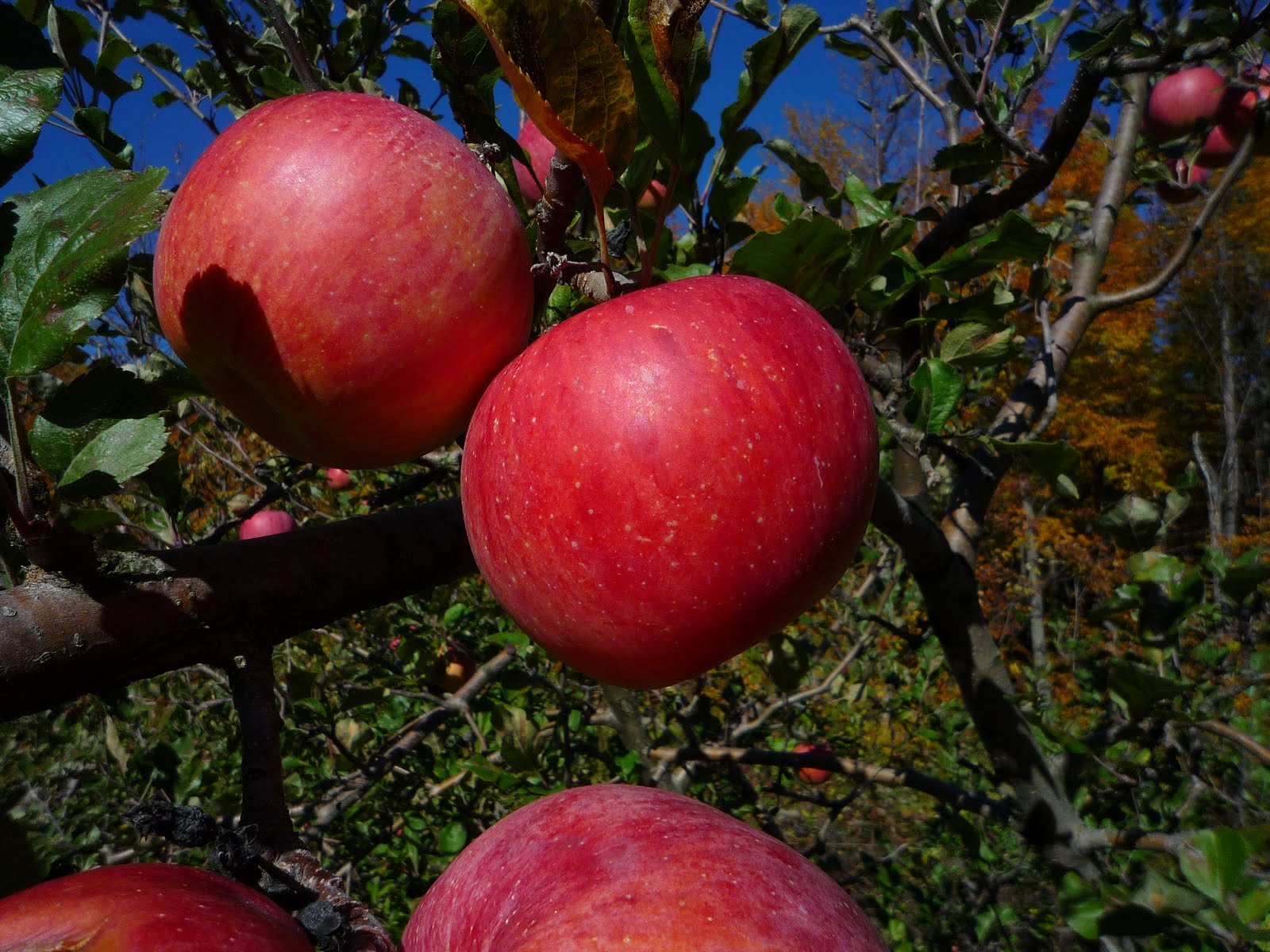
fig. e: Ida Reds, up-close and in-person

You might need to borrow a ladder to get at some of the prize specimens, but the trees are so overloaded, so ripe for the picking, that you can easily fill 4 or 5 buckets in a matter of about 15-20 minutes. If you have plans to do a lot of seasonal baking or cooking with apples, or you enjoy eating about 4 or 5 apples a day (the way I usually do this time a year), there really is no better way to get the very best apples at the very best price. Throw in some fresh country air and possibly some sunshine, and you can't ask for a more pleasant, more satisfying outing.

We got ourselves a nice mix of apples, but we picked a whole bunch of Ida Reds (like the ones you see above), which have a lovely blush when cooked,

fig. f: Northern Spys

and we positively loaded up on Spys, which have a tartness that we absolutely love and that makes them ideal for apple desserts.

m. safian vous offre... fig. g: M. Safian vous offre...

For directions to the Hemmingford/Covey Hill/Franklin apple-growing region (including directions to M. Safian's), look here and here.

For a recipe for Poulet à la Normande (with apples and Calvados), look here.

For a recipe for Tarte Tatin (with lots of apples), look here.

For a recipe for Huguenot Torte (with a couple of apples), look here.

For a recipe for Squash & Apple Soup, look here.

For a couple of recipes for Ketchup aux fruits (with apples), look here and here.

And if you need a recipe for the Brady Bunch Special, pork chops & apple sauce, look no further:

Pork Chops & Apple Sauce

4 meaty pork chops
extra-virgin olive oil
kosher salt
freshly ground black pepper
1/4 cup Calvados, Cognac, or Bourbon

brine:
2 tbsp kosher salt
1 tbsp sugar
2 lemons, sliced in half
4 cups water

apple sauce:
4 apples, cored, peeled, and roughly chopped
1 tbsp fresh squeezed lemon juice
1/4 vanilla bean, split and scraped
1/4 cup Calvados, Cognac, or Bourbon
1/4-1/2 cup sugar
1/2 cup water

In a bowl, squeeze the lemons, throwing the four halves in when you're done, then add 2 tablespoons of salt and 1 tablespoon of sugar, and 4 cups of water, and stir until the sugar and salt are fully dissolved, making a basic brine. Add the pork chops, cover, and refrigerate for at least 2 hours.

Meanwhile, make your apple sauce. Add the apples, the lemon juice, the vanilla bean, the sugar (the amount will depend on how sweet your tooth is and how tart your apples are), the Calvados/Cognac/Bourbon, and the water to a medium saucepan. Bring to a boil, then simmer gently for 45 minutes.

30 minutes before you intend to cook your pork chops, remove them from the refrigerator, pat them dry, rub them lightly with just a bit of olive oil, and salt and pepper them. Set them out on a plate to come to room temperature.

Preheat your oven to 300º F. When the 30 minutes is up, heat a large skillet over medium-high heat till the pan begins to smoke. Put the pork chops in the pan and sear for 2 minutes on each side, using tongs or a spatula to flip them (not a fork). When you've seared the chops on both sides, place the entire skillet in the oven and roast the chops for another 4-6 minutes, depending on their thickness.

Place the chops on plates. Meanwhile, deglaze the skillet with some more Calvados/Cognac/Bourbon. Pour a little of the resultant pan juices over each of the chops. Place a dollop of the apple sauce on top of the pan juices and serve. We recommend accompanying the pork chops & apple sauce with your favorite mashed potatoes and some braised cabbage (green, red, Savoy), but if you've got other ideas/plans, go for it.

You'll most likely have some leftover apple sauce. Don't worry, it'll be delicious. It won't go to waste.

Serves 4.


aj

Tuesday, September 21, 2010

Maybe, just maybe

toast & jam fig. a: toast & jam

To paraphrase: "God save strawberry jam in all its different varieties!" Yes, but maybe, just maybe autumn strawberries are the key. At least, here in Quebec.

Michelle's been on a quasi-Proustian quest for the strawberry jam of her youth for years, desperately trying to replicate the texture and flavor of a strawberry jam made by one Mrs. Wright in Guelph, ON, back when Michelle was just a wee lass. Countless experiments with summer strawberries have produced fine strawberry jam--excellent strawberry jams, even--but never one that has fully approximated those mythical strawberry jams of her past. Then Michelle started making her strawberry jam with local fraises d'automne, and the results were dramatically different--brighter, with an absolutely perfect set. And Michelle's expression changed accordingly. It, too, was brighter.

Strawberry Jam Enthusiasts, you may want to give autumn strawberries a whirl, if you haven't already. But remember to go easy on the sugar and to cook your strawberries gently. And, remember, the autumn strawberry season is just about up--they'll only last until the first frost--so you'll have to act fast!

Thoughts on strawberries and jam, fellow Enthusiasts? Do tell.

aj

Tuesday, April 28, 2009

sugar shock 2

sugar shack map fig. a: actual map used to get to PDC Sugar Shack

By now, if you've been keeping up with the sugar shacking scene here in Quebec, as I'm sure you have been, the basic outline of this story is probably familiar to you:

1. Earlier this year, Martin Picard & the rest of the gang at Montreal's Restaurant Au Pied de Cochon took the next logical step in their 10-year plan and bought a nice chunk of land outside of Mirabel that came complete with an extensive sugar bush and a sugar shack.
2. There they went ahead and opened their latest venture, Cabane à Sucre Au Pied de Cochon.
3. In typical fashion, they took the classic cabane à sucre menu, and turned it on its porky little ear.
4. Crowds have come flocking and Cabane à Sucre Au Pied de Cochon, which was originally meant to be something of a lark, a respite for Au Pied de Cochon's weary équipe and their loved ones, has been fully booked for weeks now.


Sensing that Quebec was more than ready for an upstart sugar shack (we certainly were), "...an endless banquet" went ahead and made a reservation for opening night, way back in March. The thing is, opening night got bumped. That's right, a couple of days before we got a polite phone call informing us that they'd had to roll back the opening by a night, and, unfortunately, the next night was out of the question for us. And by the time we got around to calling back and trying to rebook, they were totally complet--right into May. So we put ourselves on the waiting list and said our prayers.

And--wouldn't you know it--a few weeks later we actually got a call back. Some poor suckers had bowed out and suddenly we found ourselves with a reservation for three at the bar, which just happens to be our preferred way of dining at Restaurant Au Pied de Cochon.

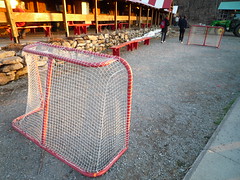
From the moment we got to Cabane à Sucre Au Pied de Cochon's location in St-Benoît de Mirabel, we loved the look of the place. No sleigh rides, no petting zoo, no period costumes, and, this being a rather balmy late-April evening, no snow. Just a simple sugar shack, a street hockey court, and some tractors.

hockey night in canada fig. b: Hockey Night in Canada

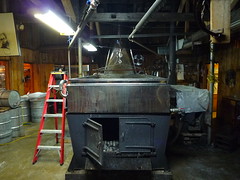
And this ain't no vanity project either. Cabane à Sucre Au Pied de Cochon is an honest-to-goodness sugar shack sitting on a heavily forested parcel of land. Why buy gallons and gallons of maple syrup if you can make almost 550 gallons of your own? Why buy firewood for your famous wood-burning oven if you can chop your own? And wouldn't it be nice to raise 50 free-range pigs that actually lived free-range lives? Yes, it would. That's the idea, anyway. In the meantime, the team at Au Pied de Cochon has a big ole wood-burning evaporator, and they know how to use it.

the evaporator fig. c: the evaporator

And the food? Well, the rumors are true. The meal is stupendous. Three massive courses, and all three are totally mental. Three and a half, if you order an extra tourtière with real ketchup aux fruits, and our advice to you is that you'd be a fool to miss out.

Highlights:

1. omelet with scallops and sea bass
2. tourtière with real ketchup aux fruits
3. buckwheat ployes with cretons and house-cured gravlax
4. salad with oreilles de crisse, ham, hazelnuts and a mustard vinaigrette
5. tempura-fried lobster maki with foie gras
6. maple-glazed magret de canard with a luscious polenta and brussels sprouts
7. and the house banana split with maple barbe à papa, maple sponge toffee, maple-glazed peanuts, and maple ice cream was certainly the most dramatic of the three (!) desserts, but our favorite was the somewhat more subdued maple baked Alaska.


And that's only about 60% of the set menu. And that's their toned-down menu. They started off serving five totally mental courses (!).

Like I said, the rumors are true. This time the sugar shock lasted two days.

Cabane à Sucre Au Pied de Cochon, 11382 rang de la Fresnière, St-Benoît de Mirabel, (450) 258-1732

prices are $45 for adults, $15 for kids under the age of 12, and little piggies under the age of 2 EAT FREE.

aj

Thursday, April 17, 2008

Top Ten #24

1. James Villas, American Taste

taste of country cooking fig. a: The Taste of Country Cooking

2. Edna Lewis, The Taste of Country Cooking

3. pan-fried chicken & cream gravy

4. Helen & Scott Nearing, The Maple Sugar Book

krokus fig. b: the arrival of spring

5. Spring is here!

6. George Eliot, Middlemarch

7. Quebec grass-fed veal

8. George Lang, The Cuisine of Hungary

9. Jeffrey Steingarten, It Must've Been Something I Ate & Jeffrey Steingarten's chocolate chip cookies

10. Marcella Hazan, Essentials of Classic Italian Cooking

aj

Tuesday, August 14, 2007

children of the corn

corn cocktail fig. a: homemade Esquites

No two summers are exactly alike, of course, but every summer around our household has its two or three full-blown food crazes that help define it. Something comes into season and shows up at the market, and for some reason--either because the quality is higher this time around, or because the variety's better, or because it's just caught you at the right moment--we just keep going to that same thing over and over again because it just feels (and tastes) right. Earlier this summer it was cucumbers. They just tasted amazing to me--better than they had in years (and I'm always a fan)--and I found myself preparing them every which way: in salads, in Asian noodle dishes, in sandwiches, in soups, even in drinks. We're still eating our fair share of cukes, because our plants have been producing like nuts and they still taste great, but, really, who are we kidding? Right now it's all about the corn.

Now, again, we're big fans of Quebec corn every year, but this year was different. This year we absolutely could not wait. A lot of this had to do with a feature on Mexico City's Mercado de la Merced that appeared in the May issue of Saveur. Not surprisingly, given its centrality to Mexican cuisine, corn figured prominently in their overview of la Merced's enormous variety of simple pleasures. Just that one photograph of those cobs of blue corn was enough to make us ravenous. But what really pushed us over the edge was the photograph of some lucky person's hand clutching a cup of Esquites: gently stewed corn with lime juice and chile powder served in a cup and topped with crumbled cheese. From the moment we contemplated making Esquites at home, Quebec's corn season couldn't come fast enough. In fact, Michelle was so focused on making Esquites and making it right that she even bought us an epazote plant at Jean-Talon Market so that we could have plenty on hand when that fateful moment arrived.

As it happens, we were in luck: corn season came relatively early this year, and the corn has been fantastic so far, and cheap too (13 for $5 [or $15 for a bag of 72!] at the market on the weekend, 5 for $1 right now at Supermarché P.A.). Naturally, the first thing we made was Esquites.

Esquites

6 cups fresh white (or yellow) corn kernels (you'll need roughly 10 ears of corn)
3 tbsp butter
1 stemmed, seeded, and finely chopped serrano chile (you can substitute a jalapeño if serranos are hard to find in your area)
torn leaves from one stalk epazote (optional)
1 cup queso fresco (or some other kind of fresh cheese, like Portuguese Santa Maria, which is readily available in our neighborhood), crumbled
2 tbsp fresh lime juice
1/2 tsp chile powder (such as A.J.'s Chile Powder, my own personal blend)
salt to taste
lime wedges for garnish

Combine the corn kernels, the butter, the fresh chile, the epazote, and 1 1/2 cups of water in a medium pot. Bring to a simmer over medium-high heat, reduce heat to medium-low, and simmer, covered, until the corn is tender, about 10-15 minutes. Set aside to let the corn and its cooking liquid cool slightly. Add the queso fresco, the lime juice, the chile powder, and the salt and toss well. Divide the corn and the liquid between cups and garnish with a lime wedge.

Serves 6.

[adapted from "La Merced," Mauricio Velázquez de Léon, Saveur, May 2007]


Was it worth the wait? You better believe it. Sweet, spicy, refreshing--we were in heaven. Those four extra portions? We took care of them ourselves.

Our other big corn kick this summer has been grilled corn, appropriately enough, because we've been giving it some Mexican flair and because it turns out the indigenous Mexican root of the word esquites is izquitl, or toasted corn. And, again, we've been grilling corn in some capacity for years now, but it just tastes better this year for some reason. Sometimes we've even had it several days in a row, which isn't something that happens all too often around here.

Grilled Corn

Carefully pull back the husk from 6 ears of corn without detaching them fully. Remove the corn silk. Replace the corn husk so that the kernels are once again hidden from view and tie the leaves in place using a piece of kitchen twine. Soak each ear of corn in water for 5-10 minutes.

Once the ears have soaked for 5-10 minutes, place them on the grill over a low fire. Close the lid and let them cook for 20 minutes.

In the meantime, melt 6 tablespoons of unsalted butter in a small saucepan over low to medium-low heat. Add 2-3 teaspoons of chipotle purée*, 1 1/2 tablespoons of lime juice, and salt to taste and stir.

When the corn has finished cooking on the grill, remove them from the fire, let them cool momentarily, and then pull away the husks and the twine. Put the corn back on the grill and brush liberally with the butter/chipotle/lime juice mixture. Grill the ears of corn for about 5 minutes or so, rolling them around occasionally so that they cook evenly, and allowing them to get just the slighest bit blackened.

grilled corn 1 fig. b: on the grill

Serve immediately, brushing them with a bit more of the butter mixture if your little heart desires.

Serves 6.


grilled corn 2 fig. c: the finished product

I love straight-up boiled corn on the cob slathered with butter just as much as the next guy, but at the moment,there's no turning back.

aj

* Chipotle chiles in adobo sauce puréed in a blender or food processor.

Tuesday, July 03, 2007

Strawberry Socialists

Canada Day weekend got started with what seems likely to become a lasting “…an endless banquet” tradition: the Ormstown Strawberry Social.

Strawberry Social, Ormstown fig. a: June 29, 2007, Ormstown, QC

We’d been talking about going to one of Quebec’s many, many strawberry socials for years now. Home-baked shortcake, fresh Quebec strawberries, whipped cream, a little socializing—what could possibly go wrong? So this year Michelle took the bull by the horns and started doing a little research. That’s how she found out about the Ormstown Strawberry Social in MacDougall Hall. Though it’s situated just 60 km southwest of Montreal along a stretch of the Chateauguay Valley that we know quite well, we’d never been to Ormstown before. Michelle had a good feeling, though. So good, in fact, that she could picture the whole thing: the old Victorian architecture, the well-kept gardens and shade trees and the tidy lawns, the central church, and MacDougall Hall, a stately old town hall sitting next to it. She didn’t have an address, but she claimed she didn’t need one—she’d just know when we got there. And that’s pretty much the way things played out. Ormstown was just as attractive as Michelle had imagined it to be, she knew exactly when and where to make a turn, and, sure enough, there was stately old MacDougall Hall perched just to the left of the central church. It was early still, it was warm and beautiful out, and we’d brought some sandwiches along for a picnic, so we sat down on the lawn in the sunshine and had our dinner and a beverage before joining the social.

New old Sprite, Ormstown fig. b: everything old is new again

Things on the inside of MacDougall Hall were more or less just as Michelle had pictured they’d be too. With our tickets in tow--$6 for a large and $3 for a small—we made our way to the eat-in counter (the take-out counter was located in an alcove off to the right of the front entrance). There we exchanged your ticket for your portion of freshly baked shortcake slathered with the ripest, sweetest strawberries imaginable (barely stewed to perfection), and a generous dollop of freshly whipped cream.

strawberry shortcake plates, small and large fig. c: l-r: small and large strawberry shortcake plates

Once we’d gotten our plates, we sat ourselves down at a smartly appointed table and were immediately greeted by a friendly man bearing cups and a pot of freshly brewed coffee. We thought we were dreaming. Then we tasted the shortcake and we were sure we were dreaming.

strawberry shortcake, Ormstown fig. d: still life with strawberry shortcake

People were definitely kind of curious about us—everybody else seemed to know each other—but when some of the organizers found out that we’d come in from Montreal it caused a bit of a stir. “You drove all the way in from Montreal just to come here?” “How was the Mercier [Bridge]?” “D’ya get stuck in traffic?” “Where did you hear about us?” “What? You read about us on the internet?” When the storm had blown over, we went back to our table, finished our strawberry shortcake, and talked about how, at that moment, there was nowhere else we’d rather be. We meant it, too.

Want to check out your very own Montreal-area strawberry social featuring real Quebec strawberries? Try the Hudson Strawberry Social in Hudson, QC, just to the west of Montreal at the mouth of the Ottawa Valley. It takes place next Saturday, July 7 at the St. James Church. Start time is 5:30 PM, and, yes, there will be a dessert auction.

am/km

Monday, October 23, 2006

Return to Covey Hill, rev. ed.

Mr. Safian's fig. a: Mr. Safian's stand, Rte. 202

For some reason we were slow to return to Covey Hill even though we’d had such a great experience there last year. Weather? Puces Pop? We were never sure why exactly, but it most certainly had something to do with the endless summer of 2005, when a warm summer stretched into a lengthy Indian summer. By the time we were done we’d been out to collect apples (and on some occasions pears) three times, the last time in early November. As some of you may remember, we discovered the man we now call our apple guy on our very first trip out last year—a trip prompted by an almost Wellesian search for the origins of an apple crate.* Yes, that was the trip where we explored Covey Hill for the first time. It was also the trip where we met Mr. Eugene Safian.

Mr. Safian's, just west of Stevenson Rd. fig. b: approximate location of Mr. Safian's stand

Of course, last year we took to calling him Monsieur Safian because we were absolutely convinced he was a b’en bon Québecois--so much so that we’d spoken to him exclusively in French in all our dealings with him. This year we found out that although he does speak French with a perfect rural Quebecois accent, he also speaks English perfectly fluently (again, with a rural accent) and that he identifies himself primarily as an “Anglo” even though his mother tongue was yet another language.

We’d had suspicions that M. Safian had Eastern European blood from the start—there was something about that family name that struck us as not exactly pure laine and maybe Hungarian or Romanian or something. When he quizzed us, those were our first two guesses, and when both of those came up short we guessed Armenian. He told us, “Yeah, everyone thinks it’s Armenian.” In fact, his parents came from the Ukraine, as it turns out, and young Eugene grew up speaking Ukrainian at home. His father had moved to Canada sometime in the 1920s, and like many other immigrants at that time (my grandfather being one of them), he bounced around the country in search of work, even making it as far as British Columbia before eventually returning east and settling in southwestern Quebec, where he established himself as an orchardist and started a family. It was Eugene’s mother who changed the family name to Safian in an attempt to create something that would seem more familiar to outsiders. The name has been mistaken for Armenian ever since.

Anyway, maybe it was all due to that shared Eastern European heritage or something, but we clicked with Mr. Safian from the first time we met him—we definitely had some kind of connection. Usually these things manifest themselves in a knowing look, a twinkle in the eye, a hesitant question about family background--like when The Capitan/Le Capitaine, the venerable Jean-Talon egg merchant, gave Michelle one of those looks one time and then asked, "Are you Czech?", completely out of the blue (we've been loyal ever since). With Mr. Safian it was different. The last time we went to visit him last year, that Monday morning in early November, we showed up and his stand was disassembled, his parking lot was cordoned off.

parking, Mr. Safian's fig. c: parking lot, Mr. Safian's

We parked the car along the side of Rte. 202 and took a look around. No sign of Mr. Safian, no sign of Susie, his faithful Doberman mix. Michelle wandered down along the 202 to the end of the slip of an orchard that makes up Mr. Safian’s southern plot. I wandered in the other direction and knocked at his front door. No luck. A few minutes later we regrouped and tried to figure out what to do. We’d just decided that we would head towards Franklin centre and hit another apple stand or two, before coming back to see if we’d have better luck the second time around, when who should appear miraculously out of the dense forest on the south side of the road but Mr. Safian himself. Sure enough he opened up his operation for us, and a half an hour later we were on our way again with a trunkload of late autumn apples.

This year we had a similar experience. We’d just been telling our friends K and S about the charms of Mr. Safian and the stroke of good luck we’d had with him the year before. Once again, it was a Monday morning. Once again, we pulled up and his stand was closed up, the parking lot was roped off, and there was no sign of Mr. Safian. Once again, we fanned out to see if we could spot him. Once again, we came up empty. We were in the process of trying to figure out what our next step would be, especially seeing as none of the apple trees we’d seen along the way were showing apples, when, once again, Mr. Safian appeared out of the blue, this time in a car. It seemed like happy days were here again, but the first thing he told us was that not only were his trees clean, but he was completely out of apples. It had been an early season this year and the trees hadn’t produced quite as many as they had in other years. We said, “Completely?," and he said, “Well, I may have a few apples left—some Macs, some Cortlands—but don’t get your hopes up.” He opened up his shed, and—he was right—there wasn’t much left, but there was plenty enough for the likes of us, and much more than he’d been letting on. Not only did he still have Russets and Spys, two of our absolute favorites, but we had lots of Macs left and some very impressive-looking (and tasting) Cortlands. We didn’t get to pick them this year, but otherwise we couldn’t have been happier.

We ended up going to see Mr. Safian twice in the course of one week, the second time to pick up a 66-lb crate of phenomenal Flemish Beauty pears, and on this second trip he filled us in on some of the vagaries of the apple trade. Yes, it had been a short growing season this year, and, yes, apple trees in southwestern Quebec hadn’t produced nearly as many apples as they were capable of producing, but there were other factors at play that had led to the present apple shortage. You see, Mr. Safian explained to us, upper upstate New York has a couple of growing regions that produce apples, and especially Macs, on a massive scale that absolutely dwarfs the output of an area like the Franklin-Covey Hill-Hemmingford corridor. These operations are “huge,” he told us, “huge.” One of the biggest of these apple orchard regions is the one that surrounds the town of Chazy, right alongside Lake Champlain some 15 miles or so south of the Canadian border. One orchard alone measures about 25 square miles of territory and produces an astronomical number of apples per annum, he claimed. Well, it seems that Chazy suffered a devastating hailstorm this summer, one that wiped out the majority of the town’s apple crop in one fell swoop. Usually, hailstorms are pretty localized and they might take out a strip of agricultural land. This one had been different: it ravaged a much larger area, including most if not all of that massive mega-orchard Mr. Safian had described to us. Just how big a hailstorm are we talking about? One eyewitness reported five to ten minutes of sustained 3/4” hail, enough to cover the ground with a thick layer. This had the effect of throwing the balance in the Northeastern apple market completely out of whack. And it meant that the demand for Quebec apples from south of the border was enormous.

There was yet another factor affecting Mr. Safian’s supply, though. He’d picked up a new client last year when a fellow apple grower/friend of his decided to get out of the orchard business after some tough seasons, handing over a prized client in the process. And just who/what was this new client? Not some big apple juice or apple sauce conglomerate, not some big bakery, not some local cidrerie. No, it was a nunnery situated in the whimsically named Salaberry-de-Valleyfield nearby, a town otherwise famous for its hydroelectric projects and its notorious traffic cops (you’ve been warned). Last year, the good sisters [he wouldn’t tell us which order] placed an order for an entire bin of apples—Cortlands only!—20 bushels to the bin.

cortland apples, Mr. Safian's fig. d: "Cortlands, only Cortlands!"

Apparently they’d been pleased with Mr. Safian’s Cortlands, because this year they doubled their order. Two weeks later they called again and asked if they could top up their order with another half a bin. By that time Mr. Safian was already running low, but he reluctantly said yes—what else could he do?—and somehow he managed to cobble together another 10 bushels of premium Cortlands. As he told us, “I’ve got no idea what those nuns do with all those apples, but when the nuns ask, you listen.” The deal had apparently been beneficial to both parties. The nuns had apparently been impressed with their bushels upon bushels; Mr. Safian had made out well. “Let’s just say I was smiling all the way to the bank,” as he put it, presumably because he’d sold so many apples in one go and managed to get a good price, but, then, you never know, he might very well had had something else in mind.

So there you have it. Last year, Quebec’s apple growers had a long growing season, one that allowed us to go a collect our last load of apples in early November, but the apples never really reached their full potential and a lack of early frost left them a bit fragile. This year there’d been a short growing season with low-production and unusually high demand, resulting in a serious shortage of apples, but three early frosts had made those apples that were available particularly sweet and unusually hardy. As the character of Roberto once put it in the film Down By Law, "It is a strange and beautiful world."

crates, sign, Mr. Safian's fig. e: "The orchardist is IN"

Oh, and Susie? We didn’t see her this year due to some rather serious health problems. Apparently she was still coming out occasionally to see people on weekends—she always had been a social dog—but mostly she’d been taking it easy, resting in the warmth and safety of home.

aj

*Okay, it really wasn’t "Wellesian" in the least, but the term has a nice ring to it.

Monday, September 04, 2006

Two Quebecois Classics

baby white turnips fig. a: baby white turnips

I get an itching for this kind of meal around this time of year anyway, but a visit with my Great-Aunt Juliette on Saturday cinched the deal. I came back and I knew it was time for a bouilli, that classic Quebecois harvest meal. After all, Juliette had been so good as to pass along her basic recipe for her cherished sucre à la crème (minus the “touch” that separates those who make good sucre à la crème from those who make revered sucre à la crème like Matante Juliette) to me—so I needed a suitable accompaniment.

Look it up and you’ll see that bouilli generally refers to boiled beef with vegetables, and that in Quebec the word became a generic term for boiled meat—beef, chicken, or ham—with vegetables. There’s no question that the meat component can be important—and this is a meal that’s famous for getting families to fight over the beef bone or ham bone that’s so central to its flavor—but as any true Quebecois will tell you, it’s the vegetables that are key. That’s why this meal is a classic high summer/harvest time meal—a meal that’s at its tastiest when the vegetables are at their peak, a meal where the onions, turnips, carrots, potatoes, greens, and other goodies that you find in your garden or your local markets or farm stands are the real stars of the shows. In fact, the real secret to a good bouilli, according to my Grandmaman Bilis, had nothing to do with the meat or even the bones, it all had to do with her p’tits oignons—with the onions she’d slow cook lovingly for 45 minutes or more until they’d just begun to caramelize, giving off the most heavenly flavor. That’s why for years I made a perfectly respectable bouilli that included no meat whatsoever. I just made sure to make those p’tits oignons just so, in honor of my grandmother, and the water I poured into the pot would quite magically become the most delicious vegetable broth imaginable after I’d cooked my vegetables gently for 1/2 an hour to an hour (making sure to add my vegetables strategically, of course, so that they’d all wind up tender and not overcooked at the end of my cooking time). Funny thing is, in all the years I made bouilli 100% vegetarian, I never missed the beef, chicken, or ham, but I never managed to have my bowl of this venerable vegetable stew without mustard. You see, one of the true pleasures of a beef or (a highly unconventional) ham bouilli , my two favorites, is the way mustard (preferably Dijon or some kind of rustic or whole-grain variety) accidentally finds itself into your bowl, further enriching the broth. That was a flavor sensation I was wholly unwilling to part with, so I’d just place a little mustard on the lip of my soup bowl, dip the occasional potato or carrot in the mustard to spice it up a little, and let the mustard “accidentally” find its way into the broth. Not a lot, mind you, just enough to give it that depth I craved.

It’s been a while now that I’ve been eating beef, chicken, and pork again, but last night was the very first bouilli I’d ever made with meat. It’s not that I thought it’d be better necessarily—I, like my grandmother, am also convinced that the onions are the most crucial part of the equation—it’s just that I wanted to make a somewhat more traditional one this time around, and one that wouldn’t have poor Michelle scratching her head trying to figure out how the mustard fit into the picture. So, after picking up our assorted vegetables from the Jean Talon farm stand that’s probably our all-around favorite, in addition to being the farm stand we're convinced has the best name, “Jacques et Diane,” we made our way to the Boucherie du Marché to pick up a healthy hunk of smoky bone-in ham.

Later in the day, after we’d done a year’s worth of tomato sauce canning (that’s right, yesterday was The Day), we set about assembling our classic bouilli. Keep in mind that the vegetables are more or less interchangeable, although I’ve never had a bouilli that didn’t have onions, carrots, and potatoes in it. Use the very best vegetables that you can find. Savor them. This week’s bouilli went as follows; next week’s could be entirely different.

(Not Your Grandmaman's) Bouilli

2 tbsp butter
1 large onion, minced finely
1 clove garlic, minced
3 leeks, white parts only, cleaned and chopped finely
1 turnip, peeled and chopped finely
3-4 baby white turnips, sliced
8-10 baby potatoes, scrubbed but left whole
6-8 carrots, cleaned but left whole
1/2 lb. yellow string beans
1 healthy hunk of ham, preferably bone-in
8-12 cups of water, depending on the size of your ham and the amount of vegetables you choose to use
Coarse salt and freshly ground black pepper to taste

Melt your butter over medium heat in a large pot. Add your onions and lower your heat to medium-low, cooking them slowly and stirring frequently for a good 45 minutes, until they’ve begun to caramelize and have developed a rich flavor. (You may want to add a bit of salt to help the onions release their juices.) Turn your heat back up to medium and add your garlic, and cook, stirring frequently, for another 1-2 minutes. Add your leeks and cook until the leeks have softened and have begun to give off a pleasing aroma, stirring frequently all the while. Add your turnip and cook for about 5 minutes, again, stirring frequently. Add your ham and your water. Add your potatoes and turn the heat up to bring the ingredients to a simmer. Cook, covered, for about 5-10 minutes, then add the carrots. Cook for another 10-15 minutes, then add the beans. Cook for 5 minutes and adjust the seasonings. The potatoes and carrots should be perfectly tender and not overcooked. The string beans should be crisp-tender. And the broth should be rich in flavor. If using a ham, the broth should have a lovely smoky flavor, while the ham should have become infused with the flavors of the onions, leeks, turnips, and carrots. Remove your ham to carve it. Divide the showcase vegetables—in this case, the white turnips, potatoes, carrots, and beans—evenly among your bowls. Pour a ladle or two of the broth plus the minced and chopped vegetables overtop. Serve each bowl with a slice of ham on top.

Accompaniments: crusty bread, good mustard.

Serves 6-8 generously.

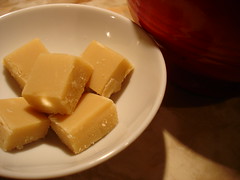
sucre à la crème fig. b: sucre à la crème

Sucre à la Crème à la Matante Juliette

2 cups light golden sugar
1 small can Carnation brand evaporated milk
5 tbsp butter
2 cups powdered sugar

Place the first three ingredients in a medium-sized pot over medium heat. Stirring constantly so as to prevent scorching, cook the ingredients until they begin to bubble, about 5 minutes. When the bubbles become bigger and denser, and the mixture has suddenly become thicker, about 1 minute later, remove from heat and pour in the powdered sugar, stirring or whisking vigorously so as to remove any lumps. Remember, the sucre à la crème cooks quickly—total cooking time at medium heat should be no more than about 5-10 minutes and the sucre à la crème should still be blond. Pour into a buttered 8”x 8” baking pan and let cool. When the sucre à la crème has cooled considerably but is still just the slightest bit warm, use a spatula to loosen it from the sides of the baking pan and flip it out onto a cutting board. Cut the sucre à la crème into small squares—the flavor is intense, so a little goes a long way—and place in a wax-paper lined metal tin. The sucre à la crème will keep for days and days in the metal tin, and if you cut it and store it at just the right moment, it will remain tender all the while.


aj

Saturday, December 10, 2005

Real Vermont Cheddar

Grafton Village's Four Star Mature Vermont Cheddar

The most unexpected find on last week's cheese and pizza trip to Vermont was without a doubt Jasper Hill's Bayley Hazen Blue, but we'd set out in search of real Vermont cheddar and we'd vowed not to return to Montreal before we'd found some. It's not that you can't find decent cheddar in Quebec--it is, after all, one of the province's traditional cheeses--but the small cheesemakers who have refashioned the cheese industry here over the last 20 years have looked elsewhere for inspiration, but mostly to France. As a result, we've yet to find a truly fantastic Quebec artisanal cheddar. (I have to admit, I'm a little picky when it comes to cheddar. During the two years I lived in London, I spent a great deal of time at Neal's Yard Dairy boning up on my British cheeses.) Head south of the border, though, and cheddar is king and, not surprisingly, artisanal cheesemakers there have sought to develop superior alternatives to the mass-market cheddars that dominate the U.S. market.

In Cabot, VT, we visited Cabot Creamery, a fairly large-scale cheesemaker, but one that functions as a cooperative, representing hundreds of the state's dairy farmers. (If you read Saveur you're probably familiar with their folksy ads featuring a veteran dairy farmer asking readers to, "Please buy [his] cheese.") We sampled a large selection of Cabot's line of cheddars, muensters, jacks, and other cheeses, including a very good select 2-year-old, but, in the words of Jeff Daniels' character in The Squid and the Whale, they weren't "serious." However, we were pleased to see that they had Grafton Village's Four Star Mature Vermont Cheddar. Grafton Village had made Saveur's list of the 50 best cheeses in America (they were #17), and they've been making fine cheeses since 1892, so we were eager to give them a try.

Grafton Village's Four Star Cheddar is exactly the kind of cheddar we've been looking for: extra, extra sharp, crumbly yet creamy, with a candy-like finish. We're well-stocked with cheese accompaniments at the moment, including an excellent Apple-Quince chutney that Michelle made last week, so we've been having that Four Star with crackers and preserves, but mostly we've been savoring it straight-up. It's so good you really just want to have it unadulterated. "Serious."

Note: We're presently in the process of lobbying Yannick to start stocking some of your finer Vermont cheeses. If our bid is successful we'll be sure to let you know.

aj

Thursday, December 08, 2005

Glorious Return: American Flatbread

American Flatbread's amazing wood-burning oven

By last weekend we really were in need of a little getaway, so we got in touch with Kazi and decided to do a daytrip down to Vermont in search of fresh air, New England scenery, artisanal cheese, and a pizza or two. Our route was plotted out based largely around a number of Northern Vermont creameries—Jasper Hill Farm in Greensboro, Cabot Creamery in Cabot, and the Vermont Butter and Cheese Co. in Websterville—but the real goal of our little escapade was to get ourselves in close proximity to Waitsfield by around 4:30 in the afternoon so that we could sign ourselves up for a table at American Flatbread. We didn’t quite make it to Websterville—we ran out of time—but we made our two other stops on our creamery tour easily (more on this here), and we had no problem doing what it took to make our rendezvous in Waitsfield. All three of us had been to American Flatbread before and it’s safe to say that we’d all had memorable experiences there. We had plenty of incentive to guide us.

Michelle and I had been to American Flatbread about two and a half years earlier. It was July of the summer of 2003 and we’d set out on a much more "adventurous" daytrip than last weekend's, one that began in Saratoga Springs, NY with a trip to the Saratoga Race Course to play the ponies. Several hours later, after a near-miss on a 44 to 1 longshot (!), lunching at the cantina that catered to the Mexican migrant workers that tend to the thoroughbreds, and a lovely drive up Hwy 4 along the Hudson and then into Vermont, we found our way to American Flatbread on the grounds of the Lareau Farm in the Mad River Valley. It was probably about 6:30 by the time we got to American Flatbread that evening, and we were familiar with the lore that surrounded their pizzas--which is why we'd been trying to make it there "early"--but we definitely weren’t prepared for the carnival we found when we got there. We’d taken Hwy 4 all the way to Hwy 100, and the drive got more and more sleepy and more and more photogenic the further we headed north along the 100. But when we made that sharp turn into the dirt driveway that leads down from the 100 to the Lareau Farm we suddenly found more cars than we’d seen since we passed Rutland an hour or two earlier. The parking lot was packed and there was quite the crowd gathered on the porch of the big old refashioned farmhouse, hanging out around a big wood fire in the firepit, traipsing across the meadow behind the farmhouse, and dining in the outdoor seating area. Michelle made her way into the restaurant to add our name to the list and when she came back she announced that there was a three to three and a half hour wait for a table. I said, “Excuse me?” Neither of us had ever heard of such a wait, so we balked for about 30 seconds or so, but then we decided, hey, we came all this way, and it really is a beautiful evening out (because it was, it was the perfect summer evening, warm and humid, with clear skies above and a gorgeous sunset in the works), and we don’t have any other place to go to, and, after all, American Flatbread is located in a town called Waitsfield, so what the hell. We ordered a couple of beers from the bar inside, brought them out to the porch, fetched a couple of books and the New York Times crossword from the car, and settled in to our surroundings. Before we knew it, a couple of hours had passed by, and by that time the sun was setting, the stars started to appear, and the fireflies were joining them over by the meadow. We were absolutely, perfectly relaxed by the time our name got called (a little earlier than expected, as it turned out), and we moved to our outdoor table and had one of the most memorable meals of the last few years. The food was great, no question about it, but this was one of those meals that was more about the all-around experience than just the food. It had to do with the weather, and the scenery, and the farmhouse, and the kids running across the meadow, and the conversation around the firepit, and the stars, and the fireflies, and the locally and organically grown ingredients used by the kitchen, and the sense of community that filled the air.

This year we talked and talked about going back, especially on another warm summer night, but, sadly, our glorious return to American Flatbread never really materialized. They’re only open for dining two nights out of the week—Friday and Saturday—and, between the two of us, we were working both of those days all summer long. Suffice to say, we were overdue for a visit by the time last weekend rolled along.

This time around there was definitely no warm, humid weather, there sure weren't any fireflies, and things at Lareau Farm were quite a bit more subdued than they had been in 2003. We showed up right at 4:30, right at the time that the staff at American Flatbread starts taking names for the evening’s dining, and we had no problem getting ourselves put near the top of that list. We hadn't really eaten since we filled up at Cosmos early in the morning, so we opted to be seated at the first available seating time, 5:30. With an hour to relax, we decided to do a little tramping across the meadow and through the snow. Night was coming on quickly and things were getting pretty dark, but one of the hosts was kind enough to lend us a headlamp (he even went out to his truck to grab it for us!), so off we went.

tramping in Vermont

45 minutes later we ambled up to the firepit, where once again a fire was burning, and we spent 10 minutes or so warming up. Then we went into the farmhouse and ordered three beers at the bar and waited for our name to get called. We got seated right in front of American Flatbread's massive and beautiful wood-burning oven--the perfect position to watch the action as well as to warm up some more after our walk in the woods. The oven occupies the central position in the dining room at American Flatbread--the high vaulted ceiling has the effect of making it look like a kind of altar, fittingly enough. Like everything else at American Flatbread, the oven was made from local ingredients like Vermont fieldstone and soapstone (which is particularly well-suited for evenly distributing heat), but, interestingly, the oven was modeled after the clay-domed ovens that were traditional in rural Quebec in the 18th and 19th centuries. I've come across pictures of these ovens like this one that was featured in The Art of Eating No. 69

clay oven, Murray Bay, QC, 1898

and places like Au Pied de Cochon here in Montreal incorporate their own modern take on these ovens as part of their charm, but in my travels across Quebec I've yet to come across one as authentic as the one at American Flatbread. On their web site the folks at American Flatbread claim, "These clay domes are considered by many master bakers to make the very best bread." This indicates that there's an entire tradition of bread baking unique to Quebec that was completely extinguished during the push towards modernization. American Flatbread uses only the finest local and organic ingredients in everything that they make, but that oven alone is enough to distinguish their work from that of so many other pizza makers across North America. At the very least you need a well-seasoned oven; American Flatbread's oven is not only well-seasoned, it's also a work of art, a labor of love, and a focus for the sense of community, the commonweal, they've developed over the last couple of decades.

When it came to ordering, we were definitely happy to have Kazi along because it meant that we could order a second pizza and try out another combination or two. On our first visit to American Flatbread we'd tried a half and half New Vermont Sausage and Punctuated Equilibrium pizza and we absolutely loved it. The New Vermont Sausage pizza was especially deluxe--it featured "Hadley Gaylord's naturally raised Waitsfield pork in a nitrate-free maple-fennel sausage," mushrooms, sun-dried tomatoes (dried and prepared on premises), caramelized onions, and a blend of cheeses, and that bright fennel-maple flavor was truly something else. The Punctuated Equilibrium, on the other hand, consisted of Vermont chèvre, red onions, roasted red peppers, black olives, herbs, mozzarella, and garlic--as the name suggests, perfect balance shot through with the pungency of that goat's milk cheese and the brine of the olives. We were so impressed by these two combos and we'd been craving them for so long that we decided that ordering them again was the only possible option. This time around we ordered a full New Vermont Sausage pizza along with a half and half Punctuated Equilibrium and Pepperoni and Peppers pizza. We were intrigued by the thought of having a quality pepperoni pizza (for once), one made with an "all natural nitrate-free pepperoni," and we were pretty sure that each half's Mediterranean vibe would complement the other. How right we were! Our Mediterranean Special was a great match--maybe even too good of a match--and ordering a full New Vermont Sausage was one of the best decisions I've ever been a part of. Halfway through our pizzas we found ourselves gazing over at the woman to the left of the oven with fascination and covetousness in our hearts (Who was she? A reviewer? An heiress?). She was sitting at her table solo with a bottle of red wine and not one, but two pizzas on her table. She had about 4 or 5 pieces of her pizzas, drank most of her bottle of wine, and then waltzed out of the restaurant with the loveliest assortment of leftovers you ever saw. Hmm...

Even the desserts were impressive last Saturday night. Kazi and I split the homemade apple pie with homemade vanilla ice cream and Michelle ordered a double order of mignardises, which wound up consisting of two chocolate-covered toffee candies and two chocolate-covered caramel candies. We'd had their excellent apple pie before, but we'd never had their candies and, like everything else, they were both thoughtful and delicious. We accompanied our desserts with two cups of coffee, and it was time to head off into that starry Vermont night and face up to our drive back to Montreal.

Heading down to Waitsfield, VT for pizza might seem like an awfully long way to go for pizza, but when you take into account the quality of American Flatbread's pies, the sad state of pizza affairs in Montreal, and the fact that even New Yorkers regularly make the trek up to the Mad River Valley solely for one of American Flatbread's justly famous pizzas (!), well, to our minds, it seems perfectly reasonable.

American Flatbread is located just south of Waitsfield, VT along Hwy 100. They're open for dinner on Friday and Saturday nights. Unless you show up at 4:30 and make a booking for yourself at 5:30, you should be prepared for a healthy (and potentially relaxing) wait. They're only open twice a week and their pizzas are very, very good. You do the math. Waitsfield is about a 3-hour drive from Montreal.

aj

Wednesday, December 07, 2005

Bayley Hazen Blue


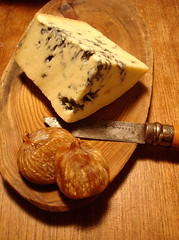
Vermont blue and figs
Originally uploaded by michelle1975.


A few years ago, I came across a cheese map of Quebec which detailed where the fromageries were and what they had to offer. We used this map a lot to find amazing local cheeses, and it became one of our main excuses for our weekend trips across the province. Quebec, like some other parts of North America, has been experiencing a renaissance in artisanal cheesemaking so you can find dozens and dozens of small cheesemakers scattered across the countryside. Thank God! There are so many incredible local cheeses right now in Quebec, such as Riopelle, Athonyte, Le Pizy, Valbert, Victor et Bertholde, and hundreds more, and so many of them are made with raw milk, too. Clearly there's a lot to be excited about, but there's still room for improvement. For reasons that might seem obvious, the cheeses that have emerged as part of this renaissance have tended to be French in style, rather than English, or Italian, or anything else. This is both a blessing and a curse. It means we have some very impressive high cream content cow's and goat's milk cheeses, but it also means that we're short on artisanal versions of the English-style cheeses that were staples here earlier. Another one of our weaknesses is in the area of artisanal butter production. To be rolling in French-style cheeses but to be lacking in French-style, fresh-churned butter is simply absurd.

Meanwhile, just south of the border, a parallel dairy renaissance has been underway. It's not that Vermont produces any more cheeses than Quebec, but step into nearly any general store in Vermont (and nearly every small town has one) and you'll find lovely local cheese, butter, milk and cream readily available. So, for instance, the blue cheese pictured above is something we bought at a little general store in Greensboro. We stopped in there looking for directions to Jasper Hill Farm, which is also in Greensboro and which we'd heard rave reviews of, but we were told that the farm didn't have a retail outlet. And, in any case, the woman at the store wasn't exactly sure where Jasper Hill Farm was located anyway. Lucky for us, they happened to stock Jasper Hill Farm's cheeses, so we picked one up. It's called Bayley Hazen Blue, and it is simply amazing, a perfect cheese. It might well be the best blue I have ever had in my life. We ate it with an apple-quince chutney and were blown away by its flavour.

Jasper Hill Farm makes only five different cheeses, and they are much sought-after by restaurants and boutiques in America. They have the aforementioned blue, Bayley Hazen, Aspenhurst, a Leicester-style cheese which is aged for one year--this year's vintage is sold out already, Constant Bliss, a soft-ripened cheese, washed-rind Winnemere, and another blue called Bartlett.

Our Jasper Hill experience was so good that plans are definitely in the works to make a trip to Vermont to pick up whatever else we can find of theirs, since their cheeses are unavailable in Montreal. * If anyone is interested in going in on a whole wheel of cheese, let me know. I can think of no better Christmas present...

If you want to plan your own Vermont cheese tour check out the Vermont Cheese Council's site. You'll find everything you need to know about Vermont goat's milk, sheep's milk, and cow's milk cheeses, recipes, and your very own spiffy Vermont cheese map.

m

* For those of our lucky readers in NYC or SF, Murray's ** and The Cheese Board regularly carry Jasper Hill Farm's cheeses.

** Did you know that the Murray's crew have a blog?

Wednesday, October 12, 2005

In Search of... Covey Hill and "Unsurpassed Flavour"


apples!
Originally uploaded by michelle1975.


This year, not only did we want to avoid those big, touristy apple orchard/amusement parks, but we actually wanted to go some place different, some area we'd never visited before to pick our crop of apples. We'd been excited to go apple picking ever since we'd paid a visit to Red Jacket in New York at the beginning of September--after all, Quebec is a premier apple growing region, too--but we really wanted to go some place new. That's why we went to Covey Hill.

We'd owned this vintage apple crate for a couple of years,


vintage apple crate
Originally uploaded by michelle1975.


but it was only a couple of weeks ago, when I started to think about where I might like to go apple picking this time around, that I took a close look at it and thought to myself, "Hmm, Covey Hill..." You see, we'd been using the crate for storage, and we'd stupidly placed the side you see in the photo out of view. The sides that read "Unsurpassed Flavour" and "Saveur Insurpassable" had always been in view, but we'd only just turned the crate around so you could see the "Covey Hill" side.

As quests go, this wasn't exactly a search for Rosebud, but it was something. Covey Hill doesn't appear on most maps these days, and the first two internet mapping services that I consulted didn't turn it up either. But I found other references to Covey Hill, and what I read--the fact that Covey Hill is the only part of the Adirondack chain that sits on Canadian territory, the fact that's its known for its unusual transitional ecosystem, etc.--got me further interested. When I finally pinpointed its location--in the southwestern corner of Quebec, just above the New York border, west of Hemmingford along the 202 just before Franklin--and found out that the area was still heavily dotted with apple orchards, I was sold.

So on Monday, we took advantage of Canadian Thanksgiving--a holiday which is awkwardly placed after a weekend and which is low on mythology and obligations (in other words, a holiday perfect for apple picking)--to make our way to the countryside. We zipped down the 15 towards the New York state line, then cut across the 219 to Hemmingford, a town that holds a place in Michelle's pantheon because of its celebrated yarn fair. We took a quick look around for any signs of a yarn fair or a Thanksgiving Day méchoui, then veered off on the 202 along a route that became more and more sparsely populated, and more and more scenic, as we headed west. Only the occasional farm, horse stable, and orchard broke up the landscape, which was getting more and more forested the further we went, and around Havelock we suddenly began to see a somewhat imposing, if low, hill that could only have been Covey Hill.

Covey Hill proper only contains a couple of apple orchards today, and we weren't able to figure out whether the apple orchard that produced our apple crate is still in existence, but we still got a kick out of locating a number of Covey Hill-related signs, Covey Hill's abandoned 1869 Zion Church,


Zion Church, Covey Hill
Originally uploaded by ajkinik.


a few spooky, mist-enshrouded farms, and some other landmarks. Then we turned our attention to neighboring Franklin, which is just a few kilometers further along the 202, and has at least a dozen apple orchards of all sizes.

We toured the area to try to get a sense of what the different orchards were like and which ones we'd be interested in picking our apples from. For the most part, they all looked pretty amazing, their trees heavy with dark red fruit, and I was relieved to see even the biggest of the orchards in that area were not all that tourist-oriented. Sure, the larger ones--like Hillspring Farm, one of the region's bigger apple cider producers--had added attractions like pony rides and whatnot, but these weren't the kind of full-on three-ring circuses that you find in some parts of Quebec. For the most part, apple orchards, like cabanes à sucre, have gone so crass in recent years, you really have to dig a little to find places that don't turn your stomach. Anyway, we were mostly interested in finding selection, because we had some harder to find apples like russets in mind, and if we could find a smaller, quieter orchard and support a small farmer, all the better.

We saw a couple of orchards that looked promising right in the heart of Franklin, but Michelle had spotted a couple of smaller orchards outside of Franklin centre, towards Havelock and Covey Hill, so after making a stop to pick up some wonderful honey crisps from one stand, we headed back towards Covey Hill. A few minutes later, we pulled into Eugene Safian's orchard, and as soon as we got out of the truck, took a look around, and talked to M. Safian we were sure we'd made the right choice. M. Safian had about 8 varieties ripe for the picking, including russets, spys, empires, cortlands, red delicious, and golden delicious, he had wonderful-looking pears for sale, his prices were right, and he was a real sweetheart of a guy.


red, delicious Cortland
Originally uploaded by michelle1975.


M. Safian took us out into his orchard and showed us where we could find what and which trees he recommended, then we sampled a couple of apples and got to work. Within a half an hour we'd filled our two big buckets with as wide a selection of apples as we could get our hands on.


Then we went back to M. Safian's stand, talked him up about his selection of homemade preserves, honeys (including his hearty buckwheat honey, which he insisted was rich in vitamin C, and therefore the perfect antidote to the common cold), and pears, made some selections, and paid up. A good-sized bucket of pears came to $10.00. Our buckwheat honey came to $4.25, with the 25¢ rebate we got for being good customers. And those two big buckets of apples came to a mere $6.00 each, about $4.00 less that most of his competitors. When we'd gone out into the orchard with him, we talked about how 2005 had proven to be a poor year for apples, with a late summer and early fall that had been too hot and too humid to make for a good apple crop. All I can say is that when we tried M. Safian's apples we sure couldn't tell it had been a bad year. His apples were as good as any apples I've ever had, crisp, juicy, and full of flavor.


the haul, pt. 1
Originally uploaded by michelle1975.


When we got home, we laid the apples out on our dining room table so that they could air dry (it had been raining in Franklin/Covey Hill). Then Michelle took a few gems from our haul, peeled them and diced them, and whipped up an apple crumble for our afternoon snack. We sat down, had a cup of "autumn blend" tea, ate our crumble, and basked in the glow of our fresh-picked apples.


the haul, pt. 2
Originally uploaded by michelle1975.


Covey Hill and Franklin are located on the 202, about 20 km west of Hemmingford, just north of the U.S. border.

M. Eugene Safian's orchard is just east of Franklin, between Franklin and Havelock, on the north side of the 202 near the point where it intersects with the 201. As his handmade business card reads, he has apples, pears, and honey for sale and you can reach him at (450) 827-2423 after 9 p.m. Sorry, he doesn't have a website.

Oh, and, by the way, M. Safian estimates that he should have apples available for about another 4 weeks.

aj