Showing posts with label David Chang. Show all posts

Friday, July 11, 2014

Toronto the Good

Tonto in Toronto 1
Tonto in Toronto 1 fig. a:  Tonto prays for poor Toronto

Poor Toronto.  It's spent decades trying to shake its reputation as "Toronto the Good," a city whose identity was primarily perceived as being strait-laced, upright, and, frankly, uptight--the capital of those dreaded "têtes carrées."  For ages, it's also endured the resentment of the rest of Canada over its wealth, power, and success, and has been ridiculed mercilessly for having the nerve to consider itself the economic and/or cultural capital of the nation.  It's home to an Original Six hockey team that's made its fans suffer since the end of the Original Six era (in spite of the city's wealth and power).  And then there's all that ongoing nonsense with the Mayor's Office.

But, you know what?  I've always thought Toronto is a pretty funky town, with some truly impressive architecture.

toronto canada fig. b:  Toronto the Great

And, regardless of all the haters with their darts and arrows, Toronto just keeps steaming along.  In fact, in many areas (but certainly not all) things have never been better.

Take the city's food culture, for instance.  In this department, from restaurants to bars, to microbreweries, markets, and purveyors of all sorts, the city seems more and more like "Toronto the Great" to me every time I visit.

Tastemakers like David Chang lament the fact that Toronto has "yet to produce any truly world-class restaurants," but I couldn't care less about any of that San Pellegrino business, and what I see is a city that has become remarkably assertive when it comes to food and drink in a very short period of time, a city that's become a true contender.

A recent trip turned up these observations:

Kensington Market

Kensington Market fig. c:  Kensington Market

Seven Lives serves excellent San Diego-style tacos and refreshing agua frescas out of a tiny storefront on Kensington Avenue.  Their signature taco is their Gobernador, and it boldly goes places no taco I've ever had before has gone, combining shrimp, smoked marlin, and cheese into an experience that's both mind-bending and mouth-watering.  It's something about the sweet juiciness of the shrimp, the almost meaty smokiness of the marlin, and the loving caress of the cheese.  If it sounds strange to you, get over it.  The Gobernador is the only taco that Seven Lives has immortalized in paint on their front window, and you can understand why--they know it's a hit.

(Note:  Seven Lives' tacos are overstuffed and an excellent value for the money.  Just one makes for a pretty decent (small) meal.)

Sanagan's Meat Locker, on Baldwin Street, is the best butcher shop/charcuterie I've encountered in Hogtown Canada.  The SML experience is comparable to Fleisher's, and that's high praise in my book.  Their meat is carefully sourced, clearly labeled, and very fairly priced, and their staff is knowledgeable, enthusiastic, and friendly.  Their selection of charcuterie is impressive.  And their kitchen is turning out fantastic sandwiches, salads, and other meals-to-go.  They also stock a great selection of locally manufactured fine food products (breads, condiments, etc.).  I picked up a honking, beautifully marbled 12-lb skin-on, bone-in Mennonite pork shoulder for just over $40 on my last day in town and turned it into some divine barbecue the next day, back in Montreal.

Fika is a tastefully appointed Swedish café on Kensington Avenue.  They make a delicious iced coffee with cardamom and mint leaves.

Queen Street West

grand electric 1
grand electric 2 fig. d:  Grand Electric

Grand Electric is another new-school Toronto taco joint that's more of a restaurant (a lot more) and less of a stand than Seven Lives, and that also features a full bar with a stunning selection of bourbons and some pretty great beers (like Negra Modelo).  All my tacos (crispy cauliflower, spicy chicken) were great (they're smaller here than at Seven Lives, so I ordered three), but my absolute favourite was the Baja fish, which was both generous (featuring a large piece of flaky, beautifully deep-fried fish) and ridiculously delicious.

The same folks also run a BBQ joint called Electric Mud, right around the corner on Brock Avenue, but I ran out of time and never made it there.  Next time!

Oyster Boy has been a Toronto institution for over 20 years--first as a supplier/caterer and then as a bricks-and-mortar restaurant (since 2001).  The oysters are plentiful, they come from some of the top oyster producers in Canada and the States, and they're expertly shucked and served with all the condiments one might want.  The rest of the menu is exactly what you're looking for in an oyster shack, and all you could dream of in a seafood restaurant that's so far from the ocean.  Our party split a selection of oysters on the half shell, and I had a salad and an oyster po' boy and I was thrilled.

Chantecler is another Parkdale restaurant (just a couple doors down from Grand Electric) that specializes in Asian lettuce wraps.  I really liked my Pork Special Wrap, with dried oysters, toasty seaweed, and puffed rice, but I absolutely loved my Fancy Wings, which came with fried garlic and shallots, and my Kale Salad, which featured the unlikely combination of oyster mushrooms, apples, and seaweed, but was truly fantastic--the best kale salad I've ever tasted.

I've heard rumours that Chantecler runs a tasting menu operation somewhere behind the scenes of their restaurant--Roberta's-style--but I didn't find out about it until I'd gotten back to Montreal.  Definitely sounds intriguing...

Ossington Avenue

Bar Isabel on College Street, just a block and a half from Ossington, is a highly rated Spanish restaurant that specializes in tapas, wine, and cocktails.  We placed our focus on tapas and bar snacks, and everything we had was exceptional, including the sardines, the boquerones, the patatas bravas, and the grilled asparagus.  I highly recommend eating at the bar, if you're dining solo or if you're a party of two--the staff there were friendly and highly attentive, and it's fun to watch them mix their expertly crafted cocktails.

(Note:  It can be very hard to get a reservation at Bar Isabel because of its reputation and its popularity, but if you show up just before they open, at 6:00 p.m., and there are just one or two of you, you can usually get a seat at the bar.)

If the idea of opening a "Paris, 1900"-style butcher shop* on a gentrified stretch of Ossington in 21st-century Toronto sounds absurd to you, you might scoff at Côte de Boeuf, but it would be a shame if you did, because you'd miss out on some of the city's best meat, cheese, eggs, milk, and other fine foods.  They also make some pretty impressive sandwiches.

Libretto wasn't new to me, and perhaps because of that, I found utterly impossible to miss out on one of their Neapolitan pizza pies.  In fact, I'd just eaten about an hour before and I wasn't even hungry, but it was after 9:00 p.m., and I could see that things had died down inside the restaurant, so I popped in and ordered a pizza-to-go "for later."  Who was I kidding?  I ducked down a side street seconds after picking up my order, and ate half the pizza right there, standing up, pizza box resting on someone's fence.  The other half I saved for later.  One quarter ended up being a midnight snack.  The last quarter was eaten for breakfast.

I guess I just had to make sure their pizzas were as good as I remembered them being.  Don't miss out on their homemade spicy chile oil.

411:

Seven Lives, 69 Kensington Avenue (Kensington Market), (416) 666-6666

Sanagan's Meat Locker, 176 Baldwin Avenue (Kensington Market), (416) 593-9747

Fika, 28 Kensington Avenue (Kensington Market)

Grand Electric, 1330 Queen Street West (Parkdale), (416) 627-3459

Oyster Boy, 872 Queen Street West (Trinity-Bellwoods), (416) 534-3432

Chantecler, 1320 Queen Street West (Parkdale), (416) 628-3586

Bar Isabel, 797 College Street (Little Italy/Ossington), (416) 532-2222

Côte de Boeuf, 130 Ossington Avenue (Little Portugal/Ossington), (416) 532-BEEF

Libretto, 221 Ossington Avenue (Little Portugal/Ossington), (416) 532-8000

aj

*  Actually, I take it back.  Their tagline on their website reads:  "A butcher shop right out of Paris in the 90s.  The 1890s."  I was off by a few years.

Thursday, February 23, 2012

Bo Knows

Speaking of wraps, I still remember our first experience of Momofuku, way back in 2006, vividly.

decor, Momofuku fig. a: Momofuku!

Like virtually everyone else, the dish that first won our hearts was David Chang's now legendary, oft-imitated steamed pork buns, with its supremely succulent braised Berkshire pork. But the dish that left a lasting impression was the ssäm.

At the time, I had the following to say about the experience:

The true revelation of our luncheon, however, was my Ssäm. I have to confess, at the time that I ordered it, I really had little idea what exactly I was ordering. The ingredients--"Berkshire pork, rice, edamame, onions, pickled shiitake, kimchi"--all sounded great to me, but I was expecting some kind of a fried rice dish, or possibly even a rice-based soup.

ssäm, Momofuku fig. b: Momofuku ssäm

What we got, instead, was a burrito--a clever Korean-American take on the Mexican-American classic. In general, we're a little skeptical when it comes to "fusion cuisine," but here was another instance of Chang taking chances and finding (not forcing) culinary affinities. The results were brilliant--but, then again, as huge fans of Mission-style burritos and Korean food, we were pretty much an ideal audience for Momofuku's ssäm burrito.

Chang writes about his ssäm burritos with humor and a healthy dose of self-deprecation in Lucky Peach #2. In fact, his opening line baldly states, "In 2005, I thought I had the greatest idea in the world: I was going to serve Korean burritos." And he goes on to explain the logic behind his brainchild:

It wasn't that much of a stretch of the imagination: Koreans wrap up everything. Go to a summer barbecue with enough Koreans and one of them will eat his burger wrapped in a lettuce leaf just because that's how we do it. Bossäm is a traditional dish where you sit around a big plate of pork belly (and sometimes oysters) and wrap up mouthful after mouthful in napa cabbage.

ssäm burrito fig. c: ssäm burrito spread

But, overall, Chang's piece reads more like an attempt to restore the reputation of his poor Korean burrito (and poke fun at himself) in the aftermath of the Korean taco phenomenon: "I was such a dumbass... (A year or two later, my good friend Roy Choi started doing Korean Tacos in L.A. Now he's so successful I want to be him instead of me.)"

Now, it's easy to make your own ssäm burritos at home. Chang's Bo ssäm recipe has appeared in Momofuku (the cookbook), in Lucky Peach #1, and elsewhere (such as Sam Sifton's New York Times article on Chang's version, "The Bo Ssam Miracle"). And in Lucky Peach #2, Chang provides a complete recipe for his original ssäm burritos.

But when I finally got around to preparing Chang's Bo Ssäm at home a few weeks ago, it struck me that he had missed out on a golden opportunity. As much as I love tacos, including Korean tacos, I still love burritos enormously. And while tacos might offer more opportunities for variation and innovation, there's one category where burritos have tacos beat hands down: breakfast.

Unless you're feeding a pack of coyotes, you're probably going to have some bo ssäm and some bo ssäm fixings leftover after your next bo ssäm-athon. And you're probably going  to find yourself so ravenous for the taste of bo ssäm again, and, in all likelihood, so incredibly hungover, that you're going to want to dig in to those leftovers sooner rather than later (like, for breakfast, the very next day). Just make sure you have some nice, big flour tortillas on hand, as well as some eggs, when you do. Then you can make yourself some bo ssäm breakfast burritos, or as we like to call them...

Ssäm Bburritos

1 extra-large flour tortilla, steamed or microwaved until warm
roast pork shoulder, Bo ssäm-style, reheated
refried short-grain rice
1 egg, fried, poached, or scrambled (depending on how you like it)
kimchi
quick-pickled cucumbers
quick-pickled radishes
ginger-scallion sauce
ssäm sauce

Pile the ingredients high, but not so high that you can't actually close the burrito.

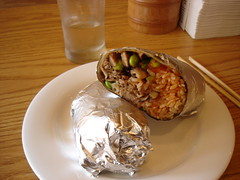
ssäm bburito 1 fig. d: ssäm bburrito 1

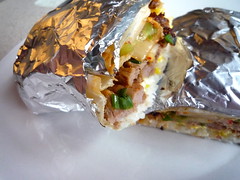
Roll and fold the burrito up tightly, and wrap with aluminum foil.

ssäm bburito 2 fig. e: ssäm bburrito 2

Devour.

Repeat as needed.

[we'd like to think this recipe is a Momofuku/AEB co-production, but mostly it relies on recipes from Momofuku by David Chang and Peter Meehan]

How did they turn out? Well, they tasted like "the greatest idea in the world."  The very greatest.

aj

Tuesday, July 27, 2010

Turning Japanese

laser suzuki fig. a: Laser Suzuki!

It may have had something to do with the Laser Suzuki t-shirt that a friend of mine got me for my birthday last year, somewhat inexplicably. I've definitely been wearing it a fair bit recently, much to the puzzlement of those who know me well and who can't understand the message.* Or maybe it was all those travel tales from Japan that we've been hearing over the last several months from all those friends who've insisted, "You really must go! It's not as expensive as you think!" Then again, it may also have been the effects of that full-on Kazu fever that we developed this spring and that has yet to relent in spite of weekly (bi-weekly?) visits. All I know is that, for a while there, our AEB test kitchen was all about the Japanese.

harumi 1 fig. b: Harumi!

And when we felt like we need a little help with this process, our newest favorite friend, Harumi, was there to guide the way. I was none the wiser until quite recently, but Harumi Kurihara is something of a sensation in Japan. A former housewife turned "lifestyle authority," Harumi has apparently gone platinum many times over with her assortment of cookbooks, interior design books, lifestyle magazines, etc. But all of that is just hearsay.

All we really know is that Everyday Harumi: Simple Japanese Food for Family & Friends, her follow-up to her award-winning Harumi's Japanese Cooking (her first book in English), is a smash hit in our household. Everyday Harumi features some 70 homestyle Japanese recipes and a whole lot of gorgeous photography, and, as the title suggests, this is a book that focuses on recipes that are unfussy and that one might make on an everyday basis, many of which call for a minimum of ingredients. Best of all, they've all been winners so far,

harumi 3 fig. c: three toppings!

from the Three Toppings Rice, which is a kind of "mother & child"/"chicken & egg" number,

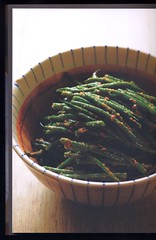
harumi 4 fig. d: green beans!

to her deliciously simple, simply delicious Green Beans with a Sesame Dressing (the same ones she's stirring in the photograph that graces the cover),

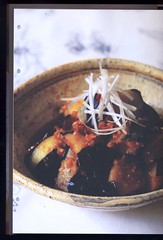
harumi 2 fig. e: eggplant!

to her Eggplant in Spicy Sauce--another ultra-straightforward, ultra-satisfying gem.

Michelle's been in heaven throughout this entire recent foray into all things Japanese, but for some reason she found the Eggplant in Spicy Sauce to be particularly brilliant, so that's the recipe I've decided to highlight.

Eggplant in Spicy Sauce

1 lb 3 oz eggplant (either Japanese, or baby Italian)
1/3 cup light soy sauce, such as usukuchi
1/3 cup mirin
2 1/2 tbsp superfine sugar (not to be confused with icing/confectioners' sugar)
1/4 cup rice vinegar
sunflower, canola, or vegetable oil for deep-frying
2-3 tbsp finely minced leeks or scallions
1 tsp finely minced garlic
1 tsp finely minced ginger
1-2 red chilies, seeded and finely sliced
shredded leek for garnish

Trim the eggplants and, using a vegetable peeler, make some stripes in its skin. Cut the eggplant into 1-inch thick disks and then quarter them. Place the chopped eggplant in a bowl of cold water, soak for 10-15 minutes, then drain and pat dry.

Combine the soy sauce, mirin, sugar, and rice vinegar to make the sauce. Stir well and set aside.

In a skillet, heat enough oil to cover the eggplant. When the oil reaches 340º F, add the eggplant pieces, and deep-fry until the pieces are golden all over and buttery soft in the middle. Remove the eggplant pieces from the skillet with a slotted spoon and drain on paper towels. Repeat process as necessary. You should be able to deep-fry all the eggplant in no more than 2-3 batches. The eggplant pieces cook quite rapidly--3-4 minutes, usually--so even 3 batches of deep-frying won't take long.

Transfer the eggplant pieces to a bowl, add the sauce, then the minced leek or scallion, garlic, ginger, and chili to combine.

Serve with some shredded leek on top, or some finely chopped scallions.

[recipe from Everyday Harumi by Harumi Kurihara]


One night we had a really lovely simple meal that consisted of the Eggplant in Spicy Sauce, the Green Beans with a Sesame Dressing, steamed short-grain rice, and an assortment of simple Asian pickles,

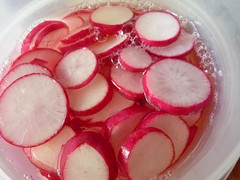
simple radish pickles fig. f: pickled radishes!

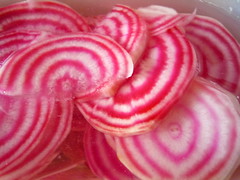
pickled beets fig. g: pickled beets!

including pickled cucumbers, pickled radishes, and pickled beets.

On special occasions, we've been combining recipes from Everyday Harumi with some of the more Japanese or Japanese-inspired recipes from David Chang's Momofuku cookbook.

momofuku tofu salad fig. h: Asian cherry tomato salad!

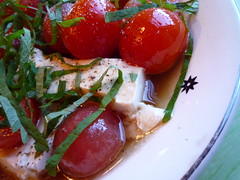
One day we even made his wonderful Cherry Tomato Salad with Silken Tofu & Shiso,

cherry tomatoes 1 fig. i: cherry tomatoes!

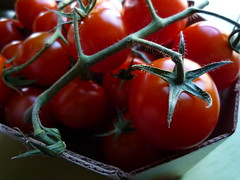
which required us to score the best cherry tomatoes we could find,

cherry tomatoes 2 fig. j: naked cherry tomatoes!

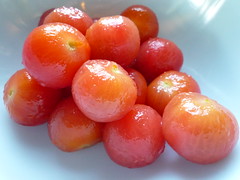
before blanching and peeling some of them (others were left uncooked and fully clothed).

shrouded

shiso leaves fig. k: shiso leaves!

It also required us to hit up our friendly, neighborhood sushi restaurant (one of the city's very best) for some real, honest-to-goodness Japanese shiso leaves, which was kind of like hitting up your neighbor for a cup of sugar or a stick of butter or something, only way more magical.

aj

* I mean I'm down with David Suzuki, the David Suzuki Foundation, and The Nature of Things, but suddenly I'm reminded of a story I once heard about the chair of an anthropology department at a prestigious Canadian university. The chair in question was a diminutive Japanese man who'd cultivated a convincing Ho Chi Minh mustache and beard combo. His office was adorned with a single, solitary bit of decoration--a massive poster of Karl Marx. The Ho Chi Minh look + the Karl Marx poster seemed to suggest that this gentleman was a card-carrying Marxist--most who visited him in his office drew what appeared to be the logical conclusion. In fact, appearances were deceiving. He just liked the way the poster looked.**

** Presumably, he also just liked the way that Ho Chi Minh mustache and beard combo looked.

Tuesday, June 22, 2010

Grits, Asian-American Style

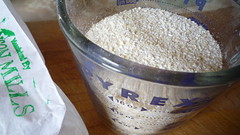
anson mills antebellum white grits fig. a: Anson Mills coarse white grits

A stamped white paper bag, a Pyrex measuring cup, and some white grits.

Doesn't look like much, I know. But those aren't just any grits, they're Anson Mills antebellum coarse white grits, the grits David Chang has called "the killerest grits ever."

These grits being "the killerest," you could make them straight-up, add some salt and pepper, add a little butter, and you'd be sitting pretty, but you're not going to settle for straight-up, are you? Didn't think so.

No, you're going to follow David Chang and Team Momofuku on one of their flights of fancy. People often misunderstand the Momofuku experience as being just another example of "Asian fusion." Now, there's no question that there's some fusion going on within the Momofuku empire, but there's also quite a bit of fission. And, yes, Asian elements figure prominently. But there's a side to David Chang that's almost Kenny Shopsin-like. As far as I know, he hasn't invented any countries, then set about creating their national cuisines, but there's more imagination than one generally associates with the term fusion. The narratives are richer. They're more profane. They're also a hell of a lot funnier.

As Chang describes things, Momofuku Noodle Bar's Shrimp & Grits was a pivotal dish, because aside from the Asianesque broth that Chang used to make the grits, and that you couldn't actually see, "there was no Asian foundation, relation, or appearance to the dish. No other "noodle bar" was serving shrimp and grits."

The idea, the dream, behind the dish was to take a down-home Southern soul food classic, disarticulate it, ruminate on it, and then reanimate it in Momofuku's laboratories:

I imagined what it would be like if my ancestors had ended up in Charleston, South Carolina, a few generations before I was born. They would have eaten corn, they would have eaten grits, they would have cooked with bacon. Or, if Southerners were magically transplanted to Korea, they'd eat jook instead of grits at breakfast. And you know a people who can handle the salty power of a country ham certainly could have gotten down with kimchi. I imagined a Japanese cook making grits--you know he'd boil it in dashi and season it with soy.

I guess these were all conversations I was having with myself. I didn't want to be cooking shitty fusion food. I consoled myself by thinking about how Vietnamese cuisine and Cajun cooking adapted French techniques into something that might have looked French but tasted totally different. But it was with this dish that I decided--or accepted--that if we reached past "tradition" to create the truest and best version of a dish for our own palates, then what we were doing wasn't bullshit.
Chang recommends making this dish with either his Ramen Broth or his Bacon Dashi. We went with the latter a) because it's way simpler, b) because it's way cheaper to make, and c) because it's another great example of the Momofuku Philosophy at play. As Chang puts it:
I can't overstate the significance of bacon dashi to us at Momofuku. It's not the dashi itself--though it is delicious--but the thought process that went into it. The successful transposition of bacon from Tennessee for Japanese dried and smoked fish was an important early success for us, and it continues to be a driving inspiration of how we cook.

We respect tradition and we revere many traditional flavor profiles, but we do not subscribe to the idea that there's one set of blueprints that everyone should follow.
So the following are Chang's instructions (more or less verbatim), using Momofuku's Bacon Dashi.

Still can't see what all the fuss is about? Well, here goes:

s& g:  before fig. b: before

Momofuku Shrimp & Grits

2 cups water
2 cups white or yellow quick-cooking grits, preferably from Anson Mills (SC)
2 cups Bacon Dashi (recipe follows)
2 tablespoons light soy sauce, such as usukuchi
kosher salt and freshly ground black pepper
8 tbsp unsalted butter, cut into pieces
1/2 pound smoky bacon, such as Benton's (TN) or North Country Smokehouse (NH), cut crosswise into 1- to 1 1/2-inch-long lardons
1 pound medium shrimp (16 to 20 count), shelled
2 tbsp grapeseed or other neutral oil, such as canola
4 freshly poached eggs
1/2 cup chopped scallions, greens and whites included

Combine the water and grits and soak the grits overnight (or for at least 8 hours) in the pot you'll cook them in.

Drain the grits, add the broth to the grits, and bring to a simmer over medium-high heat, whisking all the while. Continue to whisk for 5 minutes after the liquid simmers, then turn the heat down to low. You'll reach "first starch"--the point at which the fine corn particles thicken the liquid just enough to suspend the larger particles--after 5 minutes, and it's crucial to whisk constantly until you reach that point, and to turn the heat down immediately afterwards.

Add the soy sauce, a large pinch of salt, and some freshly ground black pepper. Keep the heat low and whisk regularly if not constantly; the grits should be thickening, undulating, and letting occasional gasps of steam bubble up and out. Soaked grits will be cooked after about 10 minutes over low heat. They're ready when they're no longer grainy, and they've become thick and unctuous.

Add the butter, stirring until it has melted and been absorbed into the grits. Taste them and add additional salt and pepper as needed. Set aside, covered to keep warm, while you get the rest of the dish in order (or serve them at once if you can't take it anymore and you just want to eat them solo).

Put the shrimp in a mixing bowl, pour the oil over them, and add a couple pinches of salt. Toss them in the oil and salt until they're coated. Set aside while you take care of the bacon.

Cook the bacon in a 12-inch cast-iron skillet over medium heat until the lardons have shrunk to about half their original size and are crispy, about 5 to 6 minutes. Remove the bacon with a slotted spoon and drain them on paper towels. Drain the bacon fat from the pan and reserve for another later use. Return the pan to the stove.

Make sure you've got your eggs poached and ready to go. They're ready? Good. Proceed.

Wipe the pan cleanish with a paper towel and turn the heat up to high. Cook the shrimp in two batches. As soon as the shrimp hit the pan, press down on them, using a bacon press, the back of a big spatula, a flattish pot lid, or a smaller pan--whatever works (we've found that a flattish pot lid works best for us). Sear the shrimp for about 1 minute on the first side. Watch the shrimp closely. As the gray-pink flesh of the raw shrimp gradually turns white in the side pressed against hot pan, and when that white line creeps about 40% of the way up the shrimp, flip them and press down on the second side. Sear that side only long enough to brown them a bit, about 30-45 seconds. Ideally, they should be just slightly shy of cooked when you pull them from the pan--they'll continue to cook after they come out of the pan. Use your judgment. Cook them a little longer if you prefer, but, remember, nobody likes overcooked shrimp. Nobody. Not even you.

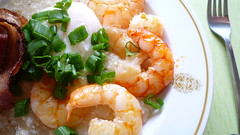
Make up plates for 4. Shallow soup plates are ideal. Start with a big helping of grits, nestle a poached egg in the middle, and arrange 1/4 of the bacon, 1/4 of the shrimp, and 1/4 of the scallions in separate piles around the edge. Serve at once. Savor.

Serves 4.

Momofuku Bacon Dashi

2 x 3-by-6-inch pieces of kombu
8 cups water
1/2 pound smoky bacon, such as Benton's (TN) or North Country Smokehouse (NH)

Rinse the kombu under running water, then combine it with the water in a medium saucepan. Bring the water to a simmer over medium heat, then turn off the stove. Let steep for 10 minutes

Remove the kombu from the pot and add the bacon. Bring to a boil, then turn the heat down so that the water simmers gently, and simmer for 30 minutes.

Strain the bacon from the dashi, and chill the broth until the fat separates and hardens into a solid cap on top of it. Remove and discard the fat and use the dashi or store it. Bacon dashi will keep, covered, for a few days in the refrigerator. You can also freeze it for later use.*

Makes 2 quarts. You'll only need 2 cups of this for the shrimp & grits, so you'll have plenty left over for other uses.

[both recipes from Momofuku by David Chang and Peter Meehan]
The resultant dish is one that's remarkably subtle, but utterly irrepressible. When I finished making the dish the first time, I remember saying to Michelle that I was surprised that the recipe didn't call for some kind of Asian-inflected sauce that you'd drizzle overtop, but then I went and took my first bite and suddenly I understood.

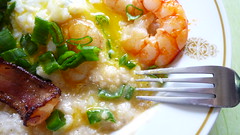
The taste sensation comes from below. It's deep in the grits, it's released by the butter that finishes the grits, and it's transformed into something that's positively rapturous when you take your fork and release the egg yolk and stir it up with the grits, the shrimp, the egg, the bacon, and the scallions.

s & g:  after fig. c: after

Are you starting to get it?

aj

P.S. A note on sources: as I've mentioned before, quality shrimp can be hard to find in Montreal, and this dish requires some reasonably fresh, juicy, tasty shrimp, so don't bother making it if you're not satisfied with the product at your local fishmonger, or, better yet, shop around. Sometimes quality can vary greatly from one poissonerie to the next. The best shrimp we've found in recent months have been at Poissonerie Shamrock (7015 Casgrain Ave., 272-5612) and at Norref (4900 Molson St., 593-9999).

You can use other brands of grits, of course, but Anson Mills' grits are pretty killer. Be sure to use quick-cooking grits, though, or you'll find yourself stirring furiously for an awfully long time.

* Among other things, Chang claims it's great with clams. I haven't had the chance to test this out yet, but I believe him.

Thursday, October 25, 2007

Brussels Sprouts x 2

Brussels sprouts

Behold the lowly Brussels sprout. Spinach may very well have been the subject to more widespread abuse over the years (here in North America, at least), but no one to my knowledge ever created a comic strip about a follically-challenged, squinty-eyed, pipe-smoking, tattooed sailor with a taste for long-legged women who develops superhuman strength every time he eats a helping of Brusssels sprouts. For our part, neither of us have ever understood the widespread aversion to Brussels sprouts. We both had vegetables that filled us with dread when we were youngsters, but we can only remember one each (his: zucchini; hers: green bell peppers), and Brussels sprouts were not among these offenders. I've never heard people go off on tirades about the equally lowly cabbage--miniaturize it, however, and suddenly it's capable of striking fear into the hearts of young and old alike.
Around here, among all the other reasons to be excited about the fall harvest season, those massive bunches of Brussels sprouts on the stalk are near the top of our list. It's not just that they have an absurdly Dr. Seussian appearance to them; it's also because they tend to be fresher and better tasting, with plenty of that earthy, almost nutty flavor that distinguishes them when they're in their prime. Our standard preparation is braised with wine, garlic, olive oil, a bit of balsamic vinegar, and some toasted pine nuts, but recently we've tested out some new Brussels sprouts recipes, both of which have wide applications.

#1 is a pasta and Brussels sprouts combo that comes from Alice Waters' Chez Panisse Vegetables, one that Michelle found herself attracted to in large part because the recipe noted that orecchiette would make an ideal accompaniment due to its similarity in size and shape to the Brussels sprout's leaf. We'd learned to make orecchiette when we took our Pasta 1 course at Mezza-Luna earlier this year, and Michelle was eager to practice making them again, but she also liked the poetry of mimicking the shape of the leaf with the shape of the pasta.

Brussels sprouts with orecchiette

Brussels Sprouts with Orecchiette

1 lb Brussels sprouts, stems removed and separated into leaves
1 red onion, thinly sliced
2 cloves garlic, finely chopped
1 pinch hot red pepper flakes
1/2 lemon, pits removed
bread crumbs (optional)
1 lb orecchiette, fresh or dried

If using dried pasta, bring your water to a boil and begin cooking your pasta. If using fresh pasta, like we did, bring your water to a boil, but you can wait to cook the pasta at the very last minute, because it only takes about one minute to cook.

Heat a sauté pan, add a little olive oil, toss in the sprout leaves, add salt and freshly ground black pepper, and sauté for about one minute over high heat. Add the onions and the red pepper flakes, and continue to sauté until the sprouts are tender and a little browned, 2-5 minutes. Remove from the heat, add the garlic, and toss. If the garlic appears to be browning, add a splash of water to the pan. Squeeze a little lemon onto the sprouts, and when the pasta is done, add it, drained, to the sauté pan and toss everything together. Taste and adjust the seasoning. Serve drizzled with good extra-virgin olive oil. If you want, toss the pasta with some toasted bread crumbs, but if the sprouts are very sweet and tasty [they were], don't bother [we didn't].

Serves two as a main, four as a side.


Rustic yet delicate, and tremendously flavorful (that squeeze of lemon being the crowning touch), Waters' Orecchiettte with Brussels Sprouts went perfectly with our fresh tomato and mozzarella appetizer, a Caesar Salad, and a hearty red wine.


#2 is testament to our ongoing infatuation with the cuisine of David Chang. Not only does Mr. Chang share our affection for Montreal (we have it on good authority that he was up here "all summer long" enjoying Montreal's laid-back appeal), but he obviously shares our affection for Brussels sprouts because he's regularly made good use of them at both Momofuku and Momofuku Ssäm Bar over the last couple of years, and when featured in newspaper and magazine articles, as he often has been, he's tended to include a Brussels sprouts recipe. Thus, Gourmet's recent 2007 Restaurant Issue included Chang's Roasted Brussels Sprouts (tossed with Asian dressing and a devilish puffed rice/shichimi togarashi mix) in its well-deserved feature on him, but the recipe we turned to this week was one that showed up in the April 12, 2006 issue of The New York Times, one that perversely combines Brussels sprouts with cabbage (in the form of kimchi), and one that had been on the AEB hitlist ever since.

Brussels sprouts with kimchee

Brussels Sprouts with Kimchi

1 lb Brussels sprouts, cut in half from top to bottom
1/4 lb bacon, minced
1 cup cabbage kimchi, plus some of its juice, at room temperature
2 tbsp unsalted butter
salt and freshly ground black pepper

Preheat oven to 400º F. Put bacon in an ovenproof pan and cook over medium heat, stirring occasionally, until almost crisp, about 5 minutes. Remove with a slotted spoon and add sprouts, cut-side down.

Cook sprouts until they begin to sizzle, then transfer to oven. Roast until brown on one side, then shake pan to redistribute. Remove when bright green but browned and fairly tender, about 10-15 minutes. Meanwhile, purée the kimchi in a food processor or blender until fairly smooth.

Return pan to stove over medium heat [we found this was unnecessary, as the pan was plenty hot enough upon reemerging from the oven] and stir in butter, salt and pepper, and bacon. Put kimchi in bottom of a bowl and top with sprouts. Spoon a little kimchi juice over all and serve.

Serves 4.


That combination of bacon, Brussels sprouts, and kimchi was positively irresistible and Chang's method worked like a charm (here, it's the addition of butter that's the brilliantly unexpected touch). We completed the scene with a simple Asian-inspired rice & fish combo not unlike this and a couple of Pilsner-style lagers.

aj

Sunday, April 08, 2007

24 clams (and then some)

Momofuking Clams

I'm not sure what got into us. Partly it was the memory of our trip to David Chang's Momofuku #1 last June, and my lingering regret over balking on his Long Island Razor Clams* with Kurowycky Sausage. Partly it was because of a desire to go back to La Mer to take a closer look at their astounding oyster selection. Whatever the case, the other day we up and hopped into Putney, our trusty, rusty '89 Jetta, and made our way back down to La Mer. When we emerged, a half an hour later, we had 24 Littleneck clams*, a small assortment of oysters from P.E.I., N.Y., and B.C., and, by some strange twist of fate, a single Dungeness crab from Alaska. Don't ask. I swear we never go this crazy (okay, almost never), but Michelle just couldn't take her eyes off those crab tanks and before I knew it I'd locked eyes too.

Anyway, we headed back home, opened up a bottle of wine (I mean, at this point, what the hell, right?), and got to work. We brought a pot of salted water to boil and threw our crab in. Then we prepared our clams according to the following recipe, one that's just a slight variation on a recipe that appeared in the New York Times almost exactly a year ago:

Momofuku-style Clams with Kielbasa

4 tbsp grapeseed oil or other neutral oil like corn or canola
1/4 onion, chopped finely
salt and pepper
24 clams, Razor, Littleneck, or Manila, scrubbed
1/4 lb smoked kielbasa
1/2 cup sake
2 tbsp finely chopped scallions
1 tbsp minced ginger
1/4 cup light soy sauce
1 tbsp sherry vinegar
chopped fresh jalapeños for garnish

Put the oil in a large skillet over medium-high heat and add the onions, salt, and pepper when the oil is hot; cook for a minute or two, stirring from time to time, until the onions soften and begin to brown a bit.

Add the clams and raise the heat to high, stirring for another minute. Add the kielbasa and stir again for a minute.

Add the sake, cover, and cook until the clams are tender or open (if you're using Littlenecks or Manilas), about 5 minutes. If applicable, discard any clams that don't open.

Meanwhile, combine the remaining oil with scallions, ginger, soy sauce and vinegar in a bowl.

Put the clams, onions, sausage and their juices in a bowl and spoon sauce over them. Garnish with jalapeños and serve.

Makes 4 servings; more if served as a side.


When we'd finished preparing the clams, the crab was fully cooked, so Michelle, in a bold show of just how pastry-kitchen-hardened she's become, plunged her hand into the boiling water and pulled him out. Somehow, miraculously, her hand reemerged unscathed, and I was there to document this phenomenon photographically:

freshly cooked dungeness crab

The only thing left to do was shuck those Raspberry Point (P.E.I.), Flower (N.Y.), and, best of all, Virginika (B.C.) oysters, place 'em on a platter and seat ourselves à table.

We never have these kind of all-seafood extravaganzas. It wasn't the most cost-efficient meal of all time, but it was absolutely worth every last penny. We melted butter for the Dungeness crab and quartered a lemon for the oysters, but both were so good, so sweet, so naturally briny that we ended up eating them unadorned. The clams had that special David Chang genius: a kind of intuitive type of fusion that's unfussy and surprisingly, refreshingly unselfconscious (in this case, an Asian/East Village riff on that classic Iberian combination of clams and pork).

The cats were happy (they got their very first taste of Dungeness crab). We were happy. Win-win.

aj

* So named because of their startling resemblance to a sheathed straight blade.

** They had razor clams, too, but they didn't look nearly as fresh as they do in NYC, while the Littlenecks, on the other hand, looked great.

Tuesday, June 20, 2006

New York, New York 3: The Great N.Y. Noodle Wars

One reason we could afford to be cavalier about our bbq bust at the Big Apple Barbecue Block Party was because by that time we were already in the midst of the survey (an ever so brief one, given we were only in New York for 2 1/2 days) we'd decided would be the focus of our trip: noodle shops. Noodle shops? Well, Michelle had had an almost monomaniacal fixation on New York's noodle shops and on Momofuku in particular for several months before we made it down. She'd been following the press on Momofuku and its delirious take on Asian street and counter food closely, but things reached critical mass when Momofuku chef David Chang's girlfriend paid a visit to Les Chèvres a few weeks ago. Michelle got to talking her up, she got herself even more revved up about Momofuku than she'd been up to that point (I wasn't sure that was possible), and when she came back from her shift that night she just looked me dead in the eyes and said, "Pack your bags." So, we went to New York knowing we were going to be paying Momofuku a visit, but when we arrived we hadn't yet settled on a theme for our visit. Which tour was it going to be? In search of real Italian-American pizza? The Latino explosión? Kosher Cuban-Chinese, the untold story? We looked into the pizza option quite seriously: we solicited opinions, gauged preferences, and took notes. Based on our research, we decided that no pizza survey would be complete without a trip to the legendary DiFara in Brooklyn, where every pie is made with care by the proprietor, Dom, and the artichoke pizza involves gently sauteeing the artichoke for a full 30 minutes before topping the pizza with it. The thing is, we'd heard that DiFara had been closed unexpectedly a couple of times in recent months for reasons having to do with health. Dom's getting up there in age, we were told, and seeing as he's the only one who handles the pies at DiFara, they haven't always been able to open up on schedule recently. We called DiFara repeatedly over the course of a couple of days but never managed to get through. After everything we'd heard and read about the place, the thought of carrying out a pizza survey without going to DiFara and having some of that artichoke pie seemed anti-climactic, to say the least, so we started to consider alternatives. And seeing as we were already had our sights set on Momofuku and, god knows, we're starved for quality noodles shops of any and all stripes here in Montreal (Michelle tried to impress this upon Mr. Chang's girlfriend: we need quality Asian counter food here now), we just shifted gears a bit and started to think "noodles." Suddenly the geography of our research changed quite drastically; now, all of a sudden, instead of having a quest that might very well have taken us from South Brooklyn, to Lower Manhattan, to Harlem, we were very much concentrated on the East Village and Chinatown and that suited us just fine.

chinatown, NYC fig. a: just some of the mysteries of Chinatown

Now, among all the other things that are radically different about New York's food culture as compared to that of a city like Montreal, one of the most striking is just how politicized it is. People have their opinions here in Montreal, sure, but they're rarely all that vehement about them. They're divided over things like where to find the best bagels, the best smoked meat, the best steak, and maybe the best Portuguese, Greek, or Indian, but it's rare that you feel like you've touched a nerve with someone when you bring up such matters. In fact, we find ourselves constantly trying to provoke these kinds of heated discussions, but unfortunately no one ever takes the bait. Go to New York, however, talk to the right people, and you find that nearly every food issue is highly divisive, splintering people into myriad competing camps. For a city of its size, Montreal's culinary side is impressive, but New York has so much more to offer and so many more people who take these things seriously, and the stakes are so much higher. I guess it should come as no surprise that culture wars are waged each and every day there over the subject of food. Bring up the topic of noodle shops with any New Yorker who happens to take their dining seriously and you might very well end up in a firestorm.

Ultimately we settled on four noodle shops, two Chinese and two Japanese (definitely not tons for a survey, but not bad considering we hit three of them over a 15-hour span). We lapped up the BBQ dishes at N.Y. Noodle Town, like the BBQ duck and the spare ribs, and the dumplings at Wonton Garden (like these lovely shrimp dumplings)

dumplings at Wonton Garden fig. b: shrimp dumplings at New Wonton Garden

always blow our minds, but it was the Japanese noodle dishes we were craving the most because Montreal is a veritable desert in the Japanese noodle department and neither of us has quite been the same since we left Vancouver behind, where we'd eaten ramen, udon, gyoza, and other Japanese noodle bar classics regularly.

Japanese noodle stop #1 was Rai Rai Ken and when we got there I thought I was dreaming. It'd be hard to imagine a more perfectly classic Japanese noodle bar. I mean, just look at that entrance.

Rai Rai Ken from 10th St. fig. c: Rai Rai Ken from 10th St.

We started with an order of pan-fried gyoza stuffed with pork and shrimp and a bowl of edamame to nibble on, then made up our minds about our ramen selections. There were four of us out together, so between the lot of us we were able to try every variation of ramen available from their small menu. We ended up ordering two shoyu ramens, one shio, and one miso. All three varieties came with braised bamboo shoots, hard-boiled egg, one of those distinctive pink fish cakes, a healthy slice of pork, spinach, a sheet of seaweed, and diced scallions.

shio ramen at Rai Rai Ken fig. d: perfection incarnate, or shio ramen at Rai Rai Ken

Each of the three broths was delicious, but my favorite was the one I selected, the shio, or seafood broth, which had that perfect combination of flavor and subtlety. The miso broth was one of the boldest, most interesting miso broths I've ever encountered, but I found it a bit too rich for my liking. The shoyu broth was good, but perhaps on bit too strong on the shoyu. All in all, though, these were top-notch ramen soups at very affordable prices, and I can't say enough about the atmosphere. If I lived in New York, I'd be a regular.

decor at Rai Rai Ken fig. e: decor, Rai Rai Ken

The next day, just before hopping on the FDR and making our way off the $24 island, we stopped back in the East Village to take lunch at Momofuku. Truth be told, this was the second time Michelle had gone that weekend: she'd popped in for a snack the day before and had an order of steamed pork buns. The steamed pork bun had been such a smash hit that she insisted that we order them again--ostensibly, so that I could have the pleasure of trying them, but actually so that she might have her third steamed pork bun in two days. Like a good number of the other offerings at Momofuku, the steamed pork buns come stuffed with the restaurant's signature braised Iowa Berkshire pork.

pork bun, Momofuku fig. f: steamed pork bun, Momofuku

You can see it there stuffed within a steamed bun, garnished with cucumber and dressed with a teriyaki-like sauce, and the rumors are true: it's some of the most succulent tasting pork you're likely to find. I still love the purity and unity of a good Chinese pork bun--the inspiration behind this version--but Momofuku's was outstanding, if unconventional, and the cucumber was a surprisingly refreshing addition.

We then proceeded to the main dishes and Michelle ordered the house special Momofuku Ramen, complete with a "Berkshire pork combo." Many of Momofuku's specialties are based on the notion of taking some kind of classic dish--a steamed pork bun, say--and staying true to its basic architecture, while making some key substitutions. Their ramen is no exception. Staples like the braised bamboo shoots, seaweed, fish cake, and diced scallions are all there, but peas appear in place of a green like spinach, the egg is poached instead of boiled, Chang replaces the standard cut of pork typical of the Japanese ramen with two different types of his Berkshire pork--his braised pork and a few generous slices of fatty, ultra-flavorful pork belly--and the only broth available is his unexpectedly subtle house pork broth. As tasty as the pork belly was, it had the effect of turning the Momofuku Ramen into an event, and Michelle confessed that the next time she'd opt for the more subdued "ramen with shredded Berkshire pork" (which, at $10, is also $4 less than the Momofuku Ramen).

The true revelation of our luncheon, however, was my Ssäm. I have to confess, at the time that I ordered it, I really had little idea what exactly I was ordering. The ingredients--"Berkshire pork, rice, edamame, onions, pickled shiitake, kimchi"--all sounded great to me, but I was expecting some kind of a fried rice dish, or possibly even a rice-based soup. Then, as we ate our appetizers and took in the scene, we started to notice the cooks assembling an intriguing-looking dish that we couldn't quite place. We studied one cook closely for a minute or two and when we were done we turned to each other and said, "That's gotta be the Ssäm." You see, what Chang has done here is that he's taken a Korean street food classic, bo-ssam--one variation on which involves marinated and grilled pork, a spicy condiment made of soy, garlic, and chili paste, and a pile of lettuce leaves--and teased out some of the similarities it bears to Mexican-American street food, transforming it into a sort of Korean-American burrito, if you can imagine that.

ssäm, Momofuku fig g: ssäm, Momofuku

Edamame replace the pinto or black beans, kimchi replaces the salsa, and the tortilla is replaced, ever so cleverly, by a mu shu crêpe, but otherwise the dish is assembled in the way a San Francisco-style burrito would be, right down to the foil wrapper. I'm not one to fall for novelties generally, but when something's this outrageous and, more importantly, this delicious, it's hard to argue. News that Chang is planning on starting up a neighboring counter restaurant in the coming months that will showcase the Ssäm the way Momofuku showcases ramen soups comes as no surprise (even if I still can't figure out what that umlauten is there for).

decor, Momofuku fig. h: decor, Momofuku

The subject of Momofuku--its food, its rock-n-roll attitude, its decor, etc.--elicits by far and away the strongest reactions from New York's culinary cognoscenti, ranging from positive (hip, tasty) to negative (overhyped, arriviste). We'd heard all the arguments and counter-arguments (no pun intended) by the time we sat down to eat. All I can say is that jumping into the fray has rarely been this pleasurable.

My only regrets of the weekend ("You mean, aside from having missed out on barbecue at the Block Party and never having made it to DiFara for that artichoke pie?")? Not ordering Momofuku's Roasted Long Island Razor Clams with "Kurowycky sausage" (recalling the East Village's Eastern European past) and ginger scallion sauce, and, even more importantly, not finding the time for Minca, yet another popular East Village noodle haunt. Next time.

N.Y. Noodle Town, 28 Bowery St., (212) 349-0923
New Wonton Garden, 56 Mott St., (212) 966-4886
Rai Rai Ken, 214 E. 10th St., (212) 477-7030
Momofuku, 163 1st Ave, (212) 475-7899

aj