Showing posts with label grilling. Show all posts

Monday, September 22, 2014

Top Ten #55

VT colours
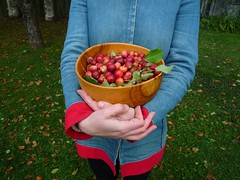
crabapple harvest

1.  Washington County, VT (and environs)

Scan 1


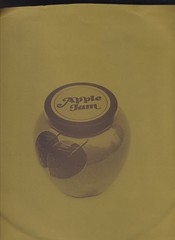
2.  George Harrison, All Things Must Pass (Apple)

sample track:  "Run of the Mill"

seven sisters farm 1
minnesota gothic

3.  Minnesota!

4.  Lauren Collins, "The Spy Who Loved Me," The New Yorker, August 25, 2014

5.  poulet grillé au gingembre

6.  This American Life #534, "A Not-So-Simple Majority"

this way to paradise
we grow 'em bigger!

7.  Cape Cod!

l. ron

8.  Lawrence Wright, Going Clear:  Scientology, Hollywood, and the Prison of Belief

david crosby

9.  David Crosby, If I Could Only Remember My Name...

10.  Boyhood (2014), dir. Linklater

aj

Monday, August 18, 2014

French Connection

While we're still on the topic of Provence and its cuisine...

So, as expected, this summer food magazines were filled with all kinds of tempting recipes for the 2014 barbecue season.  The July issue of Bon Appétit alone contained a full spread on DIY Korean barbecue; an Austin, TX spread featuring an outrageous-looking citrus-brined pork loin and a grilled rib eye recipe; a Middle Eastern/North African spread featuring mint and cumin-spiced lamb chops and Moroccan chicken brochettes; an article on cold smoking; and a guide to making and grilling your own sausages.  Just that single issue was enough to keep someone busy over their barbecue for months--and, trust me, it did.

But the recipe that turned out to be the single biggest revelation of the summer here at AEB--at least when it comes to the thrill of the grill--was a lonely little number accompanying a book review in the June/July 2014 edition of "Fare," the front section of Saveur.
Untitled fig. a:  in print

The book in question was a compendium of more than a century's worth of writing on grilling and grilled foods culled from the pages of The New York Times by Peter Kaminsky.  The Times has been on fire* with their food journalism of late, with a bolder, multimedia-savvy approach that's smart, informative, au courant, and well-designed, and this tome sounds like another play to further establish position within the lucrative food & wine media market.  It's called The Essential New York Times Grilling Cookbook, and it's as much of a legacy-builder as it is a collection of hits from the Times' recent generation of superstar food writers--it's clearly meant to prove that the Times has been writing about food with insight and passion all along, decades before the advent of modern-day foodie-ism.

Anyway, Betsy Andrews' review only features one recipe, but it was one that definitely caught my attention.  The recipe was for poulet grillé au gingembre--grilled chicken with ginger--it was co-authored by those old masters of the Times' '60s, '70s, and '80s heyday, Craig Claiborne and Pierre Franey, and it first appeared in the May 25, 1980 edition.

Andrews was effusive in her praise, but what really caught my eye was that French connection to ginger.  Though it's had a presence in European cuisine since at least the days of the Roman Empire, ginger is a rarity in French cuisine.  Waverley Root, in spite of his name,** is utterly silent on the subject in his magisterial The Food of France.  Ginger is entirely absent from Richard Olney's Simple French Food and his The French Menu Cookbook.  And the rhizome appears only once in Julia Child's two-volume Mastering the Art of French Cooking, and then only in a beef recipe that already contains gingerbread as an ingredient.

The only place I'd actually ever noticed ginger in a French cookbook before was in yet another Richard Olney book:  A Provençal Table:  The Exuberant Food and Wine from the Domaine Tempier Vineyard, a.k.a, Lulu's Provençal Table.  There, Olney doesn't make a fuss about it at all, but the recipe in question always intrigued me because it just seemed so unlikely:  "Poulet Rôti au Gingembre, Coudes au Jus" (Roast Chicken with Ginger, Macaroni with Roasting Juices).  "Macaroni & chicken?"  I'd never ever tried it, but it has been near the top of my "to make" list for a long time.  When I spied Claiborne and Franey's recipe my decision was made:  there was no doubt about it, I was finally going to test this Provençal chicken & ginger combo.  I still wasn't sure about its origins (North African?  North African by way of Italy?  Was Lulu's preparation some kind of clue?), but its apparition in Andrews' book review was clearly a sign.

Plus, the recipe is dead simple.  Mysteriously so.  As Andrews puts it, "It worried me at first:  It called simply for grilling 'until the chicken is cooked,' with no specifics as to method or signs of doneness.  And it yielded so little marinade I felt it might starve the bird of flavor."  But, according to her, the results were a classic example of one of those recipes that defies logic, one of those recipes whose process is almost alchemical:  "[When] the chicken was indeed done (a condition I ascertained with the use of a modern-day digital thermometer), how exquisite it was.  Dried thyme and bay leaf and garlic added aromatic flourish.  An abundance of lemon mingled with bristling ginger to stroke the flesh with sweetness and tenderize it to a mouthwatering moistness, abetted by a final drizzle of butter" (!).

And you know what?  I couldn't have agreed more.  I, too, had the feeling that the recipe couldn't possibly work as I prepared it.  And I, too, experienced something magical instead when I cooked the chicken.  The final product looked great, but it tasted a hundred times better--it had a perfect skin, and was literally bursting with flavour.  The ginger was subtle, but present.  And that final blast of butter...  I couldn't believe what I was tasting, and neither could Michelle.
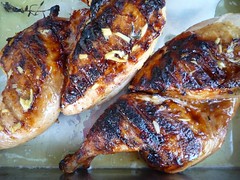
Untitled fig. b:  in real life

Without any further ado...
Poulet grillé au gingembre 
1 2.5-3-lb organic chicken, halved, backbone removed
kosher salt and freshly ground black pepper, to taste
1/4 cup fresh lemon juice
2 tbsp olive oil
1/2 tsp dried thyme, or 1 sprig fresh thyme (with fresh thyme in our garden right now, this has been my preference)
1 bay leaf, crumbled
1 clove garlic, minced
1 1-inch piece ginger, peeled and minced
3 tbsp unsalted butter, melted 
Season the chicken generously with salt and pepper.  Stir lemon juice, oil, thyme, bay leaf, garlic, and ginger in a bowl.  Add chicken and toss to coat.  Cover with plastic wrap and chill for 2-4 hours. 
Heat a charcoal grill, making sure that your charcoals are evenly spread and of an even height.  Ideally, you want a fire that's medium-hot.  Be patient.  Grill a bunch of vegetables first, if you have to. 
Grill chicken, turning as needed, until slightly charred and cooked through, about 35 minutes, or until an instant-read thermometer inserted into the thickest part of a thigh reads 165º F.  Transfer to a serving platter and drizzle with melted butter.  Tent the chicken with aluminum foil and allow to rest for 10 minutes.  This will complete the cooking process and allow the chicken to release its delicious juices into your platter.  Serve and devour. 
Serves 2 to 4 people, depending on appetite and number of side dishes. 
[based very closely on a recipe that co-authored by Craig Claiborne and Pierre Franey for The New York Times and then adapted slightly by Betsy Andrews for Saveur]
I still haven't tried Lulu's chicken, ginger, and elbow macaroni recipe yet, but I will.  Believe me, I will.  And I haven't fully figured out that French connection to ginger yet, but I like it--I really, really like it. In fact, there have been times recently when I've declared it the very best grilled chicken I've ever tasted.

aj

* Sorry.

**Apologies, once again.

Monday, July 14, 2014

Triple Threat

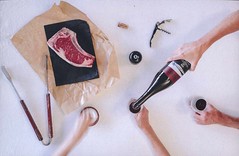
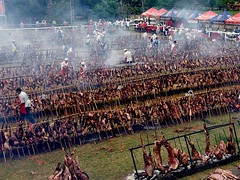
gros bbq 1 fig. a:  meat + wine + grill:  any questions?

Oenopole

      +

Foodlab

     +

Boucherie Lawrence

     =

one helluva wine-soaked barbecue

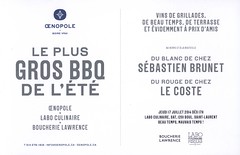
In fact, they're billing this Thursday's event as:

gros bbq 2 fig. b:  gros bbq

In addition to a white from Sébastien Brunet and a red from Le Coste, you can expect grilled pork chops, grilled sausages, and some baller steaks (grilled, of course), along with a whole slew of beautiful vegetable sides, like Michelle's famous minty sweet peas.

Having a hard time picturing it?  It will look kind of like this,

gros bbq fig. c:  très gros bbq

except that there will be greater variation in the meat offerings, a wider selection of vegetables, tastier wines, and a better view.

It all goes down:

Thursday, July 17
Foodlab/Labo Culinaire
1201 boulevard St-Laurent
Montréal, QC
5:00 p.m. - 10:00 p.m.
rain or shine (but, as of this moment, it looks like SHINE!)

aj

Wednesday, August 08, 2012

Don't let it slip you by, pt. 2

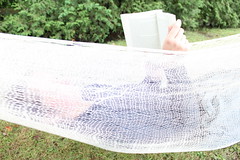
lake girl 1 fig. a:  lake girl 1

If you do have the means to get out of town:  get thee to a lake.  If you can spend a night or two there, all the better.  Just make sure to bring plenty of food and drink.  And lots of reading material.

lake girl 2 fig. b:  lake girl 2

lake girl 3 fig. c:  lake girl 3

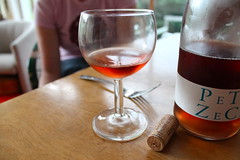
Keep the wine flowing.

rosé 1 fig. d:  rosé 1

rosé 3 fig. e:  rosé 2

Eat with regularity.

In both cases, focus on quality over quantity, although the idea is to celebrate summer, so there's no point in being stingy.

As much as possible, keep things simple.  You'll find that the dishes that are the most elemental will also often be the most memorable ones.

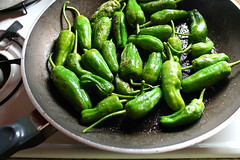
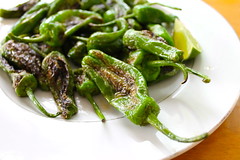
It doesn't get any more elemental than Padrón peppers, which have been a sensation from Spain to California for years, and which are finally making their presence known in Quebec, thanks in no small measure to the Birri Brothers at Jean-Talon market.

padróns 1 fig. f:  padróns 1

padróns 2 fig. g:  padróns 2

Pan-fried Padróns 
Padrón peppers
bacon fat or olive oil
kosher salt
limes
Heat the bacon fat or olive oil over medium to medium-high heat in a large pan or skillet.  When the fat begins to smoke, add as many peppers as will fit comfortably.  Sear them until they are just nicely charred.  Toss liberally with kosher salt.  Place on a serving platter and add a squeeze of lime juice.  Serve immediately.  Devour while hot.   
Padrón peppers generally aren't hot, they're pretty mild, but they do have some heat to them, and occasionally you might encounter one that might make your lips tingle.  Maybe even one that makes you sweat.   We call this game Spanish Roulette.  
Serve as a side or as a snack.
Bring a charcoal barbecue, too, if you can.  There's nothing more elemental than fuel (wood, all-natural charcoal, all-natural briquets) and fire.  And if you can find choice oysters in sufficient quantities before you head out to the country, you're really in luck.

rosé 2  fig. h:  rosé 3 w/ grilled oysters

Grilled Oysters 
fresh choice oysters
parsley
chives
garlic chives
scallions
hickory-smoked bacon
sharp cheddar cheese 
Shuck the oysters, severing the muscle and making sure to spill as little liquor as possible.   
Fry up the bacon until crisp.  Keep about one rounded tablespoon full of the bacon fat in your skillet, pouring the rest in a jar for a later use.  Mince the fried bacon into bits.  [3 strips of bacon made enough bits for 36 oysters.] 
Chop the scallions and the herbs and sauté them in the bacon fat until wilted.  Toss with the bacon bits. [4 scallions, 1/3 bunch of parsley, 1/2 bunch of chives and garlic chives made plenty enough for 36 oysters.] 
Spoon a little of the herb mixture into each oyster. 
Top with grated cheddar cheese. 
Grill over a hot charcoal fire until the cheese has melted. 
Serve immediately.  Savour.

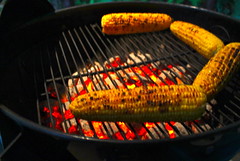
I usually make my Mexican-style corn pretty tricked out:  lime mayonnaise with premium chili powder (freshly toasted and ground); fresh cheese; aged cheese; cilantro; and grated radishes.  But even this stripped-down version is sensational if you start with great corn and you grill your cobs just so.

IMG_0150 fig. i:  grilling corn
Grilled Corn 
fresh sweet corn, preferably Grade A Quebec
mayonnaise
limes
Tabasco sauce
salt 
Shuck the corn completely.   
Mix your lime mayonnaise.  Add enough lime juice to make it just a bit looser than a regular mayonnaise.  Add salt and Tabasco sauce to taste. 
Place the corn cobs directly over a medium-hot charcoal fire.  No need to keep the husk on.  No need to soak the corn in anything.  No need to brush it with any substances.  Being careful not to scorch your corn, roast the cobs over the fire.  Rotate them from time to time.  Don't worry about cooking them completely evenly.  It's okay if some portions are slightly more charred than others.  This will only add to the taste sensation. 
When the cobs have been cooked on all sides, remove from the grill and slather with the lime mayonnaise.   
Allow to cool for about a minute, then serve while still hot. 
Repeat as needed.
[If you don't believe this method works, check out this video.  I used to fuss around with my corn cobs before I grilled them, and they often turned out great, but Mark "The Minimalist" Bittman made a convert out of me.]

As Michelle put things recently, "18 wines, 4 people, 2 days, 1 lake = perfect weekend."

80 Padrón peppers, 36 oysters, 20 eggs, 18 ears of corn, 2 briskets, 2 racks of ribs, and 1 pound of bacon didn't hurt either.

With this much fun built into your weekend, you won't even care if there's a little rain.

rain storm fig. j:  did someone say "rain"?

Go swimming anyway.  You might stay in long enough to see a truly celestial display of light.

We did.

aj


Friday, May 25, 2012

Real wines, fun times, rev. ed.

le joli mail detail fig. a:  the view from on high

Close out le joli mai in style on May 29th with a FoodLab/Oenopole co-production.  The festivities take place on the SAT's rooftop terrasse (one of Montreal's loveliest),

Oenopole-flyer-sat-NL fig. b:  Daumen + Oenopole + FoodLab

and the idea here is to pair Jean-Paul Daumen's brand new line of organic Côtes-du-Rhône and Vin de Pays wines, courtesy of Oenopole, with some grilled delicacies from your friends at the FoodLab (the menu according to Michelle:  "Grilled Toulouse sausage with apple and kohlrabi remoulade. In a bun." Yes!).  Now, doesn't that sound civilized?  Well, don't be so sure, because this is Montreal and the wine is going to be FREE.  (The grilled items will run you $5 a pop, just to maintain some sense of decorum.)

Jean-Paul-Daumen-Vielle-Julienne fig. b:  Das Daumen*

If you're not familiar with Jean-Paul Daumen, he's the talent behind the highly regarded Vieille Julienne label (Chateauneuf-du-Pape, Côtes-du-Rhône), and this is a brand-new project from him, an ode to the new generation of vignerons who've revitalized the Rhône region and its methods.  As he explains things (in English, courtesy of his website):

This project is about winemaking, it is about buying grapes from parcels whose [soils] are rich, vibrant, and alive--an integral part of my philosophy.  [This] project is also about working sustainably... 
This is a new portfolio of wines for me, wines that are meant to be accessible and authentic.  I want them to be real wines, meant to be enjoyed without pretence.  They are modest, and straight from the heart. 
Finally, this project is about being true to my approach to making wine, which is working the the best and healthiest fruit in my cellar.  This allows me to simply guide the winemaking process, with the least intervention possible.  My work will remain nuanced, avoiding extraction and artifice.  My desire is to leave my imprint as an artisan, with the challenge of making wine that expresses purity of fruit, uniqueness of vintage, and a terroir's personality.

Bring your wine-loving friends--there will be lots of fantastic wine.  Bring your food-loving friends--the eats are going to be hot & tasty.  And bring your fun-loving friends, too--this is going to be a blast!

aj

* photo credit:  frenchwineimporters.com / route des vins imports

p.s.  Well, when I predicted things might get wild at the Daumen 5 à 7, I didn't think Mother Nature was going to get in on the action.  Thanks to all those who braved the elements (apocalyptic amounts of rain, hail, thunderstorms, widespread flooding, etc.) to come on down and make the event a smash hit.  We knew this was a wine town, but this show of devotion was impressive, to say the least.  You people are amazing!--aj

michelle & theo fig. c:  mission accomplished!

Tuesday, May 15, 2012

Thrill of the Grill 3

Last year, we started a series on relatively quick grilling recipes, such as grilled sardines and Thai grilled pork skewers.  As I wrote at the time, there are times when you want to get fully invested in "slow and low"-style barbecue, in making use of smoke's considerable powers as both a tenderizer and a flavour enhancer.  But there are other times when,

you just want the pure thrill of the grill. You want the slight blackening, the light smokiness, the caramelized flavors, and the primal pleasures of cooking directly over flames. You want the payoff to come sooner rather than later. You want to take full advantage of the fact that cooking over a hot grill can be quick and easy. 


Well, it's that time of year again.  Our fully winterized balcony is a thing of the past, the barbecue is back in its place of honour, and our 2012 smoking and grilling season is well underway.  And one of the best recipes I've tested out in recent weeks is another relatively quick grilling recipe that takes us to an entirely different region of the world:  Iran.
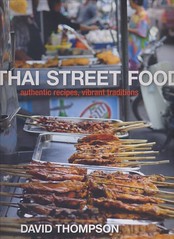
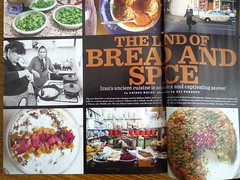
land of bread and spice fig. a:  land of bread & spice

The recipe appeared in an article on the cuisine of Iran in the March 2012 issue of Saveur by Anissa Helou ("The Land of Bread and Spice").  The article begins with a rather unexpected anecdote about a meal at Ava Gardner's house in London in 1982, but it proceeds to make a case for the centrality of Iran's "complex and captivating" cuisine to the world's foodways (both geographically and culturally)--at least those of Europe, North Africa, the Middle East, Central Asia, and South Asia.  And it's a pretty convincing case.

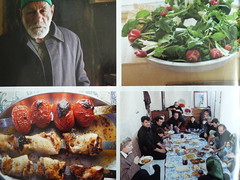
Helou's account of modern-day Iranian cuisine in Tehran, Isfahan, and beyond, encompasses everything from home cooking, to restaurants, bakeries, and cafés, and, as the title suggests, it focuses on Iranian staples like spices and herbs, bread, and rice, of which she writes, "I've never seen so many different ways of cooking rice as I did in Iran," before describing the care which goes into making their revered polows.  Her text had me pretty hooked on the idea of cooking Iranian already, but Ali Farboud's photographs really clinched things.  Sometimes the anti-aesthetics of some of Saveur's food photography leaves me a bit cold, but, here, the article came with a photo-essay that lived up to the scope of Helou's article, and that I found positively enchanting.  That said, the photographs that I gravitated to on the afternoon that I read the article were among the least exotic and the most familiar:  Farboud's photographs of sabzi, the herb salad that's a staple of the Iranian table, and of jujeh kabab, spiced chicken and tomato kebabs.  I was looking for a quick grilling recipe at the time, and that was exactly what I found.

kebabs, sabzi   fig. b:  land of sabzi & kebabs

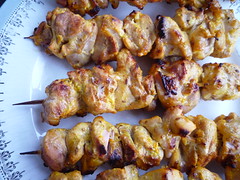
Actually, the recipe itself didn't hurt, either.  When I flipped to page 76 and found the recipe for jujeh kabab, its intoxicating blend of yogurt, citrus, and spices leapt off the page.  I felt like I had a pretty clear idea of just how succulent these kebabs were going to be, and the recipe didn't disappoint in the least.  A few hours later, when Michelle came home to a spread of jujeh kabab, sabzi, a garlicky yogurt spread, fresh limes, and grilled flatbreads, she couldn't believe her luck.

grilled chicken skewers fig. c:  Iranian-style chicken kebabs

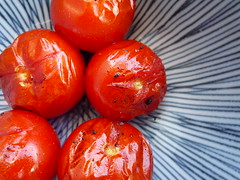
lightly grilled tomatoes fig. d:  lightly charred tomatoes
Jujeh Kabab (Spiced Chicken and Tomato Kebabs)
1 cup plain yogurt
1/2 cup fresh lime juice
2 tbsp olive oil
2 tbsp orange zest
1 tbsp ground cumin (preferably toasted and freshly ground)
1 tbsp kosher salt
1 tbsp ground black pepper
2 tsp crushed saffron
1 tsp ground coriander
6 cloves garlic, minced
1 large yellow onion, sliced
2 lbs boneless, skinless chicken thighs, cubed
4 plum tomatoes
ground sumac, to garnish
2 limes, halved
grilled flatbreads, for serving 
Stir together the yogurt, lime juice, olive oil, zest, cumin, salt, pepper, saffron, coriander, garlic, and onions in a bowl.  Chop the thighs into large cubes, roughly 1-1 1/2" x 1 1/2-2".   Add the chicken to the yogurt mixture, and toss to coat.  Chill for 4 hours (you can "chill," too, but make sure you've placed the chicken in the fridge at least four hours before you intend to grill).   
When the chicken has been properly marinated, build a medium-hot fire in a charcoal grill.  Skewer the chicken on flat metal skewers (Iranian-style), or on wooden skewers that you've had the foresight to pre-soak.  Add the tomatoes to another skewer.  Grill the chicken and tomatoes, turning often, until tomatoes are soft and charred, about 7 minutes, and the chicken is cooked through and slightly charred, about 10-15 minutes. (I recommend starting the chicken directly over the medium-hot fire, charring the meat on all sides, and then moving the skewers to indirect heat for the remaining time.)  Sprinkle the skewers with sumac.   Brush the flatbreads lightly with olive and grill quickly.
Serve with the limes and the hot flatbreads.  
Serves 4. 
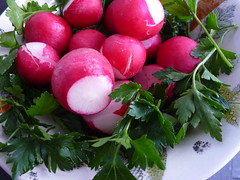
herb salad fig. e:  herbs & radishes
Sabzi 
watercress
mint leaves
parsley leaves
radishes
If you've been slow to kick off this year's grill & barbecue season, let the flames begin.

aj

Thursday, June 30, 2011

Thrill of the grill 2

Like I said, sometimes you just want the more immediate pleasures of barbecue, the thrill of the grill. And, frankly, sometimes only Asian skewers will do.
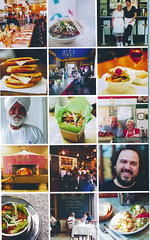
thai street 1 fig. a: Thai Street Food

It's safe to say that this latest spate of activity was inspired by David Thompson's rather impressive Thai Street Food. Like the major works of Jeffrey Alford and Naomi Duguid, Thai Street Food is richly photographed and over-sized, and much more than just a coffee table book: it's passionately written and comprehensive, it strives for the very heights of authenticity,* and its topic is much bigger than just "food." This is a book that's about the entire culture that surrounds the preparation and consumption of "single-plate food" on Thai streets and in Thai markets. It's also incredibly artful. Sure, there are dozens upon dozens of carefully composed studio shots of mouth-watering dishes like Crab Noodles From Chanthaburi and Stir-Fried Squid with Flowering Garlic Chives, but at least half of the photographs fall under the category of street photography and they can be remarkably gritty and purposely un-pretty.

thai street 2 fig. b: Thai market culture

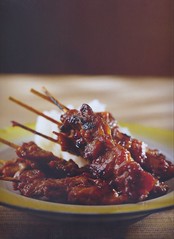
Anyway, it might have had to do with that cover photo, with those tantalizing satay skewers, but when it came time to give Thai Street Food a whirl, I found myself fixating on the grilled recipes, and especially the skewers. Photographs like this one,

thai street 3 fig. c: grilled pork skewers

for Grilled Pork Skewers, and the fact that Thompson begins his write-up for this recipe with the words "I am addicted to these," didn't hurt either.

He then continues as follows:

Along the street there are small grills, often just a large metal bowl with a rack perched on top. I'll stop and look and long for the fruits of their labour--smoky grilled skewers of pork. I'll smuggle some home as if carrying a guilty secret to relish in private. Sometimes, most of the time, I'll break into the cache on the way home.

It all sounded so illicit, so louche. By the time he got to describing the importance of charcoal to the process ("Using a charcoal grill imparts a depth of flavour that makes meat such as this grilled pork irresistible" [my emphasis]) I was 150% sold on those skewers.

Now the actual grilling time on Thai skewers like these is fairly short. After all, the pork is cut into small cubes and it's marinated. But you definitely don't want to grill them over a blazing-hot fire. The idea here is to use a fairly cool fire--Thompson recommends lighting the fire 30-60 minutes ahead of time, and waiting until the coals "glow gently." This isn't a smoked pork dish in the American tradition (ribs, pork shoulders, whole pigs), but smoke is integral to the process, so you want a fire in the neighborhood of 200º-250º F.

The marinade is positively heady. The meat is then basted with coconut cream on the grill. And the whole combination--the pork, the smoke, the marinade, the coconut cream--is pure thrills.

Grilled Pork Skewers

9 oz pork loin, neck, or shoulder
2 oz pork back fat (optional)

for the marinade:
1 tsp cleaned and chopped coriander roots
pinch of salt
1 tsp chopped garlic
1/2 tsp ground white pepper
2 tbsp shaved palm sugar
dash of dark soy sauce
2 tbsp fish sauce
2 tbsp vegetable oil

12-15 bamboo skewers
1/4 cup coconut cream**

Slice the pork into thinnish pieces about 1" square. Cut the pork fat, if using, into small rectangles (1" x 1/4").

Next make the marinade. Using a mortar and pestle, pound the coriander root, salt, garlic and pepper into a fine paste. Combine with the sugar, soy sauce, fish sauce and oil. Marinate the pork and fat in this mixture for about 3 hours. The more cautious can refrigerate this but, if doing so, then it is best marinated overnight.

Soak the bamboo skewers for at least 30 minutes before use.

Prepare the grill. Meanwhile, thread a piece of pork fat, if using, onto the skewer first followed by two or three pieces of the marinated pork. Repeat with each skewer. When the embers are glowing, gently grill the skewers, turning quite often to prevent charring and promote even caramelisation and cooking. Dab them with the coconut cream as they grill. This should make the coals smoulder and impart a smoky taste. Grill all the skewers.

On the streets, they are simply reheated over the grill to warm them through before serving, although this is not entirely necessary as they are delicious warm or cool.

[recipe based very, very closely on a recipe from David Thompson's Thai Street Food]

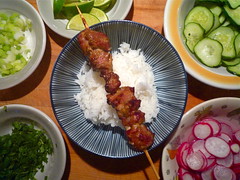
Not sure if Thompson would have approved--this being "single-plate food," after all--but we served ours with rice, cilantro, limes, and a selection of simple Asian pickles, and the spread looked something like this:

thai pork skewer fig. d: grilled pork skewers à la AEB

That smoky, caramelized pork was just layered with flavor. Thompson claims that the recipe "makes enough for 4-5," but we had a hard time putting a few skewers aside for the next day's lunch. He was right. They are irresistible.

aj

* For instance, in the introduction to Deep-Fried Salted Beef with Chilli and Tamarind Sauce, one finds this moment of authenticity: "The chilli and tamarind sauce is delectable. It can be served with any deep-fried meat or fish. I like to use maengdtaa fish sauce (made from rice roaches, bugs that scurry through the paddy fields), for its haunting aroma, but any good-quality fish sauce will do."

** More authenticity: Thompson highly recommends making your own coconut cream from scratch, a process that requires one to place the grated (or blended) coconut in cheesecloth and then "squeeze murderously, therapeutically, to obtain as much of the creamy goodness as possible." He does recognize that using canned coconut milk is "a more realistic option," however, and that's exactly what we've been doing up till now (although we're dying to make the real deal). The coconut cream is the clotted substance one finds in the top half of a can of coconut milk.

Even the canned variety imparts a wonderful flavor. One can only imagine what the artisanal stuff that one finds in Thai markets, some of which is perfumed with jasmine flowers or pandanus leaves (!), is like.