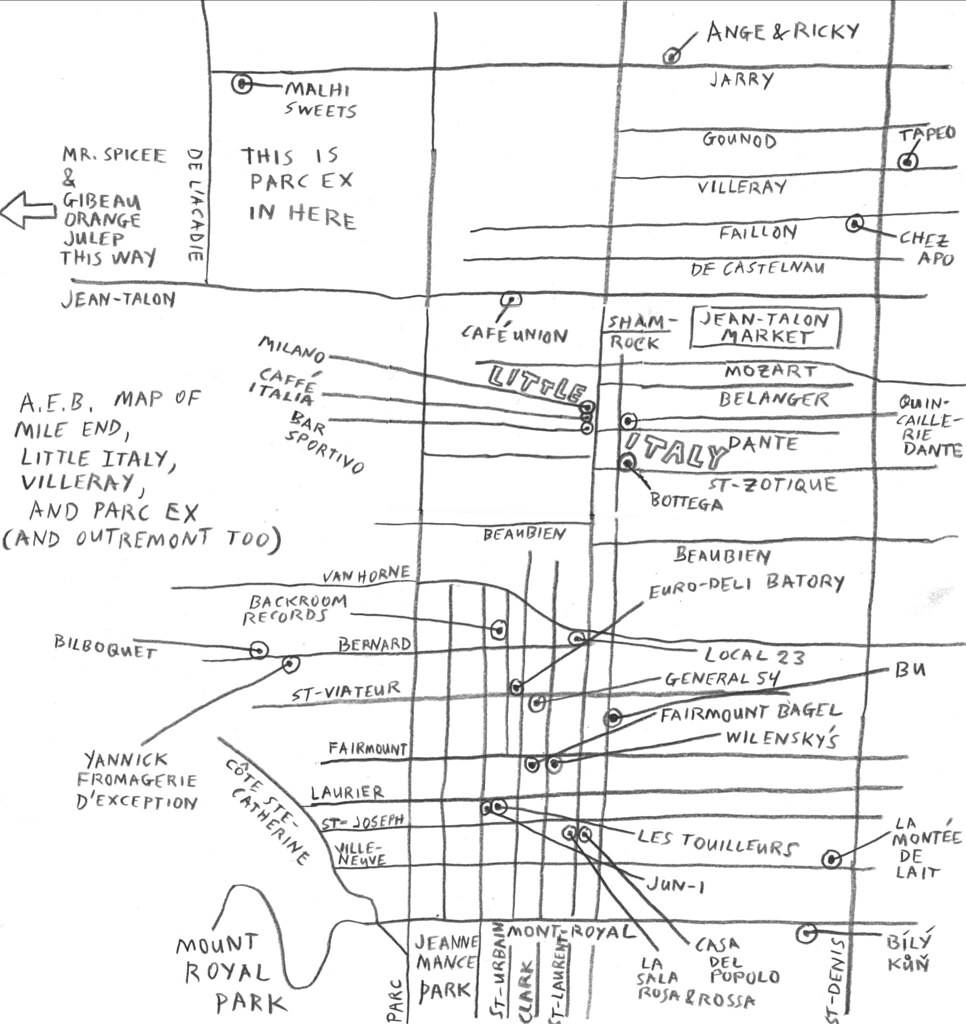
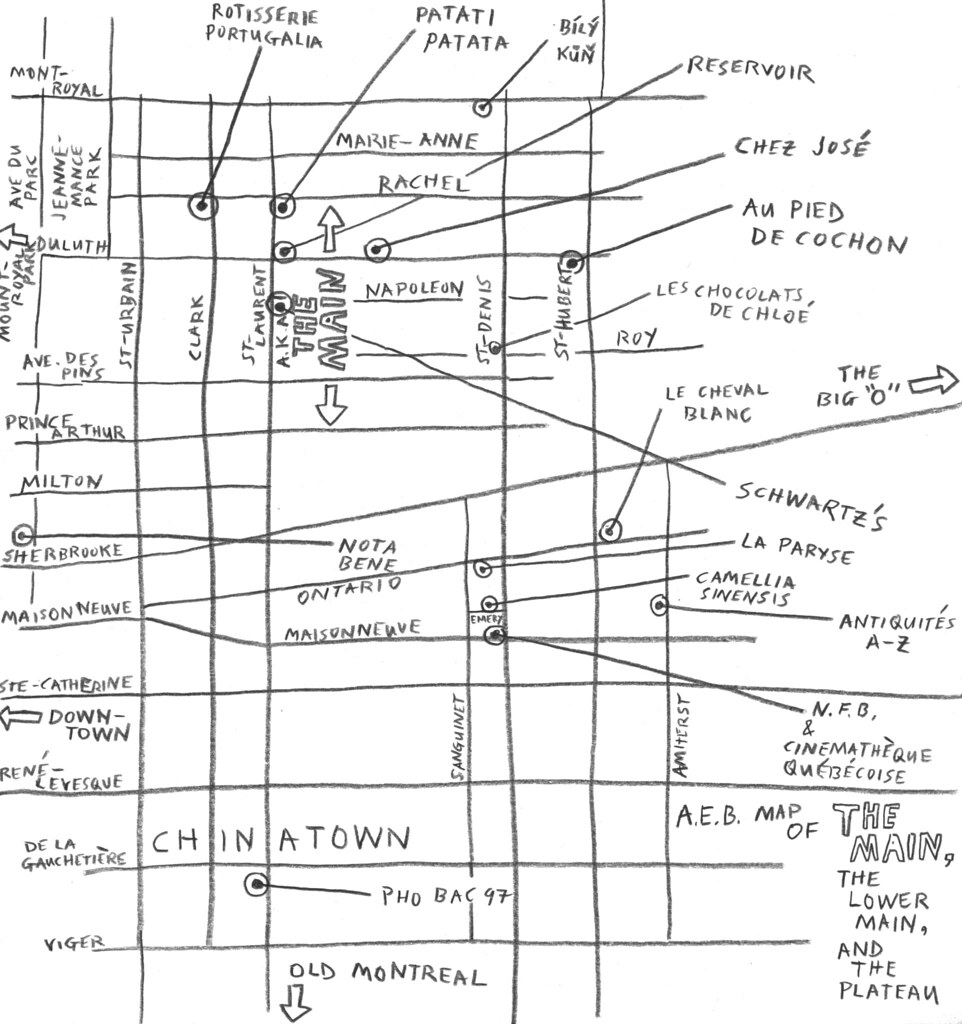
Showing posts with label San Francisco. Show all posts

Monday, August 15, 2011

In a Golden State 5: Street Food!

If you're as starved for street food as we are, and you happen to be in the San Francisco Bay Area on or around August 20, by all means, make you way to the extraordinary San Francisco Street Food Festival. The second annual edition was really one of our favorite food occasions of 2010. The third annual edition looks to be just as exciting, if not more. And it's all for a great cause.

Need further convincing? This is what it looked like last year:

The SF Street Food Festival had a full range of street food temptations, both high and low.

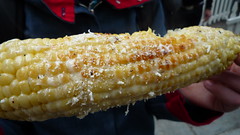
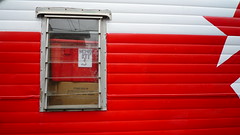
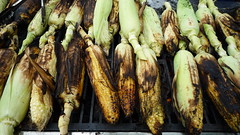
grilled corn fig. a: on the grill

The grilled corn looked great to begin with, but it was even better all-dressed.

yum! fig. b: all-dressed

Ritual Roasters had their mobile unit out for the occasion, in case you happened to be under-caffeinated. Philz was also just around the corner for those in search of a seat and a Philharmonic experience.

ritual mobile unit fig. c: Ritual in da house

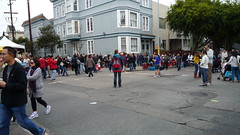
There were so many options, so many different avenues of street food delight, that Michelle found herself at a crossroads.

lost in a crowd fig. d: standing at the crossroads

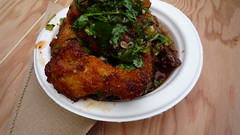
We tasted a whole lot of tasty treates, but our favorite street food delicacy of the day was this totally outrageous Japanese fried chicken.

super yum! fig. e: oishii!

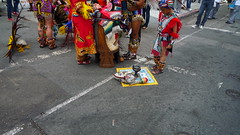
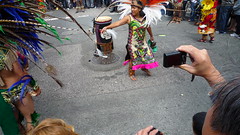
When we'd had our fill, we started to head back into the heart of the Mission when we saw an Aztec ride by on a Razor Scooter. We couldn't let that pass us by. So we turned back around and headed back into the heart of the Street Food Festival and came across this:

sacred smoke fig. f: sacred smoke

And the next thing we knew, the scene erupted into a full-on pre-Columbian frenzy.

street dance fig. g: Montezuma's revenge

The performance was riveting, creating something akin to a time portal in the urban landscape.

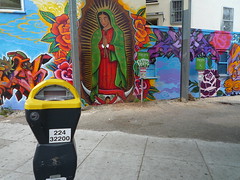
our lady fig. h: our lady

So if you happen to be in the San Francisco Bay Area this coming Saturday, if you're even remotely within striking distance, please do check out the SF Street Food Festival. We were warned that it would be "swarmed," "overrun" with "foodies," that the lines would be "a mile long," but we showed up early and found the whole experience positively convivial. And we had absolutely no problems scoring each and every delicacy we desired.

The moral of this story: don't believe the hype. Or, rather: the early birds get the street food.

aj

Postscript: The San Francisco Street Food Festival is much more than just a one-day street food extravaganza. The 2010 edition also featured a stimulating and highly inspiring two-day street food conference featuring practitioners, activists, public officials, urban planners, and academics. And there were brother and sister events all over town all weekend long, like Humphry Slocombe hosting NYC's Big Gay Ice Cream Truck for a special edition of Tranny Smackdown.

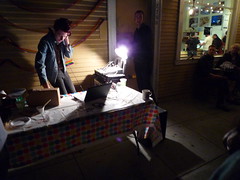
tranny smackdown fig. i: un zoo la nuit

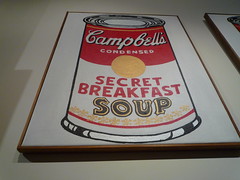
Jane Wiedlin (of the Go-Go's) performed, John T. Edge was fêted, a special sundae was concocted, and Humphry Slocombe was even more of a zoo (a wonderful one) than usual. We thought about trying the Tranny Smackdown Sundae, but ended up sticking with our very favorite Humphry Slocombe jam.

secret breakfast fig. j: shhh...

Saturday, January 08, 2011

In a Golden State 3: Tartine Bread

First, there was Tartine bread. Then, there was Tartine Bread.

fig. a: Tartine Bread

It had only been about eighteen hours since we'd touched down at SFO for our two-week Northern California vacation, but there we were, already back at Tartine Bakery. As you may remember, we'd spent a fair bit of time at Tartine Bakery on a previous tour of Northern California back in 2005. Breakfast, lunch, late-afternoon snacks, dessert, bread, coffee, wine, tea--we'd pretty much tried it all. In fact, we'd left the Bay Area so thoroughly acquainted with the whole Tartine experience, that as we made our way to 18th & Guerrero, it felt like we were going to visit an old friend.

Of course, the Tartine family had grown since the summer of 2005. Chad Robertson and Elisabeth Prueitt, Tartine's founders, opened Bar Tartine just a few blocks away from Tartine Bakery not long after our last visit. And we'd heard so many great reports about this latest venture over the years that it was right at the top of our "to do" list. But just as importantly, we wanted to make sure that Tartine Bakery--our original love--was more or less as we'd left it. We wanted to make sure that some things in life stay the same. Or, at least that some things can be depended on.  And as much as we couldn't wait to try their croissants, their morning buns, and their cookies again, what we were most excited about was Tartine's bread--their country and their walnut loaves. Which is why we actually visited Tartine Bakery twice on Day 1 of our trip--once to take a look around and have some sweets, and a second time to pick up a loaf of their country bread. Those fabled Tartine loaves are only available once a day--at around 5:00 p.m.--you either have to be very prompt, or you have to order your loaf ahead of time. We opted for the former strategy--we came back at 5:00 on the dot.

Now, like so many of the best things in life, Tartine's bread doesn't come cheap ($7), but it all makes sense as soon as you're cradling one of their loaves in your arms.  Tartine's country bread is one hefty loaf of bread (two pounds?). More importantly, it's a sight to behold, a veritable work of art.
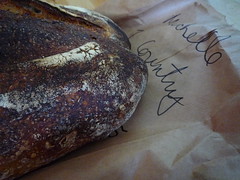
michelle country fig. b: Michelle country

As you can see, it's perfectly baked, with a deep, dark amber color and a pronounced crust.

What you can't see is a) how good it smelled as we carried it away from the store, still warm from the oven, and b) how ridiculously good it tasted when we got it home and sliced it open. The crumb is mild, moist, and incredibly open-structured; the crust is hearty, caramelized, and bursting with flavor.

Put simply, Tartine's country bread was phenomenal. We had it with cheese, with soups, with sauces. We had it plain and toasted, and we used it to make sandwiches.  We had it for breakfast, lunch, and dinner. It was huge, so it lasted for days. And because it was a true sourdough, it barely staled. I would have happily paid good money for that loaf on Day 3, let alone Day 1. But we didn't have to. We were right there, so we went back again and again.

In case you're not getting the message, we couldn't get enough of Tartine's bread during our stay. We knew Chad Robertson had a bread book slated for release in the fall even before we left for California, and we were already pretty excited, but after eating Tartine's truly memorable sourdough loaves for two weeks, we were gripped with anticipation. We were also gripped with the DTs. Montreal's bread situation has gotten more and more dire over the years--when we got back home, our store-bought loaves paled in comparison. Literally.

Our copy of Tartine Bread finally showed up on our doorstep in early October (none too soon!), and we were immediately impressed. The book is amazingly thorough: it works through the basic method for the basic country loaf in extraordinary detail, provides a number of tantalizing variations on this basic method, then moves on to cover baguettes and enriched breads (including English muffins, brioches, beignets, and croissants), before closing with over 100 pages of recipes involving days-old** bread.

It's also richly illustrated. Robertson's principal collaborator on the project was Eric Wolfinger, a cook/baker/surfer/photographer, and together they'd wisely decided that a proper bread book should be heavily illustrated. How else to teach amateurs what, exactly, to be looking for? How else to teach them to pay attention to how bread behaves?

But just as importantly, the book was inspiring. Weaved into it was a life story, one that involved love, travel, apprenticeship, dedication, collaboration, and surfing (yes, surfing), one that was motivated by a fundamental faith in that fabled "daily bread"--what Robertson calls that "elemental bread that sustained generations."

I was totally taken by the whole thing. I read it through once. I read it through twice. And then I really dug in. And, just as Robertson promised, the results were magical.
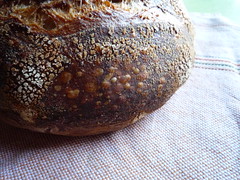
country 1 fig. c: country

Right from the start, my loaves showed great oven spring, they had beautiful burnished crusts, and they were amazingly tasty, characterized by a surprisingly sweet (not sour and tangy), rounded wheat flavor. With a bit of practice, they started to look almost professional.
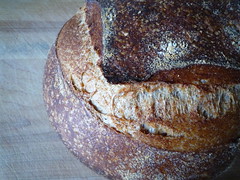
whole-wheat bread fig. d: whole-wheat

How was I getting such satisfying results so quickly? Well, Tartine Bread isn't just a thorough book on baking bread--it's also been specially designed for the home baker, so that even novices can get professional results from a conventional oven. If you've tried Jim Lahey's now legendary no-knead baking method, aspects of Robertson's approach should be very familiar.
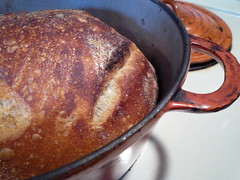
dutch oven & co. fig. e: dutch oven & co.

Like Lahey, Robertson employs the use of a Dutch oven in order to create the intensely hot and humid environment necessary to achieve a proper crust. Like Lahey, Robertson's dough is a much moister dough than you might be used to. It features an unusually high hydration level (75% in baker's percentages). This moistness is what makes Robertson's dough suitable for a no-knead method,* but it's also one of the reasons his recipe results in such a wonderfully tender crumb, not to mention a loaf with such staying power.

Tartine Bread was also rigorously tested for the home baker. Robertson assembled a team of test bakers to try out his Basic Country Bread recipe--the cornerstone of his method--then created a private blog so that notes could be circulated and data could be accumulated. The results were extraordinary:  "Many testers made exceptional bread, judged by professional standards--it was virtually indistinguishable from our own Tartine bread..." When it came time to assemble his book, Robertson realized that this test process held important lessons, and that profiling a few of his test bakers might provide his readers with the added encouragement they might need to roll up their sleeves and start making real bread at home.
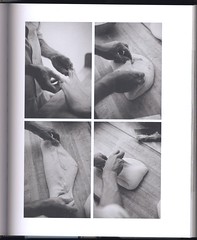
tartine bread pix fig. f: Tartine bread pix

Finally, Tartine Bread isn't just richly illustrated, it's exhaustively photographed. Robertson worked closely with Eric Wolfinger on this book, and he took full advantage of his collaborator's skills as a photographer. There are a number of other excellent bread books out there that take pains to illustrate the processes of making bread in detail. Books like Jeffrey Hamelman's Bread: A Baker's Book of Techniques and Recipes and Rose Levy Beranbaum's The Bread Bible include some photographs, but rely mostly on line drawings. Jim Lahey's My Bread: The Revolutionary No-Work, No-Knead Method uses a lot of photographs, and it recognizes photography's ability to document step-by-step instructions in a way that goes beyond what line drawings can accomplish, but its use of photographs is timid compared to Tartine Bread.

While Lahey's photo-essay "The Basic No-Knead Bread Recipe in Pictures" is composed of 24 photographs, Robertson's instructions for his Basic Country Bread includes nearly 70 photographs, not including those that illustrate "Making a Starter." The difference here isn't only one of quantity. The seriality and precision of Wolfinger's photographs provide an invaluable reference when you're first getting used to the Tartine method. Together with the thoroughness of text (which is heavy on visual cues), they provide you with all the guidance you need to make successful loaves right from the start.

Results have been so good, and the experience of making real, honest-to-goodness sourdough at home has been so rewarding, that I've become a little obsessed. I haven't actually made that many of Robertson's bread recipes, to tell you the truth, but those I have made, I've made a lot of. So in addition to many, many loaves of the Basic Country Bread, I've made a bunch of walnut loaves, some polenta bread (with pumpkin seeds and rosemary!), some olive bread (with walnuts, lemon zest, and herbes de Provence!), and a few pizzas. Yeah, that's right, pizzas.***

There have been other signs of obsession, as well. Not only did I go out and purchase a 20 kg bag of white flour, not only did I photograph it (?),
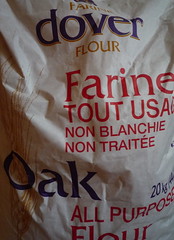
oak 20 kg fig. g: 20 kg Oak

but I worked through that bag in about a month. I've also been taking bread photos--again, a lot of them. Whole loaves, like the photos above. Half loaves and cut loaves.
country 2 fig. h: still life 1

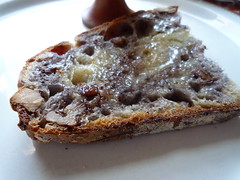
Slices.

walnut bread fig. i: still life 2

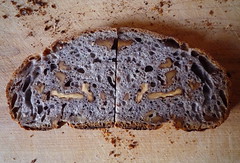
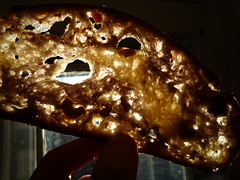
rorschach test fig. j: rorschach test

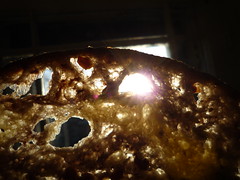
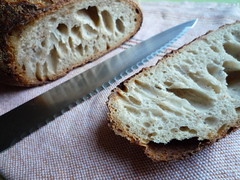
And a whole bunch of shots that highlight the bread's open structure.***
open structure 1
open structure 2 figs. k & l: open structure 1 & 2

No kidding. Baking sourdough does crazy things to you.

Just a few more notes:

Not only does Robertson insist that you don't need a professional bread baking oven to make professional quality bread, but he also insists that the flour you use isn't nearly as important as the process. This isn't to say that flour doesn't matter, or that all flours are created equal. Tests proved that the flour Robertson gets milled specially for Tartine resulted in the best loaves with the finest flavors. That said, combining conventional, supermarket-bought all-purpose flour with the Tartine method resulted in loaves that were professional quality and superior to the overwhelming majority of store-bought loaves. So there.

Robertson's method for making true sourdough bread is remarkably simple, but it still requires some investment. You're going to need some basic equipment, like a proper scale, a bench knife, a Dutch oven, etc., and you're going to need to be dedicated to reading through the process carefully, and being exact when it comes to following it. You also need to realize that while Robertson's method is somewhat less labor-intensive than other methods, it is time-intensive. The real secret to Robertson's bread has to do with letting the sourdough work its magic slowly and thoroughly. As Robertson puts it: "The baker's skill in managing fermentation, not the type of oven used, is what makes good bread. This fact makes Tartine Bread possible." So it does take a fair bit of time to get from feeding your starter to taking your finished loaf out of the oven, but the nature of the Tartine method is such that it's feasible to work sourdough bread baking into a busy schedule (although wouldn't you rather take your time, do it right, and enjoy the process?), and the book provides helpful strategies for doing so.

And, lastly, Tartine Bread isn't without its glitches (it is the first printing, after all)*****, but it's a remarkably rigorous book, and it's filled with pure inspiration from start to finish (from its Basic Country Bread, to its recipes for soups, salads, sandwiches, sides, and desserts), and I predict the book's impact on the state of baking in North America will be enormous. There was a reason Tartine Bread topped our list of cookbooks for 2010. There were a lot of great cookbooks that were released over the course of the year, but no other book held the potential to really shake things up that Tartine Bread does.

Long live "elemental bread"!

Tartine Bakery & Cafe, 600 Guerrero St., San Francisco, CA, (415) 487-2600

aj

p.s. Still need more convincing? For even more about Chad Robertson, Tartine Bakery, Tartine's Basic Country Bread, the test bakers, etc., check out Tartine's bread video.

* Instead of conventional kneading, his method relies on gently folding the dough in a bucket, a modern take on the tradition of trough kneading.

** Again, Tartine's loaves are so well made that they stale very slowly. They literally aren't stale enough on Day 2 to use in a recipe that calls for "day-old bread," hence, "days-old."

*** Robertson throws down on the topic of pizza, addressing some of the orthodoxies that have accompanied the pizza revolution of the last decade, and, in many ways, I think his common-sense approach is right on the money. He writes, "Our current pizza revival, with all the attitude, manifestos, and "secrets" (the flour! the water! the oven!), is amusing. Just start with good bread dough and a very hot baking stone, and you will end up with a great pizza." He's right, too. Get a handle on his Basic Country Bread recipe, and making amazing pizza at home is a snap. Seriously.

**** I, like so many others, was first inspired to find real French pain au levain after reading a profile of the late Lionel Poilâne in the pages of Smithsonian Magazine back in 1995 (you can find the abstract to the article here). I say "find," because for some reason, it never really occurred to me that I could make it at home. At least, not with a proper crust. Anyway, that article was a revelation, and it set me on a path to locate such bread so that I could taste what Poilâne was describing, but, more than anything, what I remember about the article was a photograph of a slice of his bread being held up to the light to show off its open structure.

***** For instance, the Whole-wheat Bread recipe (which is in process as I write) lists 20 grams of salt, but is unclear on when to add it. Whereas the Basic Country Bread recipe adds the salt (and a bit more water) to the dough after an initial resting period, the Whole-wheat Bread recipe, which requires more water because whole-wheat flour has a higher absorbency than white flour, adds all the water at once, and never mentions when to add the salt. Like many of the other recipes in the book, the Whole-wheat Bread recipe is a variation on the Basic Country Bread, and after a few different steps early on, it advises readers to "[follow] steps 5 through 9" of the Basic Country Bread recipe. Unfortunately, step 4 of the Basic Country Bread recipe is the one where the salt is added. Anyway, if you've worked through the Tartine method enough times, you figure it out.
Tuesday, November 02, 2010

In a Golden State 1: Coffee

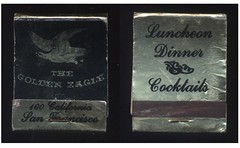
golden eagle x 2 fig. a: golden eagle, golden state

It seems like eons ago now, but in the month of August, at the height of summer, Team AEB found itself in Northern California for the first time in five years. Not for lack of desire. Our last trip had been a dream, jam-packed with all kinds of memorable adventures and discoveries. Probably the best AEB expedition of all time. Certainly one of the longest. If you had told us it would have taken five years to get back, we would have said, "Are you loco?" But that is in fact what happened. So when we finally got around to paying a return visit, we were more than ready.

Back in '05, when it came time to start typing up our field notes, we went a little overboard. We broke things down into a series of "revelations." Nine of them. Some were themed (burritos, dim sum, Point Reyes Station), but the overwhelming majority were profiles of specific places/people/businesses (June Taylor, Andy's Orchard, Tartine). This time we've elected to go a more consistently thematic route.

Installment #1, as I'm sure you've figured out, is on coffee. Few things about the Golden State helped to keep us in a consistently golden state as effectively as its rad coffee scene.*

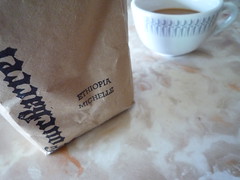
And when we got back from California, one of our most prized souvenirs was this simple bag of beans.

four barrel ethiopia michelle fig. b: the other Michelle

Not only did the bag bear the name "Michelle" on it (never did find out why), but it contained some truly lovely beans from one of the irie-est of coffee-growing regions, Ethiopia, and it hailed from one of our favorite SF coffee establishments, Four Barrel.

It's safe to say that the coffee scene in the Bay Area has changed dramatically in just five years. There may be other cities in North America that have undergone similar coffee revolutions during the same period (Chicago? Portland?), but, if so, we haven't had the pleasure of visiting them. What we witnessed in San Francisco was entirely new to us, unprecedented in any of the coffee towns we're familiar with (Montreal, New York, Toronto, Vancouver). You see, not only had several hardcore, high-end coffee operations opened across town, transforming a town that was already coffee-obsessed into a town that was positively twitchy with meticulously sourced, carefully roasted, and expertly executed coffees using a wide variety of brewing methods, but many of them were sourcing and roasting their own beans (!), and most of these establishments housed their roasting operations on-premises in beautifully designed spaces that were oftentimes minimalist in style (lots of wood, exposed beams, etc.), but gargantuan in size. Think high-end, tech-friendly, funked-up loft style, then add some post-industrial industry back into the brew.

Take Four Barrel, for instance. Here's their selection of freshly roasted coffees:

four barrel 1 fig. c: interior design 1, Four Barrel

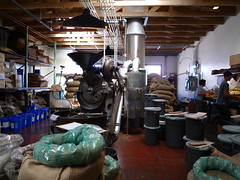
And here's the coffee roasting operation that's housed just beyond their twin banks of espresso machines.

four barrel 2 fig. d: interior design 2, Four Barrel

Add a turntable, a sizable collection of vintage vinyl, and a crowd of die-hard coffee aficionados, many of them with new media devices in tow, and you start to get the picture. This place was positively buzzing with Mission cool. And the buzz was addictive. Montreal likes to think of itself as a coffee town, and it is, but this was next-level.

Or take Sightglass, another of our favorite coffee joints.

sightglass 1 fig. e: interior design 1, Sightglass

At the time of our visit, Sightglass was just a tiny hole in the wall in another gorgeous post-industrial space. Just a small counter, an espresso machine, a bench, and some basic appliances.

sightglass 2 fig. f: interior design 2, Sightglass

Their roasting operation was next door, mostly out of view. But only temporarily. You see, they were busy transforming the warehouse space that surrounded the shop into another gigantic new-school café, and all indications were that this too would be a marvel of design.

(Again, to put this into local perspective. Take one of our favorite Montreal restaurant spaces, one that was created/renovated in recent years, and one whose design bears quite a bit of resemblance to a place like Four Barrel: La Salle à Manger. Imagine opening a space like La Salle à Manger, putting just as much care and attention into the reno, and then devoting it entirely to coffee. No food (okay, maybe just a few pastries), no alcohol, just coffee. Crazy, right? Well, that's exactly what's going on in SF.)

Most importantly, though, both places were roasting some truly mind-blowing coffees, like Sightglass' Blueboon Blend, and both had the chops to turn them into the headiest of brews.

Four Barrel Coffee, 375 Valencia St., San Francisco, (415) 252-0800 (Mission)

Sightglass Coffee, 270 Seventh St., San Francisco, (415) 861–1313 (SoMa)

ritual mobile unit fig. g: Ritual mobile unit

Other recommended SF coffee establishments:

a) new school

Ritual Coffee Roasters, 1026 Valencia St., San Francisco, (415) 641-1011 (Mission), plus two other locations

Another of the pioneering new-school cafés/roasteries, and the only one I can think of whose beans are available here in Montreal (at Myriade)

b) "hand-made"

Philz Coffee, 3101 24th St., San Francisco, (415) 875-9370 (Mission)

you know full-well how much we love Philz (Philz's?) original location on 24th--Philz has franchised widely since 2005 (they now have 7 locations!), but the original store still has all the old charm, not to mention those killer Philharmonics

aj

* to use the local parlance

p.s. Way to go, Giants!

Tuesday, January 23, 2007

Zuni Nation

zuni chicken!

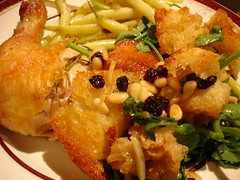
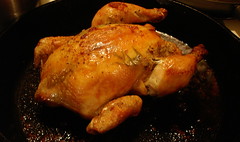
During our trip to San Francisco two years ago, we ate a number of memorable meals, as you might have been able to tell from our 10-part "Revelations" series. Among those that continue to stand out after all this time, however, is our Zuni Cafe meal, the very last meal of our trip. Was it the space's triangular shape? Its wood-fired oven? Sitting upstairs in a cozy booth? Their sinfully good roasted chicken with bread salad? Or was it the fact that the Zuni Cafe got the honor (unbeknownst to them) of putting the finishing touches on our California holiday? [Answer: all of the above.] Since finally getting Judy Rodgers' inspirational The Zuni Cafe Cookbook a few months ago, the recipe for roasted chicken just kept beckoning to us until we could bear it no longer. We finally gave in and decided, "That's that," we had to try to recreate some of the magic of that fateful night.

In her preamble to the recipe, Rodgers attributes their roast chicken's renown to a combination of elements which includes the cafe's wood-fired oven, the high quality of their birds, and the practice that one gets when roasting hundreds of chickens a week. But, that said, the basic key to their success lies in three things, three things over which all of us have a fair bit more control: a small-sized chicken, high heat, and salting the chicken 24 hours in advance. You may not be able to duplicate the lovely smoky flavor that the Zuni Cafe's oven imparts, but otherwise there's no reason to despair, and Rodgers insists that The Zuni Cafe Cookbook's recipe has been thoroughly tested and fine-tuned for the home environment. That was enough for us. We took her word for it and plunged right in the other night.

And the bottom line is this: stop whatever you are doing, print out the recipe below, run to your local butcher, and pick up the nicest small-sized chicken you can find. That's how essential this recipe is. Aside from picking out a 2 3/4 - 3 1/2 pound chicken and taking the time to salt it properly, the trick (again) is to roast the bird at a very high temperature, 450°F, and it was that detail that really piqued our interest. We couldn't believe that such an indelicate method would get the results we (and the Zuni Cafe) were looking for. There's no question about it, this high-heat method really is very dramatic. The fat sputters a fair bit when the bird hits the sizzling cast-iron pan,

roasting that zuni chicken

and the kitchen definitely gets a little smoky, but it's very worth it.

The Zuni Cafe chicken is one of the best homemade roast chickens we've ever had, and, as leaders of the Mile End chapter of the SCC, we've had our fair share. Don't go thinking you can skip the bread salad, either. That would be a terrible mistake. That bread salad is truly extraordinary; quite simply one of the best salads (of any kind) either of us has had the pleasure of encountering. The whole ensemble is perfect on a misty San Francisco night, as we found out in 2005. It's pretty awesome on a chilly Montreal winter night, too. Now, if only we had a fireplace, or one of those old-time Québécois bread-baking ovens that we've been reading about recently...

Anyway, if you're not already a proud owner of The Zuni Cafe Cookbook, and there are plenty of other good reasons to pick up a copy, here goes:

Zuni Roast Chicken (serves 2-4)

one small chicken, about 3 lbs.
4 sprigs rosemary, thyme or sage
2 1/4 tsp. coarse salt
1/4 tsp. freshly ground black pepper

1-3 days before serving, rinse the chicken and dry completely. Tuck the herbs under the skin on the breast and thighs. Sprinkle inside and out with salt and pepper, cover with plastic wrap and refrigerate for at least one day, but up to three.

for the bread salad:

a day-old medium loaf of peasant-style bread, not sourdough
6 tbsp. olive oil
1 1/2 tbsp. champagne vinegar
salt and pepper
1 tbsp. currants
1 tsp. red wine vinegar
1 tbsp. warm water
2 tbsp. pine nuts, toasted slightly
2-3 garlic cloves
1/4 cup slivered scallions
2 Tbsp. lightly salted water
1 bunch arugula, watercress or any other bitter green

Remove most of the crust from the loaf of bread and slice into thick chunks. Brush with olive oil and broil until golden on both sides. Let cool. Rip the chunks into rough pieces of varying sizes and place in a bowl. Mix 1/4 cup olive oil with the Champagne vinegar and salt and pepper. Add about 1/4 cup of it to the bread. Toss. Mix the currants with the red wine vinegar and warm water. Set aside.

Preheat the oven to 475°F. Heat a cast-iron pan over medium heat. Remove chicken from the fridge and shake off some of the salt, though you don't need to remove it all. Do not rinse the chicken. Pat dry with a paper towel if condensation has formed. Place chicken in the pan, breast-side up, and place in the oven. Roast for 30 min. If the skin is browning too quickly, reduce the oven temperature a bit. Carefully turn the bird over and roast for another 10-20 min. Finish breast-side up for 5 minutes to crisp up the skin. It should take about 45 min. to roast.

Meanwhile, sauté the garlic and scallions with a bit of olive oil until soft, but not browned. Add to the bread along with the pine nuts and drained currants. Add a bit of salted water, salt and pepper to taste and toss. Place in a baking dish and cover with foil. Place the salad in the oven after the final flip of the chicken.

Remove the chicken from the oven and turn off the heat, leaving the bread salad in there to warm up. Let the chicken rest on a serving platter while you skim off the fat from the roasting pan. Deglaze the pan with a bit of water and any drippings that the cooling chicken has given off.

Place the bread salad back in its bowl, drizzle with a spoonful (or two) of the pan juices, add the greens, a bit of vinaigrette and toss. Season to taste. Place a generous heap of salad on each plate. Carve up the chicken and serve on top of the bread salad. Enter heaven.


Worked like a charm.

[Judy Rodgers' The Zuni Cafe Cookbook: A Compendium of Recipes and Cooking Lessons From San Francisco's Beloved Restaurant was published in 2002.]

am/km

Sunday, August 27, 2006

These are a few of our favorite things...

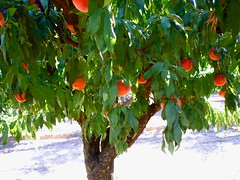
baby crawford peaches, andy's fig. a: Baby Crawfords ripe for the picking

Well, we've been mulling over Melissa's provocative "Things to Eat Before You Die" project over at The Traveler's Lunchbox for the last few days. On the one hand, it's been a breeze coming up with "absolute musts" of all kinds, but on the other, whittling our respective lists down to five has been difficult, to say the least. In the end, Michelle decided to do a fruits-only list, while I opted for a bit of a grab-bag, although it would have been easy to come up with similarly essential lists (to us, at least) that were, say, Montreal-specific or seafood-specific or pastry-specific (you get my drift). Anyway, without further ado (and without any further agonizing), here goes:

Michelle:

1. Baby Crawford peaches fresh off the tree at Andy's Orchard, Morgan Hill, CA
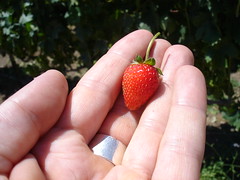
2. strawberries from Swanton Berry Farm, Davenport, CA
3. pears & black walnuts foraged in the Czech Republic (take a walk most anywhere in rural Bohemia at the right time of year and you'll find them in abundance)
4. fields of wild blueberries around Sackville, New Brunswick
5. fresh mulberries anywhere you can get them

Anthony:

1. a real S.F. burrito from a real S.F. taqueria (La Taqueria comes to mind)
2. pizza from a truck in Marseilles eaten on a bench in the Old Port with a good bottle of red wine
3. fresh (and I do mean fresh) oysters on the half-shell from a reputable source of your choice, served in generous quantities
4. real dim sum served from carts (any one of a number of places come to mind, but the best I've had in the last 12 months was at Ton Kiang in San Francisco)
5. a runny, perfectly ripe raw milk cheese (like a St. Marcellin or a St. Felicien) with some good apples, some good pears, some nice grapes, and a crisp white wine of your choice

Have your own list? Do tell.

aj

Sunday, October 09, 2005

Revelation 9: Burritos!


Yes, we're back on the topic of food in San Francisco and environs, this is most likely our penultimate California post, and, believe me, we may very well have saved the best for last.

We carried out a few taste tests while we were out in California, but there's no question that the most comprehensive taste test, and the the most satisfying one, was our burrito taste test. Once we got going, it was hard to stop. Every day we wanted to sample another taqueria's goods, or at least return to a favorite taqueria. Part of the "problem" was that we were staying with my sister in Noe Valley, just a short hop from most of the finest taqueria's in San Francisco (if not the known universe). Sometimes we almost had to force ourselves to go elsewhere and try out other cuisines to round out our experience of the Bay Area's best eats, when all we really wanted was another burrito. We don't really have this "problem" here in Montreal. There's been a spurt in the number of quality Mexican eating establishments here over the last few years, but, as of yet, there are no taquerias here that can hold a candle to those of San Francisco. I'm reminded of a line from that short-lived Spenser For Hire spin-off that focused on Spenser's associate Hawk. If memory serves me well, the line went as follows: "Take the baddest dude you know, multiply him by 2, add a couple of zeroes to that, and that doesn't even come close to how bad Hawk is" [actually, on second thought, I'm sure that wasn't an example of memory serving me "well"]. The same could be said of the relationship between a Montreal burrito and a San Francisco burrito from a place like Casa Sanchez, let alone a place like La Taqueria.

We knew we had a limited amount of time and we'd have to work fast, so we headed straight into the Mission District when we got to San Francisco and made Casa Sanchez our very first stop of the entire trip. From that point on, we tried to not let two or three days go by without having another burrito. Sometimes I wish I was more like Calvin Trillin, who claims to only be a serious eater, not a serious cook. Our desire to take advantage of the local shops and markets, with their excellent local ingredients, and to cook at home probably kept us away from quite a number of magical food discoveries--god knows what kind of Mexican and Mexican-American delights we might have chanced upon had we had more meals on the town!--but, then again, it also kept us from running out of money within 3-4 days of arrival (as opposed to 14).

When our informal burrito taste test was done, we'd tried everything from breakfast burritos (like the one pictured above--with eggs, bacon, and sausage--that we had at the Alameda Flea Market), to baked burritos (in an American-Mexican [if you catch my drift] restaurant in San Juan Bautista, to vegetarian burritos (both standard bean-based burritos, as well as a grilled vegetable burrito), to chicken, pork, and beef burritos, and a whole range of tacos (in some cases, as "dessert") to boot.

I've been going to Casa Sanchez to have their burritos for over 10 years now, I love the selection of salsas they offer from their salsa bar, and as long as they continue to maintain their high standards when it comes to their burritos and tacos I'll continue to be loyal, but the two biggest revelations of the trip, in terms of burritos and tacos, were found elsewhere. In both cases--one traditional, the other a bit more new-fangled--what distinguished our top choices from the competition had to do with the quality of the grilling, the freshness of the ingredients, and, perhaps most immediately, the tortilla itself. It's amazing what a difference just the tortilla alone can make, in terms of texture and in terms of overall flavor.

As a former vegetarian I feel a little strange saying this, but, I have to admit, I was a bit skeptical of Papalote from the moment I laid eyes on their menuboard with its wide selection of vegetarian and vegan burritos. I remember thinking, "This place is awfully close to Noe Valley. Maybe it's just the taqueria equivalent to that yuppie botanica around the corner from Karina's place on Church." Any doubts I might have had were erased within a matter of minutes when we received our three burritos--one grilled vegetable and black bean, one grilled prawn, and one carne asada. As vegetarian burritos go, the grilled vegetable and black bean was by far and away the best we encountered during our trip. Understandably, vegetarian burritos in traditional taquerias can often be a little lackluster. Papalote's was anything but. The true standouts, however, were the grilled prawn burrito and the carne asada burrito. I couldn't believe how generous the prawn burrito was, and the carne asada burrito was tender, juicy, and wonderfully seasoned. Excellent.

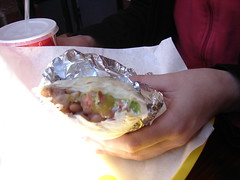
If we had to pick our very favorite taqueria, though, it seems as though we'd be in agreement with the overwhelming majority of San Francisco's burrito aficionados: La Taqueria. We tried their vegetarian burrito (pictured below), their chicken burrito, and their carne asada and carnitas tacos over the course of a couple of visits. The vegetarian burrito wasn't nearly as inspired as the one we had at Papalote, but everything else was fantastic. We had a hard time deciding which meat--chicken, beef, or pork--we liked the best, they were all so delicious, and La Taqueria's burritos come "unadulterated," without any rice, so you really get your money's worth. Plus, the atmosphere at La Taqueria is just so classic. We became La Taqueria regulars in just two short weeks in San Francisco; there's no question that we would be regulars if we actually lived there.


burrito, La Taqueria
Originally uploaded by michelle1975.


Regrets? Sure, San Francisco is absolutely overwhelming when it comes to Mexican and Mexican-American delicacies. My biggest regrets were that we never chanced upon the legendary Tamale Lady who makes the rounds of the Mission's bars late at night (although I had the pleasure of having one of her tamales years ago, so I know she would have easily merited her very own "Revelation"), and we didn't begin to scope out those vending trucks you find in the Mission, Potrero Hill, and vicinity. Oh, well, we'll be back...

Casa Sanchez, 2778 24th St., San Francisco, CA (415) 282-2400

Papalote, 3409 24th St., San Francisco, CA, (415) 970-8815

La Taqueria, 2889 Mission St., San Francisco, CA, (415) 285-7117

aj

Tuesday, September 13, 2005

Revelation 8: Tartine


As you can well imagine, a good part of our San Francisco vacation was spent walking to and from various pastry and chocolate shops in order to find "the best of the Bay." I am notoriously picky when it comes to pastries. Since becoming a professional, I've become even pickier. [Case in point: I have no favourite pastry shop in Montreal. There really aren't any worth speaking of. Thankfully, this will soon change: see note below.] I was lucky that Anthony indulged me as much as he did. We went to some beautiful-looking-but-bad-tasting places, okay-looking-but-horrible-tasting places, and the double-whammy: bad-looking and bad-tasting. Horror of horrors, I was even disappointed by the desserts I got at a couple of the Bay Area's top restaurants. Maybe I just caught them on off nights. Then again, maybe not.

Anyway, over and over again, Anthony had to put up with my oftentimes catty comments about those desserts that didn't make the cut. In fact, it's quite possible that I have some kind of strange, pastry-related form of Tourette's. One place we went to gave me a sample of their chocolates and upon trying one, without thinking, I exclaimed: "These are terrible. Next!" You should have seen the look on poor Anthony's face.

Also on my hitlist were all those "olde tyme" confectionery shops that claimed to have handmade candies, but were all vintage show without any vintage substance. I'm not sure whether Wacky Packs were ever handmade, but I sure laughed when I saw a whole stack of them at one shop.

By far and away, the best chocolate shop we tried was Recchiuti's at the Ferry Terminal (and we did try many other SF mainstays). Their chocolate was the best, their fillings were subtle with great texture, and their vanilla marshmallow was the best I've ever had. Don't get me started on their chocolate-covered fleur de sel caramels. Let's just say they rated 100%. Maybe 110%. In fact, we even staged our own caramels taste-test while we were at the Ferry Terminal, and Recchiuti's caramels blew everyone else's out of the, uh, water.


My favourite pastry shop was Tartine. As far as I'm concerned, they knocked the competition out cold. At least once a day, I would say, "You know, we could go to Tartine..." Morning, noon, and night. We tried their amazing morning bun--candied orange peel and cinnamon-- and their excellent croissants, walnut bread, mexican wedding cakes, coconut macaroons, walnut cookies, chocolate croissants, and buttermilk scones, and, as pictured above, a lovely lemon tart. Perfect. Their cakes were the best-looking, and I can only assume best-tasting, since I didn't buy one. Their bread was amazing, and only available after 4:00 p.m. I respect businesses who call the shots. When you're making the kind of high-calibre loaves Tartine is making, the people listen. The line-ups are regularly down the block. I just wish we had something like Tartine in Montreal!*

Acme Bread Company's breads are the best I found in San Francisco, and they are availble all day(!). Many retail stores carry their bread, but it's always best to go to the source. The owner used to bake bread at Chez Panisse and it shows. It is truly exceptional bread.

Recchiuti's, One Ferry Building, shop 30, San Francisco, www.recchiuticonfections.com

Tartine, 600 Guerrero Street at 18th San Francisco, www.tartinebakery.com

Acme Bread Company, One Ferry Building, shop 15, San Francisco or 1601 San Pablo Ave, Berkeley

m

* Hope is on the horizon. My friend Reema is opening a cake shop this Sunday! Go and find out what we've all been missing:Cocoa Locale 4807 Parc Ave., Montreal, Tues-Sun, 11-6ish. Good luck, Reema!

Friday, September 02, 2005

Revelation 6: dim sum and other treats in the Richmond


As indicated by our choice of image when we announced our (then) upcoming trip to San Francisco back in late July, we arrived in the Port of Saint Francis hell-bent on having Chinese food as much as possible while we were there, and some good dim sum at least once. Even though Montreal's Chinatown has a long history, it's pretty hard to find truly exceptional Chinese food these days in Montreal, and truly exceptional dim sum is even harder to come by. When we go to places like Toronto and New York, we try to make up for all the Chinese cuisine we've been missing. You can imagine just how excited we were as we looked forward to visiting some of San Francisco's excellent Chinese restaurants. We had Chinese food a few times that trip (mostly in the form of snacks and light meals), and we were fortunate enough to have dim sum twice.

We knew our stay in the San Francisco Bay Area was going to be fairly short, so we didn't waste any time. We suggested to Karina that we should go out for dim sum on our first Sunday in town and asked if she had any recommendations. Karina mentioned that her best dim sum experiences over the last few years had been in the Richmond district not in Chinatown, we we decided we'd head to that area. She'd been wanting to try Mayflower because she'd heard it was one of the standouts in that neighborhood, but she hadn't gone there yet, so that was where we went.

Mayflower doesn't have those dim sum carts I grew up loving, they bring their various dishes around on large trays, but they've got quite a large staff for a medium-sized restaurant, and the dishes come out at a furious pace. We got seated at a corner table and this ended up being a lucky break, because we were the closest table to the kitchen and each dish arrived to us freshly prepared and piping hot. In the tradition of the massive, 2-3 hour feasts I remember having at our favorite dim sum palaces when I was a kid (Asia Garden was the one I remember most fondly), we settled in and started to order plates of whatever caught our fancy. Everything we had was really tasty, but the biggest crowd-pleasers were the seafood and pork dumplings, the shrimp rolls, the pan-fried whole prawns, and the crowning touch--the plate we waited all morning for--the steamed BBQ pork buns, with actual hunks of shredded pork stuffed inside. I was pleasantly surprised to find a number of greens dishes pass by our table, and two of my favorite dishes were the pea shoots and the seaweed salad. We ate like kings and queens that Sunday at Mayflower, and the bill still managed to be ridiculously affordable ($12 each). I was reminded of a story my dad used to tell about a business trip he made to Vancouver where he and about a dozen of his colleagues ate dim sum for hours and the grand total came to a whopping $25. Of course, that was 1972.

Exactly one week later, we wound up back in Chinatown and it was a particularly chilly and blustery afternoon. The fog had rolled in early that day and the winds were whipping up off the bay. We were looking to warm ourselves up again and we thought, "What better way than with a little dim sum?" We sniffed around Chinatown for a while, but Karina hadn't had dim sum in Chinatown proper for quite some time and she wasn't sure where to go. When we didn't find anything that looked too appealing, we decided to head back to the Richmond. I'd read some rave reviews of a place called Ton Kiang, and Karina had only the highest praise for their dim sum. Enough said. Half an hour later, we were seated and staring at Ton Kiang's impressive menu.

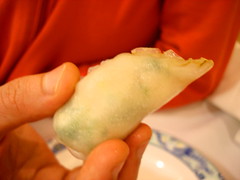
Ton Kiang specializes in two things: dim sum and Hakka cuisine, with seafood being the focus in both cases. Dim sum we all know about, but Ton Kiang was said to have some of the freshest available in San Francisco. Hakka cuisine I knew very little about. The Hakka are a nomadic tribe that live in China. They have a cuisine that is unique to their culture, but brings together elements of several different Chinese regional cuisines. I'd read that Ton Kiang's Hakka-style steamed salt chicken was to die for. We ordered the chicken and when it arrived it turned out that we'd had the exact same dish a week earlier at Mayflower (or so we thought). The steamed salt chicken is a half a chicken that comes chopped into strips, bones and all. The Cantonese version we had at Mayflower was served cold, with a pungent garlic sauce, and although I quite liked it, it was definitely the only dish we had that day that got mixed reviews. The version we had at Ton Kiang was superior in every way. It was hot, it tasted fresher, the chicken meat was more flavorful, and the garlic-ginger sauce that came with it was a subtler accompaniment. Fantastic. But it was Ton Kiang's dim sum that stole the show. I've had excellent dim sum over the years, but I think this was the best. Ton Kiang had a stunning array of dumplings, and these were the loveliest, most delicate, most delicious ones I've had the pleasure of having. Their shrimp dumplings alone came in at least half a dozen different variations (the ones we had came complete with juicy and tender whole shrimp, not shrimp paste). My favorites were the ones pictured above, the shrimp dumplings with pea tips.

Karina says that she was at Ton Kiang once for a wedding reception and that it was completely outrageous. They had the whole second floor to themselves, the kitchen kept sending out round after round of perfectly prepared dishes, and everything she tried was superb. She was particularly fond of some of their whole fish dishes. Next time I'm in San Francisco, I'm rustling together the biggest group I can find and I'm heading directly to Ton Kiang.

Mayflower, 6255 Geary Blvd., San Francisco, CA, (415) 387-8338

Ton Kiang, 5821 Geary Blvd., San Francisco, CA, (415) 752-4440

aj

Tuesday, August 23, 2005

Revelation 3: June Taylor


plums, Copia
Originally uploaded by michelle1975.


It just so happened that the day after we arrived in San Francisco June Taylor was giving a preserve-making workshop at Copia, a fancy new-ish cultural center for food and wine located in Napa. I chanced upon the announcement on her website. What luck! If you want to get a sense of why I was so excited, you can take a look at a previous post about her from a few months back here.

We left bright and early so we could take full advantage of the surrounding area, making a quick pitstop at Philz and Tartine. [More on Tartine soon, I promise--m.] The drive was beautiful. Wild fennel lined the roads adding much to the already striking North Bay scenery. We arrived at Copia about an hour before our workshop, walked through the center, tasted a few wines and beers they had to sample, stopped at a nearby farmer's market, and saw a bit of the grounds around the center. The quince tree was awfully tempting with its perfect fruit, but I stayed strong and didn't steal one.

The workshop consisted of a series of tastings; preserves, fruit, and a glass of wine. All the while June spoke informally about making preserves: how she got started and where she is going, the importance of knowing where your fruit comes from: who grows it, where, and how... She was such a warm person, I immediately warmed up to her, as did others, judging by the amount of questions and comments she inspired. I can credit her with having finally given me the complete freedom to use the amount of sugar I think is best rather than following some "safety" guideline which renders all preserves the same: sweet.


strawberry, Copia
Originally uploaded by michelle1975.


She then took us around the grounds of Copia, along with the head gardener. We smelled and tasted all kinds of fruits and herbs and talked about possible combinations to use in preserves. The highlight of the tour was the Mulberry tree. Such perfect, sweet, ripe berries. I could have gorged myself like a silkworm, but much of the fruit was out of reach on the highest branches.

After her talk, I approached her and asked if I could drop in on her workspace while I was in San Francisco. She said I just needed to give her a call to arrange a day for a rendez-vous, and that she'd look forward to my visit.


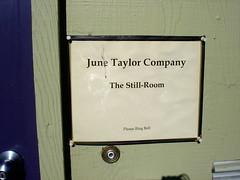
June Taylor's door
Originally uploaded by michelle1975.


The next week, I found myself walking down a long street in Berkeley towards June Taylor's Still-Room. It is situated near the water in what looks like an up-and-coming neighborhood. The area used to be an industrial one, but now houses all kinds of boutiques, restaurants, and even a distillery. I found her in the middle of making a batch of plum jam.

She took my arrival in stride, warning me that when the jam was ready, she'd be moving pretty fast, but otherwise my timing was good. The sweet and tart smell of the plums permeated the space. The front area is being arranged into a storefront, which is great news for all you Bay Area residents, and all those planning to visit the Bay Area in the near future. You will now be able to go to one place and choose the exact preserve you want, rather than being at the mercy of what select stores happen to carry. It is impressive to look at her entire catalogue made physical in the form of stacks upon stacks of boxes, each filled with a different sort of preserve: meyer lemon marmalade, greengage plum butter, strawberry-rose geranium conserve, blackberry-lemon verbena conserve, three fruit maramalade... And her line of syrups is growing alongside her preserves.

Behind the storefront space is her large kitchen. The ceiling is quite high and has a skylight, which adds to the light airiness of the room. The walls are white. The kitchen is arranged in an organized and uncluttered manner. This is definitely not the kind of home kitchen table where life's mess is swept aside to make way for the huge pot of bubbling preserves; preserves which somehow have to find their way into the jars without making too much of a mess or tipping over (i.e. my kitchen). This is definitely not the kind of kitchen where June got her start some 17 years ago. We talked for a long time about her beginnings, the long hours and the years it took for her to get to where she is. She's worked hard so as not to make compromises. Her batches are impossibly small when compared with most other preserve companies, 30 jars being her average per batch. This is the way she started things, and this is the way she intends to continue her operation into the forseeable future. She stirs every batch, tastes and adjusts it, holds it up to the light. This may not make for the soundest business plan, but, then again, she's more of an artisan than a businessperson, and this is also why her preserves taste like no others.


a selection of preserves
Originally uploaded by michelle1975.


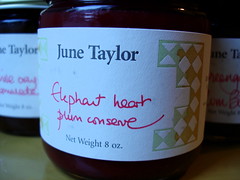
We spent a few hours together, drinking tea, chatting, and overseeing the batches as they neared the finished stage. It was a lovely way to spend an afternoon and I came away from the experience energized. I learned a lot from her in those hours, but, more importantly, I felt that I'd found a kindred soul. She jarred up the elephant heart plum conserve and left the jars to seal on a rack. I can't wait to open mine up and eat it on some fresh bread, or better yet, share it with friends over a lovely autumn dinner with wine and cheese. You can find her preserves on her website, the farmer's market at the Ferry Terminal, or at a few stores in the Bay Area, such as Peet's or the Cheese Board.

m

Saturday, August 20, 2005

Revelation 2: Swan Oyster Depot


So, we got off on the good foot almost as soon as we arrived in San Francisco, and things never really let up the whole time we were there [as you'll see--ed.]. Case in point: our visit to Swan Oyster Depot on our last day in town.

Swan was right at the top of our list of places to check out while in the Bay Area and when we still hadn't gone there during our first week we decided to make it part of our closing ceremonies. Everything we'd read about Swan--the absolute freshest seafood, its long history, its classic counter service, its reasonable prices--made it sound absolutely amazing. But we really got the bug to go there a few days earlier on a trip to Santa Cruz when Michelle tried Dungeness Crab for the very first time and I re-experienced it for the first time in some 20 years. We had it in the form of a crab sandwich and what looked like the simplest arrangement imaginable--two slices of bread, a pile of crabmeat, some Crab Louie sauce, and some salad fixin's turned out to be the hit of the day. After that, we were determined to have more Dungeness Crab (even if it wasn't exactly the season) and we'd decided Swan was going to be the place.

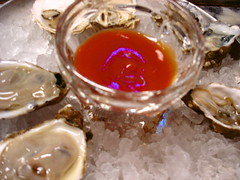
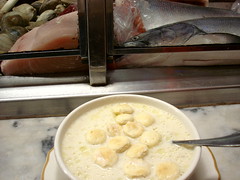
We showed up just before the lunchtime rush kicked in and got seated at the far end of Swan's counter, near the kitchen. I loved it from the moment I stepped in. What a beautiful space and what a perfect atmosphere, friendly and unpretentious. We'd been eating pretty well on this trip and I didn't have an enormous appetite when we showed up, so I arrived thinking that maybe I'd just have a few oysters and a bowl of clam chowder and leave it at that. I hadn't been expecting the impact of seeing the wide selection of seafood on offer at Swan. Fish, smoked fish, clams, oysters, shrimp, crab--it all looked so tantalizing. We stuck to our plan and ordered a couple of bowls of clam chowder and some oysters, and then we decided we'd sniff around for something else to round out our experience at Swan. That day, Swan had a selection of five different oysters to choose from. We're much better versed in Atlantic oysters and even French oysters than we are in Pacific oysters, so we weren't sure how to begin. Our waiter made things very simple for us by offering us a sampler platter, then serving us eight oysters on the half shell for the price of six (that's just the kind of place Swan is). All four types of oysters were among the best I've ever had, so good you didn't want much dressing on them, just a bit of lemon juice. But the ones that impressed us the most--both in terms of taste and aesthetics--were the Tomales Bay Miyagis, which had a lovely delicate blue hue to them [you can see one towards the upper right corner of the photo above--ed.]. Swan's clam chowder was the real deal, no thickening agent, just a whole lot of clams in a simple, hearty chowder, made with a lightly creamy broth, unlike the typically gloppy clam chowder we'd had just a few days earlier in Santa Cruz. In short: perfect.


By the time we'd finished our chowder and oysters we still hadn't made up our mind what the next act was going to be. Luckily, we'd struck up a conversation with a Swan regular named "Pat" who was sitting next to us, and she became a consultant of sorts for us. We debated the pros and cons of various dishes and combination dishes then finally settled on an unlikely combo. You see, we don't have any shortage of good smoked salmon back in Montreal (between the in-house smoked salmon at Leméac and the Wolf's Head smoked salmon that comes in from New Brunswick, we're pretty happy), but Swan had the most beautiful whole smoked salmon fillet laid out on their counter when we arrived, and I found it hard to take my eyes off it. When I asked Pat about it she said it was good, really good, "like candy," and that it was made locally by some guy near Point Reyes (if I remember correctly). I asked one of the counterhands how they serve it and he said they serve it as a platter with some bread (sourdough or rye) and whatever additional fixin's we wanted (capers, red onion, etc.). He said they could also do the smoked salmon as part of a combo platter with a shrimp salad. Michelle and I discussed the matter for another minute and then decided to get the combo with an upgrade to a Crab Louie in place of the shrimp salad. That smoked salmon was truly outrageous, and I had absolutely no regrets about ordering it. The Crab Louie was fresh and tangy, with big chunks of that oh-so-flavorful Dungeness Crab meat (it's naturally sweet and a little briny). We couldn't have been happier.

There were still plenty of temptations to be had at Swan when we finished, but we'd eaten well, and we'd been there for about an hour, so, god knows, there was a line-up of people patiently waiting to get in by that time. We paid our bill, paid a couple of fond farewells to Pat and the counter staff, and headed on our way.

Swan Oyster Depot, 1517 Polk St., San Francisco, CA, (415) 673-1101

aj

Saturday, August 13, 2005

Revelation 1: Philz


Philz Philharmonic
Originally uploaded by michelle1975.


Getting back on the food tip (as they say), our trip to San Francisco was made up of a series of revelations, some of which had a rather profound impact. Not the least of these occurred on Day 1. Somehow we'd gotten ourselves booked on a hellish flight plan on our way out to California, one that took us from Montreal to New York at 6:00 A.M., then continued on to San Francisco International Airport with a 6-hour flight. The gods were apparently smiling down upon us, though, 'cause we scored these amazing seats on the New York-San Francisco leg that were in their own little quiet compartment, between two sections in coach class and next to a flight attendants' workstation, and that had seats that fully reclined (!). We showed up in San Francisco in half-way decent shape, actually, and because it was still only noon when we got there, we had a half-day to play with.

We decided to not waste any time and just head down to the Mission District from my sister's apartment in Noe Valley and dig in to our first burrito of the journey. For our first one we went to a place I've been going to for about 10 years now and which I've always found friendly and tasty: Casa Sanchez. Not only do they make excellent tacos and burritos, but their salsa and chips are outstanding, free, and "bottomless" (courtesy of a handy self-service bar), and they have a beautiful courtyard.

Afterwards, we were in the mood for our first coffee of the day. We'd made an attempt to score a coffee in JFK, but the results were undrinkable. I'd told Michelle that San Francisco was riddled with good coffee houses and espresso bars--this was her first time to San Francisco, after all--and that, in fact, San Francisco was one of the few cities in America where you'd been able to get good, strong coffee prior to about 1990. A couple of blocks up 24th St. from Casa Sanchez we came across a coffee house, and it looked kind of interesting. It had a generic sign outside declaring that its coffee had won a Best in the Bay award, but what really intrigued us was their own sign announcing the fact that they served "handmade" coffee and that each coffee was made "one cup at a time." We didn't know it at the time, but the gods were smiling down upon us once again.

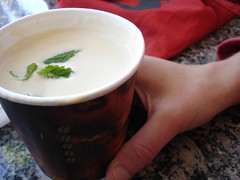
Behind the bar they had a sign listing all their espresso-based drinks, but they also had a sign with all their "handmade" coffee selections, and each of these sounded a whole lot more interesting. I initially ordered a Arabic-style "handmade" coffee, but when another patron ordered a "Philharmonic" blend I asked the barista to change my order to one of the same. She ground just enough coffee beans for my order, then threw them into a large, long paper coffee filter held in a stand and placed the coffee cup underneath. Then she threw a couple of secret potions into the filter along with the beans and added a long, steady stream of boiling water. She asked me if I wanted cream and sugar and I said, "yes." A minute or two later she handed over my perfectly brewed, perfectly creamy, and perfectly sweetened Philharmonic and I headed over to where Michelle was sitting. I took a sip on the way and it nearly blew my mind. I took the lid off the coffee and saw that it had a mint sprig on top. I handed to cup to Michelle and said, "You're not going to believe this."

Neither of us had ever tasted a coffee as exotic or delicious ever before. We both take our coffee quite seriously and we've both done a fair bit of traveling, but we'd never experienced anything like that first Philz "handmade" coffee, with its strong hints of cardamom, its wonderfully mellow depth, and its mint finish (sounds crazy, I know, but the sprig is really an stroke of genius).

Needless to say, we got seriously hooked by that first Philz coffee and Philz became a touchstone for our trip. We went back at least half a dozen times and we tried almost all of the "handmade" blends they offer. We made a point of initiating my sister into the brotherhood (she'd never been), and then we started making the silliest excuses just so we could pass by Philz. The Philharmonic remained a favorite throughout the trip, but we also became very attached to the Jacob's "Wunderbar," which was a little less spicy, but was made with a stronger roast, and the Phil's Tesoro Mocha was also a big hit, although the intensity of its chocolate flavor made it a "special occasions" blend for us.

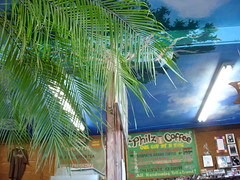
One time we stopped by and Michelle ran in for a couple of take-away coffees before we headed out to Treasure Island. When she got to the bar Phil himself was waiting for her. He asked her how she was doing and she responded, "I'll be a lot better once I've had my Wunderbar." Phil looked at her and said, "You're already fine." She was on Cloud 10 when she got back to the car--Phil is a very charming man who sports a dashing and unpretentious fedora and has a sly sense of humor. Which brings me to another point: the atmosphere at Philz takes a close second to their amazing coffees. Like many other San Francisco coffee houses the interior design is whimsical and eclectic and the place is frequented by regulars who can only be described as "true originals," but how many other coffee houses in San Francisco (or anywhere else, for that matter) can you purchase a potted plant with your coffee?


interior decor, Philz
Originally uploaded by michelle1975.


By the end of our trip I was only half-joking that Philz alone had been worth the price of our airfare out to San Francisco, but if you don't believe our hype, check out the testimonials that you can find online on the topic of Philz, or, better yet, go there yourself.

Actually, let me finish with yet another anecdote. Last night, we were gathered at Le Pocket Palace, talking with Hermine and Kazi about our trip over a glass of wine. We had gotten on the topic of Philz, as we're wont to do these days, and we were giving them the full lowdown: the "handmade" process, the use of spices and herbs, the devoted following, the rapture, etc. I was going off on some spiel about San Francisco being a city of coffee houses, but that nothing could compare with this coffee house we'd found there, when I noticed a young woman listening in on our conversation, waiting to see which coffee house I was going to name, waiting to weigh in with her own opinion. When I named the coffee house in question as Philz, she turned to us and said, "You mean the place on 24th?" Turns out she had lived just around the corner on 25th St. for six months and had become a very regular regular during her time there. Imagine her surprise. Imagine ours.

Casa Sanchez, 2778 24th St., San Francisco, CA, (415) 282-2400

Philz Coffee (a.k.a. Phil's Coffee, a.k.a. Gateway Market), 3101 24th St., San Francisco, CA, (415) 282-9155

aj

Saturday, April 16, 2005

Cioppino is back!


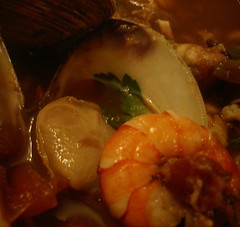
Thursday night's cioppino
Originally uploaded by ajkinik.

This is our week for dad stuff, I guess. My dad and I first made cioppino when we were living in the San Francisco bay area in the ‘70s and ‘80s. Cioppino was a local specialty, a hearty fish stew developed by Italian and Portuguese fishermen who worked the California coast, and it became the special meal we would make together after we discovered James Beard’s recipe for it. We’d go out shopping for our seafood—including a healthy amount of local Dungeness crab—then spend the evening slowly preparing the stew, before serving it with a crusty San Francisco-style sourdough bread. It was one of my favorite meals, and probably my favorite meal to make.

This week my dad and I decided to take a trip down memory lane and make it again (it had been about 15 years since the last time). We knew we would have to make do without Dungeness crab, but it still seemed like a great idea. We dug out James Beard’s recipe and made up our shopping list. Neither of us remembered the dried mushrooms being in the recipe we’d used previously, but there they were on the list of ingredients that came with his version included in The New James Beard, and they did add a lot of character to the broth. We served the stew with sourdough baguette slices, a simple Romaine lettuce salad, and lots of Pinot Noir (I had just taken dad to see Sideways a couple of days earlier, after all).

Beard’s recipe calls for a lot of seafood, and if you follow his guidelines exactly, the pricetag for this meal can get a little out of hand. I recommend mixing and matching the seafood in such a way as to keep the meal affordable. Cioppino is supposed to be a working-class meal, focusing on using fresh but reasonably priced seafood is more in keeping with the spirit of the original. In the case of the Cioppino we made on Thursday night, I would replace the crabmeat (it’s very hard to get fresh crab in these-here parts, and it’s rather pricey, given the quality) with some extra shrimp or some fish. Also, feel free to replace the clams with either mussels or oysters, depending what’s available, what’s the freshest, and what’s the least expensive—both of these variations are perfectly acceptable. Of course, if you have access to plentiful amounts of fresh, inexpensive shellfish, by all means, knock yourself out. Finally, Beard recommends using sea bass or striped bass for the fish—we used a combination of monkfish and tilapia (a firmer fish and a flakier fish, not unlike the kind of combination you’d used in a Bouillabaisse) and it turned out perfectly. All you have to do is stagger the cooking times slightly, so that the firmer fish goes in a few minutes earlier than the flakier fish.

Here’s the recipe:

Cioppino

1 quart clams (in the shell)
1 cup dry white or red wine
1/2 cup olive oil
1 large onion, chopped
2 cloves garlic, chopped
1 green pepper, chopped
1/4 cup dried mushrooms, soaked in water and drained, while retaining then straining (through cheesecloth or a coffee filter) the soaking liquid
4 ripe tomatoes, peeled, seeded, and chopped
4 tbsp Italian tomato paste
2 cups red wine, such as Pinot Noir or Zinfandel
2 tsp salt
1 tsp freshly ground black pepper
2 tbsp finely chopped fresh basil
3 pounds thick fish fillets, cut into serving pieces (sea bass and striped bass are recommended, but almost any firm-fleshed fish will do)
1 pound crabmeat
1 pound raw shrimp, shelled
3 tbsp chopped parsley

Steam the clams in the 1 cup of white or red wine until they open, discarding any that don’t open. Strain the broth through two thicknesses of cheesecloth (or a coffee filter) and reserve.

Heat the oil in a deep 8-quart pot and cook the onion and garlic until the onion has become translucent. Add the pepper and mushrooms and cook for 3 minutes. Add the tomatoes and cook 4 minutes. Add the strained clam broth, the strained mushroom broth, tomato paste, and 2 cups red wine. Season with salt and pepper and simmer for about 20 minutes. Taste and correct seasoning. Add the basil and the fish, and just cook the fish through, about 3 to 5 minutes. Finally, add the steamed clams, crabmeat, and shrimp. Heat until shrimp are just cooked through, roughly another 3 minutes. Do not overcook. Sprinkle with parsley and serve with crusty bread (preferably sourdough), a salad, and lots of red wine.

aj