Showing posts with label pork. Show all posts

Monday, May 27, 2013

On The Road 6: North Carolina BBQ Mini-Odyssey
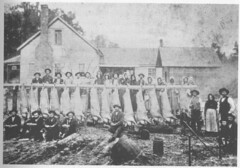
NC pig roast fig. a:  old-school NC pig roast

North Carolina.  Fabled birthplace of American barbecue.  And a state where pig is king.

lexington pig fig. b:  court jester

Actually, North Carolina's a state where pig is sometimes also the court jester.  Quite literally.

The photograph directly above was taken in Lexington, NC, in front of the Davidson County Courthouse.  This pig statue pays some kind of tribute to Lexington's status as the Barbecue Capital of the World (or, at the very least, the Barbecue Capital of North Carolina).  Of course, Lexington's not the only town to claim to be the Barbecue Capital of the World, and it's probably not the only town in North Carolina that thinks of itself as the Tarheel State's Barbecue Capital, but it's got a pretty decent claim on both titles.  It's a major barbecue pilgrimage point with an astounding number of barbecue restaurants per capita (it's got about 20, and its population is just under 19,000, so roughly 1 for every 950 citizens), a number of which are among the most esteemed in the business, and it's got a style all its own.  If all that wasn't enough, it also plays host to the Lexington Barbecue Festival--one of the world's largest--every fall.

Now Lexington may not have been the place where barbecue originated--the Anglo-American tradition dates back to First Contact, after all--but it's certainly got a long history there.  Some of the earliest barbecues in the city itself actually took place in back of the County Courthouse, on a tiny stretch of road that became known as Barbecue Alley, where the earliest purveyors of Lexington barbecue (within city limits, that is) took advantage of the courthouse's central location and its hungry jurists.
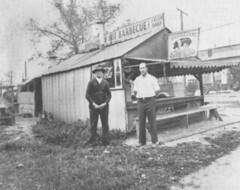
early Lexington BBQ fig. c:  early Lexington BBQ

It'd be great if Barbecue Alley was still a hotspot for Lexington barbecue, but this is what it looks like today.

bbq alley, lexington fig. d:  "Barbecue Alley" today

To find Lexington's famed barbecue establishments, you've got to travel a little ways from the geographic centre.  There may be lingering ghosts around Barbecue Alley, but with the exception of late October, when the Barbecue Festival is on, the action is happening elsewhere.

drink coke fig. e:  Drink

Lexington Barbecue

My Lexington pilgrimage was short, but it was definitely sweet.  It started at perhaps the most hallowed barbecue establishment in all of Lexington, Wayne "Honey" Monk's Lexington Barbecue, a.k.a. Lexington Barbecue #1, The Monk, The Honey Monk, or Honey Monk's.  Lexington Barbecue has been winning over devotees and racking up distinctions for over 50 years now, and it's the only barbecue in Lexington to have won a James Beard Foundation award as one of America's Classics.
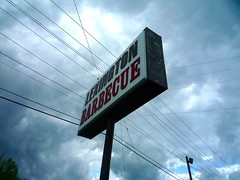
lexington bbq 2 fig. f:  #1

Lexington Barbecue is a large, barn-shaped restaurant with very few frills to it of any kind.  The specialty, of course, is their pork barbecue, served in a range of plates, platters, and sandwiches.  The default mode for Lexington Barbecue's pork is finely chopped, as it is across much of North Carolina.  But the style here is one that's typical of the city of Lexington, and of the Piedmont region more generally:  dressed with a dip that features tomato ketchup prominently, and served alongside a "red" cole slaw that also features ketchup prominently.  The meat is supremely tender, and the 10+ hours of smoking time imparts a lovely smoky flavour, but Lexington Barbecue uses primarily oak on its shoulders, so the smokiness is surprisingly mild.  The presentation may lack a certain artistry, but this is masterful barbecue.
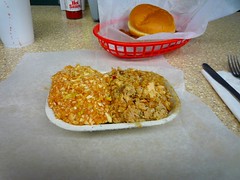
bbq platter, Lexington BBQ fig. g:  Lexington Barbecue's platter

Plates of pork barbecue are commonly served with either buns or hush puppies, but if you ask real nice you can get an order of "half 'n' half," which is exactly what I did.  Texas Pete hot sauce (the pride of North Carolina) and a large cup of Cheerwine (like my server told me, "It's kinda like cherry cola, only better") completed the scene.

I tried to really savour my platter--this was a pilgrimage, after all--but I was pretty hungry by this point, and that barbecue was just too damn good.  I polished off that platter in no time.
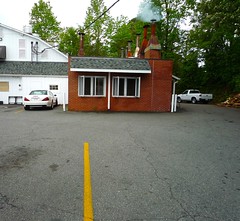
lexington bbq 3 fig. h:  Lexington Barbecue's pit

Out back, you can see Lexington Barbecue's brick smoking pit chugging away, with their pile of hardwood close at hand.  Classic.

BBQ Center

BBQ Center fig. i:  BBQ Center

I'd been told that Lexington's BBQ Center was the home of an excellent ice cream counter that served up some legendary banana splits.  But, as their name suggests, BBQ Center is primarily another serious barbecue establishment, and one that's even older that Lexington Barbecue ("since 1955"), so I took a pass on the ice cream and opted for a barbecue pork sandwich for dessert instead.
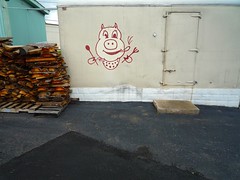
BBQ Center mascot 1 fig. j:  iconography 1

Not that I had my doubts or anything, but I could tell these guys were the real deal from the moment I pulled into the parking lot.  They had the iconography down, they had plenty of hardwood at the ready, and their pit was smokin' away.
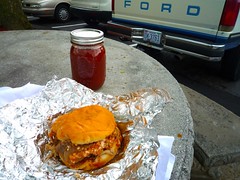
coarse chopped pork sandwich, BBQ Center fig. k:  BBQ Center's sandwich

BBQ Center still offers good old-fashioned, mid-20th-century-style curb service, but I picked up my barbecue sandwich (coarsely chopped, this time) and had it on a picnic table outside with a soda and a side of their famous dip.  I liked the coarse cut of the meat, and the smokiness of the meat was downright bold compared with Lexington Barbecue.  I wasn't even all that hungry, but that smoke worked its charms on me.

Stamey's

stamey's fig. l:  Stamey's now

Stamey's is another legend of the Lexington style.  Warner Stamey learned the trade in the 1920s and started his first barbecue restaurant in Shelby in 1930.  He came back to Lexington for a spell and then moved on to Greensboro where he established his namesake restaurant.  Warner Stamey's reputation is based on two things:  his Lexington-style barbecue and his mentorship.  Wayne Monk is just one of the future barbecue stars to have apprenticed with Stamey back in the day.  BBQ Center's Sonny Conrad was another former pupil.

Stamey's still serves good pork barbecue (very good, in fact), and they still pride themselves on doing things the right way--smoking their meat over wood (hickory, preferably), making just about everything on the menu from scratch, keeping the operation family-run--but the flagship restaurant has been renovated numerous times over the years and the latest incarnation lacks a little charm.  As a BBQ pilgrimage site, it's maybe just a little too modern, a little too generic.  It's too bad it doesn't look like this anymore:
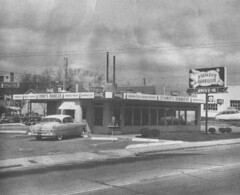
Stamey's 1950s fig. m:  Stamey's then

There's no questioning Stamey's place in the family tree of Tarheel barbecue, but these days it's definitely not North Carolina's most scenic barbecue joint.

Allen & Son
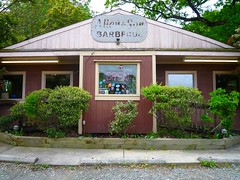
allen & son 1 fig. n:  faded glory

My brief North Carolina barbecue odyssey took me from west to east, which also means that it amounted to something of a backwards trip through time, in terms of barbecue history, at least.  You see, while barbecue had spread far and wide across the state by the late nineteenth century, and certainly by World War I, it's generally acknowledged that the North Carolina tradition got its start in the east.  It's in the east where settlers first came into contact with the region's indigenous populations.  It's in the east where the history of barbecue is most thoroughly documented.  And it's also in the east where the barbecue tradition is at its most primal:  whole hogs cooked slowly over wood, and basted with a simple vinegar-based and chili pepper-laced concoction.  On the following day of my journey I crossed over, and my first stop was Chapel Hill's Allen & Son.

Things were pretty quiet when I got there because Allen & Son opens early and I'd decided to go there for a "barbecue brunch" in order to facilitate the consumption of even more barbecue later in the day, but I didn't mind having the place to myself.  Among other things, it gave me plenty of time to admire my surroundings.  Allen & Son has the quirkiest, most idiosyncratic interior I'd yet encountered.  It's some kind of folksy, friendly, frontier fantasy they've got going on in there, featuring a wide range of old-timey artifacts and a whole lot of taxidermy.

Allen & Son is owned and operated by Keith Allen, a hulking figure of a man who has a fondness for hickory, who collects and chops all his own wood, and who prefers to work his pit and chop his pork all by himself, too.  There's definitely something of the frontiersman in Allen, and he definitely looks the part. Think Sterling Hayden in Nicholas Ray's Johnny Guitar and the whole aesthetic of Allen & Son suddenly makes a lot more sense.

Anyway, I had a chance to take in the scene, and study their menu, and I liked what I saw.  Right down to their coy mascot.
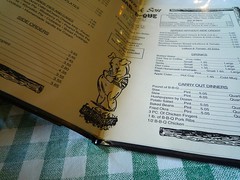
allen & son 3 fig. o:  iconography 2

But what I liked most of all was my barbecue pork sandwich plate.
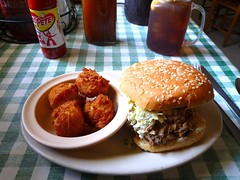
BBQ sandwich, Allen & Son fig. p:  Allen & Son's sandwich

The pork here was coarsely cut, robustly smoky, perfectly seasoned, and quite literally juicy.  The juiciest yet.  The cole slaw was no longer "red"--it was creamy and "white," it had been made with obvious care, and it was first class.  The bun, as you can see, was seeded and definitely above average.  And the hush puppies, too, were a work of art--the best I experienced over the course of a week in NC.  Hell, even their sweet tea was outstanding, with enticing hints of vanilla to it.  But the biggest revelation was Allen & Son's dip, which didn't have any tomato in it, but did contain a secret ingredient:  butter.  I'd read about early North Carolina barbecue sauces and how butter had been a fairly common ingredient well into the nineteenth century, but I'd never actually encountered one.  Allen & Son's dip also arrived fresh & hot.  And, boy, did it ever make that pork sing.  Wow!

Skylight Inn BBQ
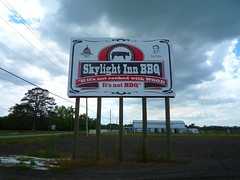
skylight 3 fig. q:  manifesto

Later that day, I'd fully crossed over.  By that time, I was in Ayden, NC, visiting yet another Tarheel legend:  Skylight Inn BBQ.  Devotees of whole hog barbecue, standard-bearers for the eastern North Carolina style, and fellow recipients of a James Beard Foundation America's Classics award, the Skylight has a reputation for being among the state's most dedicated barbecue fundamentalists.  While the Skylight was only founded in 1947, the Jones family has a history of making barbecue that dates back hundreds of years.  That said, for a long time the Skylight was primarily a local legend.  It was only in 1979, when an article in National Geographic named Pete Jones' establishment "the barbecue capital of the world" that its reputation really began to spread far and wide.

A few years later, Mr. Jones added a rotunda--a replica of the U.S. Capitol Building's--to its roof to commemorate the nomination.

Skylight 1 fig. r:  Barbecue Capitol

The Skylight's rotunda is just about its only flourish, though.  Otherwise, this is another no-frills establishment, and the ambience comes primarily from the hospitality of Bruce Jones, Pete's son, and from the musical rhythm of the chopping of barbecue that comes periodically from just behind the counter.  Here, the standard serving of barbecue comes finely and freshly chopped, and the fact that it's whole hog barbecue means that the meat is more varied than most other establishments, and that crackling plays a more significant part.  The cole slaw is a very simple affair, and the colour is almost electric.  And the classic trio comes complete with a piece of the Skylight's traditional cornpone, which is denser and less sweet than a typical corn bread.  It also comes stacked like this:
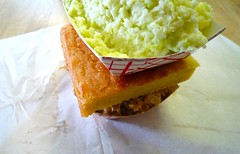
bbq platter, Skylight Inn fig. s:  Skylight Inn's platter

If you're going to post your barbecue philosophy up on a billboard, you better make sure you back it up, and there's no question that they do at the Skylight Inn BBQ.  Just think of the amount of wood it takes to dedicate yourself to whole hog barbecue.  Just look at that stack of wood they've got piled next to their barbecue pit.
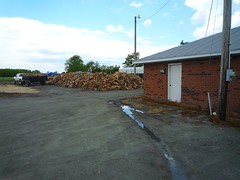
skylight 2 fig. t:  it's definitely cooked with wood

After Ayden, still pushing east towards the Outer Banks and the Atlantic, I soon pulled out of the heart of NC BBQ Country.  I knew I'd only just scratched the surface, but I was confident traditional North Carolina barbecue was holding strong, and I knew I'd be back soon enough for another BBQ pilgrimage.

A North Carolina Barbecue Primer:

1.  Remember:  pig is king.  Many of these restaurants have a lot of other distractions on their menus (burgers, chicken, etc.), but it pays not to stray.  This should go without saying, but do yourself a favour--stick to the pork barbecue. 
2.  You generally have your choice of how to have your pork barbecue served to you:  finely chopped (the norm), coarsely chopped, or sliced.  You'll be hard pressed to find pork barbecue "pulled" in an old-school Tarheel barbecue joint.  Avoid the embarrassment. 
3.  Barbecue sauce in North Carolina is called "dip."  It's generally pretty thin, it's always vinegar-based, and it's usually pretty spicy, too.  The essentials are vinegar, chili peppers/crushed red peppers, salt, and sugar.  Whether it contains ketchup, tomato sauce, or some other addition depends on geography (basically:  west-yes, east-no).  Don't expect to find any thick, gloppy barbecue sauce on your table.  Do expect to find plenty of Texas Pete, and feel free to make liberal use of it.
4.  Old-school North Carolina barbecue restaurants tend to use one of two different types of wood, or a combination of the two:  oak and hickory.  But wood, and the smoke that comes with it, are absolutely essential.  As they so delicately put it at the Skylight Inn:  "If it's not cooked with WOOD, it's not BBQ."  As in most other parts of the U.S., there are a lot of places in North Carolina advertising barbecue--please, for the love of BBQ, stick to the ones that cook over wood.
5.  The classic North Carolina barbecue sides are cole slaw and some variation of fried or baked corn meal (usually, hush puppies, but also including corn bread, cornpone, and cornsticks).  Don't expect a wide variety of other sides, although you may be pleasantly surprised from time to time (even very pleasantly surprised on occasion).  A barbecue restaurant is not necessarily a meat-and-three.
addresses:

Lexington Barbecue, 100 Smokehouse Lane, Lexington, NC

BBQ Center, 900 N. Main Street, Lexington, NC

Stamey's Barbecue,  2206 High Point Road, Greensboro, NC

Allen & Son Pit-Cooked Bar-B-Que, 6203 Millhouse Road, Chapel Hill, NC

Skylight Inn BBQ, 4618 S. Lee Street, Ayden, NC

Note:  NC's Barbecue Country basically encompasses the entire state, from far western towns like Murphy (near the borders of Tennessee and Georgia), to eastern towns like Ayden and Goldsboro, but this particular BBQ mini-odyssey only covered about 200 miles--just far enough to fully capture the transition from West to East and from early-20th-century to early-modern in terms of style and philosophy.  In other words, you could easily hit a number of these places within the space of a single day.

For more on Tarheel barbecue, John Shelton Reed & Dale Volberg Reed's Holy Smoke:  The Big Book of North Carolina Barbecue (UNC Press) lives up to its name and comes complete with lore, history, recipes, addresses, and interviews.  Check out this link for more information.

aj

Thursday, September 27, 2012

The Green Chile Variations, pt. 1

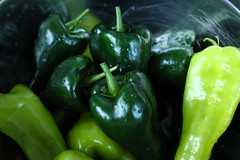
green chiles fig. a:  garden-fresh chiles

If I'm totally honest, it all started sometime in the early '90s (!?!), when I took a road trip from Washington, D.C. to the Southwest and back.  Albuquerque was a primary destination, and I spent about a week in New Mexico with good friends, checking out the town, exploring the region, and sampling the local specialties.  That was when I first experienced Green Chile Madness.  Green chile sauces and stews were everywhere, and they were generally very good, and sometimes even phenomenal.  I was particularly enamoured of those green chile salsas and sauces and the way they adorned everything from nachos, to cheese fries, to egg dishes, home fries, and cheeseburgers, taking everything they touched to a higher level.  I quite literally couldn't get enough.

I've thought about New Mexico a lot ever since, and told many a soul about Green Chile Madness, but I've never been back.  And while I'm usually pretty adept at figuring out the recipes for prized dishes and replicating them in my home kitchen, for some reason, when it came to Chile Verde, I let it slip into what Calvin Trillin calls the Register of Frustration and Deprivation, a catalogue of favourite dishes that "rarely seem to be served outside their territory of origin."

About two years ago, however, I set about ushering Green Chile back into my life.  It started with a recipe for Green Chile Stew that appeared in David Tanis' A Platter of Figs And Other Recipes.  Tanis lived in New Mexico for a spell, so he knows his stuff, and he describes Green Chile Madness thusly:

In northern New Mexico, green chile stew is legendary.  Everybody makes it, everybody eats it, and everybody loves it, even if everybody makes a different version--with or without potatoes, or tomatoes, or cumin, or tomatillos, or cilantro, but never without a healthy amount of green chile.
Evidently he caught the bug bad--he claims to have traveled "with a handful of fresh chiles in [his] pocket" ever since, as a form of "culinary insurance" (for perking up bland dishes in chile-deprived regions of the world).

These days, you can find green chile stews and sauces across New Mexico at any time of year--it was April when I experienced my Green Chile Revelation.  But the chile harvest, as Tanis explains, is in the fall.  It's at this time of year that you find, people buying big bags of them, then lining up "to have them roasted by entrepreneurial chile roasters who set up in supermarket parking lots or at roadside stands."  It's the grilling of the green chiles that really makes the difference--it's that smokiness and that caramelization that you get from roasting them over an open fire that takes things to a higher level.

Anyway, Tanis' Green Chile Stew was probably the very first thing I made out of A Platter of Figs--I had very high hopes and I wasn't disappointed.

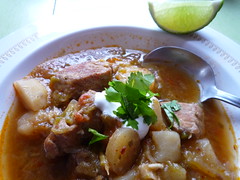
chile verde fig. b:  green chile stew 1

Green Chile Stew 
5 pounds well-marbled boneless pork butt, cut into 2-inch cubes
salt and pepper
2 tbsp vegetable oil or lard
2 large onions, finely diced
4 to 6 garlic cloves, chopped
2 tsp cumin seeds, toasted and finely ground
1/2 cup chopped tomatoes, fresh or canned
6 large carrots, peeled and chunked
1 cup chopped roasted green chiles*
2 tbsp all-purpose flour
8 cups water or chicken broth
3 lbs russet potatoes, peeled and cut into large dice
chopped cilantro
hot corn or flour tortillas 
Season the pork with salt and pepper.  Heat the oil or lard in a large Dutch oven or other heavy-bottomed pot.  Add the meat, in several batches, without crowding, and brown it lightly.  Transfer to a platter or tray. 
Add the onions to the pot and brown them.  Add the garlic, cumin, tomatoes, carrots, and green chiles, then sprinkle the flour over and stir.  Salt the mixture, then return the browned meat to the pot and stir well.  Cover with the water or broth and bring to a boil. 
Cover the pot, turn the heat to low, and simmer gently for an hour. 
Taste the broth and adjust it, adding salt or more green chile as necessary.  The broth should be well seasoned and fairly spicy.  Add the potatoes and continue cooking for 30 minutes, or until the potatoes are soft and the meat is quite tender.  Skim any fat from the surface of the broth. 
Let the stew rest for an hour or more.  Refrigerate overnight if desired (this allows the flavours to meld even more). 
To serve, reheat the stew and ladle into warmed bowls.  Sprinkle with chopped cilantro and accompany with hot tortillas. 
Serves 8 to 10. 
* Tanis notes that it takes about 12 large fresh chiles to produce 1 cup of chopped roasted chiles.  It's preferable to grill them over an open fire, but you can also blacken them under the broiler or directly over a gas burner, in a pinch.
Now, this makes for an excellent stew, and, like I said, I wasn't disappointed in the least.  But as Tanis mentioned above, one of the things about Green Chile Madness is that "everybody makes a different version."  Over the last couple of years, I've continued to follow the guidelines of Tanis' recipe, but I've come up with my own take on Green Chile Stew.

  • For one thing, we're hard pressed to find New Mexico green chiles here in the Montreal region, so I've had to improvise with the chiles.  I tend to use a mix of green chiles, one that includes everything from Poblanos, Anaheims, and Padróns, to Serranos, Jalapeños, and Cubanelles.  The larger, milder ones (the Poblanos, Anaheims, and Cubanelles) I grill over an open fire.  The hotter ones I sauté with the onions, after they've been browned
  • I've taken to replacing the tomatoes with tomatillos, especially around this time of year, when you can actually find lovely, local tomatillos here in Montreal (try the Birri Brothers stand at Jean-Talon Market).  I also use quite a bit more than half a cup.  The tomatillos give the stew tartness, additional sweetness, and a wonderful mouthfeel.
  • I always use chicken broth and not water.
  • I've taken to omitting the potatoes, which I find distract from the green chiles.
  • And I always replace the all-purpose flour with masa harina, which adds to the warmth of the dish.
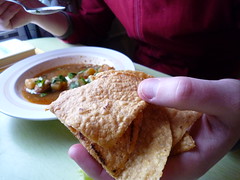
Tanis prefers his Green Chile Stew "in a bowl, with warm, thick corn tortillas on the side," but it's also pretty great with good tortilla chips (see below), and it's great in a burrito.


chile verde + chips fig. c:  green chile stew 2

END OF PART ONE

aj

Tuesday, August 21, 2012

Omnivore 'r' us

dome fig. a:  welcome to the pleasuredome

It all looks so calm, so peaceful, so reassuring, but over the last few days there was a veritable hive of activity under the Société des arts technologiques' mysterious dome.

You'll remember that when we last interacted Omnivore was just on the verge of getting underway.  You'll also remember that while Omnivore's series of "maudits soupers" was intended to create a ripple effect of culinary collaboration and experimentation across the city of Montreal, the Société des arts technologiques, and its Foodlab in particular, was slated to be Omnivore Montreal's ground zero.

Three days of workshops took place there, a great deal of the prep work for both the workshops and the dinners was conducted there, and the Foodlab was the site of a closing night dinner, pairing the talents of Les Grès' Jérome Bigot and the Foodlab's Seth and Michelle, as well as an after-hours bash for all those who participated in putting together the Montreal leg of Omnivore's World Tour 2012.  That's a significant amount of hustle and bustle for a kitchen that features virtually no modern conveniences (convection oven? sous-vide machine? Pacojet?), uses home-use electric ranges exclusively (natural gas?), and consists of a staff of three.

It was quite a wild ride, but one that was by turns illuminating, sometimes even breathtaking, and frequently inspiring, and it succeeded in forging what will surely turn out to be important links between chefs and gastronomes in Montreal, Europe, and beyond, as well as exposing Montreal's food-obsessed to a new, more interactive kind of food festival, one that looks likely to be a recurring proposition.

There are certainly more extensive reports on Omnivore Montreal 2012 to be found elsewhere, but here are just a few personal impressions focused on Michelle's involvement with the festival:

On Sunday Michelle gave her workshop on the topic of memory, fantasy, strawberries, and the nature of dessert.

strawberries, pepper fig. b:  black pepper, strawberries

She created two strawberry desserts for the event, both of them "simple," both of them designed to end a meal on a suitably light and refreshing note.  The first was a sour cream panna cotta with candied celery, a mixed herb granité (parsley, mint, basil, verbena), and strawberries.

The second was her dreamy Bohemian Rhapsody, a dessert that she created when she was still at Laloux and that was featured in the Gazette's "Strawberry Smackdown" last summer, and whose conception I described in some detail in a post at around the same time.  In case you've forgotten, it went something like this:

If you haven't had the pleasure of hearing Michelle describe the dessert herself, it all started with stories her mother used to tell her about summertime in Czechoslovakia. It seems that instead of summer camp, Czech kids used to be carted off to these summer work camps where they'd spend a couple of weeks picking hops as part of the national beer-making effort. 

Summer work camps? Nationalized industries? Doesn't sound like a lot of fun, does it? Except that apparently it was.

The kids were out of the city and in the countryside, they were camping, and they were relatively unsupervised. There was music every night, there were songs and dancing, and there was no shortage of summer intrigue, and a fair bit of summer romance, too. There were also strawberries--lots and lots of wild strawberries--and flowers.

Michelle loved hearing these stories (she still does!), especially because her mother would get so animated when she told them (she still does!). They were/are clearly among her mother's fondest memories.

Anyway, earlier this year, before strawberry season even began, Michelle came up with the idea of creating a dessert that would capture elements of these remembrances of Czech summers past. There would definitely be hops, of course--the most floral she could find. There would also be strawberries and flowers--an homage to the wild strawberries and the wildflowers that grew alongside the hops in the Czech countryside. There would be malt--another nod to the art of making beer. And there would by rye--Michelle imagined rye crumbs mingling with the hops and the strawberries and the wildflowers after the Czech youngsters had had their lunches in the fields.
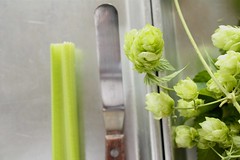
celery, hops fig. c:  celery, hops

This was exactly the story that Michelle described to the audience at her workshop, but she used it to talk about her creative process, and to reflect upon dessert's nature, on the dichotomy between desserts that are based in fantasy and those that are based in memory (whether personal or collective), and how on occasion desserts can find their inspiration in both.

mm in the dome fig. c:  Michelle 360º

She also decided that additional visuals were in order, so we drew up a leaflet to provide audience members with some important primary texts.  The four texts in question looked like this:
 strawberry picking! fig. 1:  strawberry picking in Czechoslovakia
It was late in the evening when Philip arrived at Ferne. It was Mrs. Athelny’s native village, and she had been accustomed from her childhood to pick in the hopfield to which with her husband and her children she still went every year. Like many Kentish folk her family had gone out regularly, glad to earn a little money, but especially regarding the annual outing, looked forward to for months, as the best of holidays. The work was not hard, it was done in common, in the open air, and for the children it was a long, delightful picnic; here the young men met the maidens; in the long evenings when work was over they wandered about the lanes, making love; and the hopping season was generally followed by weddings.  --Of Human Bondage, CXVIII (pg. 543), W. Somerset Maugham
fig. 2:  a fortuitous quote
Michelle's journal  fig. 3:  a page from Michelle's journal
Michelle & co. fig. 4:  Michelle & co.
I was hardly the most objective of observers, but her presentation--her reminiscences and commentary, her demo, her leaflet--appeared to have really struck a chord with the audience, and the fact that she served individual portions of her Bohemian Rhapsody to each and every attendee didn't hurt either.  In fact, it helped to create a mob scene after her talk.

mm in the dome2 fig. e:  after the demo

Later that night, on our way to a "maudit souper" at Sardine, we had a chance run-in with a long-lost friend who was visiting from Toronto.  We did the standard 5-minute check-up, catching up on the highlights of the last few years, including Michelle's move to the Foodlab, and, completely unprompted, our long-lost friend brought up our post about the Bohemian Rhapsody and how its tale of childhood romance in the hop fields of Communist Czechoslovakia had nearly brought him to tears (!).  "Wow, funny you should mention that," I said, "because Michelle just finished giving a public talk on just that very topic."  Afterwards, I made a joke that I'd only had to pay him $50 for him to stage this unexpected encounter, but, really, his timing was impeccable, and Michelle marched onwards towards Sardine with a new spring in her step.

A day later, Ève Dumas singled out Michelle's talk as one of the highlights of the festival in the pages of La Presse (!!).  Commenting on the strength of the Montreal contingent's demos over the weekend, Dumas wrote:
La palme revient à Mme Marek, qui a donné un sens nouveau a l'expression galvaudée qu'est "cuisine d'émotion."  "Un travail sur la mémoire et le fantasme, avec des fraises," était la description que las chef du Foodlab avait faite de sa présentation la semaine dernière.  Et hier, c'était exactement ça.
Partant d'un souvenir d'enfance sublimé, Michelle Marek a préparé en direct un dessert aux fraises, avec granité de houblon, crème fouettée et crumble de pain de seigle qui évoquait l'enfance de sa mère en Tchéchoslovaquie communiste.  À la fin de la démonstration, une cinquantaine de spectateurs émus voulaient connaître le goût des fantasmes de Michelle Marek qui, par chance, avait prévu une petite portion pour tout le monde.
Michelle had even more spring in her step after she discovered that write-up.  It gave her the boost she needed to face up to a huge day.

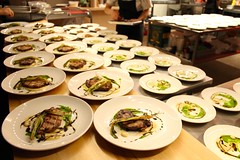
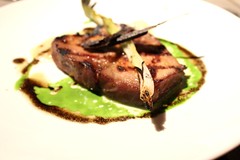
And, finally, last night, Omnivore Montreal 2012 came to its inevitable conclusion with two more seriously hot tickets:  les Frères Folmer of Couvert Couvert (Heverlee, BE) with Marc-André Jetté and Patrice Demers at Les 400 Coups and Bigot/Gabrielse/Marek (organ, drums, guitars) + Oenopole's Theo Diamantis (wines and vocals) at the Foodlab.  Unfortunately, we missed out on the festivities on rue Notre-Dame, for obvious reasons, but the collaboration between Team Les Grès, Team Foodlab, and Team Oenopole resulted in a lovely menu with real moments of magic, the highlight of which was probably the main course:  a marinated and grilled pork échine with onions served four ways (scallion purée, charred scallion oil, grilled scallions, and an onion cream) and a pork jus.

pork plates fig. f:  pork plates

It was as striking as it was tasty, and it was one of those dishes that you wanted to just keep reappearing each time you cleaned your plate.  I could have easily had one for dessert, too.

pork plate fig. g:  pork & onions

All things must come to an end, though, right?*

A few hours later, the guests had departed, the chefs had returned, and there was nothing left to do but drink, dance, play ping pong, and reminisce about the weekend.

aj

* with the exception of AEB.

Thursday, February 23, 2012

Bo Knows

Speaking of wraps, I still remember our first experience of Momofuku, way back in 2006, vividly.

decor, Momofuku fig. a: Momofuku!

Like virtually everyone else, the dish that first won our hearts was David Chang's now legendary, oft-imitated steamed pork buns, with its supremely succulent braised Berkshire pork. But the dish that left a lasting impression was the ssäm.

At the time, I had the following to say about the experience:

The true revelation of our luncheon, however, was my Ssäm. I have to confess, at the time that I ordered it, I really had little idea what exactly I was ordering. The ingredients--"Berkshire pork, rice, edamame, onions, pickled shiitake, kimchi"--all sounded great to me, but I was expecting some kind of a fried rice dish, or possibly even a rice-based soup.

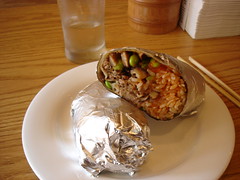
ssäm, Momofuku fig. b: Momofuku ssäm

What we got, instead, was a burrito--a clever Korean-American take on the Mexican-American classic. In general, we're a little skeptical when it comes to "fusion cuisine," but here was another instance of Chang taking chances and finding (not forcing) culinary affinities. The results were brilliant--but, then again, as huge fans of Mission-style burritos and Korean food, we were pretty much an ideal audience for Momofuku's ssäm burrito.

Chang writes about his ssäm burritos with humor and a healthy dose of self-deprecation in Lucky Peach #2. In fact, his opening line baldly states, "In 2005, I thought I had the greatest idea in the world: I was going to serve Korean burritos." And he goes on to explain the logic behind his brainchild:

It wasn't that much of a stretch of the imagination: Koreans wrap up everything. Go to a summer barbecue with enough Koreans and one of them will eat his burger wrapped in a lettuce leaf just because that's how we do it. Bossäm is a traditional dish where you sit around a big plate of pork belly (and sometimes oysters) and wrap up mouthful after mouthful in napa cabbage.

ssäm burrito fig. c: ssäm burrito spread

But, overall, Chang's piece reads more like an attempt to restore the reputation of his poor Korean burrito (and poke fun at himself) in the aftermath of the Korean taco phenomenon: "I was such a dumbass... (A year or two later, my good friend Roy Choi started doing Korean Tacos in L.A. Now he's so successful I want to be him instead of me.)"

Now, it's easy to make your own ssäm burritos at home. Chang's Bo ssäm recipe has appeared in Momofuku (the cookbook), in Lucky Peach #1, and elsewhere (such as Sam Sifton's New York Times article on Chang's version, "The Bo Ssam Miracle"). And in Lucky Peach #2, Chang provides a complete recipe for his original ssäm burritos.

But when I finally got around to preparing Chang's Bo Ssäm at home a few weeks ago, it struck me that he had missed out on a golden opportunity. As much as I love tacos, including Korean tacos, I still love burritos enormously. And while tacos might offer more opportunities for variation and innovation, there's one category where burritos have tacos beat hands down: breakfast.

Unless you're feeding a pack of coyotes, you're probably going to have some bo ssäm and some bo ssäm fixings leftover after your next bo ssäm-athon. And you're probably going  to find yourself so ravenous for the taste of bo ssäm again, and, in all likelihood, so incredibly hungover, that you're going to want to dig in to those leftovers sooner rather than later (like, for breakfast, the very next day). Just make sure you have some nice, big flour tortillas on hand, as well as some eggs, when you do. Then you can make yourself some bo ssäm breakfast burritos, or as we like to call them...

Ssäm Bburritos

1 extra-large flour tortilla, steamed or microwaved until warm
roast pork shoulder, Bo ssäm-style, reheated
refried short-grain rice
1 egg, fried, poached, or scrambled (depending on how you like it)
kimchi
quick-pickled cucumbers
quick-pickled radishes
ginger-scallion sauce
ssäm sauce

Pile the ingredients high, but not so high that you can't actually close the burrito.

ssäm bburito 1 fig. d: ssäm bburrito 1

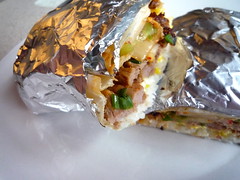
Roll and fold the burrito up tightly, and wrap with aluminum foil.

ssäm bburito 2 fig. e: ssäm bburrito 2

Devour.

Repeat as needed.

[we'd like to think this recipe is a Momofuku/AEB co-production, but mostly it relies on recipes from Momofuku by David Chang and Peter Meehan]

How did they turn out? Well, they tasted like "the greatest idea in the world."  The very greatest.

aj

Thursday, June 30, 2011

Thrill of the grill 2

Like I said, sometimes you just want the more immediate pleasures of barbecue, the thrill of the grill. And, frankly, sometimes only Asian skewers will do.

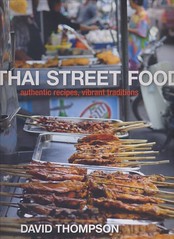
thai street 1 fig. a: Thai Street Food

It's safe to say that this latest spate of activity was inspired by David Thompson's rather impressive Thai Street Food. Like the major works of Jeffrey Alford and Naomi Duguid, Thai Street Food is richly photographed and over-sized, and much more than just a coffee table book: it's passionately written and comprehensive, it strives for the very heights of authenticity,* and its topic is much bigger than just "food." This is a book that's about the entire culture that surrounds the preparation and consumption of "single-plate food" on Thai streets and in Thai markets. It's also incredibly artful. Sure, there are dozens upon dozens of carefully composed studio shots of mouth-watering dishes like Crab Noodles From Chanthaburi and Stir-Fried Squid with Flowering Garlic Chives, but at least half of the photographs fall under the category of street photography and they can be remarkably gritty and purposely un-pretty.

thai street 2 fig. b: Thai market culture

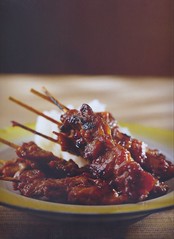
Anyway, it might have had to do with that cover photo, with those tantalizing satay skewers, but when it came time to give Thai Street Food a whirl, I found myself fixating on the grilled recipes, and especially the skewers. Photographs like this one,

thai street 3 fig. c: grilled pork skewers

for Grilled Pork Skewers, and the fact that Thompson begins his write-up for this recipe with the words "I am addicted to these," didn't hurt either.

He then continues as follows:

Along the street there are small grills, often just a large metal bowl with a rack perched on top. I'll stop and look and long for the fruits of their labour--smoky grilled skewers of pork. I'll smuggle some home as if carrying a guilty secret to relish in private. Sometimes, most of the time, I'll break into the cache on the way home.

It all sounded so illicit, so louche. By the time he got to describing the importance of charcoal to the process ("Using a charcoal grill imparts a depth of flavour that makes meat such as this grilled pork irresistible" [my emphasis]) I was 150% sold on those skewers.

Now the actual grilling time on Thai skewers like these is fairly short. After all, the pork is cut into small cubes and it's marinated. But you definitely don't want to grill them over a blazing-hot fire. The idea here is to use a fairly cool fire--Thompson recommends lighting the fire 30-60 minutes ahead of time, and waiting until the coals "glow gently." This isn't a smoked pork dish in the American tradition (ribs, pork shoulders, whole pigs), but smoke is integral to the process, so you want a fire in the neighborhood of 200º-250º F.

The marinade is positively heady. The meat is then basted with coconut cream on the grill. And the whole combination--the pork, the smoke, the marinade, the coconut cream--is pure thrills.

Grilled Pork Skewers

9 oz pork loin, neck, or shoulder
2 oz pork back fat (optional)

for the marinade:
1 tsp cleaned and chopped coriander roots
pinch of salt
1 tsp chopped garlic
1/2 tsp ground white pepper
2 tbsp shaved palm sugar
dash of dark soy sauce
2 tbsp fish sauce
2 tbsp vegetable oil

12-15 bamboo skewers
1/4 cup coconut cream**

Slice the pork into thinnish pieces about 1" square. Cut the pork fat, if using, into small rectangles (1" x 1/4").

Next make the marinade. Using a mortar and pestle, pound the coriander root, salt, garlic and pepper into a fine paste. Combine with the sugar, soy sauce, fish sauce and oil. Marinate the pork and fat in this mixture for about 3 hours. The more cautious can refrigerate this but, if doing so, then it is best marinated overnight.

Soak the bamboo skewers for at least 30 minutes before use.

Prepare the grill. Meanwhile, thread a piece of pork fat, if using, onto the skewer first followed by two or three pieces of the marinated pork. Repeat with each skewer. When the embers are glowing, gently grill the skewers, turning quite often to prevent charring and promote even caramelisation and cooking. Dab them with the coconut cream as they grill. This should make the coals smoulder and impart a smoky taste. Grill all the skewers.

On the streets, they are simply reheated over the grill to warm them through before serving, although this is not entirely necessary as they are delicious warm or cool.

[recipe based very, very closely on a recipe from David Thompson's Thai Street Food]

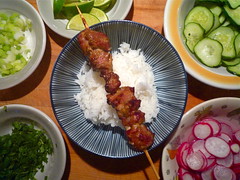
Not sure if Thompson would have approved--this being "single-plate food," after all--but we served ours with rice, cilantro, limes, and a selection of simple Asian pickles, and the spread looked something like this:

thai pork skewer fig. d: grilled pork skewers à la AEB

That smoky, caramelized pork was just layered with flavor. Thompson claims that the recipe "makes enough for 4-5," but we had a hard time putting a few skewers aside for the next day's lunch. He was right. They are irresistible.

aj

* For instance, in the introduction to Deep-Fried Salted Beef with Chilli and Tamarind Sauce, one finds this moment of authenticity: "The chilli and tamarind sauce is delectable. It can be served with any deep-fried meat or fish. I like to use maengdtaa fish sauce (made from rice roaches, bugs that scurry through the paddy fields), for its haunting aroma, but any good-quality fish sauce will do."

** More authenticity: Thompson highly recommends making your own coconut cream from scratch, a process that requires one to place the grated (or blended) coconut in cheesecloth and then "squeeze murderously, therapeutically, to obtain as much of the creamy goodness as possible." He does recognize that using canned coconut milk is "a more realistic option," however, and that's exactly what we've been doing up till now (although we're dying to make the real deal). The coconut cream is the clotted substance one finds in the top half of a can of coconut milk.

Even the canned variety imparts a wonderful flavor. One can only imagine what the artisanal stuff that one finds in Thai markets, some of which is perfumed with jasmine flowers or pandanus leaves (!), is like.