Saturday, January 08, 2011

In a Golden State 3: Tartine Bread

First, there was Tartine bread. Then, there was Tartine Bread.

fig. a: Tartine Bread

It had only been about eighteen hours since we'd touched down at SFO for our two-week Northern California vacation, but there we were, already back at Tartine Bakery. As you may remember, we'd spent a fair bit of time at Tartine Bakery on a previous tour of Northern California back in 2005. Breakfast, lunch, late-afternoon snacks, dessert, bread, coffee, wine, tea--we'd pretty much tried it all. In fact, we'd left the Bay Area so thoroughly acquainted with the whole Tartine experience, that as we made our way to 18th & Guerrero, it felt like we were going to visit an old friend.

Of course, the Tartine family had grown since the summer of 2005. Chad Robertson and Elisabeth Prueitt, Tartine's founders, opened Bar Tartine just a few blocks away from Tartine Bakery not long after our last visit. And we'd heard so many great reports about this latest venture over the years that it was right at the top of our "to do" list. But just as importantly, we wanted to make sure that Tartine Bakery--our original love--was more or less as we'd left it. We wanted to make sure that some things in life stay the same. Or, at least that some things can be depended on.  And as much as we couldn't wait to try their croissants, their morning buns, and their cookies again, what we were most excited about was Tartine's bread--their country and their walnut loaves. Which is why we actually visited Tartine Bakery twice on Day 1 of our trip--once to take a look around and have some sweets, and a second time to pick up a loaf of their country bread. Those fabled Tartine loaves are only available once a day--at around 5:00 p.m.--you either have to be very prompt, or you have to order your loaf ahead of time. We opted for the former strategy--we came back at 5:00 on the dot.

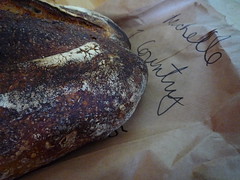
Now, like so many of the best things in life, Tartine's bread doesn't come cheap ($7), but it all makes sense as soon as you're cradling one of their loaves in your arms.  Tartine's country bread is one hefty loaf of bread (two pounds?). More importantly, it's a sight to behold, a veritable work of art.
michelle country fig. b: Michelle country

As you can see, it's perfectly baked, with a deep, dark amber color and a pronounced crust.

What you can't see is a) how good it smelled as we carried it away from the store, still warm from the oven, and b) how ridiculously good it tasted when we got it home and sliced it open. The crumb is mild, moist, and incredibly open-structured; the crust is hearty, caramelized, and bursting with flavor.

Put simply, Tartine's country bread was phenomenal. We had it with cheese, with soups, with sauces. We had it plain and toasted, and we used it to make sandwiches.  We had it for breakfast, lunch, and dinner. It was huge, so it lasted for days. And because it was a true sourdough, it barely staled. I would have happily paid good money for that loaf on Day 3, let alone Day 1. But we didn't have to. We were right there, so we went back again and again.

In case you're not getting the message, we couldn't get enough of Tartine's bread during our stay. We knew Chad Robertson had a bread book slated for release in the fall even before we left for California, and we were already pretty excited, but after eating Tartine's truly memorable sourdough loaves for two weeks, we were gripped with anticipation. We were also gripped with the DTs. Montreal's bread situation has gotten more and more dire over the years--when we got back home, our store-bought loaves paled in comparison. Literally.

Our copy of Tartine Bread finally showed up on our doorstep in early October (none too soon!), and we were immediately impressed. The book is amazingly thorough: it works through the basic method for the basic country loaf in extraordinary detail, provides a number of tantalizing variations on this basic method, then moves on to cover baguettes and enriched breads (including English muffins, brioches, beignets, and croissants), before closing with over 100 pages of recipes involving days-old** bread.

It's also richly illustrated. Robertson's principal collaborator on the project was Eric Wolfinger, a cook/baker/surfer/photographer, and together they'd wisely decided that a proper bread book should be heavily illustrated. How else to teach amateurs what, exactly, to be looking for? How else to teach them to pay attention to how bread behaves?

But just as importantly, the book was inspiring. Weaved into it was a life story, one that involved love, travel, apprenticeship, dedication, collaboration, and surfing (yes, surfing), one that was motivated by a fundamental faith in that fabled "daily bread"--what Robertson calls that "elemental bread that sustained generations."

I was totally taken by the whole thing. I read it through once. I read it through twice. And then I really dug in. And, just as Robertson promised, the results were magical.
country 1 fig. c: country

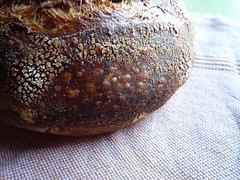
Right from the start, my loaves showed great oven spring, they had beautiful burnished crusts, and they were amazingly tasty, characterized by a surprisingly sweet (not sour and tangy), rounded wheat flavor. With a bit of practice, they started to look almost professional.
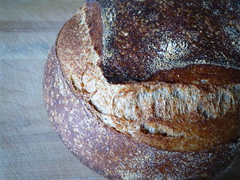
whole-wheat bread fig. d: whole-wheat

How was I getting such satisfying results so quickly? Well, Tartine Bread isn't just a thorough book on baking bread--it's also been specially designed for the home baker, so that even novices can get professional results from a conventional oven. If you've tried Jim Lahey's now legendary no-knead baking method, aspects of Robertson's approach should be very familiar.
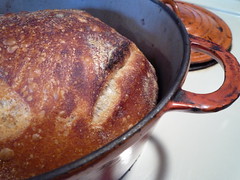
dutch oven & co. fig. e: dutch oven & co.

Like Lahey, Robertson employs the use of a Dutch oven in order to create the intensely hot and humid environment necessary to achieve a proper crust. Like Lahey, Robertson's dough is a much moister dough than you might be used to. It features an unusually high hydration level (75% in baker's percentages). This moistness is what makes Robertson's dough suitable for a no-knead method,* but it's also one of the reasons his recipe results in such a wonderfully tender crumb, not to mention a loaf with such staying power.

Tartine Bread was also rigorously tested for the home baker. Robertson assembled a team of test bakers to try out his Basic Country Bread recipe--the cornerstone of his method--then created a private blog so that notes could be circulated and data could be accumulated. The results were extraordinary:  "Many testers made exceptional bread, judged by professional standards--it was virtually indistinguishable from our own Tartine bread..." When it came time to assemble his book, Robertson realized that this test process held important lessons, and that profiling a few of his test bakers might provide his readers with the added encouragement they might need to roll up their sleeves and start making real bread at home.
tartine bread pix fig. f: Tartine bread pix

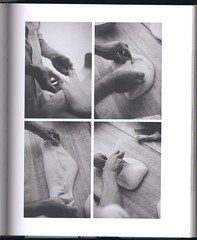
Finally, Tartine Bread isn't just richly illustrated, it's exhaustively photographed. Robertson worked closely with Eric Wolfinger on this book, and he took full advantage of his collaborator's skills as a photographer. There are a number of other excellent bread books out there that take pains to illustrate the processes of making bread in detail. Books like Jeffrey Hamelman's Bread: A Baker's Book of Techniques and Recipes and Rose Levy Beranbaum's The Bread Bible include some photographs, but rely mostly on line drawings. Jim Lahey's My Bread: The Revolutionary No-Work, No-Knead Method uses a lot of photographs, and it recognizes photography's ability to document step-by-step instructions in a way that goes beyond what line drawings can accomplish, but its use of photographs is timid compared to Tartine Bread.

While Lahey's photo-essay "The Basic No-Knead Bread Recipe in Pictures" is composed of 24 photographs, Robertson's instructions for his Basic Country Bread includes nearly 70 photographs, not including those that illustrate "Making a Starter." The difference here isn't only one of quantity. The seriality and precision of Wolfinger's photographs provide an invaluable reference when you're first getting used to the Tartine method. Together with the thoroughness of text (which is heavy on visual cues), they provide you with all the guidance you need to make successful loaves right from the start.

Results have been so good, and the experience of making real, honest-to-goodness sourdough at home has been so rewarding, that I've become a little obsessed. I haven't actually made that many of Robertson's bread recipes, to tell you the truth, but those I have made, I've made a lot of. So in addition to many, many loaves of the Basic Country Bread, I've made a bunch of walnut loaves, some polenta bread (with pumpkin seeds and rosemary!), some olive bread (with walnuts, lemon zest, and herbes de Provence!), and a few pizzas. Yeah, that's right, pizzas.***

There have been other signs of obsession, as well. Not only did I go out and purchase a 20 kg bag of white flour, not only did I photograph it (?),
oak 20 kg fig. g: 20 kg Oak

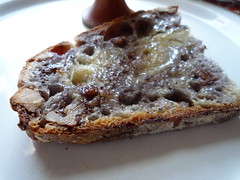
but I worked through that bag in about a month. I've also been taking bread photos--again, a lot of them. Whole loaves, like the photos above. Half loaves and cut loaves.
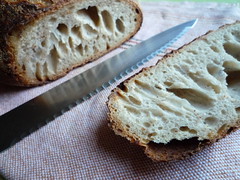
country 2 fig. h: still life 1

Slices.

walnut bread fig. i: still life 2

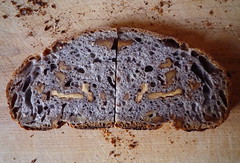
rorschach test fig. j: rorschach test

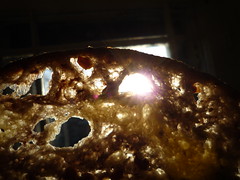
And a whole bunch of shots that highlight the bread's open structure.***
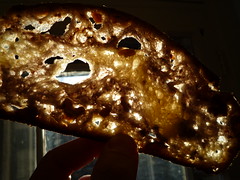
open structure 1
open structure 2 figs. k & l: open structure 1 & 2

No kidding. Baking sourdough does crazy things to you.

Just a few more notes:

Not only does Robertson insist that you don't need a professional bread baking oven to make professional quality bread, but he also insists that the flour you use isn't nearly as important as the process. This isn't to say that flour doesn't matter, or that all flours are created equal. Tests proved that the flour Robertson gets milled specially for Tartine resulted in the best loaves with the finest flavors. That said, combining conventional, supermarket-bought all-purpose flour with the Tartine method resulted in loaves that were professional quality and superior to the overwhelming majority of store-bought loaves. So there.

Robertson's method for making true sourdough bread is remarkably simple, but it still requires some investment. You're going to need some basic equipment, like a proper scale, a bench knife, a Dutch oven, etc., and you're going to need to be dedicated to reading through the process carefully, and being exact when it comes to following it. You also need to realize that while Robertson's method is somewhat less labor-intensive than other methods, it is time-intensive. The real secret to Robertson's bread has to do with letting the sourdough work its magic slowly and thoroughly. As Robertson puts it: "The baker's skill in managing fermentation, not the type of oven used, is what makes good bread. This fact makes Tartine Bread possible." So it does take a fair bit of time to get from feeding your starter to taking your finished loaf out of the oven, but the nature of the Tartine method is such that it's feasible to work sourdough bread baking into a busy schedule (although wouldn't you rather take your time, do it right, and enjoy the process?), and the book provides helpful strategies for doing so.

And, lastly, Tartine Bread isn't without its glitches (it is the first printing, after all)*****, but it's a remarkably rigorous book, and it's filled with pure inspiration from start to finish (from its Basic Country Bread, to its recipes for soups, salads, sandwiches, sides, and desserts), and I predict the book's impact on the state of baking in North America will be enormous. There was a reason Tartine Bread topped our list of cookbooks for 2010. There were a lot of great cookbooks that were released over the course of the year, but no other book held the potential to really shake things up that Tartine Bread does.

Long live "elemental bread"!

Tartine Bakery & Cafe, 600 Guerrero St., San Francisco, CA, (415) 487-2600

aj

p.s. Still need more convincing? For even more about Chad Robertson, Tartine Bakery, Tartine's Basic Country Bread, the test bakers, etc., check out Tartine's bread video.

* Instead of conventional kneading, his method relies on gently folding the dough in a bucket, a modern take on the tradition of trough kneading.

** Again, Tartine's loaves are so well made that they stale very slowly. They literally aren't stale enough on Day 2 to use in a recipe that calls for "day-old bread," hence, "days-old."

*** Robertson throws down on the topic of pizza, addressing some of the orthodoxies that have accompanied the pizza revolution of the last decade, and, in many ways, I think his common-sense approach is right on the money. He writes, "Our current pizza revival, with all the attitude, manifestos, and "secrets" (the flour! the water! the oven!), is amusing. Just start with good bread dough and a very hot baking stone, and you will end up with a great pizza." He's right, too. Get a handle on his Basic Country Bread recipe, and making amazing pizza at home is a snap. Seriously.

**** I, like so many others, was first inspired to find real French pain au levain after reading a profile of the late Lionel Poilâne in the pages of Smithsonian Magazine back in 1995 (you can find the abstract to the article here). I say "find," because for some reason, it never really occurred to me that I could make it at home. At least, not with a proper crust. Anyway, that article was a revelation, and it set me on a path to locate such bread so that I could taste what Poilâne was describing, but, more than anything, what I remember about the article was a photograph of a slice of his bread being held up to the light to show off its open structure.

***** For instance, the Whole-wheat Bread recipe (which is in process as I write) lists 20 grams of salt, but is unclear on when to add it. Whereas the Basic Country Bread recipe adds the salt (and a bit more water) to the dough after an initial resting period, the Whole-wheat Bread recipe, which requires more water because whole-wheat flour has a higher absorbency than white flour, adds all the water at once, and never mentions when to add the salt. Like many of the other recipes in the book, the Whole-wheat Bread recipe is a variation on the Basic Country Bread, and after a few different steps early on, it advises readers to "[follow] steps 5 through 9" of the Basic Country Bread recipe. Unfortunately, step 4 of the Basic Country Bread recipe is the one where the salt is added. Anyway, if you've worked through the Tartine method enough times, you figure it out.

Saturday, January 01, 2011

Goodbye to all that (2010 edition)

Song


Charlie Christian, Solo Flight: The Genius of Charlie Christian (CBS)

Charlie Poole, The Legend of Charlie Poole (County)


Kurt Vile, Childish Prodigy and Square Shells EP (Matador)

Michael Hurley, Blue Hills (Mississippi)

Mike Hurley, First Songs (Smithsonian/Folkways)

John Lee Hooker, Endless Boogie (ABC)

Black Mountain, Wilderness Heart (Jagjaguwar)

Metal Mountains, "Structures in the Sun" (Amish)

Cold Cave, Love Comes Close (Matador)

Dead Meadow, Old Growth (Matador)


Vashti Bunyan, Some Things Just Stick in Your Mind: Singles and Demos, 1964-1967 (DiCristina)

Ratatat, LP4 (XL)

Arcade Fire, "The Suburbs" (Merge)

The Six and Seven-Eighths String Band of New Orleans, s/t (Folkways)

The Dough Rollers, M.H. Merchant Stone House, Cornwallville, NY, June 2010

Joanna 1

Joanna Newsom, Have One on Me (Drag City)

Pylon, Chomp More (DFA)

Destroyer, "Archer on the Beach/Grief Point" 12" (feat. Tim Hecker and Loscil) (Merge Records)

Wolf Parade, Expo 86 (SubPop)

Townes Van Zandt, In the Beginning (Compadre) & s/t (Fat Possum)

Steve Earle, Townes (New West)

Rosanne Cash, "Girl From the North Country" (Manhattan)


Harlem, Hippies (Matador)

Fairport Convention, s/t (Polydor) and Unhalfbricking (Four Men with Beards)

Wendy René, "After Laughter" (Stax)

Big Star, "Motel Blues (Demo)," Keep An Eye on the Sky (Rhino)

Fleetwood Mac, Future Games (Reprise)

The Bee Gees, First (Atco)

Status Quo, "(April) Spring, Summer, and Wednesdays" (Pye)

Thee Silver Mt. Zion Memorial Orchestra, Kollaps Tradixionales (Constellation)

The Clean, "Changing Your Head," Unknown Country (Flying Nun)

Grinderman, Grinderman 2 (Anti)

V/A, Casual Victim Pile: Austin 2010 (Matador)

Ella Fitzgerald, Savoy Recordings, 1936-1937 (Savoy/ASV Living Era)


Captain Beefheart* & His Magic Band, Safe as Milk (Buddha) and sur le sable, Cannes, '68

Print

AEB cookbook of the year: Chad Robertson, Tartine Bread


Kermit Lynch, Adventures on the Wine Route: A Wine Buyer's Tour of France and Inspiring Thirst: Vintage Selections From the Kermit Lynch Wine Brochure

Everyday Harumi: Simple Japanese Food for Family and Friends

Michelle and Philip Wojtowicz and Michael Gilson with Catherine Price, The Big Sur Bakery Cookbook: A Year in the Life of a Restaurant


W. Somerset Maugham, Of Human Bondage

Jim Thompson, The Killer Inside Me

George Eliot, Silas Marner

James Beard, American Cookery

Joan Didion, Slouching Towards Bethlehem

Thomas Frank, The Wrecking Crew

Suzanne Goin with Teri Gelber, Sunday Suppers at Lucques

F. Scott Fitzgerald, Tender is the Night

Thomas Hardy, Far From the Madding Crowd

René Redzepi, Noma: Time and Place in Nordic Cuisine

Edward Behr, "The State of Pork: Iowa, Pigs, Corn, and Pasture," The Art of Eating (Spring 2010, no. 84)


Popular Plates BBQ: Across the Country with Roadfood's Jane & Michael Stern

David Pasternack and Ed Levine, The Young Man and the Sea: Recipes and Crispy Fish Tales From Esca

Moving Images

Errol Morris' First Person: The Complete Series

Inside Job, dir. Ferguson

Incendies, dir. Villeneuve


Ace in the Hole, dir. Wilder

Spartacus, dir. Kubrick

Exit Through the Gift Shop, dir. Banksy

Mr. Smith Goes to Washington, dir. Capra

The Man Who Shot Liberty Valance, dir. Ford

The Life and Death of Colonel Blimp, dir. Powell

The Housemaid

The Housemaid, dir. Kim Ki-Young

30 Rock

The Ghost Writer, dir. Polanski

The African Queen, dir. Huston

A Serious Man, dir. Coen

K Street

Traffik

Thieves' Highway, dir. Dassin


The White Ribbon, dir. Haneke

The Fighter, dir. Russell

The Office (U.S.)

Food and Drink

Kazu 3

AEB Montreal restaurant of the year: Kazu

AEB non-Montreal restaurant of the year: Flour + Water (San Francisco)

AEB pâtisserie of the year: Pâtisserie Rhubarbe, Mtl

AEB sandwicherie of the year: Saltie, NYC

eating your way across New York City

eating your way across Los Angeles

eating your way across Northern California

Le Comptoir, Montreal

100 Almond Curry

grits

Smith Island cake

AEB burgers

Lièvre à la royale + smoked suckling pig dinner for two + Gerard Schueller Riesling Bildstoecklé, 2007, Joe Beef

Fleisher's pork shoulders

MM @ KLWM

Kermit Lynch Wine Merchants, Berkeley, CA

tboc 3

Tomales Bay Oyster Company

baking Tartine bread at home

Les 400 Coups, Montreal

Bandol/Alsace night with friends


Oenopole

Miscellaneous

Stinson Beach, CA

Fort Tilden, NY

Rehoboth Beach, DE

Big Sur, CA

swimming on two coasts in two weeks

Les Étoffes, 5253 St-Laurent, Montreal

you light up my life

Machine Age lamps

This American Life

La Founderie, 6596 St-Laurent, Montreal

Essex County, NY

Prelinger Library, SF

learning to play bridge

New York High Line

Jericho Center, VT, Jericho, VT, and "Snowflake" Bentley

fall bazaars

...

Goodbye 2010, hello 2011!

...

Want to check out earlier lists of faves? Here are the links:

2005
2006
2007
2008
2009

am/km

* RIP

Tuesday, December 21, 2010

Our Own Private Vermont

her own private VT fig. a: Michelle, Shelburne Farms

Our own private Vermont is an awfully nice place. It's made up of many of the sites we've visited over the last ten years, as well as many of the tastes we've tasted. It consists of numerous trips and countless memories. 2010 had its fair share, so when we tried to figure out what we'd be serving at this year's AEB holiday bash, we ended up settling on a Vermont theme. Which, of course, meant we had to pay yet another visit to the Green Mountain state to stock up on Green Mountain goodies. And although we made sure to hit a few old favorites--like Al's for lunch, Shelburne Farms for aged cheddar, and Dakin Farm for ham and bacon--we also got a chance to visit a few new places and further expand our Vermont.

settlers sunset

settlers shadow figs. b & c: Jericho sunset, Jericho shadow

We arrived at Jericho Settlers Farm in Jericho Center just as the sun was setting, and consequently the light was as gold as it gets and the shadows were as long as can be.

settlers farmstand fig. d: Settlers' farmstand

We'd read some great things about Jericho Settlers Farm's pastured meat, and especially their pastured heirloom pork. We'd also read that you could get their meat in Burlington, but we were curious to see what the farm looked. And with that sun setting, and fresh snow on the ground, it looked pretty heavenly.

There was no one around, but Jericho Settlers Farm has a farmstand that's open to the public 365 days a year, and it runs on the honor system (!).

settlers birds fig. e: Settlers' birds

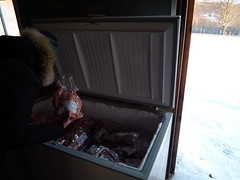
We stepped inside, took a look around,

settlers freezer fig. f: Settlers' freezer

and made some selections. We were pretty focused on their pork, beef, and chicken,

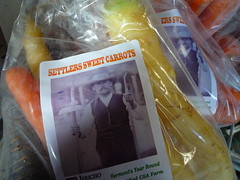
settlers sweet carrots fig. g: Settlers' sweet carrots

but we were happy to see that they had some root vegetables for sale too, so we added some beautiful multicolored carrots and some fingerling potatoes to our bag and logged our purchases. We noticed that we were the first farmstand customers of the day, which is hardly surprising, I guess, because Jericho Settlers Farm operates primarily as a CSA.

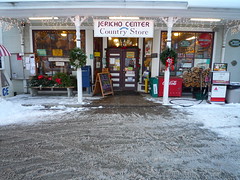
Jericho Center Country Store fig. h: Jericho Center Country Store

Just down the road, in the very center of Jericho Center, we found the Jericho Center Country Store, one of the oldest continuously operating country stores in all of Vermont (since 1807!). The interior is a true treasure trove--it's filled to the rafters with antiques and memorabilia from its 203-year history--and in addition to all the usual country store staples, they also carry meat from Jericho Settlers Farm, in case the farmstand happens to be closed.

In the village square, directly across the street from the country store, Michelle noticed a historical marker that told the story of Wilson Alwyn "Snowflake" Bentley. I had no idea who she was talking about, so she filled me in (scientist, photographer, snowflake specialist) on the ride out of town.

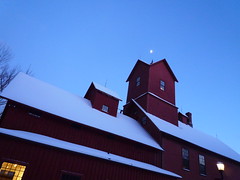
Old Red Mill fig. i: Moonlight on Vermont

A few minutes later, in Jericho (not to be confused with Jericho Center), we spotted an old red mill and decided to take a closer look.

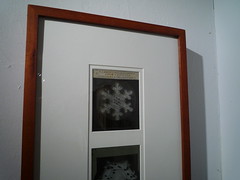
snow crystals by W.A. Bentley fig. j: snow crystals by "Snowflake"

And inside the Old Red Mill (a.k.a., the Jericho Historical Society), not only did we find reproductions of the work of "Snowflake" Bentley for sale, but we also found a small museum display on his life and work. It included quite a number of Bentley's original photographs and slides of (what else?) snowflakes,

Bentley quilt fig. k: 19th-century Op Art

but it also included this magnificent quilt made by old mother Bentley.

On the way back home to Montreal, we listened to some episodes of This American Life that we'd collected on our mp3 player. One of the segments was a story of fate, faith, and destiny, chance and coincidence, and much of the segment focused on events that occurred in and around the town of Snowflake, AZ--a town that had been founded by two men, one named Snow and the other named Flake. Apparently, still to this day, half the town is named Snow and half is named Flake. Presumably there are a few Snow-Flakes there too.

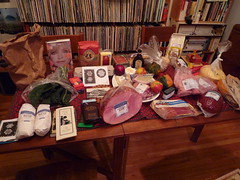
When we got back to our neighborhood, I dropped Michelle off at home and then set off again to find a parking spot. When I returned our dining room table looked like this:

the loot fig. l: L is for loot

And a few days later we threw our Our Own Private Vermont party, featuring a smoked country ham from Vermont glazed with a mustard-maple syrup concoction, a selection of Vermont cheeses (Shelburne Farms' nutty, crumbly 2-year cheddar and Jasper Hill impossibly creamy Moses Sleeper and Bayley Hazen blue, Lazy Lady's lovely ashed Trillium, and Von Trapp Farmstead's [yes, those Von Trapps] washed-rind Oma), and some baked beans made all the more succulent with 100% pure maple syrup and a smoked ham hock from Jericho Settlers Farm. Completing the scene was a white birch.

Martha's Maple-Mustard Glazed Ham

1 whole (18-lb) bone-in, fully cooked, smoked ham, room temperature
1/2 cup champagne vinegar
1 cup 100% pure maple syrup
2/3 cup Dijon mustard
2 tbsp apricot jam
pinch of kosher salt
freshly ground black pepper

Preheat oven to 350º F. Line a roasting pan with heavy-duty aluminum foil.

Rinse ham under cool running water. Pat dry and wrap with parchment paper-lined aluminum foil; place in prepared roasting pan. Transfer to oven for 4 1/2 hours.

Meanwhile, in a small saucepan, heat vinegar over medium-high heat until reduced to 2 tablespoons, about 6 minutes. Add maple syrup, mustard, jam, and salt; season with pepper. Cook, whisking, until well combined, about 2 minutes. Set glaze aside.

Remove ham from oven and uncover. When cool enough to handle, cut off rind using a sharp knife. Slice off most of the fat, leaving a 1/4-inch-thick layer. Score fat on top of ham in a pattern of 1- to 2-inch diamonds.

Brush ham evenly with one-third of the glaze and return to oven. After 20 minutes, brush ham again with half the remaining glaze. Cook for 15 minutes and brush with remaining glaze. Continue baking ham until an instant-read thermometer inserted into thickest part of ham reaches 145 to 150 degrees, about 15 minutes more.

Transfer to a cutting board. Let ham cool 30 minutes before carving.

Serves a whole lot of people.

Note: We used half a ham (9 lbs) and adjusted the recipe accordingly. We fed 30+ guests.

[Martha Stewart ain't from Vermont, but she makes an awfully good maple-mustard glazed ham. This is pretty much exactly her recipe]

Jericho Settlers Farm, 22 Barber Farm Road, Jericho Center, VT, (802) 899-4000

Jericho Center Country Store, 25 Jericho Center Circle, Jericho Center, VT, (802) 899-3313

The Old Red Mill, Route 15, Jericho Village, VT, (802) 899-3225

If you're intrigued by the sound of Jericho Settlers Farm's pastured meat, but you can't make it out to Jericho Center, you can also find their meat at a massive health food store in South Burlington called Healthy Living (which lies in close proximity to Al's French Frys and South Burlington's Dakin Farm outlet, conveniently enough). They've got an outstanding meat counter with a wide range of organic, pastured, and artisanal meats on offer, and a talented butcher who offers workshops on everything from butchering to sausage-making.

Healthy Living, 222 Dorset St., South Burlington, VT, (802) 863-2569

For more on Jericho Settlers Farm's heirloom pork, as well as the state of sustainable, humanely raised pork production in America, please consult Edward Behr's in-depth report in The Art of Eating #84.

aj

Monday, December 20, 2010

The Mighty Bûche

xmas 2010 fig. a: the look of xmas 2010

In case you didn't get the memo, it is that time of year again. Time to deck the halls with boughs of holly. Time to get lit on egg nog. Or if you're feeling especially adventurous, time to contemplate making your very own bûche de noël.

Now, here at AEB, we've been known to lean toward pastries that have a bit more of a Central and Eastern European inflection during the holidays, but there are exceptions. Plenty of them, actually. And most of them involve candied fruit in one way or another: there's panforte, panettone, and stollen, plum pudding, mincemeat tarts, and fruitcake. But one Christmas dessert that has never really been a big part of Michelle's repertoire is the traditionally French (and by extension, French-Canadian) bûche de noël, the yuletide log in pastry form. Michelle learned to make a professional-caliber bûche de noël in pastry school, of course--Quebec's pastry schools are nothing if not classical--but when she bakes Christmas goodies for our home, she dreams of sugar plums and crescent moons, wasps' nests and infant Jesuses.

All that said, when Ève Dumas of La Presse approached Michelle with an intriguing proposition--what if you were to re-imagine the bûche de noël to reflect your family roots--she couldn't pass it up. Suddenly the mighty bûche took on new relevance.*

In terms of appearance, Michelle modeled her bûche de noël after the beautiful white birches (les bouleaux) that are such an important part of our forests here in la Belle Province (and in the Northeast in general);

graffiti fig. b: white birch

and in terms of taste, she gave it a torte-like character that drew from her Central European heritage.

The result was a walnut cake with mocha filling, one that came liberally spritzed with rum and iced with a white meringue with beautiful brûlé accents. It looked like this:

birch bûche fig. c: birch bûche 1

The recipe ran in La Presse at the end of November, but Michelle wasn't crazy about the accompanying photograph. The photographer chose a low angle, probably to highlight the cake's "tree rings," but in doing so he lost most of the cake's birch-like qualities.

birch bûche 2 fig. d: birch bûche 2

Which is why we decided to run the recipe again here, with new photographs.

Feeling inspired? Here's the recipe as it appeared in La Presse (with translation courtesy of Yours Truly):

Gâteau à rouler/cake roll (10 personnes)

Ingrédients

2 oeufs/eggs

3 jaunes d'oeufs/egg yolks

1/4 de tasse de sucre/cup of sugar

4 c. à soupe de farine/tbsp flour

4 c. à soupe de fécule de maïs/tbsp corn starch

1/2 t. de noix de Grenoble/cup walnuts

Préparation

Mélanger la farine, la fécule et les noix dans un robot culinaire pour faire une farine et réserver. Chauffer les oeufs, les jaunes et le sucre dans un bain-marie en brassant, jusqu'à ce que ce soit chaud. Fouetter jusqu'au ruban (lorsque le mélange tient sa forme en tombant) avec une mixette ou un batteur sur pied.

[Preheat oven to 350ºF. Blend the flour, starch, and walnuts in a food processor until powdered and well mixed, then set aside. Heat the eggs, the yolks, and the sugar in a double-boiler, stirring constantly, until the mixture is hot to the touch. Whip with a mixer or a standing mixer until the egg mixture "holds a ribbon."]

Ajouter les ingrédients secs avec une maryse en faisant attention de pas trop mélanger. On ne veut pas faire tomber l'appareil. Étendre sur une plaque à biscuits (18" x 13") couverte de papier parchemin ou d'un tapis en silicone.

[Add the dry ingredients and fold in with a spatula taking care not to overmix so that lose volume. Spread on a parchment paper-lined baking sheet or a Silpat™.]

Cuire de 8 à 10 minutes à 350°F, jusqu'à ce que le gâteau soit doré. Couvrir tout de suite avec un linge humide et laisser refroidir.

[Bake 8 to 10 minutes, until the cake is golden. Cover with a damp towel and let cool.]

Crème mocha/mocha cream

Ingrédients

1 t. de chocolat noir haché/cup of chopped dark chocolate

1/4 de tasse d'espresso chaud/cup hot espresso

1/2 c. à thé d'espresso en poudre (de type Nescafé)/teaspoon powdered espresso (such as Nescafé™)

1/3 de livre de beurre mou/pound softened butter

1/3 de tasse de sucre à glacer/cup icing sugar

2 jaunes d'oeufs/egg yolks

Préparation

Dans un bain-marie, faire fondre le chocolat avec le café et le café en poudre. Réserver à la température de la pièce.

[In a double-boiler, melt the chocolate with the espresso and the espresso powder. Set aside and keep at room temperature.]

Avec une mixette, battre le beurre et le sucre jusqu'à ce qu'il soit léger. Ajouter les jaunes et mélanger. Ajouter le chocolat fondu et mélanger encore jusqu'à ce que ce soit homogène.

[With a mixer, beat the butter and the sugar until they are fluffy. Add the yolks one at a time and mix. Add the melted chocolate mixture and mix some more until thoroughly combined.]

Glaçage meringue/meringue icing

Ingrédients

4 blancs d'oeufs/egg whites

1 t. de sucre/cup of sugar

Préparation

Faire chauffer les blancs et le sucre au bain-marie, en brassant.

[Heat the egg whites and the sugar in a double-boiler, mixing all the while.]

Fouetter jusqu'à formation de pics moyens.

[Place mixture in a mixer and whip until it forms medium peaks.

Assemblage/assembly

1 oz de rhum brun (ou plus!)/ounce dark rum (or more!)

Feuilles de laurier fraîches/fresh bay leaves

Canneberges fraîches/fresh cranberries

pine branches

Démouler le gâteau à l'envers sur un morceau de papier parchemin et enlever l'autre morceau de papier avec délicatesse. Couper les bordures pour faire des côtés droits. Badigeonner le gâteau avec le rhum brun.

[Unmold the cake onto a piece of parchment paper and remove the other piece of parchment paper carefully. Trim the edges to make right angles. Brush the cake with the dark rum.]

Étendre le glaçage chocolat avec une spatule coudée. Couvrir toute la surface.

[Cover the entire surface of the cake with the chocolate cream using an offset spatula.]

Lentement, commencer à rouler le gâteau dans le sens de la longueur. Le papier va vous aider.

[Slowly roll the cake lengthwise. The parchment paper should make this process easier.]

Couvrir la bûche avec la meringue. Pour obtenir l'effet bouleau, adopter un mouvement de côté à côté, et non en longueur.

[Cover the bûche with the meringue icing. To get the birch effect, use a side-to-side motion, instead of applying the icing lengthwise.]

Faire colorer la bûche avec le chalumeau. Commencer tranquillement, sinon ça va faire l'effet d'une bûche dans le foyer! Si vous n'avez pas de chalumeau, saupoudrer de la poudre de cacao (dans un tamis fin) au-dessus de la bûche pour créer une texture.

[Use a torch to give the bûche its brûlé highlights. Start gently, otherwise you might get a burnt log effect instead. If you don't own a torch, you can dust the surface with cacao powder instead to give it some texture and highlights.]

Disposer les feuilles de laurier autour, puis les canneberges.

[Garnish with bay leaves, cranberries, and pine branches according to desire.]

Servir la journée même. Sinon, faire le gâteau et le remplir la veille. Bien emballer et mettre au frigo. Finir avec la meringue le lendemain.

[Serve the cake on the day you make it. If you'd rather make it the day before, make the cake, fill it, and roll it, then wrap it tightly with plastic wrap and keep refrigerated. Ice the cake with the meringue and decorate it the next day.]

Makes one bûche, roughly 18" in length.

Now, once you've made your very own bouleau de noël/yuletide birch, the only thing left to do is to invite some folks over for the log-sawing ceremony. Make a batch of punch or some egg nog, some mulled wine or glögg, and send out invitations to friends and family.

Our AEB ceremony looked like this as things got underway.

bûche-serving ceremony fig. e: sawing log

What you can't see are the 20+ ravenous souls who were standing/sitting/crouching off-camera, just waiting for their own slice. Within an hour or two, there was nothing left of that 3-foot monster bûche but the branches.

aj

p.s. Thanks to all those who helped us burn through our log in record time!

p.s. No time? Holidays got you frazzled? Get your very own ever-so-stylishly deconstructed bûche from Pâtisserie Rhubarbe.

* For one thing, there was no reason it had to look so Smurfy.

Tuesday, December 07, 2010

Some Candy Talking, 2nd rev. ed.

the set-up fig. a: the set-up

If you couldn't attend last night's class on candying fruits and holiday baking led by Michelle and hosted by Natasha, Bernie, and Dépanneur Le Pick Up, and you're curious about what it looked like, well, the scene was something like this as Michelle launched into her introductory remarks.

the class fig. b: Michelle in effect

We're happy to report that attendance was 100%, in spite of the chaos and headaches that inevitably accompany the season's first real snowstorm. Plus, everyone showed up with their "A" game--they were eager, enthusiastic, and ready to roll up their sleeves and do some cookin'. The class was loose, fun, participatory, and it finished with the distribution of the night's booty, which included wedges of panforte, slices of stollen, cookies, and jars of candied fruit.

who's that girl? fig. c: who's that girl?

Michelle has posted quite a number of recipes, ideas, helpful hints, and other tidbits of information regarding the making and using of candied fruits here in the pages of AEB over the years. So, if you're interested in the topic, you weren't able to attend (space was extremely limited), and/or you're prepping for the holidays, you might want to check out the following links:

candying Meyer lemon peel

making fruitcake with exotic fruits

making homemade panettone

making panforte

making the world's most expensive marmalade

and last, but certainly not least, making quince paste

Finally, thanks to Natasha for organizing, to Bernie and the Dep for hosting, and especially to everyone who took part in the course. The idea is that Michelle's class was the kick-off to a cooking class series at Dépanneur Le Pick Up, so stay tuned to these two blogs for any and all information about upcoming events.

am/km

p.s. If you're interested in a somewhat less biased (and much more thoroughly photographed) account of Michelle's night of candied fruits, check out this link to the Gastronomeal blog. You won't be disappointed.

p.s. 2 Still hungry for more photographs? Check out the extensive coverage at Dépanneur Le Pick Up's blog!

Monday, December 06, 2010

Hear, ye! Here, ye!

Wow, that was quick.

MM @ CBC 2 fig. a: MM @ CBC #2

For those of you who missed Michelle being interviewed on yesterday's edition of All in a Weekend, you're in luck--the interview's already available. Just click here, and you'll be taken to the CBC's "Listen Again" archive.  Scroll down the list, click on the appropriate tab next to the words "Michelle Marek," and you'll get to hear Michelle and Jeanette Kelly having a chat about desserts, candied fruits, holiday baking and more.

And for those of you who'd like to see the dessert that Jeanette was sampling during the interview, it looked something like this,

apple fig. b: apple x 3

minus the dulce de leche ice cream (which would have melted en route).

However, if you'd like to actually try the dessert Jeanette tried, sorry, no link, no photograph will do. You're just going to have to go and visit Laloux (or Pop!) in person.

aj

Sunday, December 05, 2010

AEB @ CBC

MM @ CBC fig. a: Michelle! Live!! On Air!!!

Actually, it was more like "MM @ CBC," because that's where Michelle was to be found today at about 7:40 am: on air, with the CBC's Jeanette Kelly. I was in-studio, too, but only to lend moral support (and to snap a photograph or two).

The occasion? Well, Michelle has a cooking class on candied fruits and how to use them tomorrow evening at Dépanneur Le Pick Up, and when the good folks at All in a Weekend caught wind, they asked her down to the studio to say a few words about candied fruits, holiday baking, being in the restaurant biz, and how she got into this pastry chef racket in the first place.

If you're thinking to yourself, "what's the point of telling us after the fact?," well, Michelle specifically asked me not to advertise her guest spot on AEB. She told me she was shy. Then she went ahead and tweeted all about it, unbeknownst to me. Go figure.

Anyway, I bring up the matter only to tell you that if you're interested in taking Michelle's class, you might still be able to. The class was SOLD OUT, but as of this morning, there was one spot available because some unlucky soul had to cancel. So if you contact Natasha at "natasha DOT pickowicz AT gmail DOT com"--in a hurry!--you might just be able to join us for the fun. And, if you missed this morning's broadcast, our friend Graham at "All in a Weekend" told us that they'd be archiving Michelle's interview later this week, so we should be able to post the link sometime soon.

How'd the interview go? Great. Michelle was a little more buttoned-down than usual, and 7:40am is a little early for a pastry chef/night owl like her, but she loved talking to Jeanette, and Jeanette really enjoyed talking to Michelle, and the fact that Michelle brought in some treats (ginger cookies!) didn't hurt either.

Can't make the class? Missed the radio show? Feeling shut out? Well, you can find an AEB-approved recipe for panforte (with candied fruit) here.

Now we're back at home, having a coffee, enjoying the morning, and listening to Michael Hurley sing about having tea and listening to the CBC...

aj

Wednesday, December 01, 2010

Top Ten #38

Me'al Moun'ains

1. Metal Mountains, "Structures in the Sun" (Amish Records)

2. Errol Morris' First Person: The Complete Series

country 1

3. Tartine basic country bread

4. W. Somerset Maugham, Of Human Bondage

wade in the water

5. Destroyer, "Archer on the Beach/Grief Point" 12" (feat. Tim Hecker and Loscil) (Merge Records)

6. Kermit Lynch, Adventures on the Wine Route: A Wine Buyer's Tour of France

blue hills

7. Michael Hurley, Blue Hills (Mississippi Records)

8. Soirée Choucroute, Pop!, feat. James MacGuire, Nov. 29, 2010

9. Anvil: The Story of Anvil, dir. Gervasi

black moun'ains

10. Black Mountain, Wilderness Heart (Jagjaguwar)

aj