Saturday, March 06, 2010

New York Winterlude 2, rev. ed.

Day 2 of our Winterlude began with us roughing it on breakfast (we packed a makeshift Schaller & Weber sausage special), and hitting the pavement. I had some business to attend to, so I dragged Michelle on an architectural tour of Lower Manhattan that began with us emerging from the subway underneath the Municipal Building,
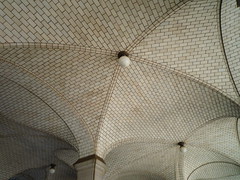
municipal bldg. fig. a: up from the underground

and focused on an area around the intersection of Broadway and Wall Street.

cloud-scrapers fig. b: cloud-scrapers of New York

It also involved me posing Michelle in front of locations from old films and tempting her with hot dog carts.
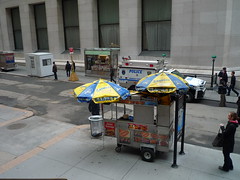
wall st. 1
wall st. 2 figs. c & d: Wall Street

By lunchtime, we'd made our way back to Midtown and had the time to check out Raymond Hood's News Building en route to a lunch date Michelle had arranged for us.
encounters at the end of the world fig. e: under the Hood

I'd read a fair bit about Tudor City over the years, but I'd never seen it up close until this visit, in February 2009.
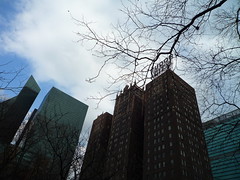
tudor city fig. f: cloud-scrapers of Midtown

It took a reservation at Michael White's Convivio to finally get up close and personal with Fred C. French's strange Tudor Modern (Early Modern Modern?).

convivio 3 fig. g: Early Modern Mod

New York magazine described White as "the Mario of Midtown." As much as we may be big fans of Mario Batali's cookbooks, we wouldn't know. One visit to Batali's Otto hardly seems like enough of a measuring stick. What we can tell you, however, is that Convivio is a true jewel.
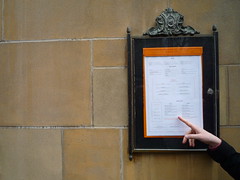
convivio 2 fig. h: the writing is on the wall

In fact, it's quite likely the finest Italian restaurant either of us has ever visited. Expert antipasti featuring house salumi, a supernaturally plump, juicy grilled quail appetizer, homemade pasta with crab and a truly luscious sea urchin-based sauce, and a utterly superior grilled bistecca were just some of the pleasures of one of our absolute top meals of 2010.

The lowdown:

sfizi: marinated shitaakes, mellow pickled cucumbers, spicy olives w/ spicy salami, burrata with tomatoes and herbed oil w/ toasts

antipasto: grilled quail skewer, bacon, onions, shitakes, chives, vin cotto

primi: cod-stuffed ravioli, many egg-yolk pasta, sausage, rapini, herbed oil; saffron gnocchetti, crab, sea urchin, breadcrumbs

secondo: bistecca, grilled, w/ winter vegetables (carrots, brussels sprouts leaves, etc.) and a peppery wine sauce

dessert: lemon semifreddo, pistachio sablé, candied pistachios, acacia honey wafer, candied citrus peel, acacia honey ring with vanilla bean
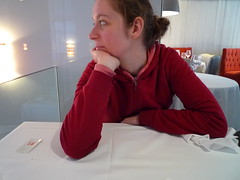

convivio 1 fig. i: Convivio dreaming

And while on this particular occasion we'd decided to cut loose and splurge a little, we realized that lunch at Convivio had the potential to be very affordable indeed. Portions were surprisingly generous, and we pictured ourselves returning and having a (transcendental) pasta lunch at Convivio's bar.
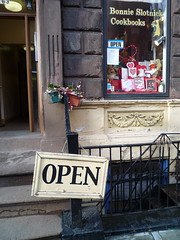
bonnie slotnick 1 fig. j: exterior, Bonnie Slotnick

As you know, we've scoured other New York bastions of culinary arts & letters before, but, oddly, this was the first time we'd visited Bonnie Slotnick. Not for lack of trying, though. We'd tried to visit on two or three occasions, but had always managed to swing by on days where the store happened to be closed (in spite of its well-deserved notoriety, Bonnie Slotnick remains a very small operation, so hours can be irregular).
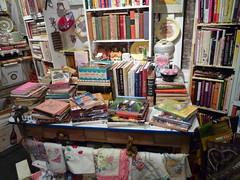
bonnie slotnick 2 fig. k: interior, Bonnie Slotnick

Anyway, we were happy to finally get a chance to explore Bonnie Slotnick. Not surprisingly, we found plenty of material to keep us occupied and broaden our horizons, so we ended up spending about two hours there. We also had a long conversation with the chatty, gracious clerk (Bonnie passed through at one point to drop off her latest haul of books, but otherwise she was on the hunt). We could have easily spent another two hours. It felt like a home away from home.
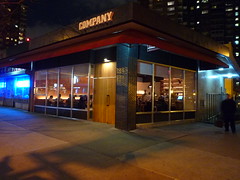
company fig. l: electric Company

That night we met R & M at Jim “Our pies are not always round" Lahey's (then) newly opened Company (a.k.a. Co., but not to be confused with David Chang's Ko). We'd heard great things, our Sullivan Street slices the day before had gotten us good and primed, and Co. didn't let us down in the least. Okay, so the pies weren't always round, but we found them perfectly cooked with great structure and just the right amount of blistering, with a tomato sauce that was tangy and bright, and toppings that were novel without being too "fusion." As is so often the case with top-notch pizza (and the pies we had that night were definitely top-notch), the simplest pies are often the most satisfying. So, for instance, as much as we appreciated Co.'s Flambé, with béchamel, lardons, and caramelized onions, it was their Margherita that really stood out for us. In fact, Co.'s margherita was so lovely, so perfect, we opted for a second one "for dessert." We loved the space, the service, and the buzz of the place too.

The lowdown:

appetizers: pizza bianca; toasts, e.g. with lemony chicken liver paté; butter lettuce salad w/ roasted squash, pumpkin seeds, lemon, olive oil

mains: 2 x margherita; 1 pie w/ anchovies, green olives, olive oil, tomatoes; 1 "santo" w/ shaved radicchio, parmesan, taleggio, mozzarella; 1 special w/ bechamel, leek, spicy sausage

desert: homemade blood orange gelato; homemade chocolate gelato; a generous banana split w/ homemade ice cream and candied walnuts


We haven't to spend a lot of time on this stretch of 9th Avenue when we visit New York, but, here too, we swore we'd be back.

Convivio, 5 Tudor City Pl., New York, NY, (212) 599-5045

Bonnie Slotnick Cookbooks, 163 W 10th St # Ge, New York, NY, (212) 989-8962

Company, a.k.a. Co., 230 9th Ave., New York, NY (212) 243-1105

aj

Monday, February 22, 2010

New York Winterlude 1, rev. ed.

self-portrait w/ snow fig. a: several large men's footprints, one giant shadow

Maybe it's the fact that Snowpocalypse 2010 has had me thinking of our friends to the south. Then again, maybe it's just that Sam Sifton's review of Motorino this week has left me in a tizzy--a pizza tizzy. Whatever, the case, I finally got around to revising a post that got started about a year ago, not long after a short, sweet mid-February New York Winterlude in early 2009.

It went something like this:

Day 1 began with us having to move our car out of our Midtown, 2nd Ave. parking spot by 8:00 am to avoid getting a nasty ticket. We weren't planning on using the car while we were in New York, but once we got in the car, we figured, "if we have to move it anyway, might as well get some use out of it, right?" So we went about as far crosstown as you could possibly go, to Jim Lahey's Sullivan Street Bakery on W. 47th near 11th Ave. A little crazy, I know, especially when you're on vacation, but Michelle had a hankering for croissants and I had designs on some of their famous flatbreads, so... Plus, we had plans to visit Lahey’s just-opened Co. later in the trip, so this was research.

They'd just opened when we arrived, and they were still very much in the process of setting up shop, but they had plenty of fresh croissants on hand and their counter display already looked pretty appealing.

sullivan st. bakery fig. b: display case, Sullivan St. Bakery

So we grabbed a couple of croissants, and a couple of slices and headed back through the crosstown traffic and the mayhem in search of coffee.

michelle nyc fig. c: Michelle & Juan

We didn't find any of New York's "serious" coffee shops, but we did find Juan Valdez, and he was happy to serve us.

central park east fig. d: sous les pavés, la forêt

Day 1 was all about Midtown and the Upper East Side. We were lucky enough to be staying with friends on E. 57th, and we had museums we wanted to visit, so we put our car in long-term parking and hit the pavement.

sullivan st. potato pie fig. e: Sullivan St. Bakery's potato pie

By the time we reached the Met, we were a little peckish again, so Michelle pulled out a slice of Sullivan Street's lovely potato pie that she'd wisely stashed in her backpack, and we refueled in Central Park. We love their basic marinara slice, but those guys definitely have a way with potatoes. Look how golden they are!

campbell prunes fig. f: one in a thousand

Our main reason for going to the Met was to check out their "Walker Evans and the Picture Postcard" exhibition, which displayed hundreds of artifacts from Evans' gargantuan personal collection of early 20th-century postcards (including this beauty depicting plums being dried into prunes in Campbell, CA) and made a very interesting argument about how this collection influenced his work. It was a phenomenal exhibit, but, I have to say, it attracted a strange crowd. It was a compact exhibition too, so it wasn't as though you could get away from all those weird people with their loud voices and their bad attitudes. It felt more like an antiques show than that contemplative museum experience I've heard so much about.

arbus postcard fig. g: To: Walker Evans; From: Diane Arbus

Even with all those difficult people, we still had a great time, and we particularly liked this postcard from Diane Arbus to Walker in particular, with its idiosyncratic script and its curious left field reference to Evans' talents in the kitchen (and his way with potatoes).

fancy feet 1 fig. h: fancy feet 1

Afterwards, we made the most of our donation and toured a fairly wide cross-section of the Met's collection, but we were particularly taken by the Medieval tapestries.

fancy feet 2 fig. i: fancy feet 2

By mid-afternoon, we had made our way up the street to the Neue Galerie. In part, so that we could immerse ourselves in its Mitteleuropean splendor.

return to café sabarsky fig. j: return to Café Sabarsky

But mostly, so that we could pay a repeat visit to our friends at Café Sabarsky. This was our first time having a full meal at Café Sabarsky, and I suspect it won't be our last. Goulash, sausage and rotkohl, beer, kaffee und kuchen--we were in Hapsburg Heaven.

The lowdown:

mains: weisswurst w/ potato salad and mustard; goulash soup w/ potatoes

desserts: sabarsky torte; milchrahmstrudel


schaller & weber fig. k: Schaller und Weber

So much so, in fact, that when we asked about our amazing weisswurst and found out it came from the legendary Schaller & Weber, we made that our very next stop. There we bought some more weisswurst and some frankfurters, and some of their famously spicy house mustard, and we admired their whimsical beer paraphernalia.

shad is here! fig. l: Shad is here!

Speaking of repeat visits and old favorites, that night we had a hankering for seafood, so we went back to visit our friends at the Grand Central Oyster Bar. We love the atmosphere at the bar--the mix of regulars, tourists, and the seasoned staff, the banter, the repartee--and GCOB’s selection of oysters on the half-shell is always impressive. We ordered a cross-section of house specialties--baked, fried, stewed, and raw (representing Long Island, the Chesapeake, Nova Scotia, and Washington)--and a round of beers, and we settled right in.

The lowdown:

appetizer: clams casino

raw bar: blue points; bras d'or; kumimoto; royal miyagi

hot dishes: oyster stew; clam pan roast


the campbell apartment fig. m: inside the Campbell Apartment

Afterwards, we found out our friends R & M had a little surprise in store for us: a nightcap at the Campbell Apartment, the cocktail bar that occupies the former office of William J. Campbell, a financier and railroad tycoon. A former office in a railway station. Sounds glamorous, right? Well, this was no ordinary office. Campbell evidently had a thing for the Northern Italian culture of the late Middle Ages--he spent loads to have the place decked out in medieval Florentine splendor, and just to make sure everyone understood that he had money to burn, he placed a huge, imposing safe in his sizable fireplace. Campbell’s 3,500 sq. ft. office has been fully renovated to its previous splendor (including the safe), but now much of the space is taken up by a big, old bar, and the Campbell Apartment functions as a swanky cocktail bar. Talk about a nightcap!

To be continued...

Sullivan Street Bakery, 533 West 47th Street, New York, NY (212) 265-5580

Colombian Coffee Federation/Juan Valdez Coffee, 140 East 57th Street, New York, NY (917) 289-0981

Café Sabarsky, 1048 5th Avenue, New York, NY (212) 288-0665

Schaller & Weber, 1654 2nd Avenue, New York, NY (212) 879-3047

The Grand Central Oyster Bar, 89 East 42nd Street, New York, NY (212) 490-6653

The Campbell Apartment, 15 Vanderbilt Ave., New York, NY (212) 953-0409

Monday, February 15, 2010

Top Ten #33

the big sur bakery cookbook

1. Michelle and Philip Wojtowicz and Michael Gilson with Catherine Price, The Big Sur Bakery Cookbook: A Year in the Life of a Restaurant

2. Steve Earle, Townes

3. The AEB Burger


4. Fitzcarraldo, dir. Herzog + My Best Fiend, dir. Herzog (again)


5. Pylon, Chomp More

6. Lièvre à la royale + smoked suckling pig dinner for two, Joe Beef

7. Rosanne Cash, "Girl From the North Country," The List + Bob Dylan, "Girl From the North Country," The Freewheelin' Bob Dylan + Bob Dylan & Johnny Cash, "Girl From the North Country," 1969

8. Fleisher's Grass-Fed and Organic Meats, Kingston, NY

9. Strongtree Organic Coffee Roasters, Hudson, NY


10. Top Hat (a.k.a. Sombrero de Copa), dir. Sandrich

aj
Saturday, February 13, 2010

onions, pickled

We've gotten a few requests for this over the last week, so...

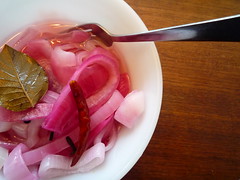
Zuni's pickled onions are a real coup de coeur in our household. It's one of Judy Rodgers' simplest recipes, but it's truly one of our favorites. Great with charcuterie, excellent in a grilled cheese sandwich, and essential with our burgers. They're a bit tedious to make, because the recipe requires to repeat steps (three times!), but the extra effort is absolutely worth it. Trust us.

pickled onions fig. a: pickled onions à la Zuni

Zuni Cafe Pickled Onions

2 medium-large red onions, peeled
3 cups white vinegar
1 1/2 cups sugar
1 cinnamon stick
a few cloves
a few allspice berries
a dried red chili
2 bay leaves
a few peppercorns

To prepare your brine, combine everything but the onions and bring to a boil. Remove from heat and allow to infuse.

Slice onions about 3/8" thick. Separate them into rings. Bring the brine to a boil again and add about 1/3 of the onions. Bring back to a simmer, and as soon as it does, remove the onions, placing them on a baking sheet. Continue this process with the rest of the onions, then repeat the entire process twice, so that each batch of onions gets blanched a total of three times in the brine. Make sure to allow the onions to cool between each round of blanching.

The onions will turn a bright fuchsia hue and will be perfectly tender-crisp.

Place the onions in a jar with enough of their brine to cover and refrigerate. The onions will keep for several weeks in the refrigerator.


Look at that color! Talk about perfect for St. Valentine's Day... Talk about a gift that keeps on giving. Just a thought.

aj
Monday, February 08, 2010

death by chocolate

death by chocolate fig. a: death by Chloé, actually

Montreal's Les Chocolats de Chloé makes these adorable solid dark chocolate skulls specially for the Hallowe'en/All Souls' Day/Day of the Dead rush, and God knows that's fitting (Hallowe'en + All Souls; Day of the Dead + Mexico + chocolate). But don't you think they'd be nice for St. Valentine's Day too?

I mean, think The Smiths' "There is a Light That Never Goes Out," think Harold & Maude, think The Modern Lovers' "A Plea for Tenderness",* think Gun Crazy. Hell, think Baudelaire.

les fruits du mal fig. b: les fruits du mal

What could be more more romantic?

Sure, St. Valentine's Day chocolates have gotten all grown up over the years, but isn't it about time they got Modern?

Do you think they'd make another special limited edition run if we asked them nicely?

Les Chocolats de Chloé, 546 Duluth Ave., 849-5550

aj
* to wit: "'...I want to show you that I understand you, now.' This is the guy talking to the girlfriend. He's gonna show you that he understands the deepest, darkest parts, when he says, he says, 'I know how beautiful death is, and I know why you hate life, but I'm just a tender soul, so be glad you know...'"

Thursday, February 04, 2010

AEB classics #87: the AEB Burger

We've been pretty serious about our burgers for a while now, but when we got a meat grinder attachment for our standing mixer, things got even more serious. In fact, the burgers that have resulted have been seriously outstanding, taking our deluxe home burger to new heights.

What are the keys to a full-on AEB Burger? The quality of the meat, the fat content, salting the meat 24 hours in advance, grinding the meat fresh, and forming the patties just so, without overworking them. Then there's the buns--always crucial. And while this burger is so good it doesn't require a whole lot of fixings, we really don't make burgers that often, so we'll be damned if we're not going put out a nice spread so that we can turn that burger into a gloriously overstuffed mess.

The AEB Burger

2 lbs beef chuck from a reputable butcher, roughly 20% fat content
kosher salt

If you're grinding your own beef, 24 hours before you make your burgers, salt your beef generously, and keep it in the refrigerator overnight.

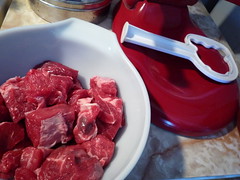
before fig. a: chuck

special equipment: a meat grinder
freshly ground black pepper
4 tbsp unsalted butter, portioned into four pats of butter

The next day, grind your meat twice through your meat grinder (we have two attachments for our grinder, and we use the coarser of the two). Season the meat with black pepper (remember, you've already salted the meat--no need to do it again).

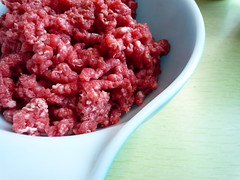
after fig. b: freshly ground chuck

Obviously, if you don't have a meat grinder, just start the recipe here. Try and get the best, freshest ground chuck you can find. You'll be missing out on the added value of salting the meat 24 hours in advance, but you'll still wind up with a great burger (just remember to salt each patty a bit when you season them).

Separate the beef into four portions. Gently form each portion of beef into a patty, making sure to place a pat of butter inside each of your patties. [The butter will baste the meat from the inside as it cooks.] Use just enough pressure to form the ground beef into a patty, and no more. Avoid overworking the meat. Set aside.

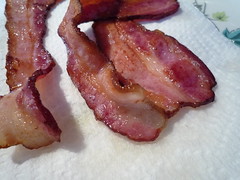
bacon fig. c: freshly fried smoky bacon

4 strips of good, smoky bacon

Fry up your bacon in a large cast-iron pan until your strips are crispy. Set aside.

4 quality hamburger buns

Slice your buns and plate them.

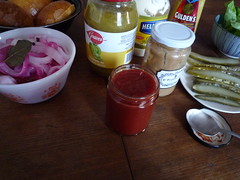
pickled onions fig. d: pickled onions

Now, lay out your hamburger fixings.

We recommend:
Boston lettuce
sliced beefsteak tomatoes (if in season, which they absolutely were not last, when we made the latest batch of these burgers, so we excluded tomatoes altogether)
sliced pickled cucumbers
pickled onions
pickled green tomato chow chow
mayonnaise
quality mustard
ketchup, preferably homemade

Whatever you settle on, your fixings tables should convey plenitude. It should look something like this:

fixings table fig. e: hamburger fixings

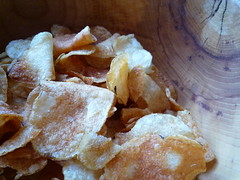
Fresh French fries are awfully nice, but a good potato chip can do the trick too. We're particularly fond of Covered Bridge (Hartland, NB) brand at the moment.

Covered Bridge potato chips fig. f: real potato chips

special equipment: large pan, preferably cast-iron
a large lid that fits the pan
4 slices of cheese, preferably something interesting but not overwhelming, like an aged cheddar or a caraway gouda (yes!)

Now it's time to cook up your burgers. Choose the largest cast-iron pan you have on hand. If it's the one you cooked the bacon in, set it a notch above medium heat. If it's not the one you cooked the bacon in, transfer the bacon fat to the pan and turn the heat to a notch above medium heat. When the pan is good and hot, place all four of your patties in at once. The pan should be hot enough to make the patties sizzle on contact. Let the patties sizzle for 3 minutes without moving them or flattening them. Flip the patties over and cook for another 3 minutes. The patties should have a nice deep crust on them, but they shouldn't be overly blackened. When the second 3 minutes are up, flip the patties again, turn the heat down to low, cover the pan and cook for 2 minutes. Make sure your cheese slices are ready. When the 2 minutes are up, flip the patties again, cover them with cheese, cover with the lid again, and cook for a final 2 minutes. The patties should be perfectly medium-rare after this final 2 minutes.

Place each patty on a bun, adorn with a slice of bacon, and serve, allowing your dining companions to dress their burgers according to their own whims. (Mine: lettuce, pickled onions, chow chow, mayonnaise, strong Belgian mustard, and an occasional dab of homemade ketchup.)

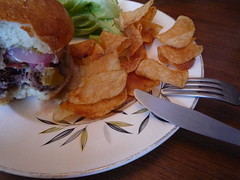
The finished product should look something like this, and it should look and smell so crazy-good that you just start chomping, possibly without even remembering to put your lettuce inside your burger first.

burger time fig. g: burger time

Your burger should taste so crazy-good, that just thinking about it, days later, drives you, well, crazy. Seriously crazy.

Fully satisfies 4.

Got your own burger dos and don'ts? By all means, send 'em in.

aj

ps--Thanks to Judy Rodgers' Zuni Cafe Cookbook for the tips on purchasing, salting, and grinding our beef, and to Saveur's "The Burger Bible" issue (our fave issue of 2009) for the "pat of butter" tip and a whole lot of inspiration.

Friday, January 29, 2010

Calling all Anise fans! Calling all Bazaar fans!

Just a quick note to let all you Anise/Bazaar fans know that Laloux is hosting Anise's former chef, Racha Bassoul, for a special tasting menu. With our new chef (and Racha Bassoul protégé), Seth Gabrielse!

fig. a: reunited, and it feels so good*

Two nights only: Tuesday, February 9th and Wednesday, February 10th. Here's the deal: six courses, including foie gras, for $80 without the wine pairings, or $120 with the wine pairings.

What's for dessert? Glad you asked: a rose & cardamom-scented semolina pudding with a fresh orange salad (Seville & blood oranges, to be specific), candied pistachios, and a dash of rose water.

To reserve, call (514) 287-9127. For more information, take a look here.

And to all you modern lovers: you can find our St. Valentine's day menu here.

Laloux, 250 Ave. des Pins E.

peace,
m

*photo: Christine Bourgier

Monday, January 18, 2010

Faire la chaudière

flaky cubist pilot fig. a: flaky pilot

I’ve said it before, but there’s something about those dishes that spark controversy, the ones that people worked up about, the ones that they’ll argue over late into the night. They’re the ones that have the greatest relevance to the greatest cross-section of people, the ones that are at the very heart of a culture, and that serve to define it. In other words, the level of controversy is an indicator of cultural significance. Of course, in the hyper-opinionated world we live in, with its discussion groups, chat rooms, comments sections, "likes" functions, etc., it's sometimes hard to distinguish a true controversy from your standard-issue tempest in a teapot. But there's a reason that people get so agitated about things like barbecue, chili, and pizza. Stakes is high.

Now, correct me if I’m wrong, but I get the feeling that that moment has passed when it comes to chowder, that chowder is no longer as absolutely central to the culture and the identity of vast numbers of North Americans, especially those hailing from the Mid-Atlantic and points north and east, as it was just a few decades ago. Blame it on America’s continued drift westward and southward, blame it on decades of relentless attacks against New England and its notorious liberal elites, but take a look back and you’ll see that chowder was as hotly contested and divisive a dish as there was in North America. Sure there was that fabled Boston vs. Manhattan split, but, really, it went way, way beyond that. So far, in fact, that when J. George Frederick waxed enthusiastic on the topic of chowder for his Long Island Seafood Cook Book of 1939 (reprinted in a Dover edition in 1971), not only did his chapter span 38 pages and roughly 60 recipes covering seafood chowders of all sorts (clam, fish, oyster, and shrimp included), as well as a host of other related soups and stews (from the prosaic [Fishwife’s Stew] to the exotic [Sea Tang]), but the magnitude of the topic elicited a particularly memorable title from him: “The Great Disputatious Chowder Family.”

Mr. Frederick explained:

If anybody tells you that the American people are “regimented” or “standardized,” just ask quietly, “What about clam chowder?” Your cocksure informer will get very red in the face, for nothing is more notorious that that various sections of Eastern America come to blows over chowder. Tomatoes or milk is the crucial question, also caraway seeds and salt pork. New England is rent and torn over these dissenting practices, but Boston, Maine, and Connecticut are allied against Manhattan or Long Island chowders, while Rhode Island teeters in between.


As Mr. Frederick would have it, and as has become accepted knowledge since, chowder, that most Yankee of dishes, has its roots in Brittany’s tradition of faire la chaudière, where the citizenry of coastal towns would each contribute something to the communal pot, be it fish, vegetable, or spices and herbs, and each would partake of the dish that resulted, a “hodgepodge” (Frederick’s term) consisting of “fish and ship biscuits, vegetables and savory ingredients” (my emphasis).

When French fisherman began settling in Newfoundland to take advantage of the (then) teeming bounty of the Grand Banks, they naturally brought faire la chaudière with them, transplanting it to the New World, where the tradition quickly took root. There it became part of the cultural exchanges (French, British, Portuguese, Spanish, etc.) that defined coastal Newfoundland, and eventually found its way southwest, through the Maritimes to New England, with the assistance of the sailors and fishermen who had made seafood chowder their own, and whose travels often covered vast areas of the Atlantic Seaboard.

Though this was not a part of the original French tradition, Early American chowders were predominantly milk-based chowders--when they became so is unclear. Was this an American invention? Did it have roots in such time-honored Northern European concoctions as Flemish waterzooi? I’m not sure. What is clear is that even though the tomato originated in the Americas, the addition of tomato to American chowder came relatively late in the game, and, most likely, it came by way of Europe. During its early history, authentic American chowder was based on this fab four and this fab four only: seafood, potatoes, pork (usually salt pork), and hardtack/sea biscuit, or some analog, such as pilot biscuits (preferably flaky ones) or common crackers.

flaky pilot biscuits fig. b: flaky pilot biscuits

The tomato was a late arrival to the world of chowder, but when it did, its effect rippled out from the New York area where it first came into vogue, throughout the Mid-Atlantic and New England. Some 70 years ago, at the time that Mr. Frederick published his tome, Long Island was a divided island, but his account took pains to indicate the complexity of the matter:

Since Long Island has all this time been the place where New York and New England merge (at the eastern tip) it is not surprising that the chowder controversy rages even today on Long Island, despite the fact that a majority opinion certainly sides with the tomato. But a few old, gnarled eastern island baymen, and hardy old ladies, who learned the cookery arts somewhere around the Civil War period when the tomato was still an outlaw, today continue to cling to the milk basis for chowder, and will not surrender. Canceling this out is the fact that many New Englanders, even up into Maine, and particularly in Rhode Island, have acquired the tomato chowder idea and uphold it against their scandalized neighbors. Connecticut is too close to New York to be pure New England, and also is in part a renegade from the milk chowder. And, in the main, west of the Hudson, as New York goes, so goes the U.S.


If anything, I’d argue that “Boston” or “New England-style” chowder has been the style that's dominated the continent in recent decades, but there’s no question that each tradition has had tremendous reach. Back in the day, my family’s favorite chowder house in Santa Cruz, CA, was just one of many such establishments that handled any possible disputations with the greatest of tact (or was it spinelessness?): they served both.

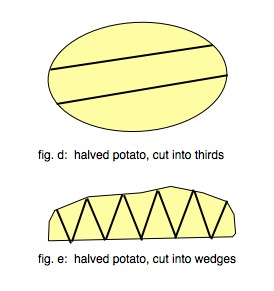
In any case, for my money, the tomato vs. milk debate is a bit of a non-issue. Properly made, I’d be happy (ecstatic, even) with either. The real issue for me in recent years has been finding a chowder made from scratch, one made from fresh seafood and not from its canned or frozen doppelgänger, and one made without the use of corn starch and other non-traditional thickening agents. The idea is to use the freshest possible seafood (recall the concept behind faire la chaudière), and to achieve thickness from the inclusion of the hardtack/sea biscuit/pilot biscuits/common crackers and, especially, the potatoes. In fact, the traditional Yankee seafood chowder was known to begin with potatoes cut in irregular shapes, one end purposely cut larger than the other. This facilitated one end cooking faster than the other, disintegrating into the broth, and lending the chowder a perfectly thick texture without the need of any additional agents. Few things disappoint me as much as a corn-starch-laden seafood chowder, especially when served at an otherwise reputable establishment; few things are as totally satisfying as a true seafood chowder.

The following is the recipe we’ve been using recently for our New England-style fish chowder. It's an amalgam of a few different recipes. If, however, your preferences are tomato-based and spicy, you might want to check out this recipe, which appeared in “...an endless banquet” way back in 2004. It's a great recipe for Manhattan clam chowder, and it might also give you ideas for a spicy fish chowder.

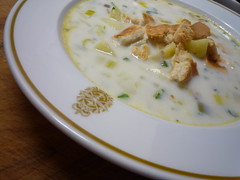
fish chowder fig. c: fish chowder

AEB Fish Chowder

1 lb haddock, or cod, fillets
1 bay leaf
1/4 lb bacon ends, or bacon, or salt pork (salt pork being the most traditional option; smoky bacon ends being what we've actually been using of late)
1 medium onion, finely chopped
1 small leek, white part only, thoroughly rinsed, cleaned, and finely chopped
2-3 medium potatoes, chopped into irregular pieces as described above and pictured below (see figs. d & e)
1 tbsp parsley, minced
2-3 sprigs thyme, leaves only, minced
1 1/2 cups milk
salt and freshly ground black pepper
pilot biscuits or common crackers

Bring three cups of lightly salted water to a boil. Add the fish and the bay leaf, lower the heat, and simmer gently for 7-8 minutes. Using a slotted spoon, remove the fish to a plate or cutting board, but keep the broth warm on a back burner. Fry the bacon ends (or bacon, or salt pork) in a skillet until they've rendered their fat and have begun to crisp. Add the onion and the leek and sauté until the onion begins to turn translucent and the leek has turned tender. Add the onion/leek mixture and the chopped potatoes to the fish broth. Bring to a boil, lower the heat, and simmer for 12-15 minutes, until the potatoes are nice and tender and the broth has thickened slightly. Meanwhile, gently flake the fish fillets. When the potatoes are ready, turn the heat down to the lowest setting, add the fish, the parsley, the thyme, and the milk to the broth, and let the chowder steep for 5-10 minutes. Taste and adjust the seasoning.

Set your oven to broil. Split your common crackers or pilot biscuits, and if you're using the latter, break them up into smaller pieces. Being careful not to over-toast them (read: burn them), toast your common crackers or pilot biscuits gently, until they're a light golden brown. (Sounds unnecessary, but it will only take a minute and, trust me, toasting them makes a huge difference.)

Serve each bowl of chowder topped with the toasted pilot biscuits or common crackers.

Serves 4.


potato wedges 2

Note: fish chowder tastes good at any time of year, but it's particularly good on a cold winter day.

ice bridge 2 fig. f: cold winter day

aj

Saturday, January 16, 2010

Help Haiti now. Please.

Our hearts go out to the people of Haiti, to the Haitian community here in Montreal, and to all of those who lost loved ones in Tuesday's earthquake.

Help Haiti Now

The UN World Food Programme is just one of the organizations that is on the ground in Haiti, aiding with the recovery effort and helping to feed the hungry.

If you've made a donation to Menu for Hope over the last few years, you've supported the WFP's efforts to end world hunger through initiatives like Purchase for Progress (P4P), which helps small farmers to improve their farming practices, become self-reliant, stabilize local economies, and contribute to the WFP's operation. Haiti needs immediate help, and lots of it, but it also needs an immense amount of long-term help, including programs such as P4P, programs that will help restore Haiti's thoroughly depleted agriculture and help bring about a new era of stability.

If you'd like to make a donation to the World Food Programme's work in Haiti, please follow this link. If you'd like more information about the World Food Programme, please click here.


And if you live in Montreal and you'd like to help out by attending a fundraiser, there'll be a Haiti Tweetup at Casa del Popolo (4873 St-Laurent) on Tuesday, January 19, from 5:30pm till 8:30pm, featuring a raffle and the prodigious talents of DJ Andy Williams. Admission is free, but guests are strongly encouraged to donate $10 or more. All proceeds will go towards the Red Cross's Haitian campaign.

Finally, the CBC has responded to the crisis with a helpful resource that lists still more ways to help.

aj

Tuesday, January 12, 2010

Fleisher's Follow-up, or Down to the Bone

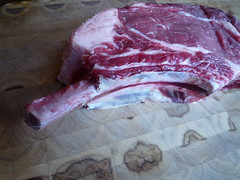
this is our steak fig. a: on the cutting board

Without question, the finest steak either of us has ever tasted. We only got one because we knew we wanted to eat it relatively soon, and because Fleisher's dry-aged rib steaks were the biggest, meatiest rib steaks we'd ever had the pleasure of purchasing. We knew one of those honking steaks would be more than enough for the two of us, and we were right. We ate and ate well, and we still had enough for leftovers (yes!) the next day.

And, the thing is, buying, cooking, and eating grass-fed beef from a place like Fleisher's is not only ethically and environmentally sound, it's also a game-changer. Once you get that taste, why would you want to eat anything else? I'm happy to hold out until the next time we get a chance to visit Fleisher's. Why would I want to settle for less? Hell, I can still taste that steak right now as I write.

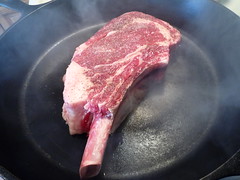
this is our steak in our searing-hot frying pan fig. b: in the pan*

We cooked our rib steak exactly the same way we always cook our rib steaks: first in a searing-hot cast-iron pan, then in the oven, followed by a good 5 minutes of rest. This is an excellent way to prepare perfect steaks at home and it happens to be exactly the way Fleisher's recommends preparing their beef. Once again:

1. Oven preheat 300º [10 minutes]
2. Heat pan on stovetop to smoking point
3. Pre-salt each side [5-10 minutes ahead of time]
4. Put into pan / sear for 2 minutes each side
5. Put steak into oven w/ pan
6. Steak > 4-8 minutes in oven [120º]
7. Take out of oven--let sit [rest] for 5 minutes


That steak was so tender, so tasty, so good, there wasn't a scrap left.

aj

* Just to give you some perspective: that's an oversized 13 1/4" Lodge cast-iron pan.