Saturday, August 20, 2005

Revelation 2: Swan Oyster Depot


So, we got off on the good foot almost as soon as we arrived in San Francisco, and things never really let up the whole time we were there [as you'll see--ed.]. Case in point: our visit to Swan Oyster Depot on our last day in town.

Swan was right at the top of our list of places to check out while in the Bay Area and when we still hadn't gone there during our first week we decided to make it part of our closing ceremonies. Everything we'd read about Swan--the absolute freshest seafood, its long history, its classic counter service, its reasonable prices--made it sound absolutely amazing. But we really got the bug to go there a few days earlier on a trip to Santa Cruz when Michelle tried Dungeness Crab for the very first time and I re-experienced it for the first time in some 20 years. We had it in the form of a crab sandwich and what looked like the simplest arrangement imaginable--two slices of bread, a pile of crabmeat, some Crab Louie sauce, and some salad fixin's turned out to be the hit of the day. After that, we were determined to have more Dungeness Crab (even if it wasn't exactly the season) and we'd decided Swan was going to be the place.

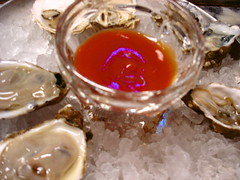
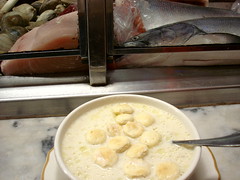
We showed up just before the lunchtime rush kicked in and got seated at the far end of Swan's counter, near the kitchen. I loved it from the moment I stepped in. What a beautiful space and what a perfect atmosphere, friendly and unpretentious. We'd been eating pretty well on this trip and I didn't have an enormous appetite when we showed up, so I arrived thinking that maybe I'd just have a few oysters and a bowl of clam chowder and leave it at that. I hadn't been expecting the impact of seeing the wide selection of seafood on offer at Swan. Fish, smoked fish, clams, oysters, shrimp, crab--it all looked so tantalizing. We stuck to our plan and ordered a couple of bowls of clam chowder and some oysters, and then we decided we'd sniff around for something else to round out our experience at Swan. That day, Swan had a selection of five different oysters to choose from. We're much better versed in Atlantic oysters and even French oysters than we are in Pacific oysters, so we weren't sure how to begin. Our waiter made things very simple for us by offering us a sampler platter, then serving us eight oysters on the half shell for the price of six (that's just the kind of place Swan is). All four types of oysters were among the best I've ever had, so good you didn't want much dressing on them, just a bit of lemon juice. But the ones that impressed us the most--both in terms of taste and aesthetics--were the Tomales Bay Miyagis, which had a lovely delicate blue hue to them [you can see one towards the upper right corner of the photo above--ed.]. Swan's clam chowder was the real deal, no thickening agent, just a whole lot of clams in a simple, hearty chowder, made with a lightly creamy broth, unlike the typically gloppy clam chowder we'd had just a few days earlier in Santa Cruz. In short: perfect.


By the time we'd finished our chowder and oysters we still hadn't made up our mind what the next act was going to be. Luckily, we'd struck up a conversation with a Swan regular named "Pat" who was sitting next to us, and she became a consultant of sorts for us. We debated the pros and cons of various dishes and combination dishes then finally settled on an unlikely combo. You see, we don't have any shortage of good smoked salmon back in Montreal (between the in-house smoked salmon at Leméac and the Wolf's Head smoked salmon that comes in from New Brunswick, we're pretty happy), but Swan had the most beautiful whole smoked salmon fillet laid out on their counter when we arrived, and I found it hard to take my eyes off it. When I asked Pat about it she said it was good, really good, "like candy," and that it was made locally by some guy near Point Reyes (if I remember correctly). I asked one of the counterhands how they serve it and he said they serve it as a platter with some bread (sourdough or rye) and whatever additional fixin's we wanted (capers, red onion, etc.). He said they could also do the smoked salmon as part of a combo platter with a shrimp salad. Michelle and I discussed the matter for another minute and then decided to get the combo with an upgrade to a Crab Louie in place of the shrimp salad. That smoked salmon was truly outrageous, and I had absolutely no regrets about ordering it. The Crab Louie was fresh and tangy, with big chunks of that oh-so-flavorful Dungeness Crab meat (it's naturally sweet and a little briny). We couldn't have been happier.

There were still plenty of temptations to be had at Swan when we finished, but we'd eaten well, and we'd been there for about an hour, so, god knows, there was a line-up of people patiently waiting to get in by that time. We paid our bill, paid a couple of fond farewells to Pat and the counter staff, and headed on our way.

Swan Oyster Depot, 1517 Polk St., San Francisco, CA, (415) 673-1101

aj

Saturday, August 13, 2005

Revelation 1: Philz


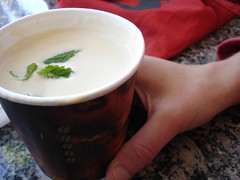
Philz Philharmonic
Originally uploaded by michelle1975.


Getting back on the food tip (as they say), our trip to San Francisco was made up of a series of revelations, some of which had a rather profound impact. Not the least of these occurred on Day 1. Somehow we'd gotten ourselves booked on a hellish flight plan on our way out to California, one that took us from Montreal to New York at 6:00 A.M., then continued on to San Francisco International Airport with a 6-hour flight. The gods were apparently smiling down upon us, though, 'cause we scored these amazing seats on the New York-San Francisco leg that were in their own little quiet compartment, between two sections in coach class and next to a flight attendants' workstation, and that had seats that fully reclined (!). We showed up in San Francisco in half-way decent shape, actually, and because it was still only noon when we got there, we had a half-day to play with.

We decided to not waste any time and just head down to the Mission District from my sister's apartment in Noe Valley and dig in to our first burrito of the journey. For our first one we went to a place I've been going to for about 10 years now and which I've always found friendly and tasty: Casa Sanchez. Not only do they make excellent tacos and burritos, but their salsa and chips are outstanding, free, and "bottomless" (courtesy of a handy self-service bar), and they have a beautiful courtyard.

Afterwards, we were in the mood for our first coffee of the day. We'd made an attempt to score a coffee in JFK, but the results were undrinkable. I'd told Michelle that San Francisco was riddled with good coffee houses and espresso bars--this was her first time to San Francisco, after all--and that, in fact, San Francisco was one of the few cities in America where you'd been able to get good, strong coffee prior to about 1990. A couple of blocks up 24th St. from Casa Sanchez we came across a coffee house, and it looked kind of interesting. It had a generic sign outside declaring that its coffee had won a Best in the Bay award, but what really intrigued us was their own sign announcing the fact that they served "handmade" coffee and that each coffee was made "one cup at a time." We didn't know it at the time, but the gods were smiling down upon us once again.

Behind the bar they had a sign listing all their espresso-based drinks, but they also had a sign with all their "handmade" coffee selections, and each of these sounded a whole lot more interesting. I initially ordered a Arabic-style "handmade" coffee, but when another patron ordered a "Philharmonic" blend I asked the barista to change my order to one of the same. She ground just enough coffee beans for my order, then threw them into a large, long paper coffee filter held in a stand and placed the coffee cup underneath. Then she threw a couple of secret potions into the filter along with the beans and added a long, steady stream of boiling water. She asked me if I wanted cream and sugar and I said, "yes." A minute or two later she handed over my perfectly brewed, perfectly creamy, and perfectly sweetened Philharmonic and I headed over to where Michelle was sitting. I took a sip on the way and it nearly blew my mind. I took the lid off the coffee and saw that it had a mint sprig on top. I handed to cup to Michelle and said, "You're not going to believe this."

Neither of us had ever tasted a coffee as exotic or delicious ever before. We both take our coffee quite seriously and we've both done a fair bit of traveling, but we'd never experienced anything like that first Philz "handmade" coffee, with its strong hints of cardamom, its wonderfully mellow depth, and its mint finish (sounds crazy, I know, but the sprig is really an stroke of genius).

Needless to say, we got seriously hooked by that first Philz coffee and Philz became a touchstone for our trip. We went back at least half a dozen times and we tried almost all of the "handmade" blends they offer. We made a point of initiating my sister into the brotherhood (she'd never been), and then we started making the silliest excuses just so we could pass by Philz. The Philharmonic remained a favorite throughout the trip, but we also became very attached to the Jacob's "Wunderbar," which was a little less spicy, but was made with a stronger roast, and the Phil's Tesoro Mocha was also a big hit, although the intensity of its chocolate flavor made it a "special occasions" blend for us.

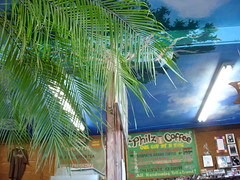
One time we stopped by and Michelle ran in for a couple of take-away coffees before we headed out to Treasure Island. When she got to the bar Phil himself was waiting for her. He asked her how she was doing and she responded, "I'll be a lot better once I've had my Wunderbar." Phil looked at her and said, "You're already fine." She was on Cloud 10 when she got back to the car--Phil is a very charming man who sports a dashing and unpretentious fedora and has a sly sense of humor. Which brings me to another point: the atmosphere at Philz takes a close second to their amazing coffees. Like many other San Francisco coffee houses the interior design is whimsical and eclectic and the place is frequented by regulars who can only be described as "true originals," but how many other coffee houses in San Francisco (or anywhere else, for that matter) can you purchase a potted plant with your coffee?


interior decor, Philz
Originally uploaded by michelle1975.


By the end of our trip I was only half-joking that Philz alone had been worth the price of our airfare out to San Francisco, but if you don't believe our hype, check out the testimonials that you can find online on the topic of Philz, or, better yet, go there yourself.

Actually, let me finish with yet another anecdote. Last night, we were gathered at Le Pocket Palace, talking with Hermine and Kazi about our trip over a glass of wine. We had gotten on the topic of Philz, as we're wont to do these days, and we were giving them the full lowdown: the "handmade" process, the use of spices and herbs, the devoted following, the rapture, etc. I was going off on some spiel about San Francisco being a city of coffee houses, but that nothing could compare with this coffee house we'd found there, when I noticed a young woman listening in on our conversation, waiting to see which coffee house I was going to name, waiting to weigh in with her own opinion. When I named the coffee house in question as Philz, she turned to us and said, "You mean the place on 24th?" Turns out she had lived just around the corner on 25th St. for six months and had become a very regular regular during her time there. Imagine her surprise. Imagine ours.

Casa Sanchez, 2778 24th St., San Francisco, CA, (415) 282-2400

Philz Coffee (a.k.a. Phil's Coffee, a.k.a. Gateway Market), 3101 24th St., San Francisco, CA, (415) 282-9155

aj
We're back!

That's right, we're back from our trip to San Fran and environs and, boy, do we have stories to tell. We just spent the evening telling tales of orchards, oysters, and handmade coffees. We had to get ourselves warmed up for the flurry of posting that it's going to take to get y'all caught up.

The photo above doesn't have a whole lot to do with food, but it does have a whole lot to do with Vertigo, and Vertigo was an important part of our trip. We re-watched Vertigo just prior to leaving in order to bone up for our trip and we tried to make as many Vertigo-related stops as possible while we were away, from San Juan Bautista to Muir Woods to the Palace of the Legion of Honor to Mission Dolores.

I picked up The New York Times in the airport for our flight home and I noticed in the obituaries section that Barbara "Midge" Bel Geddes had passed away. We'd made numerous references to Midge and her Telegraph Hill apartment over the course of our stay. Others may have known her as "Miss Ellie," but she'll always be Midge to us.


When we showed up in San Juan Bautista we found signs of other Vertigo pilgrims:


It was hard to frame out the tourists at Muir Woods, but somehow I managed. When we went out for a 4-hour hike afterwards we discovered that tourists don't hike (at least not the ones who go to Muir Woods):


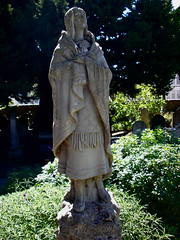
At Mission Dolores we found a totally unexpected trace of Montreal in the form of a statue commemorating "the Lily of the Mohawks," but no trace of Carlotta:


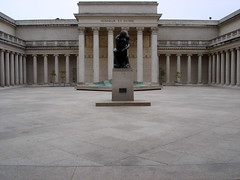
We hit the Palace of the Legion of Honor on our final day in San Francisco. We got let in for free because the museum was just about to close, but, again, we found no sign of "beautiful Carlotta, sad Carlotta."


Michelle complained that an earlier version of this post ended abruptly. I had to remind her that Vertigo also ends rather abruptly.

aj

Monday, August 08, 2005

Nougabricot, part 2

By special request, here is the recipe for Nougabricot jam from this post.
It's from Christine Ferber's Mes Confitures.

1,150 kg apricots
650 g sugar
200 g honey
1 lemon, juiced
100 g slivered almonds
100 g shelled and chopped pistachios
2 pinches of orange zest
2 oranges, juiced
a handful of apricot pits

-Cut apricots in half and pit them, reserving some pits which you will then smash and remove the nuts.
-Mix apricots with sugar, honey, orange zest and juice, and lemon juice. Cover and let sit one hour.
-Bring mixture to a boil and pour into a non-reactive bowl, cover with parchment paper so it touches the surface, and place in fridge overnight.
-Pour mixture through a jelly bag or cheesecloth, reserving the juice.
-Peel the skin off of the apricots.
-Bring the juice to a boil and stir it until it reaches 105 degrees celcius.
-Add the apricots and nuts, bring it back to a boil, simmer a few minutes, skimming if necessary.
-Place in clean, dry, sterilized jars, adding a few apricot nuts to each jar, and seal.

Enjoy.

m

Sunday, July 31, 2005

IMBB #17: Tea


All right,we finally got it together to participate in an Is My Blog Burning? event. We'd been tempted by several IMBBs in the past ("egg" and "orange" come to mind); this one, though, we just couldn't pass up on (even if we are on the road at the moment). Tea has been an important part of our relationship since Michelle put together a "Tea Time with Anthony" tea sampler soon after we met. And these days, tea takes up almost an entire cupboard at our place.

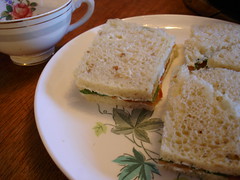
Pictured above is a watercress, smoked salmon, and cream cheese tea sandwich made with genmai cha bread. The bread took a number of tries to get right. Michelle experimented with several different amounts of tea and found that "more is more." She replaced the water in her bread recipe (a recipe for sandwich bread from R.L. Berenbaum's The Bread Bible) with a cup of dry tea steeped in the amount of water called for (3/4 cup). Actually it took a bit more liquid, because the tea swells so you have to compensate for this in order that you end up with 3/4 cup of strong tea. She also kept the toasted rice grains after she steeped the tea and added them to the bread to give it extra flavor and a bit more texture--we also wanted to try and retain genmai cha's distinctive character.

This loaf was inspired by the green matcha bread served by Mariage Freres with some of their tea sandwiches. Our loaf didn't have nearly the color of the Mariage Freres loaf (we have a sneaking suspicion they add a bit of food coloring to their bread), but the main thing is that it was pretty delicious. The tea flavor was subtle (even with that strong batch), but it was certainly present and it went very well with the watercress and the smoked salmon. It's sure to become a standard at our house. Eventually Michelle wants to try a matcha loaf, too.

For our sandwiches, we were dead set on using watercress because our little garden has produced so much this summer and we've been enjoying it so. We first tried a classic watercress sandwich with just watercress and butter, but found that combination a bit on the dull side (although a herbed butter would probably make for a very nice sandwich). We then decided to combine the spiciness of the watercress with some smoked salmon (and just a little bit of cream cheese). This combo was much more to our liking.

Finally, we invited some guests over one afternoon and served our tea sandwiches with Kusmichoff's Troika tea, an old favorite. The setting wasn't the elaborate garden party we'd originally imagined--it was just our living room--but the company was lovely, the tea just as lively as ever, and the sandwiches were a hit.

am/km

Wednesday, July 27, 2005

It's Sour Cherry Time


sour cherries
Originally uploaded by michelle1975.


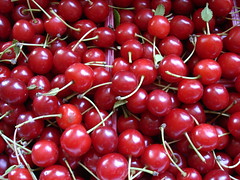
Just my luck that they should appear right now. In 24 hours, I will be in California, far away from the perfect sour cherries which call to me from the Jean Talon market. My timing is disastrous.

Our lovely tomatoes are ripening on the vine, including white heirloom ones which I've never tasted, and probably never will. I gave my sister instructions to pick them and eat them, then to write me and tell me what they were like.
The fennel is in flower, as is the coriander. Who will harvest the seeds? And let's not mention the pollen. It's too painful.
My mother's garden is overrun with the plumpest raspberries you've ever seen. I don't have time to do anything about it.
Blackberries, gooseberries, black raspberries, oh, God, the currants. Not them, too.

And I only had enough time to buy a half-flat of sour cherries which I used to make pickled sour cherries and a sour cherry almond preserve. What about my brandied cherries? And cherry syrup? Next year.

This frenzy reminds me of a hilarious passage I recently read in Beverley Nicols' charming book Merry Hall. One summer, he is called away from his house and garden on business. During those few weeks, he calls his manservant, Gaskin, every day to ask how the garden is doing, what is in bloom and does he think it will still be there when he returns. ("Don't you think you should put a bouquet of lilies in the cold room, in case?" He does.)

I hope you all take full advantage of the short sour cherry season in my absence.

What am I talking about? I'm going off on vacation...

m

Tuesday, July 26, 2005

California, here we come!


Things might become a bit more sporadic over the next couple of weeks as we head out to sunny California (!) on vacation, but think of all the things we'll have to write about afterwards...

Oh, and if any of you out there have any tips, food-related or otherwise, for San Francisco and Northern California please send them along. We love tips.

--eds.

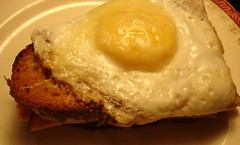
Croque Madame, pain Poilane


Croque Madame, pain Poilane
Originally uploaded by michelle1975.


When you walk the streets in Paris, you'll notice that many of the cafes offer Croques Monsieurs or Madames. Like so many other clichés of French cuisine--French onion soup and the French omelet come to mind--most of these spots advertising their Croques Monsieurs and Madames aren't worth a second glance. However, if you're looking for a honest-to-goodness Croque keep your eyes open for those little signs that read "Pain Poilâne."

Poilâne was started in 1932 by Pierre Poilâne, and what distinguished Poilâne bread was its use of stoneground flour and natural leavener at a time when bread baking in France was rapidly moving away from those traditional methods and towards "modern" baking methods. By the immediate post-World War II Poilâne was already completely anomalous in a country that had fully embraced white breads. Pierrre's son Lionel took over the operation beginning in the 1970s and he began to completely overhaul the way Poilâne baked its bread, introducing an extensive number set of changes that he labeled "retro-innovation." Lionel's program combined a deep respect for the tradition of French bread baking borne out of a profound sense of the history of bread baking with a hard, scientific approach to the technical aspects of making and baking bread. I remember reading a long Smithsonian profile on Lionel Poilâne back in the mid-1990s and being fascinated with the kind of improvements he'd made to the firm's traditional ovens. I also remember spending hours contemplating what Poilâne meant when he said that bread was closer to beer than it was to other foods, including baked goods (or at least it should be).

It's safe to say that Lionel Poilâne's program of "retro-innovation" was one of the principal thrusts behind the international resurgence of artisanal sourdough baking over the last quarter of a century. Sadly, Lionel Poilâne passed away a couple of years ago in a helicopter accident. The Poilâne firm has continued to undergo change since his demise. These days the enterprise includes two stores in Paris and a store in London, as well as a mail order service that ships Poilâne's distinctive sourdough loaves all over the world. The simplicity of the original storefront on Rue Cherche-Midi in St-Germain des Près belies the complexity of the operation, but this storefront is still the perfect setting for Poilâne's rustic loaves sold whole, by the half, or by the quarter.

When our friend Camilla asked us if we wanted anything from Paris just before she hopped on a plane to go on vacation there, we put in an order for a quarter loaf from Poilâne. By the time that loaf got to us it was a little worse for wear, but those traditional sourdoughs are a hearty breed and it was still making for the best breakfast toasts you can imagine. But what we most excited about making with our Poilâne loaf were Croque Madames. We got some Gruyère cheese, some nice ham, and some eggs, cooked up our Croque Madames and served them with a salade composée and a couple of beers. It was a little taste of Paris right in our own kitchen and it was heaven. Thank you, Camilla. Thank you, Lionel.

aj

Monday, July 25, 2005

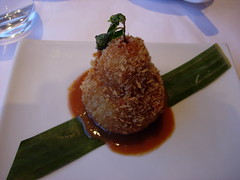
faux pear chez Nonya


Nonya's faux pear
Originally uploaded by michelle1975.


So, the other night a party of three of us went up to the newest incarnation of Nonya, up on Bernard. Nonya started offering up relatively simple Indonesian dishes at a location of St. Laurent down below Sherbrooke a few years back. Our waitress described this as Nonya's "rock & roll" period. They then moved to an ill-fated location on Ste. Catherine just opposite Simon's and the massive Paramount complex. Their menu got more elaborate and their prices went up, but they didn't remain in that location very long. A few months ago now they brought their extensive menu up to an attractive space in Mile End.

We had just finished our Gado-Gado and I had just finished going off on some little spiel about how some of the most important staples in Indonesian cuisine--peanuts and corn, for instance--are actually products indigenous to the New World that only arrived in the "Spice Islands" in the 16th century, but that they've been so thoroughly assimilated that it's as if they'd always been part of the culture (something like peanuts in West Africa), when Mr. S.'s krokett arrived. This was one of the most beautiful creations I've seen in a restaurant in quite some time. Maybe it was because it was so unexpected. Maybe it was because I'm so fond of pears. Whatever the case, we were bowled over by Nonya's faux pear with its Panko-encrusted skin and its sizzled Thai basil stem and leaf. It tasted great, too. The body of the krokett was made up of a mashed potato mixture, with a layer of spiced ground beef near the bottom. It was served in a pool of tamarind-based chutney. Anyway, the funny thing is, upon tasting it I was immediately reminded of the Colombian empanadas I'd had just a few days earlier, even with that Panko coating. It's a small world after all, and it's often a tasty one.

All in all the food we had was quite good--everything from chicken satay to tilapia cooked in banana leaves--but Mr. S. was definitely the big winner that night. Not only did he get that standout krokett but he also ordered Nonya's outrageous roasted Cornish game hen with coconut rice, kecap manis, and stewed chayote.

Nonya also offers a traditional Indonesian rijstafel. You need 2 people minimum, and the prices range from $35 to $55 per person.

They also have a number of vegetarian options on their menu.

Nonya, 151 Bernard West, 875-9998

aj

p.s. Thanks for Mr. S. for the lovely digital pic.--eds.

Thursday, July 21, 2005

Beautiful Losers


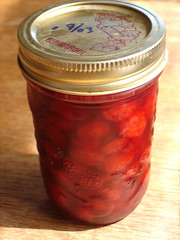
a beautiful failure
Originally uploaded by michelle1975.


It's not often that I admit defeat in the kitchen. Thankfully, I've gotten to the point where it's not often that there's cause to, but every once in a while...

This was supposed to be a sun-dried strawberry jam, as featured in Chez Panisse's Fruit book. You can find a link to the recipe here. I followed the directions exactly and... Well, in this recipe, the strawberries are cooked briefly with sugar and then left to "dry" in the sun until the syrup thickens into a jam. Apparently, this method results in a particularly flavorful jam, one that truly does justice to the quality of the fruit. I left my concoction out for several days, in full sun, and the syrup got no thicker. I'm not sure what the problem was, but it may have had to do with the relative humidity here the week I made this jam, as opposed to in Berkeley. Whatever the case, by the fourth day I started to fear for my perfect berries. I strained the syrup, added pectin, which I never do, and cooked it to a jell stage. I then added the strawberries and put it into jars.

I added a bit too much pectin. When you hold the jam upside-down, it doesn't even move. We are eating it now, and it's okay, but I can't help but think about what could have been, and what I thought would be. If anyone has had luck with that recipe, please let me know.

m

Just to set the record straight: yes, the jam is a little firmer than I've become accustomed to around here, but it's hardly just "okay." The strawberries + the hybrid method still resulted in one of the best strawberry jams I've ever tasted. Maybe even the best.

aj