Showing posts with label rye. Show all posts

Tuesday, December 17, 2013

Toasts & Roasts

holiday sp1 fig. a:  holidaze 2013

We hold these truths to be self-evident:

1.  The holiday season is upon us.

2.  Good God, there's nothing like a perfectly seasoned, perfectly rosé slab of roast beef--preferably one that's then sliced extra-thin, and served with horseradish.*

Okay.  Yes, the holidays are here.  And that means it was time for our annual "...an endless banquet" Christmas spectacular.
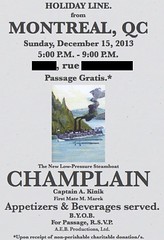
AEB xmas invite REDACTED fig. b:  all aboard!

But, the thing is, sometimes LIFE confronts you with an unexpected storm, and, suddenly, you have to chart a new course.

That's kind of what happened this year.  Everything's fine now, there's no need to worry, but something came up that forced us to make a last-minute adjustment.  What it meant was that the Christmas spectacular didn't actually take place at our place this year.  Consequently, we toned things down a bit, scaled things back, and got "back to the basics."

The holiday bash that resulted might not have been quite as wide open as it had been in the past, it might not have been quite as extravagant, but it was still pretty spectacular, and it was much more of a collaborative effort--and all the better for it.  For all these things, we owe our undying gratitude to our hostess.  (TY, RD!)  Such a lovely apartment, such a wonderful atmosphere, such a great time!!
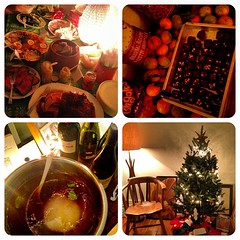
AEB xmas 2013 fig. c:  S.S. Shamrock!

Originally, we'd come up with this vague Lake Champlain "holiday steamship" theme.  The "point of departure" was meant to be our apartment.  I guess we ended up docking just a little ways up the coast.  And we exchanged the S.S. Champlain for the S.S. Shamrock.

Did I mention that there was a pretty significant snowstorm the day of the party?  No big deal.  We're Montrealers, we know how to deal with such situations.

Anyway, "back to basics" meant simpler preparations.  It also meant fewer last-minute preparations.  But it was still pretty plentiful.  The spread:
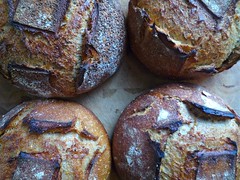
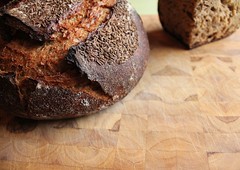
holiday rye fig. d:  rye!

1 spiral-cut, cob-smoked, maple-glazed Vermont ham with mostarda cherries
1 roast beef with horseradish
nordic shrimp salad
smoked trout & smoked sturgeon platter with cream cheese
crudités & herb dip
baked artichoke dip & corn chips
cheese platter (featuring 1 Jasper Hill Moses Sleeper + 1 Shelburne Farms cloth-bound cheddar)
freshly baked Danish rye & corn rye loaves 
Spanish clementines
gingerbread cookies
festive fudge 
AEB rum punch
aged egg nog
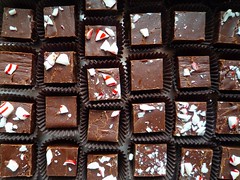
holiday fudge fig. e:  fudge!

And, yes, getting back to that point #2:  a perfectly executed roast beef is a thing of beauty.  It also seemed like just the kind of thing that would have been served in the dining room of an elegant steamship back in the day.

We discovered a method for a simple roast beef that we really love--and that's proven to be foolproof--earlier this year in the pages of The New York Times.  The recipe accompanied an article on Louisville's enigmatic Henry Bain sauce.  Though the sauce was designed to be served as a condiment with everything from steaks to game, it's a stone-cold natural with roast beef.  In fact, Sam Sifton claimed that this may be the sauce's "highest use" in his article, so he turned to Tyler Kord, the sandwich master at New York's No. 7 Sub, for a killer roast beef recipe to go along with his recipe for Henry Bain.  And that's exactly what he got.  I liked the recipe for Henry Bain--it was definitely unlike anything I'd ever tasted before, and, it's true, it made for a tasty accompaniment--but I absolutely loved the recipe for that roast beef.

As many of your probably know already, getting perfect results with roast beef can be a little tricky.  Nobody likes a roast that's extremely undercooked, and overcooking a roast is all too easy.  This recipe relies primarily on ambient heat to gently warm the roast all the way to its centre, resulting in that ideal rosy hue, not to mention an extremely savoury crust, optimal juiciness, and some outrageous pan juices.

I've been impressed with Kord's recipe since the first time I tried it, but recently I made an adjustment to it that's even more to my liking:  I added ground caraway seeds to its spicy-garlicky rub, giving it a finish that was very much in tune with the nordic characteristics of our Christmas party spread.
Off-Oven Roast Beef  
1 beef roast, like top, eye or bottom round, approximately 3 lbs
1 tbsp kosher salt
1 tbsp freshly ground black pepper
1/2 tbsp freshly ground caraway seeds
3 cloves garlic, peeled and minced
1 tbsp olive oil
red pepper flakes to taste
prepared horseradish or horseradish cream
Remove the roast from the refrigerator.  
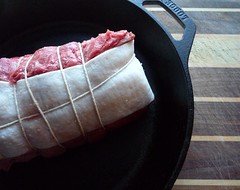
nature fig. f:  raw!
In a small bowl, mix together the salt, pepper, caraway seeds, garlic, olive oil and red pepper flakes to create a paste.  Rub this all over the roast.  
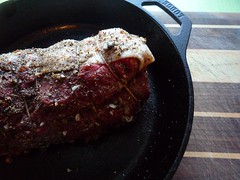
rubbed fig. g:  rubbed!
Place the roast in a cast-iron skillet or roasting pan, fat side up, and allow the roast to come to room temperature, about 1 to 2 hours.
About 15 minutes before you want to begin roasting, preheat your oven to 500º F.
Place the roast in the oven.  Cook, undisturbed, for 5 minutes per pound.  [I tend to go a little over this recommendation:  e.g. 15 minutes for a 2.6-lb roast, and 30 minutes for 5.25-lb roast.]
Turn off the oven.  Do not open the oven door.  Leave roast to continue cooking, completely undisturbed, for two hours.
After the two hours is up, remove the roast from the oven.  Slice as thinly as possible.  
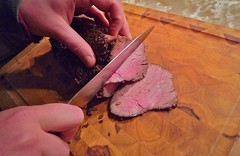
slicin' fig. h:  roasted!
Serve with pan juices and prepared horseradish.  Or use to make whatever your preferred kind of roast beef sandwich is. 
[recipe based very closely on Tyler Kord's Off-Oven Roast Beef recipe, as featured in The New York Times, January 17, 2013] 
Just how good is this roast beef?  Well, the photos above are of the 2 3/4-lb roast we made the day after we made a 5 1/2-lb roast for our party--a 5 1/2-lb roast that completely disappeared (as tasty things often do).  You see, the next day we found ourselves still having major roast beef cravings, so I went out and picked up another roast and we whipped up another batch--this one served with roasted broccoli and a mixed greens salad.  And horseradish, of course.

The point is:  this recipe is a keeper any time of year, but it's great for the holidays.  Great for a party spread. Great for pleasing a crowd.  Great for making sandwiches.

Happy holidaze 2013!  Eat well!  Drink well!  Be well!

aj

*Actually, roast beef's a pretty lovely thing to serve with radishes à la crème, too.  In fact, the two combined would make for a pretty amazing open-faced roast beef sandwich.  Just a thought...


Tuesday, November 26, 2013

Corn Rye

Corn and rye make for one of my all-time favourite combinations, but this recipe has nothing to do with corn mash or bourbon.  It's just a really nice recipe for a sourdough rye, featuring a couple of ingredients that are quintessentially American:  corn and molasses.

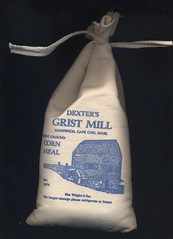
I got the idea after picking up some beautiful stoneground corn meal from Dexter's Grist Mill in Sandwich, MA back in August when we were visiting Cape Cod.

Dexter's corn meal fig. a:  corn meal

This corn meal was excellent, but it was also much coarser than I was used to, and a little too coarse to make my corn bread with.  (Read:  rustic!).  I had the idea of using it in a sourdough mixture so that the corn meal and its kernels would have the time to go through a slow fermentation process, retaining their size and their colour, but becoming more pleasantly edible.  I've always loved the combination of corn and rye, and bringing them together with molasses in a riff on my Danish sourdough rye made a lot of sense to me.

The results have been fantastic.  The kind of bread that you can't wait to turn into hot buttered toast in the morning.  The kind of bread that makes lunchtime a true joy.  The kind of bread that has you running home in the evening so that you can enjoy some more with your dinner.  That kind of bread.

My sourdough method is borrowed entirely from Chad Robertson's from Tartine Bread.  Moreover, my rye loaves--like my basic rye, my caraway rye, my Danish rye, and now this Corn Rye--are all based on Robertson's sourdough rye recipe from the very same book.  For optimum results, you should follow his directions closely.  Here, I'm just providing the measurements (in weight) and baker's percentages that you need to make two large loaves (roughly 2 pounds each).

Sourdough Corn Rye 
200 grams leaven (20%) 
600 grams warm water (80º F, ideally) + an additional 50 grams of warm water (65%)
100 grams fancy molasses (10%)  
[total hydration:  750 grams (75%), including the molasses] 
600 grams AP flour (60%) 
300 grams rye flour (30%) 
100 grams stoneground corn meal (preferably coarse) (10%) 
 [total flour:  1 kg (100%)]
20 grams of kosher salt (2%)
Photographic documentation:

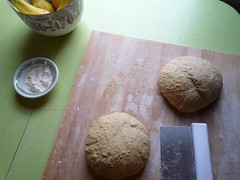
Untitled  fig. b:  after first shaping

Here, the loaves have been given their initial shaping.  They've rested for 30 minutes.  They're just about to get their final shaping.

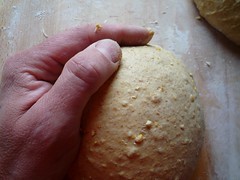
Untitled fig. c:  after second shaping

Here's loaf #1 after its final shaping.

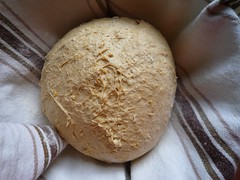
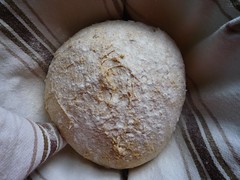
Untitled fig. d:  before dusting

This loaf has received its final shaping and it's been placed in a rice flour-dusted towel in a bowl.  It's also upside down.  It will get dusted with more rice flour, it will get covered by the towel, and it will then go through its final fermentation process over the course of a few hours.

Untitled fig. e:  dusted!

Now the same loaf has been dusted, and it's waiting to get wrapped in the towel.

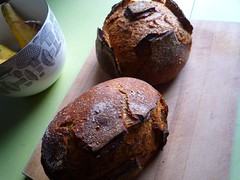
Untitled fig. f:  half loaf, full loaf

These are the two finished loaves.  One is already half-gone.

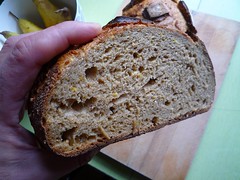
Untitled fig. g:  corn rye

Finally, this is an interior view of that half loaf.  You can see plenty of evidence of the coarse corn meal.  And it it looks moist, that's because it is.  In fact, it's a real keeper.  Still delicious days after baking (if you haven't eaten it by then).

This would  make a great loaf for a Thanksgiving feast.  It could also make for an excellent bread stuffing, so you might want to bake some extra and let it stale a little before the Big Day.  Just stick with those traditional, honest-to-goodness American flavours when you construct your stuffing.

Happy baking.  And happy Thanksgiving!

aj

Friday, September 20, 2013

Top Ten #51

CC 2

P1030622

P1030630

IMG_0902

1.  Cape Cod!

2.  Adam Leith Gollner, The Book of Immortality (Doubleday Canada)

3.  dinner for seven at Impasto, Mtl

4.  Steve Gunn, Time Off (Paradise of Bachelors)

sample track:  "Lurker"


(And if you're lucky enough to live in the NYC area, or to be just passing through, be sure to catch Steve Gunn, along with Endless Boogie and Tom Blacklung & the Smokestacks @ 285 Kent in Brooklyn on Monday, September 23rd.)

museum_hours_film_still_a_l

5.  Museum Hours (2012), dir. Cohen

(watch the trailer)

6.  late-night revelry at Le Vin Papillon, Mtl

7.  Faces, Long Player (Warner Bros.)

sample track:  "Maybe I'm Amazed"


8.  AEB chicken paprikash + sourdough caraway rye (Igen!)

9.  Girls (season 2)

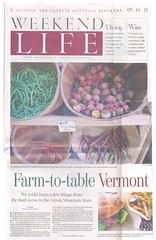
farm-to-table VT

10.  Farm-to-Table VT (including Misery Loves Company, Pistou, and Vergennes Laundry)

aj

Monday, April 01, 2013

Today's loaves today 1

dan pump1

dan pump2

dan pump3 figs. a-c:  testing 1-2-3

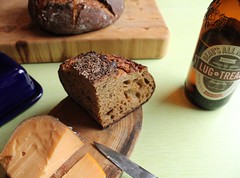
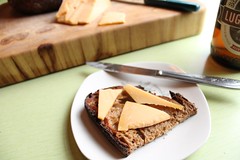
Easter Monday. Tests on AEB's sourdough Danish pumpernickel are going exceedingly well. Great with sweet butter. Great with cream cheese and tomatoes. Great with Old Amsterdam aged Gouda.  Testing continues. Desperately Seeking Smoked Fish.

News update: Michelle declared the following the "Best sandwich ever!": 2 x slices Danish pumpernickel, mayonnaise, Old Amsterdam, AEB spicy pickles, lettuce. I'm pretty sure she was exaggerating somewhat, but I know the feeling. Dense, moist, hearty with the taste of rye, crusty, somewhat salty, a touch sweet, and full of that wonderful toasted caraway flavour--this is a loaf that's got it all goin' on.

aj

Monday, February 25, 2008

Noma 1: Definitely not your average morning Danish, rev. ed.

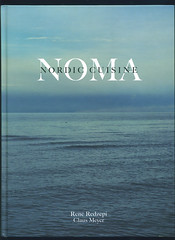
noma fig. a: Noma: Nordic Cuisine

There's something downright exhilarating about René Redzepi and Claus Meyer's Noma: Nordic Cuisine (2006). It begins with the photographs that grace the cover and continue throughout the text. Sometimes stark (like the photo above), oftentimes almost absurdly picturesque (like this photograph),

nordic landscape fig. b: landscape by Noma 1

and at times even sublime, much of the impetus behind Noma's photography has to do with situating the restaurant's cuisine within Denmark's formidable landscape, and the impression one gets is of a countryside that's equal measures forbidding and abundant. Thus, alongside pictures of Greenland's desolate glaciers (what remains of them),

greenlandic landscape fig. c: landscape by Noma 2

you get pictures of lovable old Danish hippies carefully collecting herbs

danish hippie fig. d: lovable old Danish hippie

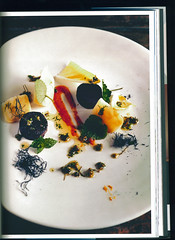
that may very well end up on Noma's artfully composed plates--in this case, Hay-baked Celery Root, Black Pudding and Yellow Archangel, the first of the book's winter recipes.

archangel fig. e: Hay-baked Celery Root, Black Pudding and Yellow Archangel

The thing is, according to Noma's philosophical outlook, Greenland's glaciers and southern Denmark's countryside don't form the strict binary opposition one might think they do. Where others see mountains of ice creeping across the landscape, the folks at Noma see "a rich flora and fauna, with crowberries, reindeer, grouse and musk ox." Bounty is in the eye of the beholder.

Now, if you've noted a little Nordic Pride in my description of the Noma cookbook, you're definitely onto something. Already, when the restaurant first began to take shape, there was the idea that a restaurant housed in an old warehouse that had once been part of the Royal Greenland Trade Enterprise and that would soon be the new site of the Nordatlantens Brygge (North Atlantic House) should have a vision that was pan-Nordic in orientation. But over the next nine months, in the lead-up to the restaurant's launch, Noma's vision really took on form. For one thing, Claus Meyer, the owner, and René Redzepi and Mads Refslund, the restaurant's two chefs at the time, took an extensive trip across the north, including jaunts to the Faroe Islands, Iceland, and Greenland, to search for ingredients and begin the process of making the contacts necessary to establish an alternative to the distribution networks available back in Copenhagen. The trip was a revelation, exceeding all expectations, and immediately the three "gastronomic explorers" knew they were onto a good thing, even if it might mean a lot of extra work.

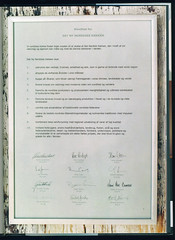
By the time they returned to Copenhagen and began to work in earnest on what would become Noma's cuisine their vision had begun to develop into a full-fledged philosophy. Among its central tenets: take the Mediterranean notion of terroir, as well as the cultivation of biodiversity and the celebration of seasonality that goes along with it, and use it to utterly reject Southern European cuisine and its dominance of fine dining internationally. In other words, develop a cuisine "built on a basis of traditional and non-traditional Nordic ingredients," as Claus Meyer noted after one early planning meeting, one that would give "expression to the seasons' changes in a maximum way, taking things all the way to the limit." By March 2004, just four months into Noma's life, this sort of feistiness, this proudly anti-Mediterranean attitude, was already paving the way to the Nordic Cuisine Symposium, where in true Danish fashion--this is the same country, after all, that gave birth to Dogme 95--they banged together a 10-point manifesto that set the parameters for this New Nordic Cuisine. There were twelve signatories to this manifesto, representing Denmark, Sweden, Norway, Finland, Iceland, and Greenland, and René Redzepi's signature stands front and center.

manifesto fig. f: manifesto for a New Nordic Cuisine

Anyway, there's a lot here that appeals to us here at "...an endless banquet": seasonality and a focus on indigenous ingredients, Nordic pride and the development of a cuisine that's both innovative and steeped in tradition and that truly represents the region, and, yes, even a manifesto. We've said it before and we're going to say it again: for all the talk about Montreal's "European" flavor, this city, this province, is often at its best when it readily acknowledges its peculiar Nordic character (let's not forget that Montreal is at roughly the same latitude as Milan). Noma: Nordic Cuisine offers a virtual blueprint for how to develop a region's cuisine, how to create a cuisine that truly reflects the terroir, and how to do this within the context of a northerly climate.*

That said, Noma: Nordic Cuisine did present us with a couple of problems. First of all, I would characterize it as being one of those cookbooks that's more interested in spreading the reputation of a particular restaurant and its chef and in communicating with other top chefs than it is in communicating with the amateur. There's nothing necessarily wrong with this approach, of course, but it often results in vagueness when it comes to articulating recipes, and that's certainly the case with Noma. Take the Hay-Baked Celery Root recipe, for instance, which begins like this: "Light the hay with a match, some place away from the kitchen, and burn off the first bit of smoke." The ideas are there, and they're frequently brilliant, but you might have to be a chef (or a psychic) to figure out how to bring them to life. Secondly, Noma's tireless efforts when it came to tracking down indigenous Nordic ingredients means that quite a few of the recipes are impossible to replicate without access to their alternative distribution networks. It might be a little difficult to find local sources for musk ox, yellow archangel, and seakale, but Noma certainly leaves you with the desire to broaden your repertoire of regional and indigenous ingredients, and, overall, there's a surprising amount of overlap between the seasonal specialties there and here: fiddlehead ferns, lobster, hare, jerusalem artichokes, oysters, pears, ramps, and so on.

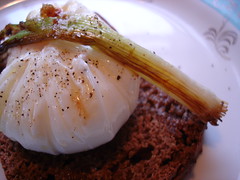
When it came to actually putting Noma: Nordic Cusine to use, however, we started off very tentatively. Michelle took elements from a couple different recipes and paired them, creating a new breakfast combo all her own. The first was a wonderful spice bread recipe, one that had that exact Northern European spice bread flavor that Michelle had been seeking but had otherwise failed to find. The second was a novel and, quite frankly, ingenious approach to the poaching of an egg, one that allowed for the egg to be aromatized as it cooks--in this case with white truffle oil.** She then added a caramelized scallion as a finishing touch.

Danish poached egg fig. g: spice bread, truffled egg, caramelized scallion

Spice Bread (metric)

5 g cinnamon
5 g clove
2 g nutmeg
2 g green anise
150 g rye flour
150 g wheat flour
20 g baking powder
50 g wholewheat flour
100 g honey, preferably chestnut honey
150 g maple syrup
125 g whole milk
125 g eggs
fresh rosemary
butter and salt

Preheat the oven to 160º C. Mix the dry ingredients together in a bowl. Crush the spices and sift them over the dry ingredients. Stir in the honey and maple syrup, then the milk, and finally the eggs. Place in a buttered loaf pan and bake until a knife inserted in the center comes out clean, about 45 min. Let cool on a rack.

Spice Bread (imperial)

1 1/2 cups rye flour
1 1/2 cups all purpose flour
1/2 cup whole wheat flour
1 tbsp baking powder
2 tbsp cinnamon
2 tbsp cloves
1 tbsp nutmeg
1 tbsp green anise
1/3 cup + 1 Tbsp honey
1/2 cup maple syrup
1/2 cup milk
2 whole eggs
1 egg yolk

Preheat the oven to 325° F. Mix the dry ingredients together in a bowl. Crush the spices and sift them over the dry ingredients. Stir in the honey and maple syrup, then the milk, and finally the eggs. Place in a buttered loaf pan and bake until a knife inserted in the center comes out clean, about 45 min. Let cool on a rack.

Truffled eggs

1 egg per person
truffle oil
microwaveable plastic wrap

The basic method is as follows. Line a coffee cup with a small piece of plastic wrap, making a bowl. Take a small amount of truffle oil and spread it on the bottom. Carefully break an egg into the cup, gather the edges of the plastic up around the egg and twist it tightly closed. Secure it with twine or a twist tie. Repeat with as many eggs as are needed. Bring a small saucepan of water to simmer and maintain its temperature. Drop the eggs into the water and let them poach about 4 minutes. Carefully remove them from the water and gently take off the plastic wrap.

[both recipes from Noma: Nordic Cuisine]

To serve:

Lightly toast the bread and spread it with butter. Top with an egg and a caramelized scallion, season with salt and pepper, and enjoy.


This initial experiment having turned out a smashing success (if a modest one), we decided to take bigger steps with Noma: Nordic Cuisine the next time around.

To be continued...

am/km

P.S. If you'd like to read an actual firsthand account of what it's like to dine at Noma (complete with a whole slew of beautiful photographs)--which just received two Michelin stars in their Main Cities of Europe 2008 guide--check out Very Good Food's in-depth report.

P.S. 2 May 4, 2008: Now The New York Times has published a review of Noma as part of a piece on New Danish Cuisine in Copenhagen. Check it out here.

* More thoughts on cuisine and le grand nord: Just two week ago I attended a conference where one of the presenters, a local poet, waxed poetic (what else, right?) about Quebec's essentially Northern spirit, about the Idea of North that lies at the heart of Québécois culture. Well, as much as I wish this were true on some level, I couldn't help but think that the same culture that declared "Mon pays c'est l'hiver" some forty years ago, has spent the last 50-60 winters focusing its collective energies and fantasies southwards, towards places like Florida and Las Vegas. And, frankly, cuisine here in la belle province oftentimes suffers from the same fixation, which is why Montreal's standout restaurants are the ones that are the most fiercely independent, the ones that recognize that not only does it pay to support local and regional producers, doing so can be a source of inspiration and a sure-fire way to put yourself on the map. Does this mean we're advocating some kind of entrenched provincialism when it comes to cuisine? Of course not, but if you're going to transpose the cuisine of northern Italy or of southwestern France on the Québécois milieu, why not transpose the strong sense of terroir that goes hand-in-hand with those traditions?

** "Whoa! White truffle oil?!? Isn't that as Mediterranean as it comes?" Not at all. Locally harvested truffles figure prominently on Noma's autumn menu. Of course, the truffle we used was Italian, but that's another matter. Those fabulous Tennessean truffles we've been hearing about haven't made their way north in the form of truffle oil yet, to our knowledge.

Thursday, February 16, 2006

The Hungarian New Wave Starts at Home

Pride of Szeged

Just as Montreal was once a respectable city for rye bread, it was also once an important hub for Canada’s Hungarian immigrant population and, as a result, a city with its fair share of Hungarian restaurants, delis, and bakeries. It goes without saying that the virtual disappearance of these two aspects of Montreal’s former food culture is no mere coincidence. Again, it’s not that you can’t find Hungarian food in Montreal—one of the city’s best boucheries/charcuteries is the venerable Charcuterie Hongroise, which has been selling their exceptional sausages, smoked bacon, and other specialties on the Main for some 50 years now. When it comes to actual sit-down restaurants, the metro area has a few, but it’s safe to say that there isn’t a whole lot of competition in this department anymore. Gone are the days when Hungarian establishments were clustered along a good portion of St. Laurent Blvd., gone are the days when Hungarian-continental restaurants like Pam Pam (my parents’ favorite) graced the city’s downtown dining scene. When it comes to Hungarian restaurants and their dwindling numbers, though, it strikes me that Montreal isn’t alone among North American cities. It might just be my imagination, but it seems to me that Hungarian restaurants were much more of a fixture 20-30 years ago (maybe it’s just because I was spending so much more time in the Goulash Belt back then). What happened? Did tastes just shift away from Hungarian, and, if so, why? Did the clichéd trappings of your average Hungarian restaurant—the mandatory ersatz beef goulash, the strolling gypsy violins, etc.—finally suffocate the cuisine? One would have thought that the fall of the Iron Curtain might have triggered a new wave of Hungarian restaurants across North America. Maybe it has elsewhere, but if it has I haven’t read anything about it. It certainly hasn’t in Montreal. If ever there was a cuisine just begging to be revisited and revitalized it was Hungarian cuisine. We’re constantly being told how young and brash and exciting a city Budapest is (and those of us who’ve been there know that it is). I say, bring on the Hungarian New Wave!

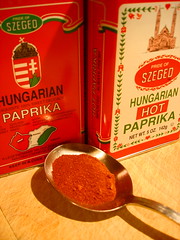
In the meantime, you’ll have to take matters into your own hands as we did the other night. Disappointed by the last “chicken paprikash” I had in a restaurant, and having been eager to experiment with some of the Hungarian recipes we had at home, I went out to the store to get a fresh tin of hot Hungarian paprika, Pride of Szeged brand, and we rolled up our sleeves and got to work.

Now the recipe I chose came from Saveur’s special issue of Food for the Holidays (Winter 2004), and it came under the unpretentious and somewhat vague title Paprika Chicken. The write-up mentioned only that it was a “home-style version of an iconic Hungarian dish,” but it didn’t specify which dish in particular. You see, things get a bit complicated when it comes to those dishes that have become know as the classics of Hungarian cuisine. First off, the Hungarian equivalent to the Anglicism “goulash” has nothing to do with stew, it’s the word for cattle driver (gulyás). This word, in turn, is associated with a soup (not a stew) called gulyás leves, meaning “soup of the cattle driver” or “soup of the cowboy,” a soup that bears little resemblance to “Hungarian goulash.” What is known internationally as “Hungarian goulash” is known in the motherland as either pïrkïlt or paprikás. Now, Hungarian cattlemen, shepherds, and pig herders had been making dishes involving cubes of meat, onions and spices (like “Hungarian goulash”) for at least 150-300 years before the arrival of paprika, and one common version involved roasting the meat over an open fire until it reached the point just prior to burning, acquiring a slightly burned surface (the quality of which became known as pïrkïl). According to Alan Davidson, although paprika was mentioned in a Hungarian dictionary as early as 1604—not too long after its ancestor pepper (Capsicum Annuum) was brought to Europe from the New World—it was not until the early 19th century that paprika took hold in Hungary (by way of Turkey and Bulgaria) and that the Hungarian people reinvented their cuisine, practically eliminating the use of ginger and black pepper in the process. When they experimented with this new spice, Hungarians discovered they could use it to reach the point of pïrkïl, flavor-wise, without actually burning the meat, and that, in fact, they preferred this variation to most ways of cooking meat that had preceded it. This new dish became known as pïrkïlt, paprikás if sour cream had been added to it, it was used to cook beef along with veal, pork, rabbit, and poultry, and it quickly became the national dish, the dish that vaulted paprika to the status of “national condiment.” What does this all mean? Well, I guess it means that the dish we made was in actuality a pïrkïlt because although sour cream is listed, it only appears in the form of a dollop alongside the dish. That being the case, you can understand why Saveur might have fudged the name a bit (in fact, some of you out there might be wishing that I had, too).

What’s important here is that the dish is a stunner. Simmer down that sauce and it turns into a thing of beauty even though it doesn’t involve a roux in any way, shape, or form (I was a bit surprised). The mix of paprika powders gives the dish an impressive depth, of course, and feel free to play around with the ratio a bit if you prefer your dishes a little spicier, but the real surprise was the effect of the green pepper, which gave the sauce a subtle flavor that I’d never been able to place before. It’s traditional to serve this dish with spätzle-like dumplings (what my Baba used to call by the Slovak word halusky), but almost as classic is the combo with egg noodles, and that’s the path we followed this time around. Lastly, that sour cream/milk mixture might seem a bit arbitrary, but it was worth doing—it improved the consistency and mellowed it out considerably.

Without any further ado:

Paprika Chicken

1/4 cup vegetable oil
3 medium yellow onions, peeled and finely chopped
3 cloves of garlic, crushed then peeled
2 tsp sweet Hungarian paprika
1/2 tsp hot Hungarian paprika
3 fresh or canned plum tomatoes (given the season, I used canned tomatoes)
2 green bell peppers, cored, seeded, and diced finely, or, preferably, some other tastier green peppers (like Cubanelles or Italian fryers), treated in the same way
2 tsp salt
1 cup water
2 3.5-lb chickens, rinsed and cut into 4 pieces each
1/2 cup sour cream
2 tbsp milk

Heat the oil in large pot over medium heat. Add onions and cook until golden, about 10 minutes. Reduce the heat to medium-low, add garlic, the sweet and hot paprika, tomatoes, bell pepper, salt, and 1 cup of water and stir well. Add the chicken, cover, and simmer until tender, about 45 minutes, turning chicken once about halfway through (and possibly rearranging the pieces to ensure that they get evenly cooked, as I did). Remove the chicken pieces from the pot and set them aside.

Strain the sauce through a fine strainer into a bowl, making sure to press down on the vegetables to squeeze every last drop of liquid out of them. Discard the vegetable solids. Return the sauce to the pot, increase the heat to medium, and simmer until the sauce has thickened, about 20-30 minutes. Meanwhile, when the chicken is cool enough to handle, remove and discard the skin and bones, keeping the breasts and thighs intact (to be honest, we weren’t that methodical about this step—we didn’t care if it resulted in a somewhat messier meal, we were all friends and family). Return chicken to the pot, reduce heat to low, and keep warm, tossing the chicken in the sauce so that it gets coated evenly.

Mix the sour cream and the milk together in a small bowl and set aside.

Serve the chicken pieces with egg noodles, a ladle full of that amazing sauce, and a dollop of the sour cream/milk mixture. Bread and salad is all you need to make a meal of this.

Serves 4 to 6.

By the way, we’re compiling variations on traditional Hungarian pïrkïlt and paprikás dishes. We’d be ecstatic if any you out there would send us your home recipes.

aj

Andrew Dalby, Dangerous Tastes: The Story of Spices
Alan Davidson, The Penguin Companion to Food

Saturday, February 11, 2006

On "Saturday Afternoon Bread" and New York-Style Rye

Between the two of us, we had some limited experience with baking bread at home and even a little professional experience*, but when Michelle decided that she wanted to get into bread baking more seriously almost a year and a half ago now, she discovered that it was even more demanding than she’d imagined. She started to collect some of the essential literature on the subject, she did a lot of reading, and she acquired things like a proper baking stone, she even got some help from a professional when it came to her sourdough starter, and all of these preparations resulted in some very good loaves of bread, but the loaves were few and far between, and the problem had to do with fitting complicated methods into a busy life. Because of this, Michelle felt vindicated when she came across a review of a half-dozen of the top North American books on bread baking in the last issue of The Art of Eating (#70) by no less of an authority than James MacGuire, the Montreal-based professional who owned and ran Le Passe-Partout for over 20 years and who now lectures at the CIA (not “the Company,” the other one), among other places. MacGuire’s generous review encompasses everything from a comparison of baking habits in North America and Europe, to a brief history of the challenges encountered by the North American artisanal bread baking movement that began in the 1980s, but for the most part he carefully examines each of the titles under discussion, and doesn’t mince words in his appraisals. MacGuire notes serious problems with most of the books reviewed, and some books even get a drubbing, but one of his biggest gripes has to do with how overly and (in some cases) needlessly complicated these bread books tend to be. He quips that with some of these books, “the necessary dedication might lie somewhere between that required by a serious hobby and a minor religion,” before singling out Nancy Silverton’s Breads from the La Brea Bakery: Recipes for the Connoisseur: “in one recipe she suggests that readers begin work at six o’clock on Saturday morning in order to have the loaves ready by about ten o’clock that night.” What mystifies MacGuire is that most of these books are both overly technical and riddled with inaccuracies and, from time to time, outright mistakes, and he ends up pointing out that there the market is sorely in need of something that’s both solidly grounded and practical:

Missing from the lineup is a short book that someone could use to bake a few loaves of bread on a Saturday afternoon, a book that would explain what is genuinely essential but still leave room for chores, errands, or even a nap.

With all this in mind, we’ve recently decided three things: that we want to bake bread more often, that we want to bake bread together, and that we want to focus on recipes that are manageable. Oh, and if we can bake something that’s hard to find or altogether missing from the local bread market (believe me, as good as Montreal’s bread can be at times, this isn’t difficult), all the better. That’s why we made our first experiment as part of this new order rye bread. We’re both serious about our caraway rye, and if there’s really a serious rye available in Montreal at present, neither of us know of it. It’s certainly been a while now since there was a true European-style rye bread (MacGuire describes these as having a minimum of 60-65% rye flour) available in Montreal, but these days it’s even hard to find a good North American-style rye (20-30% rye flour). In fact, I'd be surprised if your average Montreal rye loaf (the kind of stuff they use for the smoked meat sandwiches at Schwartz's, say) has more than 10-15% rye flour. Try to find a good caraway rye and your success rate bottoms out entirely.

After consulting a number of recipes, we settled on Rose Levy Beranbaum’s recipe from her The Bread Bible. Now, MacGuire reviewed this book, of course, and he criticized it for “pseudoscientific precision” as well as for “an admissibly low” ratio of rye to wheat flour “for anything approaching real rye bread,” but we’d decided that weren’t even going to try to make a true European-style rye, that we wanted to make a New York-style rye with plenty of caraway seeds, and we wanted to be able to make our loaf within a matter of a few hours (more or less). We liked the way Beranbaum’s recipe read and it met all the above criteria.

New York-style rye

“Levy’s” Real Jewish Rye Bread

note: keep in mind that we’ve only included the directions for the electric mixer version of this recipe. Michelle got a brand-new KitchenAid mixer for Christmas, so she might as well use it, right?

special equipment: a half sheet pan, sprinkled with cornmeal (Michelle used a piece of parchment instead)

a baking stone OR baking sheet

a mixer

Sponge:

3/4 cup bread flour
3/4 cup rye flour
1/2 tsp instant yeast
1 1/2 tbsp sugar
1/2 tbsp malt flour
1 1/2 cups water (at room temperature, 70º F to 90º F)

In a mixer bowl or other large bowl, place the flour (both kinds), yeast, sugar, malt, and water. Whisk until very smooth, to incorporate air, 2 minutes. The starter will be the consistency of a thick batter. Scrape the sides of the bowl. Set aside covered with plastic wrap while you make the flour mixture.

Flour mixture:

2 1/4 cups bread flour
1/2 tsp + 1/8 tsp instant yeast
2 tbsp caraway seeds
1/2 tbsp salt
1/2 tbsp vegetable oil
2 tsp cornmeal for sprinkling

Combine the ingredients for the flour mixture and add to the sponge. In a large bowl, whisk together the bread flour, rye flour, yeast, caraway seeds, and salt. Gently scoop it onto the sponge to cover it completely. Cover tightly with plastic wrap and allow it to ferment for 1 to 4 hours at room temperature. (The sponge will bubble through the flour mixture in places while you’re waiting. Don’t worry, this is fine.)

Add the oil and mix with the dough hook on low speed (#2 on a KitchenAid) for about 1 minute, until the flour is moistened enough to form a rough dough. Raise the speed to medium (#4 on a KitchenAid) and mix for 10 minutes. The dough should be very smooth and elastic, and it should jump back when pressed with a fingertip. If the dough is at all sticky, turn it out onto a counter and knead in a little extra flour. (The dough will weigh about 2 pounds, 1.7 ounces.

Now it’s time to let the dough rise. Turn the dough out onto a lightly floured counter and press it down to flatten it slightly. Round the dough into a ball about 5 1/2 inches by 2 1/2 inches high and set it on the cornmeal sprinkled baking sheet (or parchment paper). Cover it with a large container or oiled plastic wrap. Let the dough rise until almost doubled, about 1 hour to 1 hour and 15 minutes. It will be about 7 1/2 inches by 3 1/2 inches high, and when pressed gently with a fingertip the depression will very slowly fill in.

Preheat the oven to 450º F one hour before baking.

With a sharp knife or single-edged razor blade, make 1/4- to 1/2-inch-deep slashes in the top of the dough. Mist the dough with water and quickly but gently set the baking sheet on the hot stone or hot baking sheet (if you use parchment paper, just slide the loaf onto the hot baking sheet directly). Bake for 15 minutes. Then lower the temperature to 400º F and continue baking for 30 to 40 minutes or until the bread is golden brown and a skewer inserted into the middle comes out clean (an instant thermometer inserted into the center will read about 190º F).

Remove the bread from the oven, and transfer to a wire rack to cool completely.

Being fans of a hearty, full-flavored rye, we followed Beranbaum’s “Ultimate Full Flavor Variation,” which meant that we allowed the sponge to ferment for 1 hour at room temperature, then refrigerated it for almost 24 hours.

Because Canadian unbleached all-purpose flour is higher in gluten than its U.S. counterpart, and therefore a lot closer to bread flour than it would be in the States, we opted to use it instead of bread flour. Michelle feels like she’s already got too many different types of flour on hand without having to buy yet another one.

Also, Beranbaum actually recommends a method whereby a cast-iron skillet or sheet pan is placed on the floor of the oven, then filled with 1/2 cup of ice cubes at the point when you begin baking the bread (the skillet or sheet pan should be pre-heated, of course). This method adds steam to the baking environment and makes for a better crust. We would love to use this method ourselves, but our oven won’t allow for it. Our crust turned out wonderfully anyway.

As indicated earlier, Beranbaum’s rye is very much a New York rye, not at all like the rich, dark ryes I got used to when I lived in Germany (and which Michelle quickly fell in love with when she came to visit). It’s got a good rye flavor, if a subtle one, and it contains just the perfect amount of caraway. It’s also remarkably sweet—not cloyingly sweet, mind you, but it’s definitely got a perkiness to it. That being said, this is an excellent loaf, and one that’s very manageable. I wouldn’t quite characterize it as a “Saturday afternoon bread,” but it’s pretty close.

Just how good is this rye? Well, Michelle’s mom (a.k.a. Helen) danced after she tasted the 1/2 loaf Michelle brought to her. Helen doesn’t suffer poor loaves of rye gladly and she doesn't dance very often, so that's saying something.

Next up: true pumpernickel.

As for that "as yet unwritten Saturday afternoon bread book"--if only MacGuire would write it. Just imagine.

aj

*Ha, ha. That’s a laugh—I was the temporary, fill-in bread baker at a vegetarian take-out restaurant in London in the early 1990s. I had some previous experience in the kitchen, so I did a reasonable job. I did make improvements to the house cornbread recipe, though, using my American know-how. When the regular bread baker came back from “vacation” (he’d had a nervous breakdown), I was moved to food prep in the kitchen because they liked me and I was competent. I remember that the regular bread baker was a bit difficult, prone to frustration and fits of rage. The rumor was that he had a plate in his head, and that when things got hot (literally) in the kitchen/bakery, well…

Friday, February 10, 2006

Hello, Greengage plum butter

Greengage plum butter

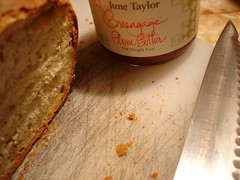
Well, that jar of Baby Crawford peach jam from Andy’s Orchard disappeared in a hurry, and we had such a good time with it that we decided to bust out another of our California souvenirs. This time, however, we didn’t open up one of our can-as-you-go specials (although we do have a couple of those kicking around), we opted instead for one of the beauties Michelle bought directly from June Taylor last August, the day she got her personal workshop: Greengage plum.

We were familiar with the lore that surrounds Greengages, but neither of us had actually ever tried one until we visited Andy’s. Greengage season was effectively over by the time we got our tour of Andy’s Orchard, but Mr. Marinari managed to rustle up a few specimens for us nonetheless, even if they were past their prime in his eyes. Like everything else we had at Andy’s, they were outrageously good, so much better than Andy’s disclaimers would have led you to believe, and easily among the very best plums we’ve ever had. Obviously, this had a lot to do with Andy’s Orchard and the way they were cultivated, but it also had a lot to do with the variety itself, whose perfectly rounded honey-sweetness is the stuff of legends.

Alan Davidson notes that the Greengage originated in Armenia, by most accounts, but that the variety had reached France by the time of the reign of François I, where it was received very warmly indeed and was soon named after François’ wife, “Reine Claude,” the name by which the variety is still known to this day in that part of the world. By the early 18th century the variety had been introduced to England, where it also took hold, and where it became known as the Greengage (or Green Gage) because of its color and because of Sir Thomas Gage, who was one of the earliest horticulturists to develop the variety on English soil, having purchased a number of fruit trees from the monks of Chartreuse, one of which turned out to be a Reine Claude plum tree. Our favorite fruit book of the moment, The Fruits and Fruit Trees of America by A.J. Dowling (1845), lists numerous other varieties of plum bearing the name “Gage,” including Autumn Gage, Bleecker’s Gage, Hudson Gage, Imperial Gage, and Yellow Gage, but the Greengage is the one that predated all the rest and the one that has largely outlasted the rest, and in both cases the reason has to do with its famous taste. Dowling goes so far as to write, “The Green Gage is universally admitted to hold the first rank in flavour among all plums, and is every where highly esteemed… It is pronounced… the best plum in England, and we must admit that we have no superiour to it here [in New York],” and he describes its fruit as “exceedingly melting and juicy” with a “flavour, at once, sprightly and very luscious.” We couldn’t agree more. Davidson, for his part, has the following somewhat contradictory comments to make: “Greengages, being the finest of dessert plums, should be enjoyed in their natural state. They also make the most luxurious of plum jams.” We were lucky enough to have had them both ways, but opening a jar of Greengage plum butter in February (on a –20 C night, no less) was like a godsend.

So much so, that we decided to celebrate their unveiling.

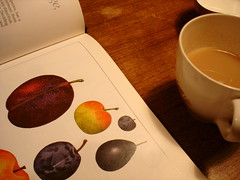
1. We brewed ourselves a pot of tea to accompany our reading material.

tea and plums

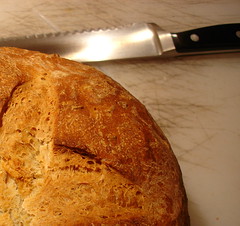
2. We put the finishing touches on a loaf of rye bread [recipe soon to follow], then baked it in the oven.

rye bread

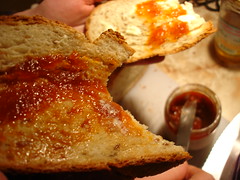
3. And, finally, we slathered butter and generous amounts of the Greengage plum butter on our still-warm slices of bread.

Greengage plum butter on bread

No question about it. This was the best dessert I’ve had in weeks (sounds crazy, I know, but you're going to have to trust me on this one). I remember June Taylor telling us about how she often feels stumped when asked for recommendations on how to use her wonderful line of jams and butters. Look no further, June.

aj