Showing posts with label asado de puerco. Show all posts

Saturday, April 21, 2007

Mexicali Madness I

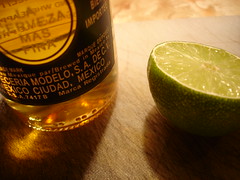
corona & lime

By the time of my birthday, in the first week of April, all signs of spring had vanished and the temperature had plummeted to a high of 1º C. We decided to soldier on regardless, turning South of the Border for strength (actually, south of a couple of borders), to Mexico. Our menu and our approach to Mexican this time around was going to have some California flavor to it, though, so when we came up with the name for our night, we called it "Mexicali Madness." We got so inspired it really didn't take long to draw up our menu/shopping list
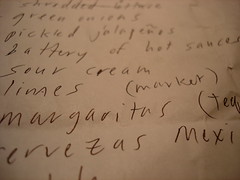
mexicali menu

and then we designed our invitations, with a little help from J.G. Posada.

mexicali madness I

I knew I wanted a roast pork dish that'd be falling off the bone and just begging to get scooped up in a fresh, hot tortilla as the centerpiece. I also knew I wanted fish tacos. More than anything, though, I wanted the table to be a tribute to those extraordinary condiments trays you find in Baja when you go to a fish taco joint and place your order, the ones with a dizzying array of toppings, from freshly prepared guacamole and salsa, to pickled onions, carrots, and jalapeños, to crema and those ubiquitous bottles of Tapatío, each of these assortments unique to that particular establishment. The idea here was to have a celebration of bounty, one not unlike this vision of cornucopia, but spicier, hotter, more savory (if you can believe that).

mexico, land of plenty

The menu that we settled on included queso fundido, asado de puerco a la Veracruzana, tacos de pescado a la A.J., guacamole, salsa ranchero a la A.J., frijoles negros, and a whole whack of fixin's, and mostly we turned to our friends Diana Kennedy, Philippe de Vienne and John Thorne for assistance.

Queso fundido

Mexican queso, Monterey Jack, or medium cheddar

Preheat your oven to 325º F. Grate the cheese and place it in an ovenproof dish. Add sliced mushrooms, chorizo sausage slices, or strips of grilled peppers, if you like. Bake in the oven for 5 minutes, or until the cheese has fully melted. Serve hot accompanied with hot corn tortillas.

[from Philippe de Vienne]


Simple, elemental, gooey, delicious.

Asado de Puerco a la Veracruzana

5 lb pork roast on the bone, preferably pork butt
6 garlic cloves
1 tbsp salt
5 tbsp fresh lime juice
6 ancho chiles, seeds and veins removed
4 morita chiles, or 1 chipotle or mora
1/2 cup water, approximately
4 whole allspice, crushed
frozen banana leaves sufficient to wrap the roast in a double layer, thawed and wiped clean

Pierce the meat all over with the point of a sharp knife. Mash the garlic with the salt and moisten with the lime juice. Rub this mixture thoroughly into the roast and set aside to season while you prepare the chile mixture.

Lightly toast the ancho chiles on a hot griddle. Cover them with hot water, add the whole, untoasted morita chiles, and simmer for 5 minutes. Turn off the heat and let the chiles soak another 5 minutes.

Transfer the chiles to a blender with the water. Add the allspice and blend until smooth. Add a little more water only if the paste remains too thick and doesn't blend properly.

Coat the pork liberally with the chile paste. Hold the banana leaf over a hot heat until it softens and wrap it around the meat. Let the meat season overnight in the refrigerator.

The next day, preheat the oven to 325º F.

Place the banana-leaf-wrapped meat in a Dutch oven or casserole with a tightly fitting lid (or seal it tightly in a large roasting pan with aluminum foil, like we did) and bake for 2 hours, by the end of which time there should be plenty of juices at the bottom of the casserole. Remove the lid, discard the banana leaves, and continue cooking the meat uncovered, basting it from time to time, for about 2 hours longer, or until the meat is soft and falls away from the bone with ease.

Serve hot, with fresh corn tortillas.

[from The Essential Cuisines of Mexico by Diana Kennedy]


As soon as I saw this recipe I knew it was The One for this occasion. As soon as I saw that marinade, that chile paste, and those banana leaves I could visualize the end result. I'd love to do a slow-cooked version of this sometime, but this time around we followed Kennedy's specifications to a tee, and, believe me, it didn't disappoint. Kennedy mentions that this dish is much better the day of than it is the day after, but we threw all caution into the wind and did a double recipe anyway, because we knew we were going to have a hungry crowd. We were pretty pleased when it turned out we had some leftover pork at the end of the evening, and we managed to revive those leftovers just fine the next day when we recreated our pork taco feast all over again.

Tacos de pescado a la A.J.

In Baja, the chunks of fish that you get with our fish tacos are always batter-fried--they're batter-fried with finesse, but they're still batter-fried. Sometimes I prefer to just sauté my fish for my home version. I get a couple generous hunks of a fish that's got some body to it, but that won't break the bank, something like Opah (or Moonfish). Then I cut them up into 1-1 1/2 inch cubes and I marinate them in a combination of lime juice and tequila in the refrigerator for about 30 minutes. When they're ready to go, I heat a few tablespoons of flavorless oil (like Canola or grapeseed) in a skillet or wok until it's smoking. I take the fish out of the marinade with a slotted spoon, place them in the hot pan, and stir-fry them until they're just done, no more than 3 minutes or so. Serve with hot corn tortillas.

Guacamole

1 serrano pepper, minced
1/2 tsp salt
1/2 onion, minced
1 medium-size ripe tomato, diced
2 avocados, just ripe
minced cilantro to taste
juice of 1/2 lime (optional)

Whether you add lime juice or not is going to have a lot to do with how good and ripe your avocados are. I'm kind of partial to lime juice, but that's mainly because I can't get the kind of avocados up here that I became accustomed to in Orange County, CA one summer. Frankly, I feel the same way about the tomato. If you can't find a really nice, ripe one, it might pay to just leave it out. Nothing ruins a guacamole faster than a mealy, previously frozen supermarket tomato.

[This recipe's mostly Kennedy's classic version with a little de Vienne thrown in for good measure.]

Fast Frijoles Negros

1 onion, chopped
1 head of garlic, broken into cloves, peeled, and minced
1/4 cup olive oil
4 19-oz cans black beans, drained
1 tablespoon chipotle purée
juice of 1 lime
salt and pepper to taste
minced cilantro (optional)

In a medium-size pot, heat the oil and sauté the onion and garlic until the onion is soft. Add the beans, stir, fill up one of the empty cans of beans with water and add that, too. Bring to a boil, then simmer on low for 20-30 minutes, making sure to stir from time to time to make sure the beans aren't getting scorched, and adding additional water if necessary. Add the chipotle purée, the lime juice, and adjust the seasonings. Garnish with cilantro if you like.

[Adapted from a Cuban black beans recipe in John Thorne's Serious Pig]


What's getting left out in all of this is Michelle's fantastic dessert. She asked me what I wanted and I was honest: cookies and ice cream. Not some big cake (as much as I love big cakes), something simple and somewhat lighter, something befitting a Mexican fiesta. So she made Mexican vanilla ice cream with dark caramel brittle and Mexican chocolate cookies to go with it.

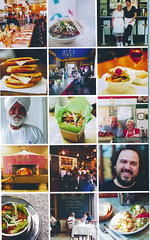
Documenting the evening's festivities with his impressionistic photographic eye was none other than Mr. S., but somehow he managed to miss the piñata, the Mexican hat dance, and the all-human, cruelty-free bullfight that we organized as entertainment. He did manage to capture the following photographs, though. L-R: Michelle, LPs, Julie, Alina, Seth, A.J., Nick, Mexican chocolate cookies, Susan.

mexicali montage

Thanks to T., A., A., C., V., H., M., S., J., N., J., C., S. and M.

By popular demand (top L-R: Seth, Camilla, Susan, Nick; middle L-R: Seth, Juliet, A.J., Tim; bottom L-R: Hermine, Python, Adam, Nick):

mexicali squares

aj

Friday, December 29, 2006

2006, The Year of the BBQ Finale: Cuban Holiday BBQ

pig A to M fig. a: can you locate the pork shoulder?

The first time I ever heard about lechón asado was back in the early '90s when I was living in London. One of my closest friends at the time was a fellow US expat from Miami, and while her father was a Rhode Islander of Irish stock, many of his best friends down in Hialeah were Cuban and over the years he'd been initiated in the ritual of lechón asado. Evidently, he'd been well taught, because the former pupil had eventually managed to become the recognized master within his particular community. Come Christmas and New Year's--the two traditional dates for Cuban lechón asado--he was in high demand. Hire him and you'd get the full treatment--from the pig farm to the table.

Go to Miami over the holidays, make your way to Little Havana or any of the other neighborhoods in the region were Cubans are prevalent, and you'll smell the the distinctive smell of lechón asado being slow-cooked on Christmas Eve (a.k.a. Nochebuena) and New Year's Eve: the fires, the roasted banana leaves, the pork, the pungent marinade. By now I'm sure there are countless variations when it comes to preparing lechón asado (including ones involving the so-called China Box, that secret weapon in the Cuban barbecue arsenal), but the basic method is a pit barbecue method involving marinating a suckling pig (hence the name lechón, which is derived from leche, the Spanish for milk) for 24 hours in a Cuban adobo sauce (in this case, a sour orange and garlic-based marinade), digging a pit in your backyard, layering the pit with banana leaves, placing the pig in the pit, covering the pit with a sheet of steel, building a fire on top of the steel sheet, and then roasting the pig in the pit for the better part of a day. Gather your friends, drink your choice of beer and rum-based drinks liberally, listen to good music, perhaps do a little dance, and generally have yourself a swell time. Sound like fun? It is. The pig turns out great, too. Tender, juicy, and impossibly flavorful on the inside, crispy on the outside, it’s absolutely irresistible when dressed with Cuban mojo (which, it must be noted, is pronounced “mo ho” not “mo jo” outside of the blues idiom).

Now, 2006 had been somewhat of a Year of the BBQ around here, as those of you who've been following this year's activities are probably aware of. Sometime in November I started fixating on lechón asado, planning the event that would bring Year of the BBQ to a close. And while I was sure that "Grandpa," our landlord, would never in a million years let us dig a pit in his beautiful garden downstairs, I had visions of picking up an actual suckling pig and developing some kind of alternate roasting method that would remain as true to the original as possible. I eventually scrapped the idea of buying an actual suckling pig altogether primarily because of the cost. What I did instead was go back to our old friend the pork shoulder and try a variation on lechón asado, one that could more rightly be called puerco asado a la Cubana (or something to that effect). Sure, it wasn't going to turn out nearly as dramatically as a suckling pig and I was going to have to do without the pleasures of that crispy skin, but I was positive that the marinade + that pork shoulder was going to make for some awfully fine pulled pork, and I was excited about working with banana leaves, too, to lend some traditional lechón asado-like fragrance.

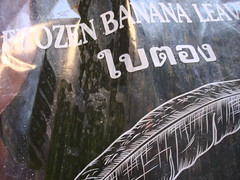
Thai frozen banana leaves fig. b: Thai frozen banana leaves

Together with that traditional adobo and the distinctive notes imparted by the Mexican oregano (not to mention the traditional pit barbecue technique), it’s the banana leaves which help distinguish Cuban lechón asado from other forms of pork barbecue, Caribbean or otherwise. Here, the type of wood that’s burned plays a relatively insignificant part (unlike Jamaican and most American styles of barbecue). And that’s one of the reasons I felt comfortable working on an oven version.

Once I’d gotten myself some Mexican oregano and some banana leaves—you'll find them both at Jean-Talon Market, the former at Olives et Épices, the latter at La Dépense—I looked around for sour oranges (a.k.a. naranja agria). Clearly, sour oranges must be readily available somewhere to the south of us, but I struck out here in Montreal. Apparently, you can find Caribbean-style sour oranges in some of the city’s Latino grocery stores from time to time, but I opted to use lime juice and a combination of lime juice and orange juice instead for my adobo and mojo. Not quite the same thing, but perfectly acceptable in a pinch.

The only other thing I needed to attend to was the pork shoulder. Here, I went to Vito and special-ordered my cut, opting for a half a pork shoulder because I wasn’t planning on feeding the multitudes on this occasion. The next day I was good to go.

Puerco Asado a la Cubana

1/2 bone-in pork shoulder, roughly 5kg (or 1 whole fresh ham of a similar weight)
1/2 package frozen banana leaves

adobo marinade:
2 heads garlic, broken into cloves and peeled
2 tbsp kosher salt
2 tsp dried Mexican oregano
2 tsp ground cumin
2 tsp freshly ground black pepper
1/2 tsp ground bay leaves
2 tbsp olive oil
2 cups sour orange juice or lime juice
1/2 cup dry sherry
2 large onions, sliced thin
fresh coriander (optional)
salt and pepper to taste

Put the garlic, the salt, the oregano, the cumin, the pepper, the bay leaves, and the olive oil in a food processor or blender and puree. Add 1 cup sour orange or lime juice and mix. Rub this mixture all over the pork shoulder. Place the pork in a large, sturdy plastic bag with the remaining sour orange juice or lime juice, the sherry, and the onions. Marinate the pork overnight, turning it on several occasions to marinate the meat evenly.

The next day, preheat your oven to 300º F. If you’ve bought frozen banana leaves, thaw them out gently (and if you’ve left the thawing to the last minute, you can speed up the process a little bit by placing them in the oven for a few minutes, like I did). Once the banana leaves are thawed, carefully pull them apart, keeping them in one piece if you can. Line an oversized roasting pan with a healthy length of aluminum foil. Line the aluminum foil with a couple of large banana leaves. Take the pork out of the marinade-filled plastic bag, and gently place it on the banana leaves. Wrap the pork shoulder entirely with the banana leaves then wrap the banana leaf-enveloped pork shoulder with the aluminum foil, making sure to make a tightly sealed package. Fill the roasting pan with a couple of inches of water, making sure to keep the water line below the point where your aluminum foil envelope is sealed. Place the roasting pan in the oven and roast the pork for 8 hours, checking on the water level from time to time and replenishing if necessary.

The pork should have an internal temperature of well over 160º F when fully cooked. Cubans like their pork well done, about 180º F. The pork should be somewhere in between after your 8-hour cooking time.

Shred your pork and season it lightly with salt and pepper, keeping in mind that you’ll be finishing the pulled pork with the mojo momentarily.

Serve with Portuguese buns, black beans and rice, some kind of salad, like a simple carrot/lime juice/scallions/cilantro salad (our personal favorite with this meal), and plenty of mojo.

mojo sauce:
1/2 cup olive oil
8 large garlic cloves, finely minced
2/3 cup fresh sour orange juice or 1/2 cup fresh lime juice + 3 tbsp fresh orange juice
1/2 cup water
salt to taste
1 tsp ground cumin
1 tsp freshly ground black pepper
1 tsp ground Mexican oregano
3 tbsp chopped fresh cilantro

Heat the olive oil in a deep saucepan over medium heat. Add the garlic and cook until fragrant and a pale golden brown, being careful not to let it become brown, at which point it will begin to turn bitter.

Stir in the lime juice, water, cumin, Mexican oregano, salt, and pepper, and be prepared for the sauce to sputter a bit. Bring the sauce to a rolling boil. Turn the heat off and correct the seasoning, adding salt and pepper to taste. Let the sauce cool to room temperature, then stir in the cilantro.

Serve the mojo in a jar, a bottle, or out of a bowl with a serving spoon. Shake or mix well before serving.

[both recipes adapted from the work of Steve Raichlen]


We didn’t actually make this meal for Christmas Eve, we made it for Boxing Day instead, further breaking with tradition, but it makes for a fantastic holiday meal (even from this home version you can understand why Cubans are as passionate about lechón asado as Americans are about Thanksgiving turkey), and it would make for a fantastic New Year’s Eve feast. It also made for a pretty amazing breakfast the following morning with some eggs over-easy, some more black beans, some hot sauce, and some good strong coffee.

aj


`