Saturday, July 31, 2010

A summer tart, in 140 characters or less...

tarte d'été fig. a: Michelle's summer tart

The other day, a reporter called me from La Presse asking for a Twitter-friendly recipe for a story on chefs who tweet. Luckily, I had just made this amazing little tart for some friends the night before and was more than ready for the challenge.

This tart is so simple, it hardly took 140 characters to write the recipe (of course, I had to leave out the instructions for the tart crust, and I also named it "tarte d'été," instead of "tarte aux framboises," in the interest of space). Light, elegant, lovely, this is a tart that really lets the raspberries shine. Invite some friends over and share it with a sparkling wine.

tarte d’été

un fond de tarte 6" cuit
fouetter 200g fromage blanc, 250g crème, sucre vanillé au gout
placer des framboises fraîches dessus

or
summer tart

1 6" tart crust, cooked
whip 200g quark cheese, 250g cream, vanilla sugar to taste
place raspberries on top

or, if tweets just aren't your thing, or you're not sure what recipe to use for the tart crust,

summer tart

crust:

125g flour
75g icing sugar
1/4 tsp. baking powder
1/4 tsp. salt
100g butter, soft
1/2 egg white

Mix the flour, sugar, baking powder and salt in a small bowl. Add butter and rub in with fingers until it resembles a fine meal. Add egg white and mix to combine. Wrap in plastic wrap and chill at least 1 hour.

Roll out on a floured surface to 1/8" thick. Place in 6" tart pan and carefully tamp down the sides. Trim off excess crust and chill 30 minutes. Place a layer of tin foil on the crust and fill it with pie weights or dried beans. Blind bake at 375º F for 10 minutes, remove foil and weights and bake 5-10 minutes more, until the crust is fully baked and quite golden. Let cool.

filling:

200g quark
250g cream
vanilla sugar to taste
fresh raspberries

Whip the cheese, cream and vanilla sugar to medium peaks and fill the cooled tart crust. Place the raspberries on top in a concentric pattern, or pell-mell, if that's more your style, and chill at least 30 minutes. Serve.


m

Tuesday, July 27, 2010

Turning Japanese

laser suzuki fig. a: Laser Suzuki!

It may have had something to do with the Laser Suzuki t-shirt that a friend of mine got me for my birthday last year, somewhat inexplicably. I've definitely been wearing it a fair bit recently, much to the puzzlement of those who know me well and who can't understand the message.* Or maybe it was all those travel tales from Japan that we've been hearing over the last several months from all those friends who've insisted, "You really must go! It's not as expensive as you think!" Then again, it may also have been the effects of that full-on Kazu fever that we developed this spring and that has yet to relent in spite of weekly (bi-weekly?) visits. All I know is that, for a while there, our AEB test kitchen was all about the Japanese.

harumi 1 fig. b: Harumi!

And when we felt like we need a little help with this process, our newest favorite friend, Harumi, was there to guide the way. I was none the wiser until quite recently, but Harumi Kurihara is something of a sensation in Japan. A former housewife turned "lifestyle authority," Harumi has apparently gone platinum many times over with her assortment of cookbooks, interior design books, lifestyle magazines, etc. But all of that is just hearsay.

All we really know is that Everyday Harumi: Simple Japanese Food for Family & Friends, her follow-up to her award-winning Harumi's Japanese Cooking (her first book in English), is a smash hit in our household. Everyday Harumi features some 70 homestyle Japanese recipes and a whole lot of gorgeous photography, and, as the title suggests, this is a book that focuses on recipes that are unfussy and that one might make on an everyday basis, many of which call for a minimum of ingredients. Best of all, they've all been winners so far,

harumi 3 fig. c: three toppings!

from the Three Toppings Rice, which is a kind of "mother & child"/"chicken & egg" number,

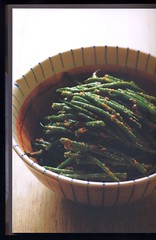
harumi 4 fig. d: green beans!

to her deliciously simple, simply delicious Green Beans with a Sesame Dressing (the same ones she's stirring in the photograph that graces the cover),

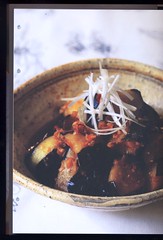
harumi 2 fig. e: eggplant!

to her Eggplant in Spicy Sauce--another ultra-straightforward, ultra-satisfying gem.

Michelle's been in heaven throughout this entire recent foray into all things Japanese, but for some reason she found the Eggplant in Spicy Sauce to be particularly brilliant, so that's the recipe I've decided to highlight.

Eggplant in Spicy Sauce

1 lb 3 oz eggplant (either Japanese, or baby Italian)
1/3 cup light soy sauce, such as usukuchi
1/3 cup mirin
2 1/2 tbsp superfine sugar (not to be confused with icing/confectioners' sugar)
1/4 cup rice vinegar
sunflower, canola, or vegetable oil for deep-frying
2-3 tbsp finely minced leeks or scallions
1 tsp finely minced garlic
1 tsp finely minced ginger
1-2 red chilies, seeded and finely sliced
shredded leek for garnish

Trim the eggplants and, using a vegetable peeler, make some stripes in its skin. Cut the eggplant into 1-inch thick disks and then quarter them. Place the chopped eggplant in a bowl of cold water, soak for 10-15 minutes, then drain and pat dry.

Combine the soy sauce, mirin, sugar, and rice vinegar to make the sauce. Stir well and set aside.

In a skillet, heat enough oil to cover the eggplant. When the oil reaches 340º F, add the eggplant pieces, and deep-fry until the pieces are golden all over and buttery soft in the middle. Remove the eggplant pieces from the skillet with a slotted spoon and drain on paper towels. Repeat process as necessary. You should be able to deep-fry all the eggplant in no more than 2-3 batches. The eggplant pieces cook quite rapidly--3-4 minutes, usually--so even 3 batches of deep-frying won't take long.

Transfer the eggplant pieces to a bowl, add the sauce, then the minced leek or scallion, garlic, ginger, and chili to combine.

Serve with some shredded leek on top, or some finely chopped scallions.

[recipe from Everyday Harumi by Harumi Kurihara]


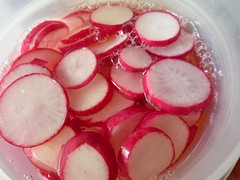
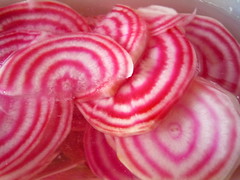
One night we had a really lovely simple meal that consisted of the Eggplant in Spicy Sauce, the Green Beans with a Sesame Dressing, steamed short-grain rice, and an assortment of simple Asian pickles,

simple radish pickles fig. f: pickled radishes!

pickled beets fig. g: pickled beets!

including pickled cucumbers, pickled radishes, and pickled beets.

On special occasions, we've been combining recipes from Everyday Harumi with some of the more Japanese or Japanese-inspired recipes from David Chang's Momofuku cookbook.

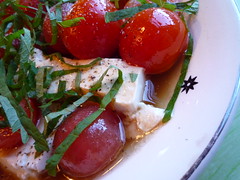
momofuku tofu salad fig. h: Asian cherry tomato salad!

One day we even made his wonderful Cherry Tomato Salad with Silken Tofu & Shiso,

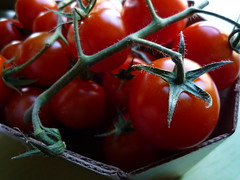
cherry tomatoes 1 fig. i: cherry tomatoes!

which required us to score the best cherry tomatoes we could find,

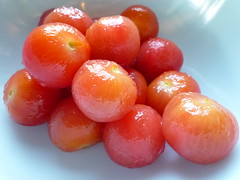
cherry tomatoes 2 fig. j: naked cherry tomatoes!

before blanching and peeling some of them (others were left uncooked and fully clothed).

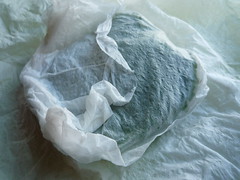
shrouded

shiso leaves fig. k: shiso leaves!

It also required us to hit up our friendly, neighborhood sushi restaurant (one of the city's very best) for some real, honest-to-goodness Japanese shiso leaves, which was kind of like hitting up your neighbor for a cup of sugar or a stick of butter or something, only way more magical.

aj

* I mean I'm down with David Suzuki, the David Suzuki Foundation, and The Nature of Things, but suddenly I'm reminded of a story I once heard about the chair of an anthropology department at a prestigious Canadian university. The chair in question was a diminutive Japanese man who'd cultivated a convincing Ho Chi Minh mustache and beard combo. His office was adorned with a single, solitary bit of decoration--a massive poster of Karl Marx. The Ho Chi Minh look + the Karl Marx poster seemed to suggest that this gentleman was a card-carrying Marxist--most who visited him in his office drew what appeared to be the logical conclusion. In fact, appearances were deceiving. He just liked the way the poster looked.**

** Presumably, he also just liked the way that Ho Chi Minh mustache and beard combo looked.

Monday, July 26, 2010

Guys & Doll

Burger lovers,

As you may have heard, there's a new outfit in town, and this time it's one of America's premium chains. Even with the glut of burger joints we've got at present--high, low, and in between--someone has decided that Montreal is ready for a nouveau concept, a nouveau système. But whose? White Castle? Krystal? In-n-Out? Nope, Arlington, Virginia's very own 5 Guys Burgers and Fries, the chain that reputedly holds the distinction of being President Obama's favourite burger (or, at least, one of them).

Now, 5 Guys have yet to actually make it to the island of Montreal, but they have set up shop in the area, and are poised for a glorious entrance into Montreal proper. Their first regional franchise--the first in Eastern Canada--is in Vaudreuil, just minutes from both the 20 and the 40 to the west of the island. But apparently 5 Guys are planning to go toe-to-toe with the big boys and open a location in Old Montreal sometime in the very near future.

AEB received an invitation to sample the 5 Guys experience firsthand, so that's exactly what we did. We assembled a seasoned team of burger lovers--3 guys and 1 doll--and we took the mobile unit out to Vaudreuil to check out 5 Guys.

Observations:

The first thing you notice is the red check interior.

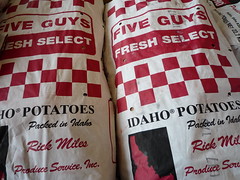
five guys spuds fig. a: 5 Guys spuds

The next thing you notice are the matching stacks of Idaho spuds, just waiting to be transformed into 5 Guys famous fries.

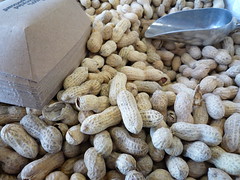
five guys goobers fig. b: 5 Guys goobers

After that, you notice the complimentary goobers, which are there to keep you occupied while you wait for your freshly prepared 5 Guys burger to be assembled.

5 Guys burgers fall into two categories: double-pattied hamburgers, cheeseburgers, bacon burgers, and bacon cheeseburgers, and single-pattied little hamburgers, little cheeseburgers, little bacon burgers, and little bacon cheeseburgers. It's a little confusing, I know, but that's how 5 Guys rolls--their standard burger consists of two hefty patties. Regular toppings include mayo, ketchup, mustard, relish, onions, grilled onions, lettuce, pickles, tomatoes, grilled mushrooms--so an "all-dressed" would consist of all of the above. Specialty toppings include jalapeño peppers, A-1 sauce, BBQ sauce, and hot sauce. All toppings--both regular and specialty--are free.

Fries come in two varieties: regular and Cajun.

The preferred beverage is Coca-Cola.

Place your order and you help set an entire team of food service professionals into a frenzy of activity. Burgers are fried and assembled in the open, behind a glass partition, and the impression that's given is of an organization whose execution is almost military-like, with a general keeping the grunts in precise order.

5 Guys patties are sizable, and their fries also take a little bit longer than your usual fast food fare, so there's a bit of a wait between ordering and receiving, and you actually have to wait until your number is called, but you've got the goobers to keep you company and this is still definitely fast food.

five guys burger fig. c: 5 Guys bacon cheeseburger

And the burger? With two hefty patties, and a whole lot of toppings, the standard 5 Guys burger has a considerable amount of girth to it. I'd even venture to call it a whopper. It's tasty, too. The next time I'd lay off of the cheese (which didn't appear to be Kraft singles, unfortunately) and just go with a bacon burger, and I found my grilled onions a little anemic (not caramelized the way I like them), and most of us agreed that the bun should have had some more substance to it, but this was definitely not your standard chain burger (which is one of the reasons it's not priced like one). 5 Guys prides itself on its freshness, and on that count, and others, they delivered.


The fries? Neither Michelle nor I were crazy about their Cajun spices, but the fries themselves were quality. Not quite like Al's, at their finest, but a cut above your average chain fries.

Will 5 Guys make it in the Montreal market? They might catch a little flak from the Language Police, but otherwise I have a feeling they're going to do just fine.

Will I join Obama and declare 5 Guys my #1 burger? All I'm going to say is that President Obama has obviously never had an AEB burger.

5 Guys Burgers and Fries, 54 Boul. de la Cité des Jeunes, Vaudreuil-Dorion, QC, (450) 510-0710

aj

PS--We weren't the only ones who were curious. Check out a full report on 5 Guys at the new & improved Montreal Burger Report.

Tuesday, July 13, 2010

My dinner with Bruce, rev. ed.

fig. a: now THAT'S what I call a business card

Some offers you just can’t pass up. And this was definitely one of them.

Get this: The phone rings. You pick it up and it’s your good friend M. He says to you, “Have I got an invitation for you.” And then he proposes the following list of activities:

1. attend the premiere of Gallants, a Hong Kong chop-socky flick that’s playing at the 2010 edition of Montreal’s Fantasia festival (!)
2. bask in the glow of kung-fu great Bruce Leung, who not only stars in the film, but will be in attendance to introduce the film and address his legions of fans (!!)
3. then, finally, attend a banquet in Leung’s honour at La Maison Kam Fung (!!!), a popular Chinatown cantonese restaurant and dim sum house

Sold.

An hour and a half later, there we were, sitting in Concordia University’s Hall Theatre, listening to Bruce Leung--the one and only Bruce Leung--introduce Gallants to a rabid audience.

We couldn’t quite figure out why someone had decided to give this highly entertaining and tender-hearted martial arts film the awkward English title Gallants instead of countless other more appropriate and more alluring titles, but there’s a reason the film was a co-winner of an Audience Award at this year’s New York Asian Film Festival--the film’s plenty appealing, and Bruce Leung, as “Tiger,” and Teddy Robin, as “Master Law,” steal the show.

Now, I wouldn’t exactly call Gallants a “food film,” but much of the action revolves around a traditional Cantonese teahouse--its bamboo steamers constantly steaming away--and a preserved duck does play a central role.

Anyway, after the film, Bruce came back out and charmed the audience all over again, and if that wasn’t enough, he was also awarded a Kung Fu Star Award for his contribution to martial arts filmmaking and Asian filmmaking more generally.

By 9:30 we’d made our way to a special banquet room at La Maison Kam Fung, where there were four tables set up, with seating for about 40. M. and I chose two seats entirely arbitrarily at Table #2, and the next thing I knew Bruce Leung himself was sitting next to me (!!!!). I’m sure he could have found himself a dining mate with a knowledge of Hong Kong’s long history of martial arts filmmaking that was more encyclopedic, but Bruce and I hit it off famously, and what ensued was a two-hour lesson in grace and wisdom, peppered with some impressive feats of martial arts prowess.

The food was a nearly endless banquet of Cantonese and Cantonese-Canadian classics (salt chicken, batter-fried lobster, cashew shrimp, etc.), and, served by the hands of a kung-fu legend, it tasted even better than usual. But, more than anything, what I’ll remember is that sly smile, those impressive callouses,* and his knack for making his translator blush with an off-color joke. Talk about a master...

My most cherished souvenir? Bruce's wicked business card, which you can see pictured above.

-----

Fantasia 2010 continues through July 28, and in addition to the usual entertaining assortment of fantasy, gore, sex, and ultraviolence, this year’s line-up features a couple honest-to-goodness food films. And I’m not talking about the flesh-eating variety, either.

Tonight, July the 13th, you get your one and only opportunity to check out Baek Dong-hoon's Le Grand Chef 2: Kimchi Battle, a South Korean battle-of-the-sexes/food flick that’s sure to make you want to get your galbi and banchan on. And on July the 14th and July the 16th you’ll get a chance to check out yet another South Korean food film, Hong Ji-young’s The Naked Kitchen, a film that, as the title suggests, is more “sex” than “battle-of-the-sexes.” Here, “poetic” and “breathtakingly beautiful” shots of the elaborate rituals that make up the preparing and serving of food “serve as the backdrop to a steamy love triangle,” according to Robert Guillemette.

The Housemaid fig. b: look psycho? she is!

Finally, on July 24th, late in the afternoon, you get your final chance to see Kim Ki-young's truly mind-altering The Housemaid. This is one hell of a family melodrama--literally. And it features some of the wickedest plot twists in the history of film. Plus, no less an authority than Martin Scorsese had the following to say about the film: "...The Housemaid is one of the true classics of South Korean cinema, and when I finally had the opportunity to see the picture, I was startled. That this intensely, even passionately claustrophobic film is known only to the most devoted film lovers in the west is one of the great accidents of film history." What, exactly, are we talking about? Take one part Sirkian family melodrama, add one part Polanski's Repulsion, and a touch of Jean Genet's The Maids, set it in South Korea, at the very beginning of the post-Korean War economic miracle, and voilà. Yes, but is it a food film? Well, not exactly, but food does figure prominently--most of it poisoned.

Le Grand Chef: Kimchi Battle, July 13, 19:20, Hall Theatre, Concordia University (1455 de Maisonneuve Boul. W.)

The Naked Kitchen, July 14, 18:30, la Cinémathèque québécoise (335 de Maisonneuve Boul. E.), and July 16, 14:45, Salle de Sève, Concordia University (1455 de Maisonneuve Boul. W.)

The Housemaid, July 24, 17:10, J.A. De Seve Theater, Concordia University (1400 de Maisonneuve Boul. W.)

And for a complete rundown of this year’s Fantasia festival, check out their website.

aj

* Bruce is in his 60s now. He began practicing martial arts well over 50 years ago, and started out as a stuntman in martial arts films not long after that. Not surprisingly, his knuckles are hugely calloused.

Tuesday, July 06, 2010

Evening Danish

fig. a: Noma's pickled vegetables and smoked bone marrow*

Not just a great New York Times article on René Redzepi and the New Nordic Cuisine of Noma, but one whose ability to transport you to the Danish countryside (where Redzepi and his staff forage for Noma's exotic ingredients) brought a breath of fresh Nordic air into our sweltering AEB headquarters.

Forecast for July 7, 2010:
Montreal: sunny & 34º C / 93º F
Copenhagen: sunny & 23º C / 73º F

Beat the heat.

Sorry, no recipes, but there is an anatomical rendering of Redzepi's shrimp with sea urchin powder, a dish that comes complete with beach mustard, goosefoot leaves, sea coriander, wildflowers, and a few decorative stones.

aj

* photograph by Eric Refner for the New York Times

Thursday, July 01, 2010

Syrupy Sweet

fig. a: p'tit livre

It may be a little late for sugaring-off (after all, Canada Day is already upon us), but Anne Fortin's Cuisiner avec le Sirop D'Érable du Québec is hot off the presses.

It's a handsome book--well photographed and well designed--and recipes cover everything from sides & mains, to desserts & drinks. You get all kinds of down-home classics, like Baked Beans, Maple-Glazed Ham, and Pouding Chômeur, but Fortin has wisely decided to augment her own recipes, and the ones she's collected from friends, with recipes from a number of talented local chefs and food personalities. So not only do you get a recipe for Chicken with Spices and Maple Syrup from Tapeo's Marie-Fleur St-Pierre, but you also get a recipe for Crispy Sweetbreads with Maple and Absinthe Sweet & Sour Sauce from Ethné and Philippe de Vienne of Épices de Cru/Olives et Épices/La Dépense. Ever wondered how the good folks at Havre aux Glaces make their fantastic Maple Caramel Brûlé Ice Cream? That recipe is in here too.

And if all that wasn't enough, you get two recipes from Michelle (!). One for her positively sinful maple-caramel tartinade, and the other for her invigorating Gin Tonic.

fig. b: gros gin

The idea here was to humorously riff on both the legendary tonic properties of maple water and those New-Agey maple-lemon-cayenne pepper cleanses that people insist on inflicting on themselves, while simultaneously concocting a cocktail (a reasonably strong one) that's crisp and undeniably refreshing.

Michelle created her Gin Tonic as a spring cocktail that would complement Sugaring-Off Season and help with the transition from winter to summer. It also makes for a pretty fine summer cocktail, one that would be perfect for a Canada Day apéro, for instance.

Gin Tonic

1 1/2 oz gin
1 oz lemon juice
3/4 oz medium grade Quebec maple syrup*
ice cubes
seltzer water or club soda
2 small pinches espelette pepper
slice of lemon

Mix first three ingredients in a highball glass. Add ice cubes and tonic water to taste. Stir in espelette pepper. Garnish with a slice of lemon. Serve.


Anne Fortin's Cuisiner avec le Sirop D'Érable du Québec is available in French and English (as Cooking with Québec Maple Syrup) at fine bookstores and online book retailers everywhere. It's co-published by Jean-Talon Market's Librairie Gourmande, so if you're visiting the market, stop in and give it a gander.

aj

* Any high-quality maple syrup will do, of course, but Quebec's is pretty choice.

Tuesday, June 22, 2010

Grits, Asian-American Style

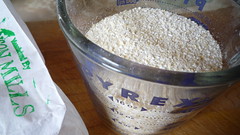
anson mills antebellum white grits fig. a: Anson Mills coarse white grits

A stamped white paper bag, a Pyrex measuring cup, and some white grits.

Doesn't look like much, I know. But those aren't just any grits, they're Anson Mills antebellum coarse white grits, the grits David Chang has called "the killerest grits ever."

These grits being "the killerest," you could make them straight-up, add some salt and pepper, add a little butter, and you'd be sitting pretty, but you're not going to settle for straight-up, are you? Didn't think so.

No, you're going to follow David Chang and Team Momofuku on one of their flights of fancy. People often misunderstand the Momofuku experience as being just another example of "Asian fusion." Now, there's no question that there's some fusion going on within the Momofuku empire, but there's also quite a bit of fission. And, yes, Asian elements figure prominently. But there's a side to David Chang that's almost Kenny Shopsin-like. As far as I know, he hasn't invented any countries, then set about creating their national cuisines, but there's more imagination than one generally associates with the term fusion. The narratives are richer. They're more profane. They're also a hell of a lot funnier.

As Chang describes things, Momofuku Noodle Bar's Shrimp & Grits was a pivotal dish, because aside from the Asianesque broth that Chang used to make the grits, and that you couldn't actually see, "there was no Asian foundation, relation, or appearance to the dish. No other "noodle bar" was serving shrimp and grits."

The idea, the dream, behind the dish was to take a down-home Southern soul food classic, disarticulate it, ruminate on it, and then reanimate it in Momofuku's laboratories:

I imagined what it would be like if my ancestors had ended up in Charleston, South Carolina, a few generations before I was born. They would have eaten corn, they would have eaten grits, they would have cooked with bacon. Or, if Southerners were magically transplanted to Korea, they'd eat jook instead of grits at breakfast. And you know a people who can handle the salty power of a country ham certainly could have gotten down with kimchi. I imagined a Japanese cook making grits--you know he'd boil it in dashi and season it with soy.

I guess these were all conversations I was having with myself. I didn't want to be cooking shitty fusion food. I consoled myself by thinking about how Vietnamese cuisine and Cajun cooking adapted French techniques into something that might have looked French but tasted totally different. But it was with this dish that I decided--or accepted--that if we reached past "tradition" to create the truest and best version of a dish for our own palates, then what we were doing wasn't bullshit.
Chang recommends making this dish with either his Ramen Broth or his Bacon Dashi. We went with the latter a) because it's way simpler, b) because it's way cheaper to make, and c) because it's another great example of the Momofuku Philosophy at play. As Chang puts it:
I can't overstate the significance of bacon dashi to us at Momofuku. It's not the dashi itself--though it is delicious--but the thought process that went into it. The successful transposition of bacon from Tennessee for Japanese dried and smoked fish was an important early success for us, and it continues to be a driving inspiration of how we cook.

We respect tradition and we revere many traditional flavor profiles, but we do not subscribe to the idea that there's one set of blueprints that everyone should follow.
So the following are Chang's instructions (more or less verbatim), using Momofuku's Bacon Dashi.

Still can't see what all the fuss is about? Well, here goes:
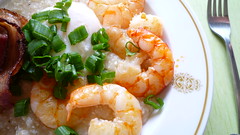
s& g:  before fig. b: before

Momofuku Shrimp & Grits

2 cups water
2 cups white or yellow quick-cooking grits, preferably from Anson Mills (SC)
2 cups Bacon Dashi (recipe follows)
2 tablespoons light soy sauce, such as usukuchi
kosher salt and freshly ground black pepper
8 tbsp unsalted butter, cut into pieces
1/2 pound smoky bacon, such as Benton's (TN) or North Country Smokehouse (NH), cut crosswise into 1- to 1 1/2-inch-long lardons
1 pound medium shrimp (16 to 20 count), shelled
2 tbsp grapeseed or other neutral oil, such as canola
4 freshly poached eggs
1/2 cup chopped scallions, greens and whites included

Combine the water and grits and soak the grits overnight (or for at least 8 hours) in the pot you'll cook them in.

Drain the grits, add the broth to the grits, and bring to a simmer over medium-high heat, whisking all the while. Continue to whisk for 5 minutes after the liquid simmers, then turn the heat down to low. You'll reach "first starch"--the point at which the fine corn particles thicken the liquid just enough to suspend the larger particles--after 5 minutes, and it's crucial to whisk constantly until you reach that point, and to turn the heat down immediately afterwards.

Add the soy sauce, a large pinch of salt, and some freshly ground black pepper. Keep the heat low and whisk regularly if not constantly; the grits should be thickening, undulating, and letting occasional gasps of steam bubble up and out. Soaked grits will be cooked after about 10 minutes over low heat. They're ready when they're no longer grainy, and they've become thick and unctuous.

Add the butter, stirring until it has melted and been absorbed into the grits. Taste them and add additional salt and pepper as needed. Set aside, covered to keep warm, while you get the rest of the dish in order (or serve them at once if you can't take it anymore and you just want to eat them solo).

Put the shrimp in a mixing bowl, pour the oil over them, and add a couple pinches of salt. Toss them in the oil and salt until they're coated. Set aside while you take care of the bacon.

Cook the bacon in a 12-inch cast-iron skillet over medium heat until the lardons have shrunk to about half their original size and are crispy, about 5 to 6 minutes. Remove the bacon with a slotted spoon and drain them on paper towels. Drain the bacon fat from the pan and reserve for another later use. Return the pan to the stove.

Make sure you've got your eggs poached and ready to go. They're ready? Good. Proceed.

Wipe the pan cleanish with a paper towel and turn the heat up to high. Cook the shrimp in two batches. As soon as the shrimp hit the pan, press down on them, using a bacon press, the back of a big spatula, a flattish pot lid, or a smaller pan--whatever works (we've found that a flattish pot lid works best for us). Sear the shrimp for about 1 minute on the first side. Watch the shrimp closely. As the gray-pink flesh of the raw shrimp gradually turns white in the side pressed against hot pan, and when that white line creeps about 40% of the way up the shrimp, flip them and press down on the second side. Sear that side only long enough to brown them a bit, about 30-45 seconds. Ideally, they should be just slightly shy of cooked when you pull them from the pan--they'll continue to cook after they come out of the pan. Use your judgment. Cook them a little longer if you prefer, but, remember, nobody likes overcooked shrimp. Nobody. Not even you.

Make up plates for 4. Shallow soup plates are ideal. Start with a big helping of grits, nestle a poached egg in the middle, and arrange 1/4 of the bacon, 1/4 of the shrimp, and 1/4 of the scallions in separate piles around the edge. Serve at once. Savor.

Serves 4.

Momofuku Bacon Dashi

2 x 3-by-6-inch pieces of kombu
8 cups water
1/2 pound smoky bacon, such as Benton's (TN) or North Country Smokehouse (NH)

Rinse the kombu under running water, then combine it with the water in a medium saucepan. Bring the water to a simmer over medium heat, then turn off the stove. Let steep for 10 minutes

Remove the kombu from the pot and add the bacon. Bring to a boil, then turn the heat down so that the water simmers gently, and simmer for 30 minutes.

Strain the bacon from the dashi, and chill the broth until the fat separates and hardens into a solid cap on top of it. Remove and discard the fat and use the dashi or store it. Bacon dashi will keep, covered, for a few days in the refrigerator. You can also freeze it for later use.*

Makes 2 quarts. You'll only need 2 cups of this for the shrimp & grits, so you'll have plenty left over for other uses.

[both recipes from Momofuku by David Chang and Peter Meehan]
The resultant dish is one that's remarkably subtle, but utterly irrepressible. When I finished making the dish the first time, I remember saying to Michelle that I was surprised that the recipe didn't call for some kind of Asian-inflected sauce that you'd drizzle overtop, but then I went and took my first bite and suddenly I understood.

The taste sensation comes from below. It's deep in the grits, it's released by the butter that finishes the grits, and it's transformed into something that's positively rapturous when you take your fork and release the egg yolk and stir it up with the grits, the shrimp, the egg, the bacon, and the scallions.
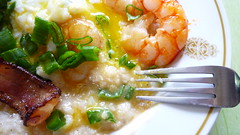
s & g:  after fig. c: after

Are you starting to get it?

aj

P.S. A note on sources: as I've mentioned before, quality shrimp can be hard to find in Montreal, and this dish requires some reasonably fresh, juicy, tasty shrimp, so don't bother making it if you're not satisfied with the product at your local fishmonger, or, better yet, shop around. Sometimes quality can vary greatly from one poissonerie to the next. The best shrimp we've found in recent months have been at Poissonerie Shamrock (7015 Casgrain Ave., 272-5612) and at Norref (4900 Molson St., 593-9999).

You can use other brands of grits, of course, but Anson Mills' grits are pretty killer. Be sure to use quick-cooking grits, though, or you'll find yourself stirring furiously for an awfully long time.

* Among other things, Chang claims it's great with clams. I haven't had the chance to test this out yet, but I believe him.

Monday, June 21, 2010

Top Ten #35

1. AEB Superdawgs

fig. a: Mr. Smith & co., 1939

2. Mr. Smith Goes to Washington, dir. Capra

3. Eating your way across NYC

4. Grilled Lobster with Pickled Peppers, Preserved Meyer Lemon, and Toasted Almonds

fig. b: Joan, 1967

5. Joan Didion, Slouching Towards Bethlehem

6. shrimp & grits

7. Radwan Moumneh/Ariel Engle + Hrsta + friends, La Sala Rossa, June 6, 2010

8. Al's French Frys, Burlington, VT

fig. c: FC, 1968

fig. d: FC, 1969

9. Fairport Convention, S/T & Unhalfbricking

10. Kazuality by Kazu

Sunday, June 13, 2010

Sweet Tweets

kesar mango 1

All those interested in following Michelle's dolce vita, look no further: she's now on Twitter.

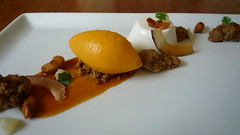
How else are you going to keep abreast of limited-time-only desserts like the mango medley* you see pictured above? Live and in-person, perhaps:

Laloux, 250 Avenue des Pins East (Plateau Mont-Royal), 287-9127

aj

* featuring Kesar mango sorbet, coconut milk panna cotta, Assam tea crumble, candied cashews, candied fresh coconut, lime, and cilantro leaves.

Thursday, June 10, 2010

Dressed to Kill

Gonna dress you up in my love
All over, all over
Gonna dress you up in my love
All over your body
--Madonna, "Dress You Up"

The word on the street for hot dogs this year is DRESSED UP. Of course, dressed up is the way many discriminating dog lovers have been doin' it for decades, especially in such advanced hot dog civilizations as, say, Chicago. But sometimes those of us who live in somewhat less sophisticated hot dog cultures need a little encouragement to go to town, so to speak. I mean I love an all-dressed toasté as much as the next guy (possibly even a whole lot more than the next guy), but does mustard, onions, salade au chou, and day-glo relish really qualify as ALL-DRESSED?

the fix is in fig. a: the fix is in

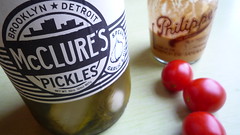
A recent whirlwind excursion to the Big Onion resulted in a number of astounding drinking and dining experiences (news to follow), but when the dust settled, we also found ourselves in the possession of a beautiful, if dear, jar of McClure's premium garlic & dill spears. And suddenly we started dressing our dogs in more elaborate attire.

AEB Superdawgs*

4 premium wieners of your choosing**
1-2 tablespoons vegetable oil
premium pickle spears, such as McClure's
premium pickled green tomatoes, such as Graves
and/or premium chow-chow, such as ours
and/or premium relish, such as McClure's
premium extra-spicy mustard, such as Philippe's
quality mayonnaise, such as Hellmann's
2 green chile peppers, preferably Anaheim, diced
minced onion, preferably red or vidalia
8-12 ripe, delicious cherry tomatoes, quartered
olive oil
red wine vinegar (optional)
salt
freshly ground black pepper

2-4 hot dog buns, toasted

Prepare your garnishes and assemble your dressings and accompaniments. In the case of the cherry tomatoes, toss them with just a bit of olive oil and a touch of red wine vinegar (if you so desire), and salt and pepper them to taste. In the case of the pickle spears, slice any and all pickle halves into thirds lengthwise to make long, slender spears.

Heat about 1 tablespoon of the vegetable oil in a pan over medium heat. When the oil is hot, place your wieners in the pan and slowly roast them until they are crispy and even just a little bit blistered all over. If done properly and patiently, this should take several minutes.

When the dogs are cooked to perfection, add the green chiles to the pan and stir-fry them quickly. If you need a bit more oil to do so, add the second tablespoon of oil. Add salt and pepper to taste. Remove from heat.

Finally, toast your buns in your hot, lightly oiled pan.

Slather your toasted buns with pickled green tomatoes (and/or chow-chow and relish) on one side, hot mustard and mayonnaise on the other. Place the hot dogs and a couple of pickle spears in the buns. Add the onions and sauteed chile peppers. Top with tomatoes.

Muster up the courage to somehow hold that overstuffed bad boy together and devour.

Satisfies 2-4 mightily.


Now, we have a bit of a hot dog bun problem in Montreal. We can get decent steamé/toasté buns like POM, but one of the reasons that our dogs aren't particularly overstuffed and those of, say, Chicago often are, has to do with the vehicle. Let's face it, our standard hot dog buns just don't have the girth and the character to handle a seriously dressed-up dog, even when they've been properly toasted. Which is why we've been experimenting with alternative vehicles here at the AEB Labs.

So, for instance, your basic Portuguese bun has a lot more to do with a traditional sausage bun than it does a traditional hot dog, but at least it's capable of carrying a heavy load like an AEB Superdawg. Not ideal, but fresh and functional. [Note: if you follow our lead and use a Portuguese bun, be sure to rip out some of the bread from the inside, otherwise it will be too bready and will overwhelm your dog. That extra bread is fine for a sausage sandwich, but a hot dog? Not so much.]

superdawg attack 1

superdawg attack 2 figs. b & c: superdawg attack!

The folks at Cheskie used to make a long, peppery onion bun that had plenty of character, but they seem to have changed their recipe recently and added whole wheat flour to the mix. So sad.

So the search goes on... Which means, if you live in Montreal and you have any ideas, please, do tell.

Meanwhile, we've been enjoying our Superdawgs with a rotating cast of vehicles.

Calling the AEB Superdawg a taste sensation would be an understatement. Yes, you guessed it--that dawg is dressed to kill.

aj

* With apologies to Superdawg of Chicago.

** Substitute with a premium veggie dog of your choosing, if you must.