Saturday, September 30, 2006

Pop Goes The Banquet

pop montreal 2006

There was a time when the Washington, D.C., area, where I grew up, was utterly devoted to The Dead. The Grateful Dead. Not only was R.F.K. Stadium an annual stop for the band, but they always played multiple shows there, and for some reason many who lived in the region found this to be cause for celebration. Colloquially, these performances were known simply as "The Shows." As in, "Hey, bra, got tickets for The Shows yet?" "Phil-side, dude." This "culture" manifested itself in all kinds of strange ways, one of which was that you used to see a lot of ads for shared dwellings in the D.C. area that billed themselves as crafts-oriented. "Crafts" here was a euphemism. It meant that this was an entrenched Deadhead household where people supported themselves in large part by making jewelry and other trinkets to be sold at The Shows. It was also not uncommon to find a home-grow operation among the "crafts" practiced in these houses and apartments. My knowledge of these hippy holes, for lack of a better term, was strictly peripheral. I had one friend who'd found herself living in such a house through some shady health food store connections that I never fully understood. The patriarch of this particular household was a self-proclaimed Buddhist named Doug. Doug had an extensive hydroponic operation in their basement that ran on power that was being illegally tapped from the local utilities company. He also sold veggie pitas by the hundreds at The Shows. Every year Doug wore the same outfit to The Shows: knee-high lace-up moccasins + purple unitard + turquoise Star of David pendant + facepaint. Apparently this outfit had helped Doug sell thousands of veggie pitas over the years. Apparently that's not the only thing it had helped him do.

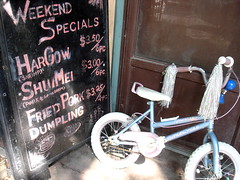
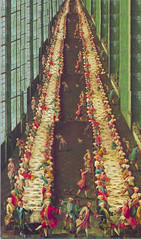
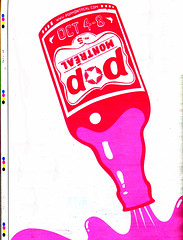
All this is to say that I've come to understand an element of the frenzy that led up to The Shows. For the second year running, Michelle and I have found ourselves busily preparing not for The Shows but for that annual dose of rock-n-roll mayhem known as the Pop Montreal Festival, and specifically their arts and crafts division known simply as Puces Pop. Švestka Preserves Inc. has been in high gear since the summer and we'll have all kinds of jams, jellies, confitures, and chutneys to offer TO YOU, dear reader. The music'll be rather different, there won't be any friendship bracelets or hand-blown pipes or purple unitards (that's what Tam-Tam, Montreal's weekly love-in, is for), but it should still be a lot of fun.* Puces Pop, the "fairest of fairs," runs from October 7th to October 8th. We encourage you to attend both days to take full advantage of the vendors, the fashion show, the "Indie Science Fair" (?), etc., but please keep in mind that our "...an endless banquet"/Švestka Preserves Inc. booth will only be in operation on October 8th. Got it? October 8th. Location: Canadian Grenadier Guards Armory, 4171 Esplanade (corner of Rachel), directly facing Parc Jeanne-Mance. Time: 12 noon - 7 p.m. (or while supplies last). Pop Montreal, as the image above attests, lasts from October 4th - October 8th. We encourage you to indulge in the Dionysian excess. Sensibly, of course.

For more information:
http://www.popmontreal.com/
http://www.puces.popmontreal.com/

aj

*note understatement

Saturday, September 23, 2006

Ode to Provence 1: Grand Aioli

ail chez M. Bertrand fig. a: M. Bertrand’s garlic

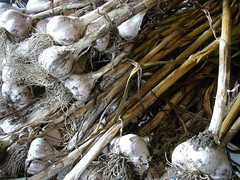
Sometime in August, Michelle picked up Richard Olney's A Provençal Table: The Exuberant Food and Wine from the Domaine Tempier Vineyard for the first time in a while. There was something in the air at the time (Was it the weather? The figs at the market? The garlic we’d seen at M. Bertrand’s [pictured above]? Who knows?) that had her daydreaming about Provence, and the next thing I knew she was toting Olney's classic from one to room to the next, reading bits and pieces as she went. Gradually the book started to fill up with the little colored Post-It® flags and before long I could tell she was planning a menu. Sure enough, a few days later Michelle began to reveal to me the finer points of the Grand Aïoli.

Richard Olney, the ex-pat American artist, gourmet, and food writer, got to know the Peyraud family, whose kitchen was the inspiration behind and the source of "the exuberant food and wine" he detailed in A Provençal Table, in the 1960s sometime after he bought an abandoned property near the tiny town of Solliès-Toucas, just a few kilometers to the northeast of Toulon. Olney continued to split his time between Provence and Paris for a few years, but after the construction of the fireplace that became the centerpiece of Olney's very own Provençal kitchen in 1964, Olney began to live in the south nearly year-round, where he'd become thoroughly enchanted by "the light, the landscape, and the odors of Provence." The Peyrauds--Lucien and Lulu, and their five children--lived on the grounds of Domaine Tempier, just outside of Bandol, a few kilometers to the west of Toulon. There they ran the Domaine Tempier vineyard, which they'd turned into an important part of the renaissance in Bandol-region winemaking, a renaissance that resulted in an AOC designation in 1941 followed by international acclaim from the likes of Kermit Lynch and Robert Parker. More importantly, they'd turned Domaine Tempier into what Olney considered a perfect expression of all that was wonderful and true about Provence.

Domaine Tempier is also the Peyraud family, impassioned, exuberant, indefatigable, dedicated to the belief that the meaning of life lies in love and friendship and that these qualities are best expressed at the table. Perhaps love and friendship can never be quite the same in the absence of the cicada's chant, of fresh sweet garlic and voluptuous olive oil, of summer-ripe tomatoes and the dense, spicy, wild fruit of the wines of Domaine Tempier, which reflect the scents of the Provençal hillsides and joyously embrace Lulu's high-spirited cuisine. For Lulu, cuisine is a language, the expression of love; for Lucien, wine is the expression of love. In Provence, cuisine and wine are as inseparable as Lulu and Lucien.

If Richard Olney was the godfather of Chez Panisse and, by extension, an entire strain of California Cuisine, Lulu could be considered the godmother. Olney made sure to introduce the young Alice Waters to the Peyrauds when she came to visit sometime in the mid-1970s. Waters later described the experience as being akin to "[walking] into a Marcel Pagnol film come to life," and Domaine Tempier would have a huge influence on Chez Panisse's approach to cuisine. By 1976, when Lucien and Lulu came to the San Francisco Bay Area as representatives of the Office International de Vigne et du Vin, Alice Waters and the rest of the Chez Panisse team were already eager to repay the Peyrauds for the invaluable lessons they'd imparted. As Lulu later recalled, "In 1976, we went all alone, like real grown-ups, to California, where we ate crabs on the San Francisco waterfront like everyone else--but then we had dinner at Chez Panisse... and that was not like everyone else!... a leg of lamb and a tart that I will remember all my life long!"

One of the meals that best summed up Lulu's approach to cuisine and to entertaining was the Grand Aïoli. A traditional Provençal feast meant to celebrate the harvest, in the hands of the Peyrauds' the Grand Aïoli became "a mad, joyous circus," one that appears to have left a deep impression on Olney. The Grand Aïoli was "an abundant meal, a traditional cornucopia of products of the earth and the sea, accompanied," as the name suggests, "by an aïoli sauce," but it also captured Provençal cuisine at its most communal. Michelle was absolutely taken in by Olney's descriptions of the Grand Aïoli, and she had visions of setting a grand table of her own in Grandma and Grandpa's garden down below and presiding over a feast worthy of Domaine Tempier, of becoming Lulu herself, if only for a day. She imagined our neighbors' prying eyes looking down from their balconies wondering what on earth the occasion could be, mesmerized by the lovely aromas, the boisterous conversation, and the Continental flair of the spectacle below. What she got was something altogether different: a rainy day that kept us in the confines our big, bright, but not particularly Provençal apartment, and an abject lesson in how difficult it is to pull off "a Lulu."* The Grand Aïoli was a big success, it's just that we didn't exactly manage to "make it look easy."

One thing you'll notice as you read through the recipes below is the preponderance of two ingredients. The first is garlic, of course. It wouldn't be aïoli without lots of garlic; it wouldn't be a Grand Aïoli without a whole lot more. The second is salt-packed anchovies.
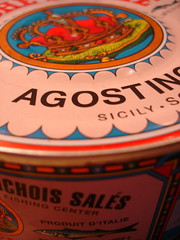
sicilian salt-packed anchovies fig. b: Italian salt-packed anchovies

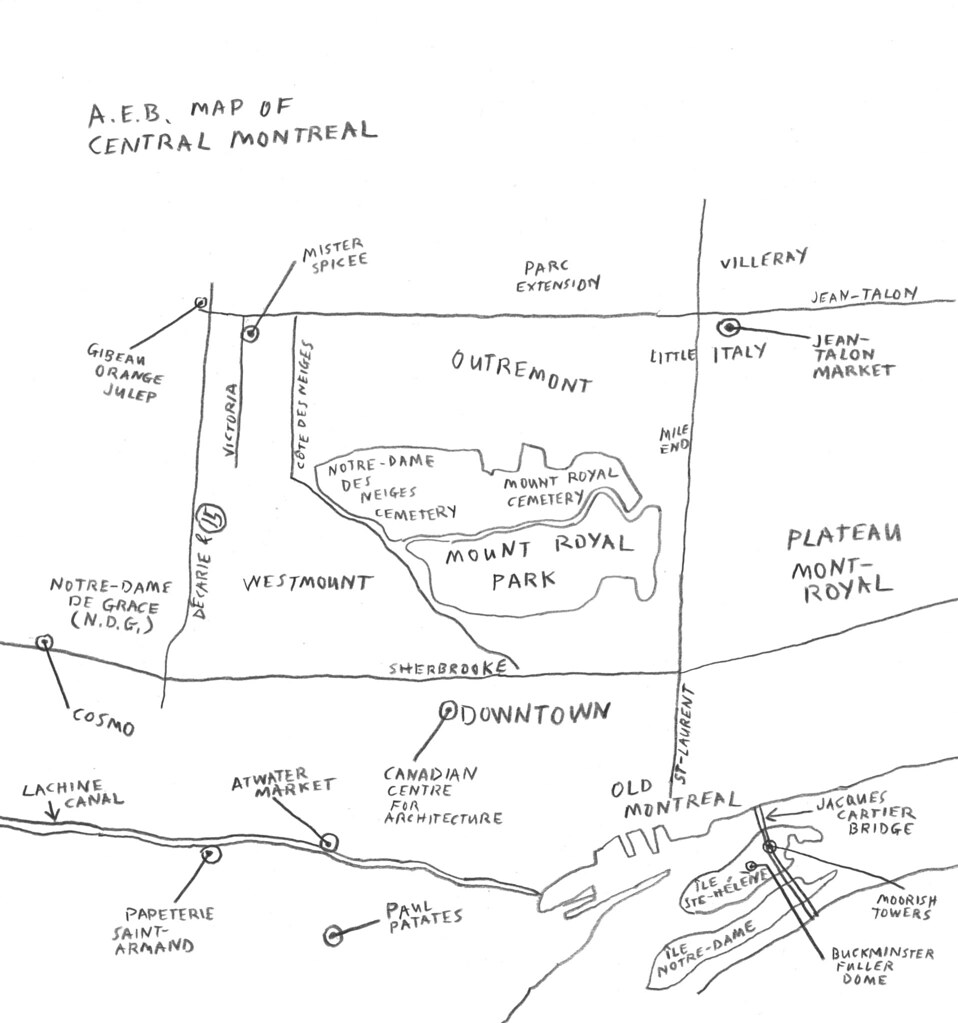
Salt-packed anchovies aren't exactly easy to find here in Montreal--in all likelihood you're going to need to make a trip to Little Italy in order to score your own tin--but they're worth the effort and they're absolutely essential to the recipes we've included. You'll find the flavor to be entirely different in nature--heartier, deeper--than the anchovies you're used to, and they also have a very different texture than their oil-packed cousins. Both of these ingredients are quintessentially Provençal--bold and unmistakable--and consequently the Grand Aïoli is not a meal for the faint of heart. It's a sophisticated meal with many nuances to it, but let's not kid ourselves, the flavors are strong and evidently not to everyone's tastes.

I say "evidently" because that very same weekend The Montreal Gazette ran a profile of a local fine foods merchant and tastemaker who declared outright his contempt for garlic, explaining that he preferred the more subtle flavors of garlic shoots. We were in shock, and, given the meal we'd planned for the next day, that interview provided us with no shortage of amusement. I mean, we've certainly met non-garlic eaters in our time (whether for cultural reasons, or just because they were unusually obsessed with upkeeping fresh breath), but coming from a professional gourmet?! Around here, we tend to be suspicious of those who shun garlic. You might as well tell us that you recoil at the sight of a cross, that you've been having recurring nightmares involving silver stakes, or that you fear the light of day. I mean, we're the kind of people that the garlic vendors at Jean-Talon sell their grand cru garlic to, because they're sure that we won't let it sit around and lose its potency (i.e. we'll go through a braid in 2-4 weeks). Now, this isn't to say that we were harboring fears about any of the guests we'd invited over for our Grand Aïoli, but I'm happy to say that every last one of them passed the test. This was no small feat either. We hadn't held back in the least. Olney recounts how Lulu was known to make two batches of aïoli. One for the Parisians, Americans, and other non-believers, and one “overpowering” batch for her beloved Lucien and all those Provençaux worth their salt. Our batch was definitely Lucienesque.

In the end, this was the menu that Michelle devised (price of admission: one good bottle of French wine, preferably Provençal; absolutely no "Chateau Dep"):

pissaladière
tapenade
Bohèmienne
olives
bread

Grand Aïoli

salad

dessert


And here are all the recipes you need for your very own Grand Aïoli, keeping in mind that we provided a perfectly excellent recipe for a pissaladière back in June of 2005.

Tapenade

1/2 lb large Greek-style black olives, pitted
2 salt anchovies, rinsed and filleted
3 tablespoons capers
1 garlic clove, peeled and pounded into a paste in a mortar with a pinch of coarse salt
1 small pinch of cayenne
1 tsp young savory leaves, finely chopped, or a pinch of crumbled dried savory leaves
4 tbsp olive oil

Reduce the olives, anchovies, capers, garlic, cayenne, and savory to a coarse purée in a food processor. Add the olive oil and process only until the mixture is homogenous--this should only take a couple of rapid whirs of the food processor.

Bohèmienne

6 tbsp olive oil
1 large onion, halved and thinly sliced
3 garlic cloves, crushed and peeled
2 lbs eggplant, peeled, sliced into rounds, salted on both sides for 30 minutes, and pressed between paper towels until dry
2 pounds tomatoes, peeled, seeded, and coarsely chopped
3 salt anchovies
salt and pepper

In a heavy sauté pan, warm 4 tbsp olive oil over low heat. Add the onion and cook, stirring regularly with a wooden spoon until softened but not colored. Add the garlic and eggplant. Cook until softened, stirring regularly. Add the tomatoes, turn up the heat, and stir until they begin to disintegrate and the mixture begins to boil. Lower the heat to maintain a simmer, uncovered, for an hour or more. Stir regularly, crushing the contents with the wooden spoon and, after about 45 minutes, crush regularly with a fork to create a coarse purée from which all the liquid has evaporated. Toward the end, it should be stirred almost constantly to prevent sticking and the heat should be progressively lowered.

Pour 2 tbsp olive oil into a small pan, lay out the anchovy fillets in the bottom, and hold over very low heat until they begin to disintegrate when touched or when the pan is shaken. Removed the eggplant-tomato purée from the heat and stir in the anchovies and their oil. Taste for salt and add some freshly ground black pepper to taste. If prepared in advance, transfer the Bohémienne to a bowl and leave, uncovered, to cool completely before covering and refrigerating.

Lulu’s Grand Aïoli

1 recipe Aïoli
2 lbs salt cod, soaked and poached
1 pound green beans, parboiled (about 5-8 minutes) in salt water
16 small carrots, peeled and parboiled (12-15 minutes) in salt water
8 small new potatoes, parboiled (about 20 minutes) in salt water
1 cauliflower, broken into florets and parboiled (3-4 minutes) in salt water
8 young artichokes, parboiled (about 20-30 minutes) in salt water, split in two, and chokes removed
4 medium beets, peeled and quartered and baked at 375º F for about 45 minutes
8 sweet potatoes, chopped and baked at 375º F for about 45 minutes
8 firm ripe tomatoes, peeled
1 recipe Stewed Octopus

Grand Aïoli à la "...an endless banquet"

1 recipe Aïoli
1 pound mixed green and yellow beans, parboiled (about 5-8 minutes) in salt water
16 mixed small yellow, red, and orange carrots, peeled and parboiled (12-15 minutes) in salt water
8 small new potatoes, washed, dried, and baked at 375º F for about 45 minutes
1 cauliflower, broken into florets and parboiled (3-4 minutes) in salt water
8 young artichokes, parboiled (about 20-30 minutes) in salt water, split in two, and chokes removed
4 mixed medium red and yellow beets, peeled and quartered and baked at 375º F for about 45 minutes
8 baby white turnips, washed, trimmed and quartered and baked at 375º F for about 45 minutes
8 firm ripe tomatoes, sliced
1 recipe Stewed Squid

Aïoli

1 large pinch of coarse sea salt
1 head (more or less to taste) garlic, cloves separated, crushed, and peeled
2 egg yolks, at room temperature
2 cups olive oil, at room temperature
1 to 2 tsp water, at room temperature

In a marble mortar with a wooden pestle, pound the salt and garlic into a smooth paste. Add the egg yolks and stir briskly with the pestle until they lighten in color. Begin to add the oil in a tiny trickle, to the side of the mortar so that the oil flows gradually into the yolk and garlic mixture, while turning constantly with the pestle. As the mixture begins to thicken, the flow of oil can be increased to a thick thread, always to the side of the mortar. Never stop turning this pestle using a rapid beating motion. When the aïoli is quite thick, add a teaspoon or tow of water to loosen it, while turning, and continue adding oil until you have obtained the desired quantity and consistency. Cover and refrigerate until serving.

(Makes about 2 cups.)

Stewed Squid

5 tbsp olive oil
1 large sweet onion, finely chopped
4 garlic cloves, crushed and peeled
2 tomatoes, peeled, seeded, and coarsely chopped
salt
3 lbs squid, cleaned, rinsed, and chopped into bite-size pieces
1 bay leaf
4 tbsp marc de Provence or Cognac
1/2 cup acidic white wine

In a large frying pan, warm 3 tbsp olive oil, add the onion and garlic, and cook over low heat, stirring with a wooden spoon, until soft and golden but not browned. Turn up the heat, add the tomatoes and salt, and sauté, tossing regularly, until the tomato liquid has evaporated.

At the same time, in a large earthenware poêlon or heavy sauté pan, heat 2 tbsp olive oil, add the squid, salt, and bay leaf, stir with a wooden spoon, and shake the pan regularly until any liquid thrown off by the squid has come to a full boil. Add the brandy, ignite it, and stir until the flames die. Bring the white wine to a boil in a small saucepan and add it. Boil for a few minutes, stirring, to partially reduce it and ride the wine of its alcohol and stir in the sautéed onion, garlic, and tomatoes. Bring back to a boil and adjust the heat to maintain a gentle simmer, uncovered, stirring regularly, for about 40 minutes, or until the squid is tender. If preparing the stew ahead, leave to cool uncovered and reheat over very low heat, stirring all the while. If prepared the previous day, cool uncovered and refrigerate covered before reheating, uncovered.

[If you'd like to make the Stewed Octopus instead (of which Olney writes: "The star preparation of Lulu's Grand Aïoli is the stewed octopus, a dish that arouses passions, not only in the Peyraud family but in all who have tasted it--when the octopus sauce and aïoli meet, flavors explode."), the instructions are the same. Just make sure to freeze the octopus first, which will help tenderize it, and simmer the octopus for an additional 10 minutes, about 50 minutes in total.]


Be sure to start early when preparing your very own Grand Aïoli, you'll find it much more relaxing and I'm sure that's the way Lulu would have liked it. One thing that we did to cut down on the number of steps involved was to roast more of the vegetables than Olney and the Peyrauds recommend. This meant that we had a lot less parboiling to do and that we could just throw a large casserole in the oven for 45 minutes and take care of several vegetables in one fell swoop. Add some olive oil and some coarse sea salt to your casserole and you're golden (as will be your vegetables). We absolutely loved the tapenade à la Lulu, the Bohèmienne, which was one of the best eggplant dishes either of us had ever tasted, and the Stewed Squid with its rich flavor and its flambéd overtones, but the roasted beets dipped in that fearsome aïoli might have stolen the show.

aj

*An act sometimes known around here as "a real Lulu."
Tuesday, September 19, 2006

A Pound of Crabmeat, or Two Crab Recipes in Two Days

We fell in love with M. Bertrand from a distance earlier this year when we read about him in Gourmet magazine’s profile of Martin Picard—a profile which dealt in large part with Picard’s relationship to high-quality, small-scale suppliers such as Bertrand. It had something to do with that disarming smile and that trademark straw hat of his,

M. Bertrand

but mostly it had to do with the descriptions of his garden and his fantastic organic produce. When M. Bertrand started to coming by Les Chèvres again this year to make his regular deliveries, Michelle finally worked up the courage to say hello, and late in the summer she asked him if the two of us might be able to stop by his garden some day to take a look around. He very kindly told her “yes,” and a couple of weeks later we made our little pilgrimage to his large garden out near Mirabel.

We’ll have more to say about this visit later, but one thing we didn’t realize before we talked to him that fine summer morning was that M. Bertrand’s cottage business is about much more than just fruits, herbs, and vegetables. He also distributes seafood, and especially Quebec crabs, harvested by his brother-in-law in the Gaspé region of eastern Quebec. He told us all about the crab feasts he’d been having and we were nearly beside ourselves with envy, but we maintained our composure and decided that we’d try to procure some of M. Bertrand’s crab through the restaurant at a later date. That later date was late last week. Michelle came home late one night and she showed up with a pound of M. Bertrand’s finest Rock Crab lump crabmeat in tow. It looked and tasted so good we decided we’d try to stretch out into two meals. And that’s exactly what we did.

Meal #1: crab cakes

I spent a good part of my youth in the Washington-Baltimore metro area, so I know a thing or two about a good crab cake. Michelle, on the other hand, had only ever had the overly breaded, overly fried hockey-puck variety that you find from time to time at receptions. She had an inkling of what a real crab cake might taste like, but she’d yet to experience a true crab cake epiphany. I’d never made what I would call a blue ribbon crab cake, but, then again, I hadn’t made a crab cake of any sort in years, and after years of drought I was eager. And with John and Matt Lewis Thorne’s Pot on the Fire in our corner we were pretty sure we’d manage to make a crab cake that packed a punch.

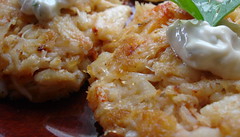
Originally we’d been thinking dinnertime for the crab cakes, but things took a swift turn. I began reading the Thornes’ chapter on “Crustaceans & Crumbs” and I noticed a footnote that cited an 1897 crab cake recipe from Marietta Hollyday’s Domestic Economy as being the earliest known crab cake recipe of any kind. The recipe was entitled “Crab Cakes for Breakfast (Very nice).” It was then that I knew we had no other recourse but to make our crab cakes for breakfast. Crab cakes are a bit of a brunch staple, of course, but with a couple of eggs over-easy and some sautéed chorizo I thought they might make for pretty mean breakfast too. And this way, ever so obliquely, we’d be communing with the very origins of the crab cake.

We followed the Thornes’ advice and steered clear of the croquette-type crab cake. Instead, we followed their Pigeon Hill Bay version, which seemed to have just the lightness of touch we were looking for, eschewing all that business that clutters most crab cakes in favor of a crab cake that lets its crabmeat shine.

crab cakes for breakfast (very nice)

Pigeon Hill Bay Crab Cakes

[Advance warning: This recipe is very simple, but it requires 1-2 hours of chilling time in the refrigerator so that the crab cakes firm up to the point that they can be fried properly.]

1 pound crabmeat, checked carefully for shell fragments
2 or 3 Saltine crackers, crumbled by hand
2 tbsp mayonnaise
1 generous dash Tabasco sauce
1/2 tsp spicy brown mustard
1 tbsp minced parsley
1/4 tsp salt
freshly ground black pepper to taste
3 to 4 tbsp butter for frying

Put the crabmeat in a mixing bowl and crumble the Saltine crackers into it. Blend the mayonnaise, Tabasco sauce, mustard, and parsley together, turn into the crabmeat mixture, and sprinkle this with the salt and black pepper. Using your fingers (or a rubber spatula), gently toss to produce a loosely textured crab salad.


[Frankly, if you can’t take it any longer you can quit here and just devour that salad, but we encourage you to see the recipe through. You won’t regret it.]

Take a biscuit cutter and set it on a large plate. Spoon approximately 1/8 of the crab mixture into the ring, tapping the ring gently when full to settle it. Remove the ring, set it elsewhere on the plate and repeat until you have 8 crab cakes. Put the plate in the refrigerator and let the crab cakes firm for 1-2 hours.

Meanwhile, to prevent the crab cakes from burning, put the butter in a heatproof measuring cup and place it in an oven turned to its lowest setting. After 15 minutes—or when the butter has turned clear and the butter solids have settled to the bottom of the cup—pour the liquid onto a griddle or large skillet, leaving behind and then discarding the butter solids.

When the moment of truth has arrived, remove the plate from the refrigerator. Heat the clarified butter in the griddle over medium-high heat. When the butter is hot, slide a thin-edged spatula under each crab cake ever so gently, and, with the gentlest of shakes, slip it onto the hot griddle. Fry the cakes until the bottoms are golden brown, about 2 minutes, then turn them over to cook on the other side. Serve at once (for breakfast, brunch, lunch, or dinner) with tartar sauce, preferably freshly made.


[Note: We halved this recipe so that we’d only used 1/2 of our crab. It made 4 beautiful crab cakes, just enough for a lovely Sunday breakfast.]

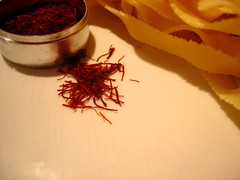
saffron, fresh pasta

Meal #2: crab pasta

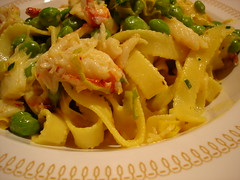
The next day we decided we’d be making some kind of pasta dish with the remaining crab. Those of you out there who’ve read us before know just how crazy we are about peas. Well, this year we’d frozen a bunch of our fresh pea haul and we’d been waiting for just the right occasion to bust them out. This seemed like the one. I’d experimented with pasta, seafood, and peas before, so I was pretty sure of where I wanted to go with this dish. I turned to a pasta with lobster and peas recipe from Tom Colicchio’s Think Like a Chef for a few pointers (quite a few, actually), but I had the idea that leeks and saffron might round out my variation nicely. The cream sauce turned into a work of art, and it made just enough to coat the noodles evenly without overwhelming the other flavors. We couldn’t have been happier with the results. Michelle quickly opened a bottle of wine and we sat down to savor the last of M. Bertrand’s crab. Just how good was it? Well, it instantly became one of Michelle’s favorite dishes of all time.

saffron crab and peas with pasta

Fettucine with Crab and Peas

1 lb fettucine, preferably fresh
1 tbsp olive oil
1 clove garlic, minced
1 pinch high-quality saffron, crushed in a mortar + 1 tiny pinch saffron, uncrushed
1 leek, cleaned thoroughly and minced
sea salt
2 cups peas
1/2 lb fresh lump crabmeat
1 1/2 cups fish stock
1/2 tsp tomato paste
1 cup heavy cream
freshly ground black pepper
2 tbsp fresh chives, minced
2 tbsp fresh parsley, minced

In a heavy saucepan, heat the oil over medium heat. Add your garlic and sauté for one minute. Add the pinch of saffron and leek and sauté for about 5-10 minutes, until wilted. Salt to taste.

Meanwhile, add the tiny pinch of saffron to the fish stock and bring the stock to a simmer in a medium-sized pot over medium heat. Add the tomato paste and continue to cook over medium to medium-high heat until reduced by two-thirds (in other words, you should be left with roughly 1/2 cup of stock and the stock should have intensified considerably). Whisk in the cream, then simmer the mixture until it has reduced enough so that it coats the back of a spoon, about 10 minutes. Add salt and pepper to taste and keep the sauce warm over very low heat, stirring occasionally.

When the leeks are wilted, add the peas and cook them until just tender, but still crisp. Adjust the seasoning if necessary. Remove the leek and pea mixture from the heat.

Bring a large pot of salted water to boil and cook the fettucine until al dente.

When the pasta is just about done, add the leek and pea mixture along with half of the minced herbs to the cream sauce and heat through.

When the pasta is done, drain thoroughly and add to the cream sauce. Toss gently a couple times to begin coating the pasta with the sauce, the leeks and the peas. Add the crabmeat and the remaining herbs and toss everything very gently until just mixed. The crabmeat will heat through in the time that you toss it, without losing its delicate flavor.

Serve immediately.

Serves 4 for dinner, with side salad and plenty of crusty bread to sop up that delicious sauce.


aj

M. Bertrand photo courtesy of Gourmet

Tuesday, September 12, 2006

Damn Yankees!, rev. ed.

One of the many advantages of living with someone who works in the pastry kitchen of an upscale restaurant like Les Chèvres (someone like Michelle), is that you're constantly being spoiled with little late-night treats. More often than not, these treats are either leftover desserts or recipe tests (delicious ones, mind you), but occasionally they're specialties that have just arrived at the restaurant for the first time, or, better yet, specialties brought back from distant and not-so-distant travels.

Two weeks ago I came home late one night to find this waiting for me on the kitchen table:

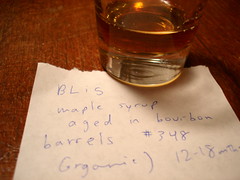
blis maple syrup

The note says it all: "BLIS maple syrup aged in bourbon barrels #348 (organic) 12-18 mths." Here was an organic maple syrup created by the folks at BLiS Caviar of all places, that had been aged in bourbon casks they'd sourced in Kentucky for about 12-18 months. Where did it come from? Well, Stelio, the chef at Les Chèvres, had come across it at Charlie Trotter's in Chicago. He was so impressed he brought some home, and for some reason he was convinced that Michelle would be particularly interested in his find. He was right. The bottom line: it was phenomenal, rich in flavor and imbued with the loveliest, warmest smokiness you could imagine. I'm not prone to toss around the term "genius," but in this case I was tempted. As varied, interesting, and innovative as the food cultures of Canada are--especially in Quebec, Ontario, and British Columbia, but elsewhere too--we're constantly amazed by the Yankee ingenuity we find south of the border. Here we are living in probably the world's greatest maple syrup producing region, and have we ever heard of anyone ageing their premium, organic maple syrup in casks of any kind? Quite simply, no.
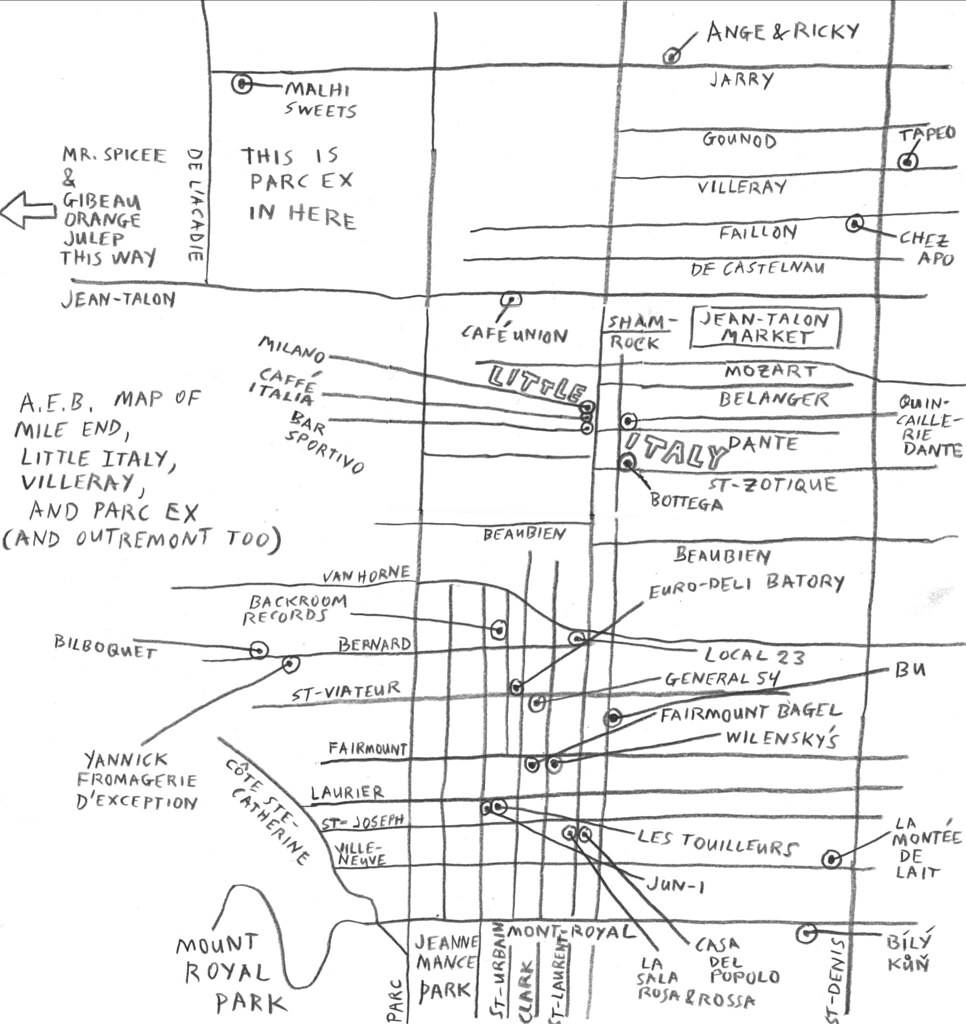
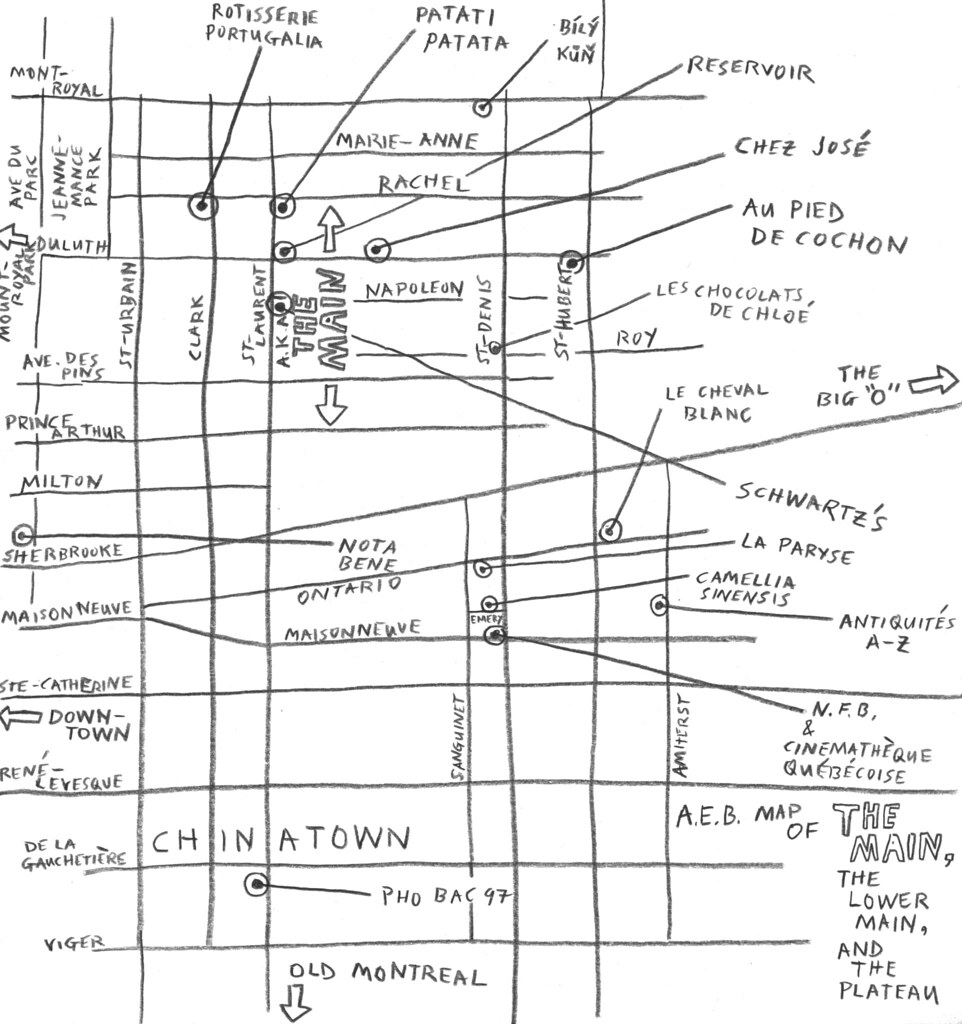
Which is why we'd like to initiate the "...an endless banquet" Maple Syrup Challenge. And, hell, if none of you savvy Canuck/Quebecois maple syrup producers out there want to take us up on this, we might very well do it ourselves. Just watch us.

In the meantime, however, if anyone wants to round up some BLiS maple syrup and send it to us, we'd be happy to pay top dollar.

aj

P.S. All right, so I talked to someone at Mikuni Wild Harvest (who distribute BLiS maple syrup in North America) today and there'd be no problem getting some bottles of BLiS shipped here from their warehouse in Vancouver. A 750-ml bottle of the bourbon-cask type runs for $29.95. Then there's the cost of shipping, which is pretty pricey for a single bottle but becomes more affordable for a multi-bottle order. Anyone here in Montreal & environs interested in going in on an order with us should contact us ASAP via my e-mail address. I'd like to place an order by early next week at the latest. Please put something about maple syrup in the subject field of your e-mail.

Monday, September 04, 2006

Two Quebecois Classics

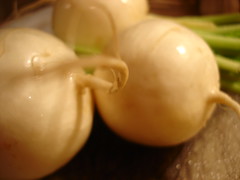
baby white turnips fig. a: baby white turnips

I get an itching for this kind of meal around this time of year anyway, but a visit with my Great-Aunt Juliette on Saturday cinched the deal. I came back and I knew it was time for a bouilli, that classic Quebecois harvest meal. After all, Juliette had been so good as to pass along her basic recipe for her cherished sucre à la crème (minus the “touch” that separates those who make good sucre à la crème from those who make revered sucre à la crème like Matante Juliette) to me—so I needed a suitable accompaniment.

Look it up and you’ll see that bouilli generally refers to boiled beef with vegetables, and that in Quebec the word became a generic term for boiled meat—beef, chicken, or ham—with vegetables. There’s no question that the meat component can be important—and this is a meal that’s famous for getting families to fight over the beef bone or ham bone that’s so central to its flavor—but as any true Quebecois will tell you, it’s the vegetables that are key. That’s why this meal is a classic high summer/harvest time meal—a meal that’s at its tastiest when the vegetables are at their peak, a meal where the onions, turnips, carrots, potatoes, greens, and other goodies that you find in your garden or your local markets or farm stands are the real stars of the shows. In fact, the real secret to a good bouilli, according to my Grandmaman Bilis, had nothing to do with the meat or even the bones, it all had to do with her p’tits oignons—with the onions she’d slow cook lovingly for 45 minutes or more until they’d just begun to caramelize, giving off the most heavenly flavor. That’s why for years I made a perfectly respectable bouilli that included no meat whatsoever. I just made sure to make those p’tits oignons just so, in honor of my grandmother, and the water I poured into the pot would quite magically become the most delicious vegetable broth imaginable after I’d cooked my vegetables gently for 1/2 an hour to an hour (making sure to add my vegetables strategically, of course, so that they’d all wind up tender and not overcooked at the end of my cooking time). Funny thing is, in all the years I made bouilli 100% vegetarian, I never missed the beef, chicken, or ham, but I never managed to have my bowl of this venerable vegetable stew without mustard. You see, one of the true pleasures of a beef or (a highly unconventional) ham bouilli , my two favorites, is the way mustard (preferably Dijon or some kind of rustic or whole-grain variety) accidentally finds itself into your bowl, further enriching the broth. That was a flavor sensation I was wholly unwilling to part with, so I’d just place a little mustard on the lip of my soup bowl, dip the occasional potato or carrot in the mustard to spice it up a little, and let the mustard “accidentally” find its way into the broth. Not a lot, mind you, just enough to give it that depth I craved.

It’s been a while now that I’ve been eating beef, chicken, and pork again, but last night was the very first bouilli I’d ever made with meat. It’s not that I thought it’d be better necessarily—I, like my grandmother, am also convinced that the onions are the most crucial part of the equation—it’s just that I wanted to make a somewhat more traditional one this time around, and one that wouldn’t have poor Michelle scratching her head trying to figure out how the mustard fit into the picture. So, after picking up our assorted vegetables from the Jean Talon farm stand that’s probably our all-around favorite, in addition to being the farm stand we're convinced has the best name, “Jacques et Diane,” we made our way to the Boucherie du Marché to pick up a healthy hunk of smoky bone-in ham.

Later in the day, after we’d done a year’s worth of tomato sauce canning (that’s right, yesterday was The Day), we set about assembling our classic bouilli. Keep in mind that the vegetables are more or less interchangeable, although I’ve never had a bouilli that didn’t have onions, carrots, and potatoes in it. Use the very best vegetables that you can find. Savor them. This week’s bouilli went as follows; next week’s could be entirely different.

(Not Your Grandmaman's) Bouilli

2 tbsp butter
1 large onion, minced finely
1 clove garlic, minced
3 leeks, white parts only, cleaned and chopped finely
1 turnip, peeled and chopped finely
3-4 baby white turnips, sliced
8-10 baby potatoes, scrubbed but left whole
6-8 carrots, cleaned but left whole
1/2 lb. yellow string beans
1 healthy hunk of ham, preferably bone-in
8-12 cups of water, depending on the size of your ham and the amount of vegetables you choose to use
Coarse salt and freshly ground black pepper to taste

Melt your butter over medium heat in a large pot. Add your onions and lower your heat to medium-low, cooking them slowly and stirring frequently for a good 45 minutes, until they’ve begun to caramelize and have developed a rich flavor. (You may want to add a bit of salt to help the onions release their juices.) Turn your heat back up to medium and add your garlic, and cook, stirring frequently, for another 1-2 minutes. Add your leeks and cook until the leeks have softened and have begun to give off a pleasing aroma, stirring frequently all the while. Add your turnip and cook for about 5 minutes, again, stirring frequently. Add your ham and your water. Add your potatoes and turn the heat up to bring the ingredients to a simmer. Cook, covered, for about 5-10 minutes, then add the carrots. Cook for another 10-15 minutes, then add the beans. Cook for 5 minutes and adjust the seasonings. The potatoes and carrots should be perfectly tender and not overcooked. The string beans should be crisp-tender. And the broth should be rich in flavor. If using a ham, the broth should have a lovely smoky flavor, while the ham should have become infused with the flavors of the onions, leeks, turnips, and carrots. Remove your ham to carve it. Divide the showcase vegetables—in this case, the white turnips, potatoes, carrots, and beans—evenly among your bowls. Pour a ladle or two of the broth plus the minced and chopped vegetables overtop. Serve each bowl with a slice of ham on top.

Accompaniments: crusty bread, good mustard.

Serves 6-8 generously.

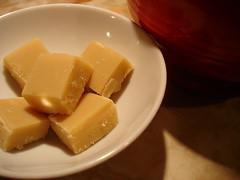
sucre à la crème fig. b: sucre à la crème

Sucre à la Crème à la Matante Juliette

2 cups light golden sugar
1 small can Carnation brand evaporated milk
5 tbsp butter
2 cups powdered sugar

Place the first three ingredients in a medium-sized pot over medium heat. Stirring constantly so as to prevent scorching, cook the ingredients until they begin to bubble, about 5 minutes. When the bubbles become bigger and denser, and the mixture has suddenly become thicker, about 1 minute later, remove from heat and pour in the powdered sugar, stirring or whisking vigorously so as to remove any lumps. Remember, the sucre à la crème cooks quickly—total cooking time at medium heat should be no more than about 5-10 minutes and the sucre à la crème should still be blond. Pour into a buttered 8”x 8” baking pan and let cool. When the sucre à la crème has cooled considerably but is still just the slightest bit warm, use a spatula to loosen it from the sides of the baking pan and flip it out onto a cutting board. Cut the sucre à la crème into small squares—the flavor is intense, so a little goes a long way—and place in a wax-paper lined metal tin. The sucre à la crème will keep for days and days in the metal tin, and if you cut it and store it at just the right moment, it will remain tender all the while.


aj

Thursday, August 31, 2006

Toronto 10-Stop Program, pt. 2

stop #6: Prague Deli and Fine Food Emporium

For us, no visit to Toronto is complete without a trip to the Prague Deli on Queen St. It is one of the only surviving signs of the huge Czech popluation that immigrated to Toronto in the late '60s (I should know, my parents came over as part of that wave and I'm a product of that very scene)--and at this point Montreal has virtually no Czech presence,* so we're generally starved for Czech treats. We always pop in for a chlebíček (an open-faced sandwich which is ubiquitous within Prague's working-class delis) and a kolač (a type of danish, of which the blackberry version is particularly recommended). This time around we were shocked to see they'd renovated since our last visit. They've modernized the place and made it more contemporary and "inviting," which took me aback at first. Then I realized that the place was full of people, and this was just the change that would keep the place open and running for years to come. And that's definitely a good thing. The service is very Czech: maybe a little brusque at first, but proper pronunciation of the menu items gets you treated like a dignitary.

jamie kennedy jar

stop #7: Jamie Kennedy Wine Bar

Through Les Chèvres, Michelle developed a pretty strong connection with the Jamie Kennedy Wine Bar (JKWB). First, there was Melissa who left a position as a line chef at Les Chèvres to seek fame and fortune (or at least some new experiences) in Toronto about a year ago, and eventually found herself with a dream job at JKWB. Then there was Renée, the pastry chef at JKWB, who spent a couple of weeks at Les Chèvres doing a stage earlier this year because (other chefs, take note) Mr. Kennedy is a big proponent of sending his chefs into the field to pick up expertise at other leading restaurants. Renée really enjoyed spending time in the "Patricerie" at Les Chèvres and she and Michelle hit it off in the time she was around. When it came time for her to head back to Toronto, she made Michelle promise that the next time we were in Hogtown we'd stop by for a meal. And, Michelle being a woman of her word, we did.

From the moment we stepped in, announced ourselves to the hostess, and were greeted with an, "Oh, my God! It's so nice to meet you! Your seats are almost ready. Make yourselves comfortable in the lounge, your Bellinis are on their way!," we knew the night was going to be one to remember. We're not all that accustomed to getting that kind of a reception--it's safe to say that we usually fly beneath the radar--but we took it in stride. Minutes later, having stretched out on a couch, sipped our Bellinis, and taken in the scene--the intriguing layout with the twin bars (one "wet" and one "dry"), the monumental floor-to-ceiling wall display of canned goods, the lively atmosphere--we were escorted to our seats at the "dry" bar, the one that faces the wine bar's external kitchen. Our hostess had recommended seats there so we could check out the cooks doing what they do best, and we jumped at the opportunity--we love sitting at the counter of a good sushi bar, and we were sure this was going to be similarly entertaining.

From the moment we sat down at the bar, we quickly established a rapport with the chef operating closest to us. He'd picked up on the fact that we were receiving preferential treatment for some reason, and he jumped right in and started sassing us about it, addressing us as "Mr. and Mrs. Rockefeller" and the like. He started to warm up to us as soon as he found out we were from Montreal, though, and when he found out Michelle was a fellow restaurant person, and a cook at Les Chèvres no less, well, he started doting on us too. Then Renée came out with her friend Tobey to greet us, and things really got underway--from that point on, the dishes kept coming at us in rapid succession and the wine flowed. It was only later that we figured out that Tobey was the chef at JKWB. Suffice to say, we were in good hands.

We started off with the brilliant charcuterie plate, featuring an absolutely luscious house duck liver pâté and a breathtaking selection of house-cured meats. Not only did the plate come with a brilliant wine pairing--a lovely 2001 Gewürtztraminer, J.M. Sohler's "Heissenberger"--but it came with exceptional bread, baked on premises and made with Canada's heritage Red Fife flour, one of the Slow Food Foundations "Presidia" products. Already, just these three elements--the house-made charcuterie, the wine, and the bread--summed up so much of what's special at JKWB: the honesty, the attention to detail, the respect for local, heirloom, and heritage ingredients, the imagination--and that was just the first course. Other standouts included their simple but lovely green salad with lovage dressing and artisanally grown organic greens, a juicy, perfectly seasoned hanger steak with fried green tomatoes, and grilled Portuguese sardines with a tangy chermoula. Course after course hit the spot, with nary a dud among them--the fact that we enjoyed the witty repartee of our cook friend the whole time, made the cavalcade of mouth-watering dishes all the more impressive. We talked Montreal, we talked organics, we talked Vancouver Island, Saveur magazine, and Sooke Harbour House, and all the while he plated dish after dish after delicious dish. Our one whimsical selection was the coq au vin poutine. We thought it would be hilarious to pull into Toronto from Montreal and order poutine, at the JKWB of all places. Boy, were we wrong. That poutine was dead serious: the chicken tender yet robust, the Yukon Gold fries beautifully golden-brown, the cheese squeaky-fresh. An unlikely combo, but no less of a knockout for it. When it came to wind down, we did so in style, with a full cheese course, featuring Ontario's finest, and an accompanying Ontario Pinot Noir, Niagara Teaching College's 2004 "Wismer Vineyard." We were in need of an education in Ontario wines and cheeses--both of which are much maligned in Quebec for no good reason--and we figured there was no better place to get it. Both were excellent, and we rounded the corner towards Renée's much-anticipated desserts invigorated.

Good thing, because the desserts quite nearly stole the show. We were a little worried we might get buried--restaurant staff have a tradition of "killing" the staff of other restaurants when they come by for a visit--but instead Renée took the Roberta Flack approach, killing us softly with a perfectly composed sampler of desserts including two sparkling sorbets, golden plum and raspberry, a blancmange with petits fruits, and a mini bundt cake with lavender honey crème fraîche. These were among the very best desserts I'd had all year, and together the assortment brought the meal to a perfect conclusion: they were light on the palate, seasonal, and memorable.

When we'd polished off the very last morsel, the only thing left to do was take a tour of the kitchen to check out the behind-the-scenes activity, meet all the superstars who'd contributed to our V.I.P. Night 2006, and sneak a peek at Tobey's smokehouse.

Okay, okay, we got seriously spoiled, but there's no question in our minds that the Jamie Kennedy Wine Bar is a place well worth checking out.

stop #8: Aunties and Uncles

I'd been to this retro-chic diner before on a conference visit, Michelle hadn't. We were a bit worried we might have to mix it up with the punters to get a seat, seeing as Auntie's and Uncle's is a popular neighborhood hang-out and it was Sunday brunch primetime, but we got seated within minutes. Michelle was instantly smitten--I could tell she loved the mismatched arborite tables and the rummage-sale cutlery, and the comfort food breakfasts were right up her alley. She opted for a breakfast burrito with chorizo, but only on the condition that I made sure to keep her plied with some of the copious amounts of peameal bacon that came with my plate. All the egg dishes were good--so were the breakfast sandwiches and the house specialty potato salad. We took in the hipster scene and whiled away the late-morning.

Intermission

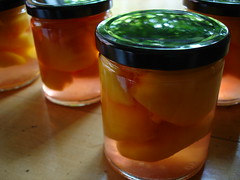
freshly canned peaches

Remember that monumental wall of canned goods at Jamie Kennedy Wine Bar? Well, when we saw it, we immediately knew we were on the same wavelenght with Jamie Kennedy & co. You see, we'd gone to Toronto for the weekend with the intention to get some canning done along the way. We'd been having a hard time finding peaches that were passing muster back in Montreal; we figured there had to be better Ontario peaches in Ontario, so Michelle got Renée to order in a crate for her. We picked it up and paid for it when we made our kitchen inspection, and we were right, they were a lot better than the ones we'd found to date. So the next day, Sunday, while I went out on a mid-afternoon ouzo bender, Michelle made use of our hostess's beautiful kitchen to can her latest acquisitions. As you can see, they turned out well. We left a jar with our hostess and took the rest back home to Montreal with us the next day.

yung sing bakery

stop #9: Yung Sing Bakery

We got turned on to Yung Sing by our friend Sandy, years and years ago. Since then, no visit to Toronto has been complete without at least a BBQ pork bun or a tofu roll. This time around, we snuck in on our way out of town. We couldn't bear the thought of leaving without popping in. Plus, we needed a good lunch to face that culinary wasteland that is the 401. After ordering my BBQ pork bun I noticed a mounted photograph of the proud owners in front of their bakery all the way back in 1968. I asked the woman who was serving me, the matriarch, about the photo and she began to giggle excitedly as she went back and pulled it down so that I could have a closer look. With the attire and the vintage quality of the image it almost looked like an outtake from Wong Kar-Wai's In the Mood for Love. I'm happy to say that Yung Sing Bakery is almost 40 years old and it's still going strong.

stop #10: Randy's Take-Out

So good we went there twice. This time on our way out of town, after our pitstop at Yung Sing. After all, the 401 is incredibly bleak food-wise, and it's always wise to be prepared for every eventuality. You never know when you might need the soothing flavors of a tasty Jamaican patty.

Prague Deli and Fine Food Emporium, 638 Queen St. W., (416) 504-5787

Jamie Kennedy Wine Bar, 9 Church Street, (416) 362-1957

Aunties and Uncles, 74 Lippincott Street, (416) 324-1375

Yung Sing Bakery, 22 Baldwin, at McCaul, (416) 979-2832

Randy's Bakery, 1569 Eglinton Avenue West, (416) 781-5313

am/km

*R.I.P. Café Toman.

Tuesday, August 29, 2006

In A Pickle

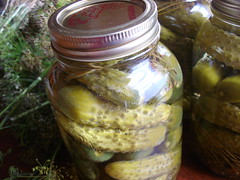
dill pickles

This week I have been caught off guard thinking it was still summer. Which, of course, it is and will be for another three weeks or so, but around here you can't take these things for granted. Doing so can be a dangerous mistake, since in the blink of an eye, depending on the year, the cucumbers can disappear. Same with the tomatoes. "But I'm not ready yet," does nothing to change the inevitable, Sweetie.

In my mind, summer's not summer without making some dill pickles. They're so satisfying, and so much tastier than your supermarket-issue brands, and they're really very easy to prepare. So go ahead and whip up a batch of dill pickles before it's too late. You can deal with the sweet pickles tomorrow, tomatoes on the weekend.

I bought my cucumbers in a moment of panic last weekend at the market ("It's already the end of August?") and was ready to pickle them when I realised I was missing a key ingredient: pickling spice. I thought about running to the store and buying some but then it occurred to me I could whip up my own batch using Phillipe de Vienne's amazing spices. What I concocted was leagues better than the usual bland pickling spice which has been sitting on the shelf for God knows how long, but boy, was it strong. I will let you know how it turns out in a few weeks.

The following is the basic dill pickles recipe I've been using for the last few years. I give it my personal touch by making some extra spicy, with the addition of some hot chiles, some extra garlicky.

Dill Pickles

pickling cucumbers *
head of dill, divided into small bunches
garlic cloves, peeled
pickling spice
pickling salt
5 % vinegar mixed with an equal part water
1 liter canning jars with lids

* I washed my cucumbers and placed them on ice for a few hours, having heard that this produces crunchier pickles.

Sterilise the canning jars and place the snap lids in a small pot of hot water. Bring the vinegar mixture to a boil and keep it simmering while you load up the jars. Take the jars, one at a time, and add the following to each: 1 bunch dill, 1 clove garlic, 1 tsp. pickling spice, 1 Tbsp. pickling salt, enough cucumbers to fill the jar, and vinegar mixture to cover cucumbers. Close the jars and either hot water process them 15 min. or let them sit on the counter overnight. Check the seals and store any unsealed jars in the fridge. Keep at least 3 weeks before opening or the pickles will be too vinegary.

Pickling Spice

mustard seeds
coriander seeds
cinnamon stick
cloves
mace
allspice
juniper berries
dill seeds
black peppercorns
bay leaves
dried chiles


It goes without saying that there are countless variations: more garlic and/or hot peppers, as mentioned above, different spices, ginger, half-sour... If anyone out there has a prize-winning dill pickle recipe that they wouldn't mind sharing, please let me know.

m

Sunday, August 27, 2006

These are a few of our favorite things...

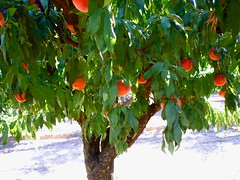
baby crawford peaches, andy's fig. a: Baby Crawfords ripe for the picking

Well, we've been mulling over Melissa's provocative "Things to Eat Before You Die" project over at The Traveler's Lunchbox for the last few days. On the one hand, it's been a breeze coming up with "absolute musts" of all kinds, but on the other, whittling our respective lists down to five has been difficult, to say the least. In the end, Michelle decided to do a fruits-only list, while I opted for a bit of a grab-bag, although it would have been easy to come up with similarly essential lists (to us, at least) that were, say, Montreal-specific or seafood-specific or pastry-specific (you get my drift). Anyway, without further ado (and without any further agonizing), here goes:

Michelle:

1. Baby Crawford peaches fresh off the tree at Andy's Orchard, Morgan Hill, CA
2. strawberries from Swanton Berry Farm, Davenport, CA
3. pears & black walnuts foraged in the Czech Republic (take a walk most anywhere in rural Bohemia at the right time of year and you'll find them in abundance)
4. fields of wild blueberries around Sackville, New Brunswick
5. fresh mulberries anywhere you can get them

Anthony:

1. a real S.F. burrito from a real S.F. taqueria (La Taqueria comes to mind)
2. pizza from a truck in Marseilles eaten on a bench in the Old Port with a good bottle of red wine
3. fresh (and I do mean fresh) oysters on the half-shell from a reputable source of your choice, served in generous quantities
4. real dim sum served from carts (any one of a number of places come to mind, but the best I've had in the last 12 months was at Ton Kiang in San Francisco)
5. a runny, perfectly ripe raw milk cheese (like a St. Marcellin or a St. Felicien) with some good apples, some good pears, some nice grapes, and a crisp white wine of your choice

Have your own list? Do tell.

aj

Saturday, August 26, 2006

Trouble in Paradise

Well, as some of you out there may have noticed, we've been having some serious technical problems with "...an endless banquet" over the last 24 hours.

bowery scene by weegee fig. a: information age frustration sets in

But if Blogger's willing and the creek don't rise, we should have everything sorted in no time.

--eds.

Thursday, August 24, 2006

Have a Heart (Nut) Cookie

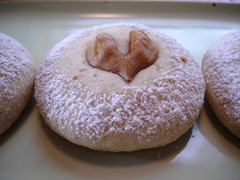
heart nut cookies

It's taken me a while to figure out what exactly to do with the stash of heart nuts we got at Windmill Point Farm. I considered breads, cakes, preserves, and tarts before settling on cookies. I wanted something simple to get the full effect of the nut's lovely heart shape. My only regret was that I didn't make the cookies smaller. I should have gotten two dozen, where I only got one. Next time. I can always head back to Windmill Point Farm to pick up some more, and, if things go according to plan, certain homesteaders* will soon be planting a small forest of heart nut trees, keeping us in heart nuts forever and ever.

These cookies are similar to Mexican wedding cakes: delicate, crumbly, and melt-in-your-mouth. Since heart nuts are a variety of Japanese walnut, you can substitute any other kind of walnut if you happen to be short on heart nuts at the moment.

To be enjoyed with a pot of tea and a good book.

Heart Nut Cookies

1 stick butter, soft
1/3 cup icing sugar, plus more for dusting
1 tsp. vanilla
1/2 tsp. salt
1/2 cup ground heart nuts
1 cup flour
heart nuts to decorate

Preheat oven to 325°F. Cream butter and sugar until fluffy. Add vanilla, salt and ground nuts. Cream until combined. Add flour and mix gently until dough begins to form. Roll dough into small balls about 1" in diameter. Place on cookie sheet, decorating each with a nut. Bake for 20 min., or until cookies are golden brown on the bottom. Cool on rack and sprinkle with icing sugar. Store in an airtight container. Eat. Enjoy.

Makes two dozen.

m

* my parents