Friday, May 13, 2005

Thank you, Dr. Price! (or The Joy of Early 20th Century Advertising Cookbooks)


Exquisite Colors by Dr. Price
Originally uploaded by ajkinik.


I just finished teaching a course on Advertising and Consumer Culture in the Film Studies Department of a certain university in Eastern Ontario, and one of the online resources that I used in my preparation for the course—and one that I referred my students to—is Duke University’s impressive "Emergence of Advertising in America: 1850-1920" archive. Check it out and you’ll find all kinds of texts and visual materials there documenting the birth of modern consumer culture in the United States—cigarette cards, flyers, posters, outdoor advertising, broadsides, postcards, and “Kodakiana”—you name it—it’s all there. One of the most amazing sections of this website, though, is the section dealing with "advertising cookbooks" from 1879-1929, the Nicole Di Bona Peterson Collection, which contains several dozen examples in full-text format including covers, title pages and illustrations. If you’re a fan of vintage cookbooks and recipes and/or vintage food illustrations, or you’re just interested in how American corporations and other institutions seized upon the cookbook as a vehicle for advertising and early branding, this is the place for you. You’ll find everything from the Best War Time Recipes of 1917, according to the Royal Baking Powder Co. of New York, to Knox Gelatine’s Dainty Desserts for Dainty People, to The Story of Coffee and How to Make It, as brought to you by the good people at Maxwell House, to How Phyllis Grew Thin with the help of the Lydia E. Pinkham Medicine Co. of Lynn, MA.

Among my favorites are:

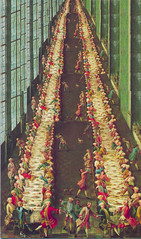
Dr. Price’s almost hallucinatory selection of “harmlessly” and "exquisitely" colored desserts (see illustration above).

The lovely chocolates produced by our friends at Walter Baker & Co., Ltd. (established 1780!), including the ever-so-tantalizingly named Smith College Fudge, Wellesley Marshmallow Fudge, and Vassar Fudge.


exhibit A: Baker's chocolates
Originally uploaded by ajkinik.


exhibit B: Baker's chocolates
Originally uploaded by ajkinik.


And the Frigidaire Corporation of America’s Frozen Delights, which brings together home refrigeration, modernity, and flapperdom, creating a powerhouse combo.


Frigidaire Frozen Delights
Originally uploaded by ajkinik.


I’m including a scan of some of Frigidaire’s recipes for your perusal, dear readers. Personally, I’m a little unsure about adding Jell-O to my ice cream (especially lemon Jell-O), but I might just try the Maple Ice Cream or the Strawberry Ice Cream this weekend anyway. (Then again, my maternal Grandmother always used to insist that Jell-O was good for my bones.)


Frigidaire Desserts
Originally uploaded by ajkinik.


I’ll let you know how it turns out if I do.

aj

"Baby's goin' to New York City!"*

Michelle is off to the Big Onion for a whirlwind 48-hour weekend (including the bus rides!) of socializing, tasting, indulging, and workshopping (she's got a date with the French Culinary Institute).

She'll be back with photos and all the details on Monday.

Bon voyage!

aj

*part of an overheard conversation in Washington D.C.'s Kramerbooks/Afterwords: A Café, ca. 1993.

Tuesday, May 10, 2005

Chuletas de Puerco Adobados

So, Michelle came home late yesterday afternoon and it was so nice out that we decided we had to grill. I had picked up some basic Mexican fixings from Tortilleria Maya earlier in the day, so we pulled out Diana Kennedy's The Essential Cuisines of Mexico and took a gander. Michelle didn't really see anything on her first read-through, but I had a particular meat and a particular cut in mind (the pork chop), so I went right to that section of the book and quickly found Kennedy's recipe for Chuletas de Puercos Adobados (Pork Chops Seasoned with Adobo Paste), which we then altered for the grill.

Adobo sauce is one of the classic marinades of Mexican cuisine, but I'd never made it before. Kennedy recommends marinating the pork overnight if possible--like most other marinades, this is a sauce that's meant to tenderize a tougher cut of meat, after all--but we made it early yesterday evening and marinated the meat for about two hours and the results were fantastic. You need to have access to a Latin American specialty store, so that you can pick up some dried ancho chiles, but otherwise this is a very simple recipe. The only other specialty ingredient that the recipe calls for is dried Mexican oregano, but we didn't have any in stock, so we made do with Italian oregano. Philippe de Vienne has at least two different types of Mexican oregano for sale, one of which is hand-picked by an associate of his in the Yucatan (!). Next time we'll make this recipe with the real thing, and, believe me, there will be a next time.

Last night we served a chop each with rice, refried black beans, sour cream, hot corn tortillas, salsa, and chips.

4 large dried ancho chiles, seeds and stems removed
1/8 tsp cumin seeds, roasted then freshly ground
1/8 tsp dried Mexican oregano
3 sprigs fresh thyme or 1/8 teaspoon dried
1 tbsp salt
2 garlic cloves
1/2 cup mild white vinegar

6 pork chops

Put the chiles in a bowl and cover them with freshly boiled water. Put a lid on the bowl and allow them to steep until tender, about 10 minutes. Remove them with a slotted spoon and place them in a blender. Add the rest of the seasoning ingredients and blend into a smooth paste. Pour into a large mixing bowl.

Rinse and pat your pork chops dry. Place them in the mixing bowl with the adobo paste and toss them until they are well-coated with the marinade. Cover the bowl and place it in the refrigerator. Marinade the pork overnight, if possible. If you're short on time, 1-2 hours will do just fine.

Heat your grill. Place the pork chops on the grill and grill them about 5-6 minutes per side, depending on the size and thickness of the pork chops.

aj

Monday, May 09, 2005

The Return of the Sunday Chicken Club, Moroccan-style, Pt. II: Djej Mechoui

This is another fantastic chicken recipe from Paula Wolfert’s Couscous and Other Good Food From Morocco. It’s very simple, but the flavors are outrageous—the smells coming off the grill alone will be enough to put your neighbors to shame. If you really want to up the ante, throw a teaspoon of Ras el Hanout into the marinade/paste. The aromas'll get up and talk to you, as they say south of the Mason-Dixon line.

We served the chicken with saffron basmati rice, a spicy Eritrean lentil dish (for that pan-African feel), and a salad. I can’t wait to make this dish again.

Here goes:

3 scallions, white parts only, chopped
1 clove garlic, peeled
2 tbsp roughly chopped mixed herbs (coriander and parsley)
1 tsp salt
1 1/2 tsp sweet paprika
1 pinch of cayenne
1 1/2 tsp ground freshly roasted cumin
1 tsp Ras el Hanout (optional)
1/4 cup softened sweet butter
2 lb (+) chicken, quartered or in pieces

Pound the scallions in a large mortar with the garlic, herbs, salt, and spices. Blend with the butter to make a paste. Rub the paste over the chicken pieces. Let stand for at least 1 hour.

Heat your BBQ.

Arrange the pieces of chicken skin side up over the coals. After 5 minutes turn and baste with any extra paste or the juices in the roasting pan. Continue turning and basting every 5 minutes until the chickens are done—depending on the heat of the BBQ.

Serve immediately.

aj

Friday, May 06, 2005

'Tis the season...


Hendrick's Gin
Originally uploaded by ajkinik.

During much of the year here in Montreal, I find it hard to even think about gin. Gin has strong associations with warm temperatures and/or summertime in my mind, and I develop something akin to a mental block with regards to gin during the long winters here. But then the temperatures begin to rise, the trees and plants start to come back to life, and suddenly gin makes sense again.

These associations of mine have a great deal to do with the appeal of the gin and tonic, which was specifically developed as a drink that would help British colonizers deal with tropical climes. But, let’s face it, gin itself is very much a product of Northern Europe—actually northwestern Europe, to be exact, Britain, Holland, and Flanders, quite specifically—hardly a region known for its balminess.

Gin (good gin, that is) is a drink caught between the modern world and the pre-modern world in many ways. Gin’s roots are generally said to lie in the Low Countries, where genever— a spirit whose name comes from the Dutch word for juniper, the ingredient that gives it its unique flavor—has been made for centuries. Gin was “discovered” by the English sometime during the late Middle Ages or Early Renaissance, and it was most likely produced in England not long afterwards, but what is certain is that in the 17th and 18th centuries gin hit the British market with the force of a hammer. Prior to this period, spirits were used mainly for medicinal purposes, and “organic” beverages such as beer and wine, where the alcohol content comes from a natural fermentation process and is at par with the sugar content of the plants from which they are produced, were the only kinds of alcoholic beverages that were enjoyed on a regular, even daily, basis, as a beverage. Things changed at the beginning of the Industrial Age, when liquor quite suddenly became an everyday drink. In his “social history of spices, stimulants, and intoxicants,” Tastes of Paradise, Wolfgang Schivelbusch makes a persuasive argument that the explosion in the liquor market, and indeed the sudden development of a taste for beverages with the impact of liquor, was very much tied to the industrialization of Northern Europe. He writes:

"Distillation raised the alcohol content far beyond the natural limits. To be precise, distilled spirits contained ten times the alcohol of traditional beer—which could not help but have far-reaching consequences. Whereas beer and wine are drunk slowly in long sips, and the inebriation process is gradual, liquor is tossed off [or tossed back, as the case may be], and intoxication is more or less instantaneous. Liquor thus represents a process of acceleration of intoxication, intrinsically related to other processes of acceleration in the modern age. The tenfold intensification of alcohol content over that of traditional beer meant that a person could now get drunk with one-tenth the quantity of liquor, or in one-tenth the time it had formerly taken. The maximized effect, the acceleration, and the reduced price made liquor a true child of the Industrial Revolution. It was to drinking what the mechanical weaver’s loom was to weaving."

Gin was the most commonly produced variety of distilled spirit in Britain at the time, and thus all spirits became known as “gin.” Time and time again, the social world produced by “gin” was depicted as being a wanton inversion of that world as it had existed in earlier times, when beer was king, as well as the diametric opposite of the social world of the developing bourgeoisie, which had recently embraced coffee, and its powerful sobering influence, and rejected the carnivalesque world of alcohol.

At the same time, gin—especially so-called “London gin”—with its essence of juniper berries and its complex combination of aromatics and botanicals, takes us back to the pre-industrial world. So, for instance, Bombay Sapphire may be a readily available, mass-produced brand of gin, but its complex flavor includes hints of everything from coriander, to Grains of Paradise, to cinnamon, to Cubeb Berries, calling to mind the drink’s origins as a Medieval medicine, as well as the premium that was placed on spices, herbs, and strong, exotic flavors in Europe during the Middle Ages (as opposed to Europe from the 17th century on, when such flavors were weaned out of the Northern European diet almost entirely).

Now, much has been made of the emergence of “boutique” vodka and small-batch vodka over the last few years, as the vodka market has continued to expand internationally, but what hasn’t been documented quite so thoroughly has been the revival of small-batch gin. In Britain, Flemish Belgium, and Holland you can find gin and genever specialists stocking dozens, even hundreds (in some cases) of different varieties of the spirit made by producers big and small, young and old. Last fall, we got a particularly nice bottle of Scottish gin—Hendrick’s Gin, “est. 1886”—that some friends of ours picked up on a walking tour of Britain. Hendrick’s Gin has a complexity that leaves even something like Bombay Sapphire in the dust. In addition to “traditional botanicals,” such as juniper, coriander, and citrus peel, Hendrick’s also infuses their gin with everything from cucumber to rose petals, resulting in what they call “a most iconoclastic gin… [that] is not for everyone.” I’m glad. There’ll be more for us.

We tried our bottle of Hendrick’s when we first received it, but it was already November when we got it, and we quickly moved on to Scotch without looking back. This week, when the sun came out and the temperatures suddenly began to rise again, I started thinking about our beautiful bottle of gin again. I haven’t dared to add any tonic to it yet—I think I’ll save the tonic for our next bottle. I’ve just been enjoying this particular gin straight, savoring it one shot glass at a time.

aj

Tuesday, May 03, 2005

The Montreal Dessert Club goes to Les Chèvres

It's official, the second meeting of the Montreal Dessert Club (MDC; the other MDC) was a success, even if I was the only member who actually attended both events. What can I say? We're a busy bunch of club members. That this is the first post about the MDC is my fault: I dropped the ball after our first outing, a trip to Brontë to sample their dessert menu.

This time around, the grande finale was a visit to Les Chèvres for a special desserts-only tasting menu, but before we got there, we had some other stops to make (!). You see, the original idea for this outing came from Thea, who suggested that we do a culinary tour of Van Horne, stopping at a few pastry shops and boucheries, before ending up at our final destination. Had Thea been able to join us, she would have learned an important lesson: there is such a thing as overkill.

We met at the Outremont Metro station for the first leg of the tour, and at this point there were only three of us, as two others were only able to meet up at 6:30. Our first stop was Lescurier. When I first moved here years ago, I was charmed by the tiny patisseries everywhere and gorged myself on Opéras, Royals, and miniature mousse cakes. These days, though, I go to Montreal’s pastry shops and I generally find myself asking, "Why do they all have the same cakes and pastries?" I asked that same question when I stepped through the door at Lescurier. We had a look around and, more half-heartedly than anything else, chose a palet au rhum, a slice of citrus, and a cup of black currant and mango mousse. Then we marched onwards to Boucherie France-Canada.

The idea was to get a slice of paté or terrine to balance the sweet-savoury ratio. Unfortunately, they were closed, even though I swear to God I checked to make sure they'd be open. So much for savoury. Next up, Paltoquet.

When Paltoquet's croissants are good, they are the best. Nothing can touch them. When they are bad, and believe me, I have had them when they've been bad more than once, they are dense, floury, and tasteless. Why? Who knows? When we got there, their shelves were empty. Only a few items remained. We got a croissant, a brioche, and three pâtes de fruits: pear, apricot, and raspberry. It's probably a good thing we weren't able get any more. We made our way to Camilla's house nearby and had our own little informal tasting with tea.

I am happy to report that the croissant was not one of the bad ones--but it wasn't one of the good ones, either. It was in between, with a nice buttery taste, but somehow both burnt and undercooked in places (?). The brioche was plain. We asked ourselves why we'd chosen it. Oh, well. The pâtes de fruits varied wildly. Pear came away the winner: a pleasant, natural pear flavour and a nice texture. The apricot one was so-so. Nothing too special. The raspberry had seeds in it, which I thought was a good sign. Not so: it had a very strange aftertaste, not unlike iodine (not that I spend that much time ingesting iodine, but...). Next.

We couldn't believe we'd chosen the palet au rhum. It was basically a nicely shaped rum ball. Anyone who has been to pastry school knows what goes into rum balls. Since both Camilla and I are in the know, we had a good laugh at our expense. It wasn't bad. Just forgettable. The citrus slice was a subtle lemon mousse. With chocolate. I don't know what I imagined when I chose it. Yes, I do. A beautiful little citrus-chocolate cake I got at Christian Constant in Paris last summer. It was divine. This one was not. Blah. And we barely touched the black currant and mango mousse. One spoon each. Double blah.

At this point, any normal person, having reached her limit, would have called it a night and gone home, but we were on the road to redemption.


carpaccio de rhubarbe
Originally uploaded by michelle1975.


We met up with Benoit and Maike at Les Chèvres and had a look at the a la carte menu. Should we get one of each and share? Should we each order what we want no matter if there's repetition. Then the waiter came over and asked, "Will you have the dessert tasting menu?" It reminded me of my experience at Au Pied du Cochon: "Will madame have foie gras with that?" There is only one possible answer to these types of questions. Yes.

*NOTE: I don't think that this dessert tasting menu is on offer every night. Correct me if I'm wrong.*

Pictured above is the first plate in what turned out to be a four-course + mignardises parade of desserts. It was one of the big favourites of the evening: a rhubarb carpaccio with fromage blanc battu, pistachio nougatine, and rhubarb sorbet. A few drops of very perfumed olive oil finished the plate. So fresh and light--a welcome change from the genre of sweets we'd eaten earlier. Rhubarb is one of my favourite fruits--after pomegranate, of course. Since starting my stage with the pastry chef at Les Chèvres, Patrice Demers, I have been bugging him to put a rhubarb dessert on the menu. He found the loveliest pink rhubarb any of us had ever seen. This was just one of his "experiments" (if you can believe that). A+.


agrumes
Originally uploaded by michelle1975.


When the next dessert came out, I started to get the feeling that it was only the beginning. (Besides, everytime we peered into the kitchen, the pastry team all had mischievous looks on their faces...) This is a miniature version of the current agrumes dessert on the menu. A coconut milk gelee with a candied kumquat slice, date purée, honey granité, and mandarin and clementine juice. It was even lighter than the first dessert, with a gentle sweetness to it. The textures came together perfectly. I realized that snacking on the individual ingredients of Patrice's desserts somehow add up to his finished creations. We sat back and took a breath, when...

Little bowls came out looking inconspicuous enough. Inside was sapote panna cotta with caramelized honey gelée and almond nougatine. This is when our table went crazy. One bite of this sent Patricia to heaven, while Benoit turned towards the kitchen and said, "Mais, non, il est malade." That's how good it was. Sapote is a hard-to-find spice which tastes of almond and is very fragrant. A seed was brought to the table so we could see and smell it in its natural state. It was simply divine.


chocolate et abricot
Originally uploaded by michelle1975.


The last plated dessert we were served was a miniature version of a new dessert on the menu at Les Chèvres: chocolat et abricot. An apricot gelée topped with two thin, crisp cookies which are filled with a chocolate cream. Alongside are poached apricots and lavender ice cream. This is a fantastic combination. I am very partial to the lavender ice cream. I think Patrice has found the perfect strength at which to use lavender. Too often lavender desserts are overpowering and even soapy. Believe me, his ice cream tops any flavour at Bilboquet. It would have been the perfect last course, except...

The mignardises arrived, and they were plentiful, including tiny ice cream sandwiches, grapefruit pâtes de fruit, lemon and black pepper financiers, sablés topped with an olive oil ganache and candied lemon peel, passionfruit marshmallows, ricotta cardamom beignes with clemantine marmalade.... My God. Is it possible we were actually able to eat them all? Satisfied, in awe, and experiencing heart palpitations (the good kind), we left for home.

Though I highly recommend the dessert tasting menu at Les Chèvres, please refrain from trying the full Van Horne dessert tour. Our dessert club clearly has an unnatural threshhold for sweets. Somehow it seems fitting that I've just started reading Cooking for Kings, a biography of Carème, the master chef. He, too, knew a thing or two about grand gestures with food.

[this edition of the Montreal Dessert Club consisted of Michelle, Camilla, Patricia, Benoit, and Maike]

Les Chèvres, 1201 Van Horne (corner Bloomfield), 514-270-1119
Dessert tasting menu: $15 without tax, tip or drinks.

m

Saturday, April 30, 2005

Three recent finds...

three mini reviews...

Tabaq
149 Jean-Talon Blvd. W.

Delicious Pakistani restaurant housed in an old corner diner space (including banquettes!). The rice alone is reason to go: it is prepared meticulously, as it should be (with bay leaf, whole cloves, and other spices), and consequently it has an fragrance to it that sets it apart from your average South Asian restaurants. But the real standout is their delightful butter chicken (butter chicken fanatics, take note), which is unique both because of its sauce’s coconut milk base and its lovely spicy heat. The service is warm and friendly and Tabaq also has the attraction of being open late. In fact, the Les Chèvres/Le Chou crowd is apparently quite fond of visits after their nightshift.

Dông-Qué
1240 Rosemont E.

Though they also feature an assortment of Pho soups, we went to Dông-Qué in search of vermicelli dishes, and vermicelli dishes we did find. We started off with an extraordinary salad with vermicelli noodles, shrimp, pork, julienned vegetables, and a piquant-sweet sauce. Afterwards, Michelle and Camilla moved on to a couple of hot vermicelli dishes, while I ordered the Vietnamese crêpe (!). The crêpe wasn’t quite as phenomenal as the one offered at my all-time favorite Vietnamese restaurant (Café Dalat in Arlington, Virginia [R.I.P.), but it was the first Vietnames crêpe I’d found in Montreal and it was still pretty damn good. Imagine a large savory crêpe stuffed with sautéed assorted vegetables, strips of marinated pork, and shrimp, and served with a sweet and sour peanut sauce. If you haven’t had one, don’t be a fool. Everything was delicious and freshly prepared, the only drawback to Dông-Qué was the service, which was—how shall I put it?—quirky.

El Sombrero
500-A Belanger E.

Quite possibly the best Mexican restaurant in Montreal we’ve yet to come across. A group of five of us went there for Saturday lunch (OK, we went there today) and had an absolute feast that included everything from picaditas (an assortment of three of the cutest little tortillas with beans and crema you’ve ever seen), to chorizo con queso made with herbs and real Mexican cheese, to three different types of tamale (salsa verde, salsa rojo, and mole, and all of them fantastic) served steaming in their corn husks, to the definitive tacos al pastor, with real hunks of pork marinated with achiote and chilies. They also have a top-notch homemade horchata and their Mexican hot chocolate was also a hit. The atmosphere is cozy and the service is attentive—combined with their excellent Mexican fare, it’s no wonder El Sombrero is a local hit.

aj

Thursday, April 28, 2005

Alain Ducasse's Big Book of Desserts


I know my birthday is long gone and I got ridiculously spoiled because it was my 30th birthday and all, but this book is too good to let it just pass through my hands... Any takers?

With a price tag over $0.50 a page (times 538!), it's a bit on the exorbitant side, but it might just be worth it.

Patrice lent me this book 2 weeks ago and I've been trying to read it as slowly as possible so it will never end. This hasn't been easy. It's a bit of a page-turner.

It's had me mesmerized. I just curl up with it and the hours while away. I flip a page and a whole world of ideas opens up. I've been jotting notes down like crazy.

I wouldn't say this is essential for the home cook, but for anyone who's a professional, or who's interested in becoming one, Ducasse's work is a font of inspiration.

m

Monday, April 25, 2005

The Return of the Sunday Chicken Club, Moroccan-style


our new tagine
Originally uploaded by ajkinik.


As promised, this was the weekend we christened the tagine and tested out our first recipes from Paula Wolfert's Couscous and Other Good Food from Morocco. Things got started on Saturday when, after hours of deliberation (okay, maybe just an hour), we decided upon Chicken with Lemons and Olives Emshmel as our main course for Sunday night's dinner. We had agreed that we wanted to start with a chicken recipe, and Wolfert's section on chicken dishes starts off with "Four Different Ways to Make Chicken with Lemon and Olives." This sounded like a good place to start, so then we just had to narrow down field, and Wolfert's description of this "classic Moroccan dish... served in an intricately spiced, creamy, lemony, and sublime sauce" was enough to seal the deal.

We made a trip to Vito's--our preferred neighborhood butcher--to pick up a couple of healthy-sized chickens and get them cut into pieces, and then it was time to go home and prepare our birds. Wolfert recommends the following method:

Wash the chicken in salted water, then drain. Pound 4 cloves of garlic and 2 tablespoons of salt into a paste in a large bowl. Toss the chicken parts in the bowl, making sure to coat the pieces as well as possible. Afterwards, rinse the poultry well under running water until it no longer smells of garlic. [The garlic is used to removed bitterness, as well as to help release the chicken's flavors, like a natural MSG.] Drain the chicken pieces well. Now you're chicken is ready to go.


Chicken with Lemons and Olives Emshmel

2-3 chickens, whole or cut into pieces, with their livers
6 cloves garlic, peeled
Salt
1 tsp ground ginger
1 tsp sweet paprika
1/4 tsp (roasted then freshly) ground cumin
1/4 tsp black pepper
1/4 cup salad oil
1 tbsp olive oil
2 1/2 cups grated onion, drained
1/4 tsp pulverized saffron
1/2 cup mixed, chopped fresh herbs (green coriander and parsley)
1 1/2 cups ripe "green-brown" olives, such as Royal-Victorias (or, in our case, Kalamatas)
2 preserved lemons
2 to 3 fresh lemons

The day before, prepare chicken according to the instructions above, then marinate the chicken and the livers in 1 teaspoon of salt, the remaining 2 cloves of garlic, sliced thin, the spices, and the salad oil. Refrigerate, covered.

The next day saute 1/2 cup of the grated onion in the olive oil for about 1-2 minutes in a large pot or casserole, then add the chicken, the livers, and the marinade. Add the saffron, the herbs, and 2 cups of water, bring to a boil, cover, and simmer for 30 minutes, turning the chicken often in the sauce.

While the chickens are cooking, rinse and pit the olives. Set aside.

Remove the chicken livers from the casserole or pot and mash them finely. Return to the casserole or pot with the remaining grated, drained onions. Add water, if necessary. Continue cooking 20 minutes, partially covered.

Rinse the preserved lemons (discarding the pulp, if desired) and quarter them. Add the olives and the preserved lemons to the sauce when the chickens are very tender and the flesh falls easily from the bone. Continue cooking 5-10 minutes, uncovered.

Transfer the chickens to a tagine or other serving dish and spoon the olives and lemons around them. Cover and keep warm in the oven. By boiling rapidly, uncovered, reduce the sauce to 1 1/2 cups. Add the juice of 2 fresh lemons to the sauce in the pan. Add more salt (and more lemon juice, if desired) to taste. Pour the sauce over chickens and serve at once.

[note: we omitted the step involving the livers and the dish still turned out wonderfully. Wolfert claims this step adds "heft" to the sauce. We'll try it next time.]

We served the chicken with Couscous Casablancaise and...

Harissa Sauce

I cup lamb broth from the couscous pot (I added 1 cup vegetable broth from the Couscous Casablancaise instead)
1 tsp Harissa paste
1 tablespoon lemon juice
1-2 tbsp olive oil
1 pinch of cumin, to taste
Sprinkle of freshly chopped parsley and/or fresh coriander

Combine all ingredients in small saucepan over high heat. Beat well and pour into a small serving bowl. Serve at once.

[recipe courtesy of Paula Wolfert]

as well as...

Salade de Pomme de Terre au Cumin aux Pieds Noirs

1 lb. small red potatoes, quartered
2 large tomatoes, peeled and diced
1/2 sweet onion (such as a vidalia), finely diced
2 tsp (roasted and freshly) ground cumin
3 tbsp olive oil
1 tbs red wine vinegar (you may need a little more than this, actually)
10 green olives, pitted
Salt and pepper to taste
12 fresh cilantro sprigs

Cook the potatoes in boiling water until tender. Drain well. While the potatoes are still warm, place them in a salad bowl and mix them with the tomatoes, onion, cumin, olive oil, vinegar olives, salt and pepper. Refrigerate, covered, for 1-2 hours, then toss with cilantro right before serving.

[recipe courtesy of North Africa: the Vegetarian Table by Kitty Morse]

I think it's safe to say the meal was a success. The chicken dish is really quite extraordinary. The sauce really begins to develop some depth around the time you add the olives and the preserved lemons. The preserved lemons are absolutely essential to this dish--don't omit them. Most good Middle Eastern specialty stores should stock them. They add a beautiful flavor to the sauce, and they also give the sauce a certain silkiness. If you're not sure about the flavor, be sure to pulp them before throwing them in. Then you remove the chicken pieces, the olives, and the lemon bits, and you reduce the sauce, and the sauce turns into something truly otherworldly (I can't even imagine what the chicken livers would do to it). We poured the sauce over the chicken pieces in the tagine before bringing the tagine to the table, but we also served a gravy boat full of the sauce on the side so that we and our guests could sauce the chicken according to our tastes.

It's official: this dish comes highly recommended.

aj

PS--you'll notice there isn't any Ras el Hanout listed for this recipe (after all my talk). I meant to add a sprinkle to the sauce last minute as a secret ingredient, but, quite frankly, I forgot. In any case, I don't think it needed it.

Stay tuned for an actual recipe including Ras el Hanout...

Saturday, April 23, 2005

candied Meyer lemon peel


candied Meyer lemon peel
Originally uploaded by michelle1975.


I swear it's only a coincidence that Clotilde at Chocolate and Zucchini just wrote about this...
You've got to believe me.
These are delicious!

m

To make them, take 6 lemons, or whatever you have, and juice them, reserving the juice for something else. Remove the pulp and slice the peel into nice strips. Blanch them in boiling water 3 times to remove any bitterness, then drain.
Make a heavy syrup using equal amounts of sugar and water, enough to cover the peel. Add some corn syrup and bring the mixture to a boil. Add the peels and simmer on low, stirring from time to time, until peels become transluscent. This will take about an hour.

You can store the peels with the syrup in the fridge, or drain them and toss in granulated sugar, as I did in the picture. If you toss them in sugar, leave them on parchment paper or on a cooling rack to dry overnight. Store in an airtight container at room temperature. Eat as is, or use in any recipes calling for candied citrus peel.