Friday, April 22, 2005

Ras el Hanout Redux

A few week ago, now, I once again received some very nice, thoughtful presents for my birthday, but among my favorite were a couple of gifts that focused on Moroccan cuisine: my very own earthenware tagine and Paula Wolfert’s Couscous and Other Good Food From Morocco. (I won’t name the culprit who gave me these gifts, but I’d like to thank her once again.) I’d been wanting a tagine for a few years, but I became quite serious about getting one after Michelle and I went to a Moroccan restaurant named Le Souk in Paris last summer (see "Highlights: Paris"). I had had tagine dishes before, but I had never had a tagine dish like the duck tagine with fresh figs, dried fruit, honey, and almonds that Michelle ordered that evening. As for Couscous and Other Good Food From Morocco, I spent years admiring Paula Wolfert’s 1973 classic back in the days when I was a bookseller, but for some reason I’d never actually acquired it.

This weekend I’m finally going to christen both the tagine and the cookbook, after weeks of contemplating when and how to first put them to use. I think I’m going to start off with one of Wolfert’s chicken tagine recipes, but there’ll be more on this later.

Like all truly great cookbooks, Wolfert’s book not only contains brilliant recipes, it also reads beautifully, situating its passion for food within a broader understanding of cuisine’s place within culture. The opening chapters of her book not only whet the appetite for a whole array of Moroccan delicacies, they also detail the epiphany Wolfert experienced from “[the] moment the Yugoslav freighter touched at Casablanca in 1959.” Wolfert spent the next two years immersing herself in Moroccan culture and developing a deep understanding of Moroccan cuisine and its various traditions. She then spent eight years in Paris obsessing over Morocco, and trying to find ways to get back, before she finally decided to write a cookbook about Moroccan cuisine, taking on the in-depth research that finally led to the publication of her book in 1973.

The opening chapter is a fascinating look into the history and development of Moroccan cuisine, as well as the philosophies that form its foundation. There she discusses everything from “the philosophy of abundance” and the striking similarities between Moroccan and Chinese banquets, to the notion of kimia, the magical power to “multiply food,” to make the most out of very little. In the second chapter, Wolfert takes up the topic of Morocco’s souks and their place within Moroccan culture. It is there that she discusses spices and spice merchants, including “the ten important spices” (cinnamon, cumin, saffron, turmeric, ginger, black pepper, cayenne, paprika, aniseed, and sesame seeds) as well as the “nine secondary aromatics” (allspice, caraway, cloves, coriander seeds, gum Arabic, fenugreek, licorice, honey dates, and orrisroot). It is also there where she launches into a lengthy discussion on the topic of our good friend, Ras el Hanout. Wolfert claims that in her travels across Morocco she came upon accounts of Ras el Hanout blends that consisted of “more than a hundred ingredients,” but the majority of the most lively blends consist of 24 to 28 different herbs, spices, and other aromatics. Her analysis (with the help of a spice merchant friend in New York) of one packet of a blend that she purchased in Fez turns up the following exotic list of ingredients:

Allspice
Ash berries
Belladonna leaves
Black cumin seeds
Black peppercorns
Cantharides
Cardamom pods
Cayenne
Cassia cinnamon
Ceylon cinnamon
Cloves
Coriander seed
Cubebe pepper
Earth almonds
Galingale [or Galangal root]
Ginger
Gouza el asnab
Grains of paradise
Long pepper
Lavender
Mace
Monk’s pepper
Nutmeg
Orrisroot
Turmeric

You’ll have to pick up Wolfert’s book to get the full details on any of the above ingredients that are unfamiliar to you. The point is: 1) Ras el Hanout is about as heady and complex as cuisine can ever be, and, once again, it provides an ample sense of just how sophisticated Moroccan cuisine can be (Wolfert makes a point of stressing how disappointing so much of the cuisine that passes itself off as “Moroccan” often is); 2) Wolfert displays her impressive talents as a sensualist even within the form of a simple list.

Like I said, this weekend I’m going to give the tagine and one of Wolfert’s recipes a shot. I’ll try and find one that involves Ras el Hanout, too.

aj

Wednesday, April 20, 2005

Maple Sugaring, Early Spring in the Northern Woods


Maple Sugaring
Originally uploaded by michelle1975.


March and April are the height of "sugaring off" season in these parts, the time when the maple sap harvest and maple syrup and maple sugar production are at their peak, the time when the numerous sugar shacks that dot the countryside go into overdrive, serving up massive quantities of traditional backwoods breakfast fare (in varieties both authentic and ersatz). Up until the late 19th century, maple sugar was the most highly prized maple product and a regional staple. This situation changed with the introduction of cheap cane sugar to the area. Even though maple syrup is now the principal product, terms such as "sugar shack" and "sugaring off" still indicate the original state of affairs.

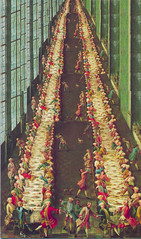
One North American sugar maple can produce gallons of sugar- and syrup-bearing sap every year, if tapped at the right time, without being seriously affected by the loss. This fact was well known by indigenous tribes in the region and this knowledge was then passed on to early European settlers, who both improved upon the method of achieving syrup and sugar and systematized production. For decades this system consisted of taps and buckets, but all but the smallest maple syrup producers have since further rationalized the process, using networks of plastic tubing to increase yields and cut back on labor. It used to be that sugar makers would have to "struggle up snow-covered hillsides to collect each day's run by hand" before toiling "far into the night in the sugarhouse, boiling off the sap into syrup," keeping in mind that it takes a legal barrel of sap (30.5 gallons) to produce a gallon of syrup. The whole enterprise was "grueling, but when the first pitcher of rich, new syrup [arrived] at the dining table, along with a batch of fresh doughnuts, it [vindicated] the sugar maker's age-old claim: 'By Gory, after all is said and done, sugaring is fun!'" This is obvious in the print above.

The best years for maple syrup are those with long, hard winters followed by a springtime with lots of temperature fluctuations--it's the sudden rise in temperature that really gets the clear maple sap flowing. This year was not one of those years. Winter wasn't all that long and hard, and spring came on steadily with very few temperature fluctuations. In fact, we kind of got caught off guard--we were seduced by how pleasant the transition from winter to spring was this year, we were seduced by the lack of freak springtime snowstorms. We've had our fair share of Bilboquet's tire d'érable ice cream, as well as new crop maple syrup and fresh tire d'érable from Jean Talon Market, and we experienced Au Pied de Cochon's sugar shack-chic a few weeks ago, right at the heart of the season, but for the first time in a few years we haven't made it out to the countryside for our annual "sugaring off" feast. There's still time, I guess, but I'm already focused on our garden.

aj

PS--When you come from Quebec, you get to be pretty serious about your maple syrup. My parents had a friend who had relocated to California from Quebec. One day she went to a local supermarket and bought some "100% Pure Vermont Maple Syrup." She took it home and when she tasted it she could immediately tell that it actually wasn't 100% pure, and that it had probably been cut with corn syrup. The next day she took it back to the supermarket and demanded a refund. The manager assured her that this maple syrup was in fact the real thing, but when she continue to protest he asked her, "How can you tell (it's not 100% pure)?" She replied, "How can I tell? I WAS BORN WITH MAPLE SYRUP IN MY VEINS!!"

[sources: American Cooking: New England by Jonathan Norton Leonard and the Editors of TIME-LIFE BOOKS; The Penguin Companion to Food, Alan Davidson; personal experience]

Saturday, April 16, 2005

Cioppino is back!


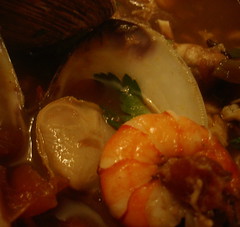
Thursday night's cioppino
Originally uploaded by ajkinik.

This is our week for dad stuff, I guess. My dad and I first made cioppino when we were living in the San Francisco bay area in the ‘70s and ‘80s. Cioppino was a local specialty, a hearty fish stew developed by Italian and Portuguese fishermen who worked the California coast, and it became the special meal we would make together after we discovered James Beard’s recipe for it. We’d go out shopping for our seafood—including a healthy amount of local Dungeness crab—then spend the evening slowly preparing the stew, before serving it with a crusty San Francisco-style sourdough bread. It was one of my favorite meals, and probably my favorite meal to make.

This week my dad and I decided to take a trip down memory lane and make it again (it had been about 15 years since the last time). We knew we would have to make do without Dungeness crab, but it still seemed like a great idea. We dug out James Beard’s recipe and made up our shopping list. Neither of us remembered the dried mushrooms being in the recipe we’d used previously, but there they were on the list of ingredients that came with his version included in The New James Beard, and they did add a lot of character to the broth. We served the stew with sourdough baguette slices, a simple Romaine lettuce salad, and lots of Pinot Noir (I had just taken dad to see Sideways a couple of days earlier, after all).

Beard’s recipe calls for a lot of seafood, and if you follow his guidelines exactly, the pricetag for this meal can get a little out of hand. I recommend mixing and matching the seafood in such a way as to keep the meal affordable. Cioppino is supposed to be a working-class meal, focusing on using fresh but reasonably priced seafood is more in keeping with the spirit of the original. In the case of the Cioppino we made on Thursday night, I would replace the crabmeat (it’s very hard to get fresh crab in these-here parts, and it’s rather pricey, given the quality) with some extra shrimp or some fish. Also, feel free to replace the clams with either mussels or oysters, depending what’s available, what’s the freshest, and what’s the least expensive—both of these variations are perfectly acceptable. Of course, if you have access to plentiful amounts of fresh, inexpensive shellfish, by all means, knock yourself out. Finally, Beard recommends using sea bass or striped bass for the fish—we used a combination of monkfish and tilapia (a firmer fish and a flakier fish, not unlike the kind of combination you’d used in a Bouillabaisse) and it turned out perfectly. All you have to do is stagger the cooking times slightly, so that the firmer fish goes in a few minutes earlier than the flakier fish.

Here’s the recipe:

Cioppino

1 quart clams (in the shell)
1 cup dry white or red wine
1/2 cup olive oil
1 large onion, chopped
2 cloves garlic, chopped
1 green pepper, chopped
1/4 cup dried mushrooms, soaked in water and drained, while retaining then straining (through cheesecloth or a coffee filter) the soaking liquid
4 ripe tomatoes, peeled, seeded, and chopped
4 tbsp Italian tomato paste
2 cups red wine, such as Pinot Noir or Zinfandel
2 tsp salt
1 tsp freshly ground black pepper
2 tbsp finely chopped fresh basil
3 pounds thick fish fillets, cut into serving pieces (sea bass and striped bass are recommended, but almost any firm-fleshed fish will do)
1 pound crabmeat
1 pound raw shrimp, shelled
3 tbsp chopped parsley

Steam the clams in the 1 cup of white or red wine until they open, discarding any that don’t open. Strain the broth through two thicknesses of cheesecloth (or a coffee filter) and reserve.

Heat the oil in a deep 8-quart pot and cook the onion and garlic until the onion has become translucent. Add the pepper and mushrooms and cook for 3 minutes. Add the tomatoes and cook 4 minutes. Add the strained clam broth, the strained mushroom broth, tomato paste, and 2 cups red wine. Season with salt and pepper and simmer for about 20 minutes. Taste and correct seasoning. Add the basil and the fish, and just cook the fish through, about 3 to 5 minutes. Finally, add the steamed clams, crabmeat, and shrimp. Heat until shrimp are just cooked through, roughly another 3 minutes. Do not overcook. Sprinkle with parsley and serve with crusty bread (preferably sourdough), a salad, and lots of red wine.

aj

Friday, April 15, 2005

Happy Birthday, Dad!


Black Forest cake
Originally uploaded by michelle1975.


This is a classic Black Forest cake I made for my dad's birthday, which is today.
When we were growing up, my sister and I always chose this as our birthday cake, and there are many photos of us stuffing our mouths with big forkfuls of it. It has a lot of good memories attached to it...neon cherries and all. If you use the best ingredients, it tastes like heaven. And making your own sour cherries, well, that is perfection. It was enjoyed by everyone, and a few bites are waiting in fridge for the first lucky person who claims it.

m

Tuesday, April 12, 2005

Chocolate City


les chocolats de Kareen
Originally uploaded by ajkinik.


As article after article has pointed out--and as we ourselves have attested to in this very blog [see Will Work for Chocolate and chez les Chocolats de Chloe]--the chocolate-making scene in Montreal has really been making waves for the last few years. Montreal may not have its own secret society of chocolatiers the way Paris does (yet), but the culinary landscape of the city has been altered quite dramatically by a number of young chocolatiers (most of whom are women) who've introduced highly inventive, locally made, high-grade, and extremely delicious chocolates of all kinds to a market that had been dominated by conservative thinking and imported fare.

As part of an assortment of birthday gifts that I received from Michelle last Thursday, I found a box of chocolates made by Kareen, a colleague and friend of Michelle's at Les Chèvres/Le Chou. Montreal now has several tiers of chocolate production, from big patisseries to small boutiques, from large catering operations to small, artisanal caterers and chocolatiers. Kareen is representative of the latter. I opened the box and contained inside was an assortment of four different flavours of her chocolates: Meyer lemon, Café Praliné, Szechuan Pepper, and Ganache au Lait (clockwise from left in the photo above). They were all perfectly formed and beautifully decorated, and the flavors.... I'm still reeling. Thank you Michelle, and thank you Kareen.

[You can reach Kareen Grondin about her Fleur de Sel line of chocolates at kareen@videotron.ca and (514) 792-6060.]

aj

Friday, April 08, 2005

Meyer Lemon Marmalade


Meyer Lemon Marmalade
Originally uploaded by michelle1975.


I know, I know, it seems like marmalade madness over at our house, but I need to make the year's worth before all the citrus fruits are out of season. I did this one in the fine-shred style, thinking it was more delicate than whole fruit or thick-cut. I was right. The subtle flavour of the Meyer lemons comes through with a magical caramel taste. Don't ask me how that happened. I am mystified. I made nine jars of this stuff, 125 ml each. It worked out to about 2 lemons per jar. There must be some way to work that into the name of this marmalade...

m

Thursday, April 07, 2005

Oops, I did it again


Carrot Cake
Originally uploaded by michelle1975.


Today was Anthony's birthday and I thought I was being so clever by picking up on the many not-so-subtle (to me) hints that he wanted a carrot cake for his birthday. I secretly baked the thing and kept it hidden until I presented it, giddy with pride. He looked at it and said, "Carrot cake? Weird." Apparently he wasn't hinting at all, and had no desire to have a carrot cake, especially since he'd just had one at a restaurant a few days earlier.

This whole fiasco reminded me of a few Christmases ago when I was so "sure" he wanted a cordless drill, and when I gave it to him he was underwhelmed, if not baffled. The fact that my dad has had it on loan since last summer only adds to the hilarity of it all...

m

Wednesday, April 06, 2005

More sourdough experiments


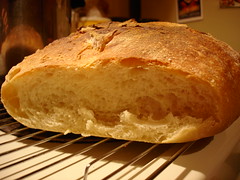
My sourdough starter has been through its share of ups and downs: being neglected in the fridge, dropped on the floor (in a container), used daily and then not for months... In spite of it all, it is still alive and well after a program of twice daily feedings for a few days, and I spent much of the day trying to convince it to become a loaf of bread. I tried a new recipe from The Bread Bible by Rose Levy Beranbaum and was shocked to see how much it differed from the King Arthur Flour Baker's Companion ones that I've been using. The texture is totally different. Where King Arthur's breads were fine-crumbed, sweet and dense, this one is full of big holes, tangy and light. Almost too light, in fact, for my taste. It turned out as I think it was supposed to, though. She has a rye caraway that I'm dying to try, as well as a pumpernickel, which also sounds perfect.

Baking bread is a wonderful thing, but when you work with sourdough you really need to stay around the house all day as it requires all sorts of folds and it needs to rise every hour or two. This makes it "inconvenient" for modern on-the-go lifestyles, especially now that the weather has turned lovely, tempting one to drop everything and run outside. I am curious to move on to some yeast breads to see if it would eat up less of the day. I'm sure they are faster, but are they better?

m

Sunday, April 03, 2005

1,001 Arabian Treats, pt. 1


Arabian Kabsa
Originally uploaded by ajkinik.


My parents arrived yesterday from the Middle East bearing all kinds of treats native to the Persian Gulf region. Along with tried-and-true faves like the exotic dates stuffed with almonds, candied lemon peel, and candied orange peel, Iranian saffron, and lemony roasted pistachios, we also received a box of traditional desserts such as ma’amoul, sesame crisps, and a whole assortment of phenomenally fresh almond and pistachio treats. The delicacy that best bookended a week that had started with our discovery of Ras el Hanout, though, was Kabsa, the most distinctive spice mix from the Arabian peninsula.

The nations that make up the Arabian peninsula today don’t have nearly the reputation for cuisine (and especially for the complex use of spices) that, say, Morocco does, but spices have long been a central preoccupation of the region nevertheless. The rise of Islam and the spice trade were absolutely and inextricably linked—not only did the spice trade finance the birth of Islam, but the Spice Route became the primary conduit for the teachings of Islam, spreading the new faith from the Arabian peninsula all the way to the Spice Islands (modern-day Indonesia and Malaysia) in the east, and as far west as Morocco and the Iberian peninsula.

Kabsa is a spice mix made up of everything from coriander, cinnamon, and turmeric, to pepper, cardamom, clove, dried ginger root, and dried Omani limes, and it lends its name to the most famous of Arabian dishes, Al-Kabsa, which can be made with a variety of different meats, but is most commonly made with lamb or chicken, along with rice, nuts, and dried fruit. We got one bag of pre-ground Kabsa and another of unground “raw” spices (you can get a sense of what it looks like from the photo above). The bag of whole ingredients looks and smells amazing, but we’ve got no idea how we’re going to manage to grind it. As soon as we do, and we get a chance to whip up a batch of chicken Al-Kabsa, we’ll let you know.

aj

1,001 Arabian Treats, pt. 2


Arabian sweets
Originally uploaded by ajkinik.


OK, I couldn't resist. Here's a detail shot of that box of Arabian sweets we got. They go perfectly with tea. We're particularly fond of those pistachio chews in the middle there (sadly, they're all gone already).

aj