Saturday, March 05, 2005

Hot Cross Buns and other matters


One Hot Cross Bun To Go
Originally uploaded by ajkinik.


Inspired by our friend Geoff, who posted an extremely tantalizing piece on Sweden’s Semlor pastries earlier this week, I started thinking about Lenten and Passover-season pastries. Semlor are quite clearly pre-Lenten delicacies (their combination of cardamom, whipped cream, and almond paste seems both too heady and too rich to meet Lent’s asceticism), but somehow over time they became seasonal specialties—ones that can now be found in some bakeries from January all the way to Easter. This shift must have something to do with the relative importance of Easter within Swedish culture, but that's another subject altogether. The bottom line, here, is that Semlor got me thinking about everything from Hot Cross Buns to Oma’s “Gremchiles.”

I’ve been an aficionado of the Hot Cross Bun since I was quite young, and they're actually one of the many ways I rate a city (along with bagels, dim sum, rotis and Jamaican patties, delicatessens, and a number of other culinary criteria)--Vancouver rated highly in this department, for reasons that would be obvious to anyone who's ever lived there. However, my knowledge of the Hot Cross Bun's history was foggy at best, so looking for a better understanding, I turned to Alan Davidson’s The Penguin Companion to Food. Hot Cross Buns have generally become sweeter and much less Lenten over the course of time, with their trademark cross now commonly made out of icing sugar and not out of pastry or a simple cross-cut in the dough, as they had been earlier. As it turns out, these icing sugar crosses really belie the pastry’s somewhat somber origins. This cross-bearing pastry dates back to ancient times, the mark being a symbol connected “with religious offerings of bread, which replaced earlier, less civilized offerings of blood,” as Davidson puts it so delicately. Previous to the Christian era, the Egyptians had made offerings of small, round cakes that bore a representation of ox horns to their goddess of the moon. Later, the Greeks and pre-Christian Romans carried on similar traditions, and the Roman Empire eventually brought this custom to the Saxon world. The Saxons ate buns bearing the image of a cross as a tribute to their goddess of light, Eostre, and it is this name that became the root of the word Easter, indicating just how central Hot Cross Buns are to the Anglo-Saxon tradition of Easter.

Oma’s “Gremchiles” are another matter altogether. Not long after I met my friend Mark, we bonded over the subject of pastries. We both had a serious taste for pastries of the Eastern, Central, and Northern European variety—Mark has Dutch and Eastern European roots, while half my family is Slovak—and Montreal at the time was a haven for those with tastes such as ours. We had a number favorite bakeries and we visited them regularly—pastries were the subjects of countless discussions, and the inspirations behind countless of other non-food-related conversations. I remember that the Modern Lovers' masterpiece of the morose, “Hospital,” where Jonathan Richman sang-spoke so plaintively, “I go to bakeries / All day long / ‘Cause there’s a lack of sweetness in my life,” resonated particularly strongly with me at the time. Mark eventually became known as the “Pastry King” within our circle of friends, and one of the things that secured this reputation, in my mind at least, was his devotion to his Oma’s “Gremchiles.” Every year, at Passover, his Oma would make her version of this Dutch-Jewish matzoh-based pastry by the dozens, and every year Mark would wax poetic about them for weeks in advance of his annual Passover trip to Toronto. Eventually, some of us couldn't take it any longer and we started placing orders for them, and Mark would come back with a couple of “Gremchiles” each. I haven’t had them in some 15 years or so, but I still remember them vividly. Finding myself daydreaming about them a few days ago, I got in contact with Mark in an attempt to obtain the recipe. Within 24 hours I’d heard back from both Mark and his mother, Claire, and not only was I now the proud owner of a recipe for them, but I’d finally found out their real name: Gremselich.

Stay tuned, I’ll have more on Gremselich in a few weeks, closer to Passover.

You can find Geoff’s piece on Semlor at Bits and Bytes From Elsewhere under the title “Stockholm Syndrome II.” Don’t miss it.

aj

Friday, March 04, 2005

Spring is coming


Spring cookies
Originally uploaded by michelle1975.


Spring cookie cutters
Originally uploaded by michelle1975.


Maybe I am jumping the gun here, as I always do this time of year, but there is something electric in the air. It must be spring. The birds outside our apartment seem to know it. They are singing louder and louder every day. The days are longer. The snow is retreating. I am cleaning. I made spring-themed cookies. You can't deny it. Don't fight it. And if winter returns with a vengeance, you can blame me for jinxing us. Sorry in advance.

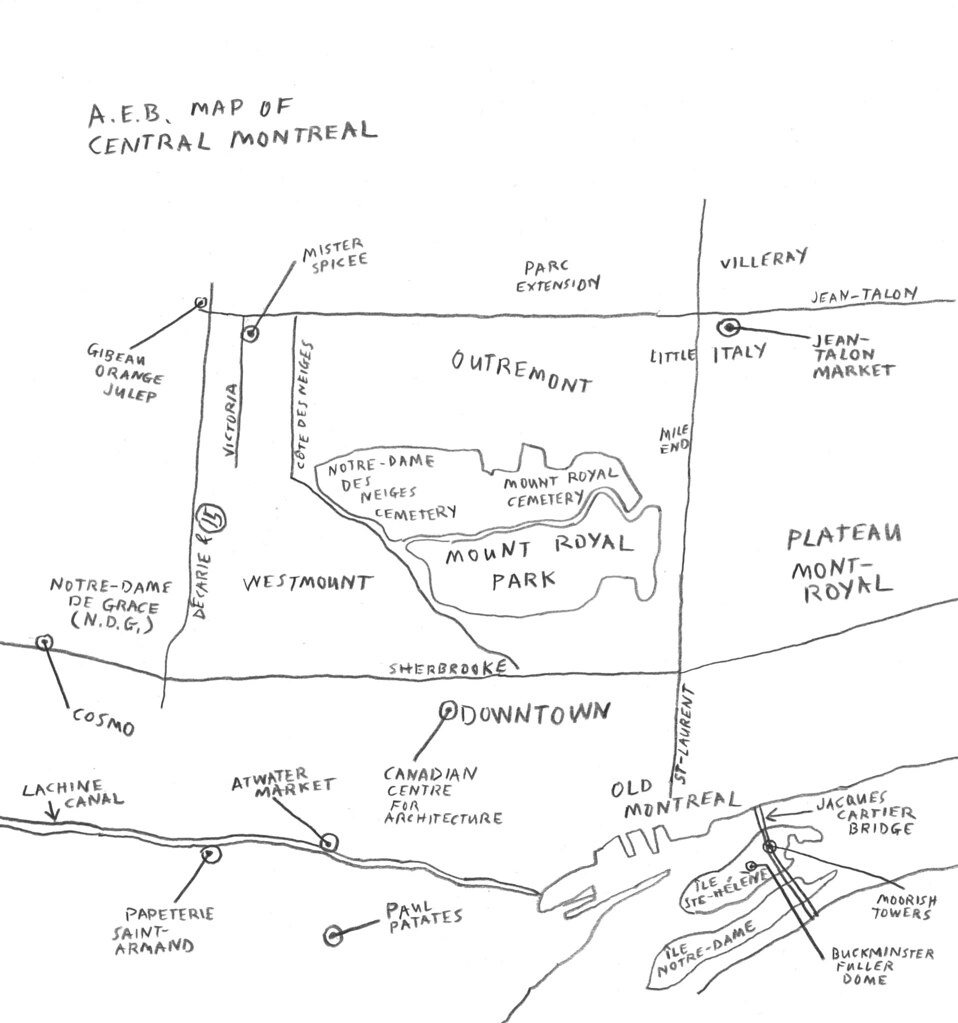
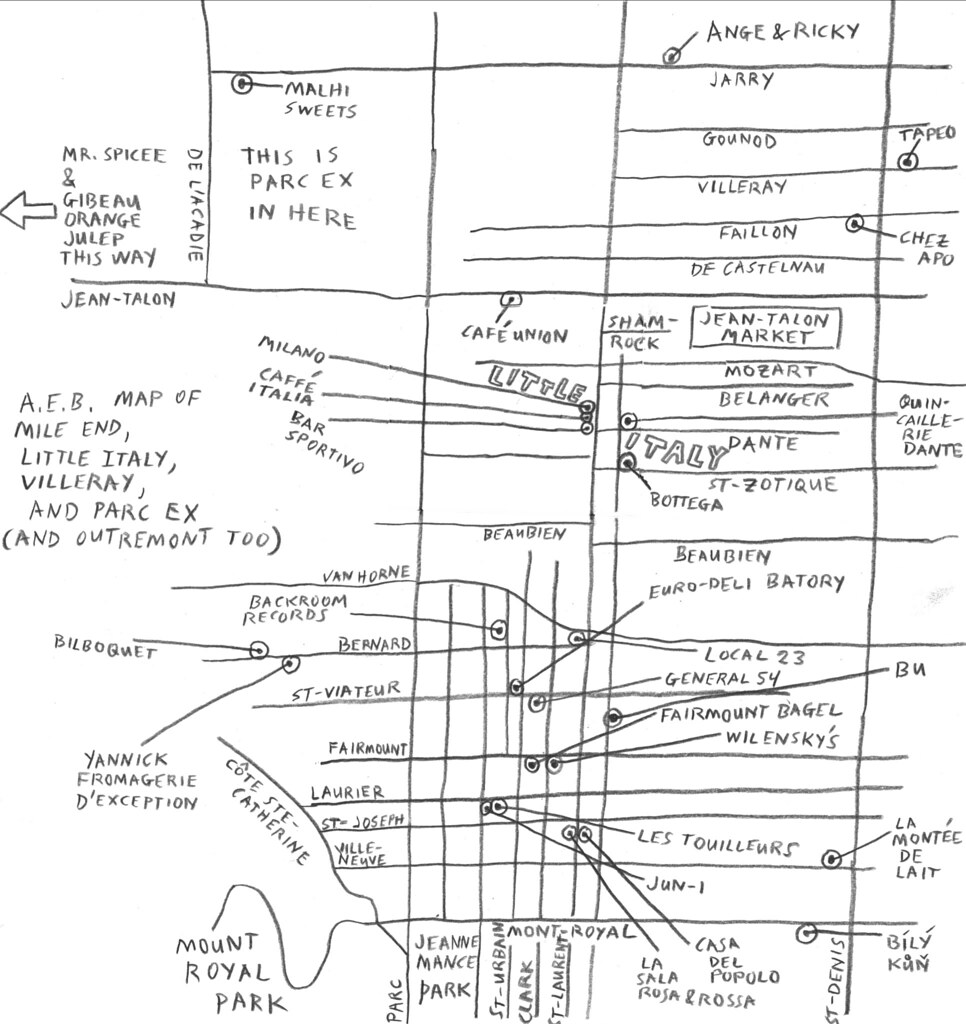
I found this cookie cutter set at Les Touilleurs for $5.50. A steal, I thought. Go get one: 152 Laurier O., near St. Urbain.

m

Sunday, February 27, 2005

Portrait of Boris and Audrey as Egg Warmers


Cat Egg Warmer pattern:

Materials: fingering yarn, any colours, size 12 needles, embroidery thread, broom bristles.

Tension: 8 sts. and 11 rows to 1 in. over st. st.

Pattern: CO 20.
K1, P1 rib for 5 rows.
St. st. for 26 rows.
Inc. 1 each end of next and every alternate row 3 times. (26 sts.)
Work to end of 36th row.
Dec. 1 each end of next and every alternate row 3 times.
Work to end of 61st row.
K1, P1 rib for 5 rows.
CO and weave in ends.

Finishing: Embroider eyes, nose and mouth. Fold cat in half and sew up seams with yarn. Thread broom bristles through nose for whiskers. If a tabby effect is desired, use a variegated yarn or different colours worked in intarsia. Done.

m

Saturday, February 26, 2005

Two Montreal Classics in Two Days, Pt. 2: Wilensky's


Wilensky's Light Lunch
Originally uploaded by ajkinik.


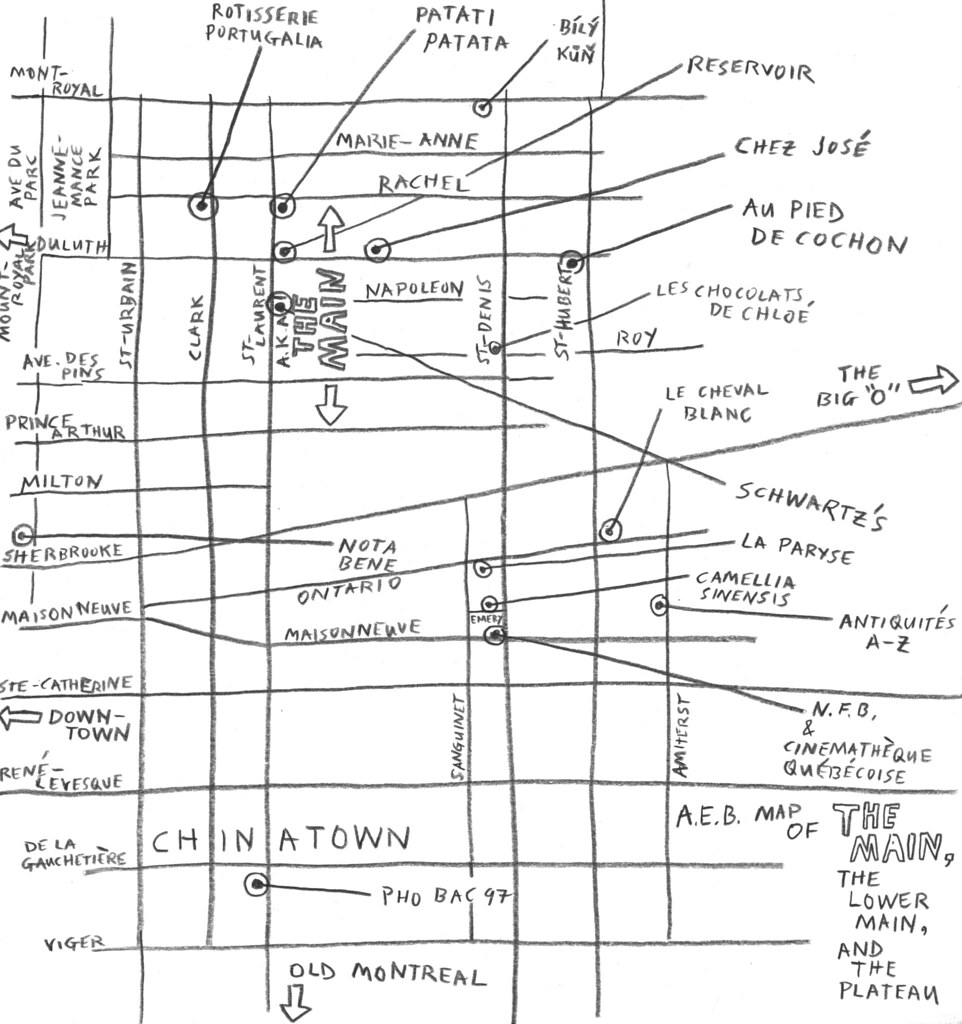
Gone are the days featured in The Apprenticeship of Duddy Kravitz, the book and the film, and there are few examples that make this as crystal-clear as Wilensky’s (34 Fairmount W.). In the film version made by Ted Kotcheff, one of the early scenes takes place in the Wilensky’s of the early 1970s standing in for the Wilensky’s of a generation earlier. The space is done up in the syle of the cigar store and light lunch counter it was some 50 years ago now. Tables occupy the shop floor, and taxi drivers (like Kravitz’s father) and others (all men) use the place as a hang-out that’s a throwback to the Old World, not unlike the way places like Café Portugalia still operate today. Wilensky’s is represented as being a lively, smoky center for the local Mile End Jewish population, a crossroads for the community. The atmosphere is boisterous and kinetic, even if the regulars come across as being rooted to their seats. Wilensky’s Light Lunch is still in operation, still serving its legendary Wilensky Specials—a hot sandwich consisting of several slices of Bologna-style beef salami squeezed between a crusty, toasted bun that’s not unlike an English muffin, and some mustard—but the tables that appear in the movie haven’t been around for ages, and much of the community that supported a place like Wilensky’s for decades (the operation has been around since the Great Depression) hasn’t existed in the neighborhood for years now. Wilensky’s still has its die-hard regulars, but the restaurant definitely isn’t the teeming crossroads that it used to be, and, not surprisingly, the Wilensky Special’s price has shot up to $3.00 after having hovered around $1.50-$2.00 for a dog’s age. With traffic somewhat lighter these days, the staff of four that sits behind Wilensky's counter is still more than ready to take your order. In fact, the other day, when I took Michelle for her very first Special, we were served our lunches—two Specials, a half-sour, and a hand-pulled cherry cola—before the seat of my pants had even hit my stool. If anyone even flinches towards the door outside, the Specials are ready and waiting for them. My friend Ira refers to this aspect of Wilensky’s as an obsession with “risk management.” The staff at Wilensky’s is also—how shall I put it?—attentive, when it comes to clearing up. I still laugh when I think about how Ira used to bring his heavy critical theory tomes to Wilensky’s, order a Special with cheese and a soda, and then actually try to settle in to read for an hour or two. Wilensky’s still has an entire library of pulp fiction stacked on its walls, harking back to the days when people actually used to linger there, but these days, cracking open Foucault’s The Order of Things and making yourself comfortable is a sure-fire way to get run out of there on a rail. Oh, well… Our Light Lunch the other day was still classic—the bun was just as unique as it ever was, the bologna and salami were delicious, the half-sour tasted homemade, and the fresh cola was still a treat—even if we were in and out of there in under seven minutes. We hardly knew what hit us, but it sure tasted great.

aj

Two Montreal Classics in Two Days, Pt. 1: Cosmo, rev. ed.


.
Interior Design, Cosmo's-style fig. a:  interior design

Neither of us had been to Cosmo in quite some time, and we'd gotten enlisted to take Michelle's sister to the airport so that she could head down to Tampa and 25 C weather (while the temperature here in Montreal had dropped back down to -15 C), so we decided we'd drown our sorrows in a breakfast at Cosmo on our way back downtown.

Cosmo (5843 Sherbrooke West) remains one of those quintessetial Montreal breakfast joints: roughly 8 stools gathered round a small counter, a tiny kitchen, two counterhands, some homespun decor [see the photo above], and some killer, king-size breakfasts, including the legendary Mish-Mash (which combines eggs, potatoes, onions, and a selection of breakfast meats into an unholy mess of goodness). The first time I went was back in the late '80s when I was an undergrad at McGill. I lived downtown at the time, and like most other undergrads my knowledge of the city was limited, to say the least. Making it east past Park Lafontaine was a big deal; so was making it as far north as Van Horne. I remember going out to the old Café Campus near the University of Montreal a couple of times and thinking that was an achievement. Notre-Dame-de-Grace seemed like another universe; I don't think I'd made it further west than Atwater Market up until my roommate and I got invited out to Cosmo by a friend of his. I distinctly remember being fascinated by the time and effort that "Cosmo" put into preparing his fried potatoes. Boiled potatoes and onions would get slapped onto the greased griddle in huge quantities, and then "Cosmo" would spend the next 15-20 minutes slowly turning the potatoes over and over again until they'd reached perfection. Then everyone who'd ordered a breakfast over the last quarter of an hour or so would get served their breakfasts in a flurry of activity, and the whole process would start over again. The other thing I remember was the banter. This was a big-city place, with repartee worthy of a screwball comedy. "Cosmo" (a.k.a. Tony) may have retired a few years ago now [if you look closely at the photo above, you can see him among the other distinguished figures that grace the walls of his restaurant], but he still stops by his old stomping grounds now and again to check up on things, and not only does Cosmo still dish out the classic breakfasts, it's still dishing out the banter. We got an earful with our delicious eggs, potatoes, and bacon combos.

aj

Thursday, February 24, 2005

By special request...


pink petit four
Originally uploaded by michelle1975.


This post is for my knitting group, who had such an enthusiastic reaction to these little pink cakes that I am posting a picture of one of them. These kirsch-flavoured minis were part of my final exam on petits fours.

Special dedication to Zoe, who is still very much a part of our knitting group, even if she is in Australia these days. Thinking of you...

m

Monday, February 21, 2005

Spinach and Roasted Pepper Frittata

Years ago, my friend Emilie gave me a copy of Annie Somerville's Fields of Greens: New Vegetarian Recipes from the Celebrated Greens Restaurant for my birthday. At first, I was a little intimidated by the book, and it took me a couple of years to warm up to it, but when I finally did, I really did. It's been a favorite cookbook ever since. The recipes are lively and delicious, with an emphasis on the use of seasonal vegetables, fresh herbs, and just the perfect amount of spice, and it's one of a number of cookbooks that I can think of that make a lie of that tired old line about vegetarian cuisine being boring and unsophisticated. I consider it a bit of a classic of California-style cuisine.

One of Somerville's recipes that we've gotten the most enjoyment out of is the following frittata recipe. It's been the centerpiece for a number of successful brunches we've held.

1 1/2 tbs light olive oil
2 bunches of spinach, stems removed and leaves washed, about 16 cups packed
Salt and pepper
4 garlic cloves, finely chopped
1 yellow or red bell pepper, roasted, peeeled and diced
2 scallions, both white and green parts, sliced on a diagonal
1 oz. Parmesan cheese, grated, about 1/3 cup
3 oz. feta cheese, crumbled, about 3/4 cup
1 tsp finely chopped fresh rosemary
2 tsp fresh lemon juice
8 eggs, beaten
3 tbs Reduced Balsamic Vinegar

Preheat the oven to 325 degrees Fahrenheit.

Heat 1/2 tbs of the olive oil in a large skillet. Wilt the spinach over high heat with 1/4 tsp salt, a few pinches of pepper, and the garlic. Drain and cool the spinach. Squeeze out the excess moisture a handful at a time and coarsely chop. Place the spinach in a bowl with the peppers, scallions, Parmesan, feta, rosemary, and lemon juice. Stir the eggs into the mixture and add 1/4 tsp salt and a few pinches of pepper.

In a 9-inch pan with an ovenproof handle (or one that you've temporarily ovenproofed with aluminum foil), heat the remaining tablespoon of oil to just below the smoking point. Swirl the oil around the sides of the pan to coat it, turn the heat down to low, then immediately pour the frittata mixture into the pan. The pan should be hot enough so that the eggs sizzle when they touch the oil. Cook the frittata over low heat for 1 to 2 minutes, until the sides begin to set; transfer to the oven and bake, uncovered, for 20 to 25 minutes, until the frittata is golden and firm.

Loosen the frittata gently with a rubber spatula; the bottom will tend to stick to the pan. Place a plate over the pan, flip it over, and turn the frittata out. Brush with the vinegar if you like. Serve warm or cool to room temperature. Cut into wedges and serve.

The frittata can also be cooked entirely in the oven. Pour into a lightly oiled baking dish and bake for about 25 minutes, until the eggs are golden and set.

Serves eight to ten.

To make Reduced Balsamic Vinegar:
In a small saucepan over high heat, reduce the vinegar to half its original volume. (For a more intensely flavored reduction, bring the volume down to one-third.) Be careful that all of the vinegar doesn't boil away as you reduce it. Cool and store in a sealed jar along with your other vinegars or refrigerate.

[both recipes from Annie Somerville's Fields of Greens]

aj

Sunday, February 20, 2005

Mexican Chocolate Cookies, take 2


This was our experiment with the corrected version of the Mexican Chocolate Icebox Cookies we posted about earlier. These cookies were much more solid and easier to work with. They could have used a touch more spice, because the added flour took out some of the punch the last batch had. The next time I will do the 3/4 tsp. cayenne rather than the 1/2 tsp. Otherwise they were perfect: crisp on the outside, soft and chewy on the inside. Much like a brownie. Highly recommended.

We served them with our brunch this afternoon. We had a spinach and roasted red pepper frittata, roasted potatoes, toasted baguette with an assortment of preserves (including blood orange marmalade), coffee, fresh-squeezed orange juice, and fresh pineapple. The cookies made a fine addition.

m

Thursday, February 17, 2005

Late St. Valentine's Day Special


Due to technical problems, we were unable to post this on V Day, as planned. This is a cupcake I made for Anthony, along with one of me. They were chocolate with vanilla buttercream, and a few drops of colour for the face... I thought they were adorable.

m