Showing posts with label apples. Show all posts

Tuesday, October 22, 2013

Thanksgiving Just Keeps on Giving

apple pickin' 1 fig. a:  apple-picker

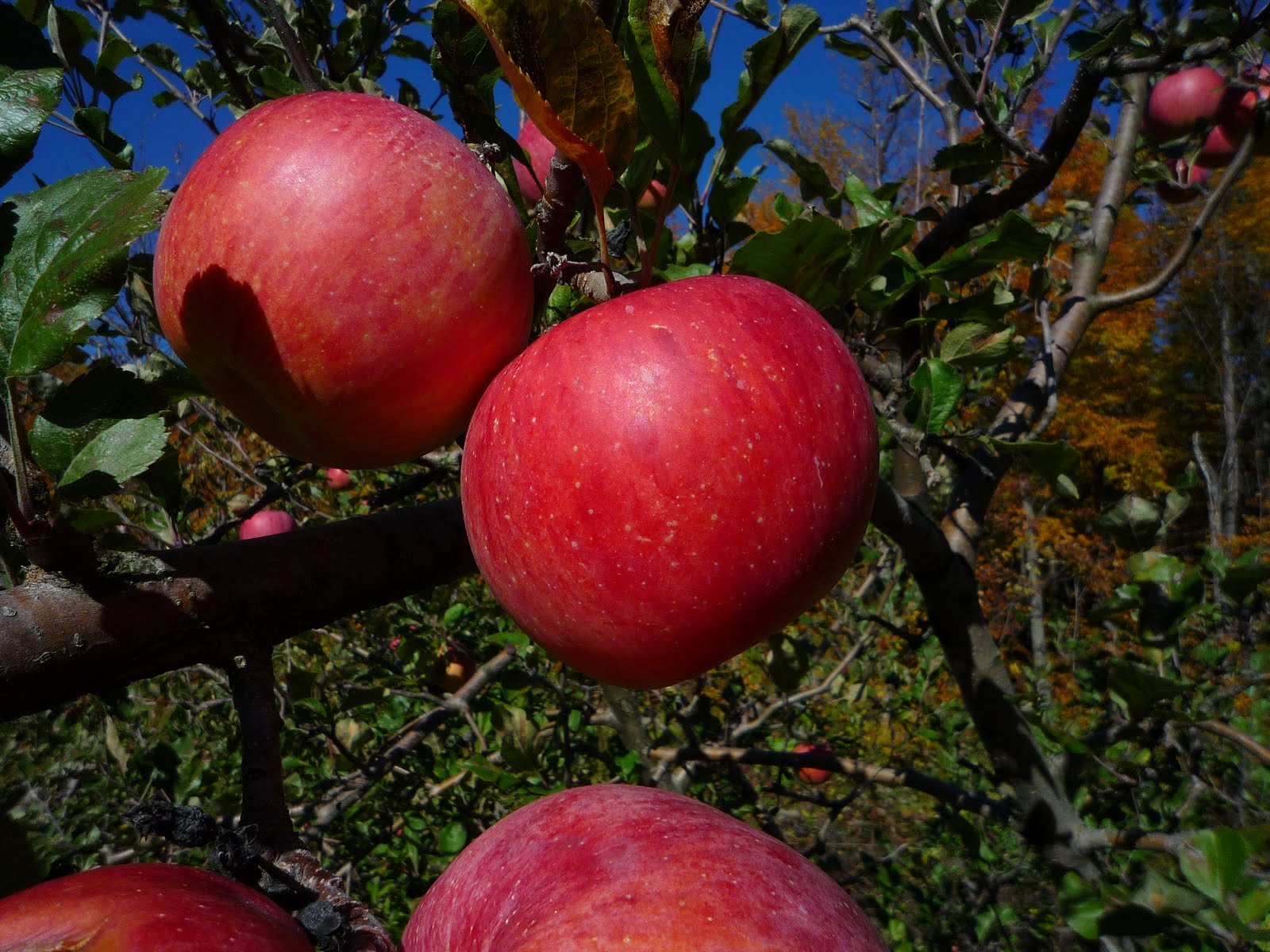
Canadian Thanksgiving 2013 began with our annual apple-picking excursion to Covey Hill.  There, we picked a couple of buckets of apples (Empires, Northern Spys, Russets, and Spartans, mainly), bought a couple of baskets more,

Untitled fig. b:  apples

and picked up some Flemish Beauty pears, as well.

Untitled fig. c:  pears

The sun was bright, the leaves were vibrant, and it was downright warm (felt more like peach-picking weather than apple-picking weather), and we got a chance to get all caught up with our good friend M. Safian.  And on the drive back we started thinking about all the possibilities we now possessed in the back of our car:  apple pie, baked pears, apple strudel, pear chutney, corn bread stuffing, squash soup, and so on.

The next day, when we actually got around to making our Thanksgiving meal, it was quite the spread.  Not surprisingly, both apples and pears played an important part.

The menu:

smoked Cajun andouille appetizer
sweet potato & peanut soup (with apple cider) 
roasted turkey
corn bread stuffing (with apples & pears)
roasted romanesco cauliflower
roasted Brussels sprouts
roasted carrots
mashed potatoes (with turnips and parsnips)
cranberry sauce
Georgian plum sauce 
mixed greens salad (with apples & pears) 
cheese plate (with pears) 
apple pie
pumpkin pie

Our turkey this year was a huge hit--it was also just plain huge.  When Michelle heard through the grapevine that Société Orignal was offering turkeys raised by the one-and-only M. Bertrand, she put through an order for a "small turkey" immediately.  The turkey that she received was beautiful, and unbelievably fresh (it had just been slaughtered two days before), but it was also almost 20 pounds (!)--the very largest we'd ever made, and not exactly the ideal size for our preferred high-temperature turkey method.  Nevertheless, we soldiered on.  And by now Michelle's got this approach down to such a science that the results were truly phenomenal.  Two tricks of the trade:
1.  Salt your bird generously, inside and out, at least one day in advance, and preferably two. 
2.  When you bring your bird to room temperature before roasting it, cover the bird's breast with ice packs to keep it cool.  Remove the ice packs right before roasting.  Doing so will ensure that the breast meat does not get overcooked, but instead will turn out juicy and succulent (already, even without this fix, we found that the high-temperature method produced the juiciest birds we'd ever encountered, but if you're roasting a larger bird, like we were, this step is essential).
Our cranberries were pretty special, too.  They came from Société Orignal, as well, and they were dry-picked, not wet-harvested.  Neither of us had ever tasted a cranberry sauce with a deeper flavour.

Our stuffing was also rather deluxe.  I've been trying to convince Michelle of the merits of corn bread stuffing for years, but she's always remained steadfastly loyal to stuffing made with white bread or sourdough.  This year amounted to a breakthrough, though.  Michelle officially declared this year's model to be her very favourite of all-time.*
AEB Corn Bread Stuffing 
1 extra-large 3x batch of corn bread
onion
celery
red sweet peppers
parsley
sage
roasted hazelnuts
2 chopped apples
2 chopped pears
bourbon
salt & freshly ground black pepper
butter 
Preheat oven to 425º F. 
Sauté the onion in butter until translucent.  Add the celery and red peppers and continue sautéing until softened.  Add the corn bread, the herbs, the nuts, and the fruit and mix gently but thoroughly (preferably with your hands, once you've allowed the onion mixture to cool slightly).  Adjust the seasoning with salt & pepper.  Spritz liberally with bourbon.  Pour a generous amount of melted butter over top and mix again.  The stuffing should be just slightly moistened by the combination of bourbon and butter.   
Place in a buttered baking dish and bake for 30 minutes covered in foil, and 15 minutes uncovered.
Anyway, we thoroughly enjoyed our meal, everyone ate heartily, and we had so much left over that we sent our guests home with doggy bags--and still we had copious leftovers.  The ultimate prize, however, was that massive turkey carcass.  It still had a fair bit of meat left on it, and it had been roasted to perfection--in other words, it had all the makings of a beautiful batch of turkey broth.  So I cut it up into portions, put them in bags, and froze them.

And the next week, when all the other leftovers had disappeared days ago, and my taste for turkey was coming back to me, I got to work on my new (since last year) favourite post-Thanksgiving ritual:  making turkey gumbo.

Thing is, because making turkey gumbo is "my new... favourite post-Thanksgiving ritual," I was already thinking about the gumbo before we'd even roasted our bird.  And because I knew I wanted to make my turkey gumbo with real Cajun andouille (a spicy, smoked Louisiana classic), and I was pretty sure locating real Cajun andouille would be a little difficult 'round these parts, I made my own.  Then, because I was smoking anyways, I decided to smoke some additional turkey legs, just for the hell of it (and in case my turkey gumbo needed to be bumped up a little).  So on Thanksgiving Sunday, while Michelle had the turkey in the oven, I had the smoker smokin' away--which is how we ended up serving freshly smoked andouille as an appetizer.

How, exactly, do you make Cajun-style andouille?  Well, I based my batch on a recipe from Bruce "America's Premier Sausage Maker" Aidells:
Cajun-style Andouille 
3 tbsp sweet Hungarian paprika
2 tbsp minced garlic
2 tbsp kosher salt
2 tbsp sugar
1 tbsp freshly ground black pepper
2 tsp ground cayenne pepper
1 tsp crushed red pepper flakes
1/2 tsp dried thyme
1/4 tsp ground mace
1 tsp curing salts (optional--for cold-smoking only)
5 lbs pork butt, fat and lean separated, and cut into 2" chunks
1/2 cup water
wide hog casings 
Mix all the spices and herbs in a small bowl.  Separate the meat and the fat into two bowls, and rub each thoroughly with the spice mixture.  Cover and refrigerate overnight. 
Grind the lean meat in a meat grinder using a 3/8 inch plate.  Grind the fat using a 1/4-inch plate.  Mix the meat and fat together in a large bowl, add the cold water, and knead and squeeze until the water is absorbed and the spices are thoroughly blended. 
Stuff the mixture into wide hog casings, and shape into medium-sized links. 
If you are hot smoking, dry for at least two hours in a cool place, then hot smoke at about 225º F, turning every 30 minutes, until an instant-read thermometer inserted in the end of a sausage shows 155º to 160º F.  This should take about 1 1/2-2 hours.
If you are cold smoking, you'll have to add the curing salts during the first step, and carefully follow instructions on how to cold smoke.  Aidells recommends an extra-long cold-smoking period for Cajun andouille:  "at least 12 hours" (!). 
Hot-smoked andouille sausages are ready to eat as soon as they've been smoked.  Cold-smoked sausages are not--they must be fully cooked first.
[recipe from Bruce Aidell's Complete Sausage Book]
Untitled
smoked andouille figs. d & e:  andouille:  before & after

While you're at it, might as well smoke a few turkey legs, right?  Just brine them for at least a few hours, and preferably overnight, then hot smoke them alongside your sausages, making sure to mist them with apple juice every 30 minutes or so.  Smoke until the juices run clear when you slice down to the bone, about 1 1/2 to 2 hours.

The results?  The skin turned out a little rubbery, but the meat was dreamy:  incredibly juicy and wonderfully smoky.  I just peeled the skin off and sliced the meat as thinly as possible before serving.  And I made sure to keep some for my gumbo.

smoked turkey fig. f:  smoked turkey
AEB Turkey & Sausage Gumbo 
for the broth: 
1 turkey carcass (recuperate as much quality meat from this carcass as possible, and put aside for the gumbo)
onions
carrots
potatoes
celery
garlic
2 bay leaves
12 peppercorns
salt to taste 
Make yourself a rich turkey broth by adding all the ingredients above to a large stock pot, covering with water, bringing the pot to a boil, and simmering for at least a few hours.  Make sure to skim the fat thoroughly.  Turkey broth might be my absolute favourite, and this method ought to produce much more than the 4-5 cups of stock you need for the gumbo.  Freeze it and save it for another worthy occasion. 
for the gumbo: 
recuperated turkey meat from the carcass 
recuperated meat from home-smoked turkey pieces (optional, but highly recommended)    
bones from home-smoke turkey pieces (again, optional, but highly recommended)  
4 smoked Cajun andouille sausages (highly recommended), or some other quality smoked sausage (like a kielbasa, for instance), cut into 1/4" "coins"
1 batch Cajun roux (made with 1/2 cup vegetable oil and 1/2 cup AP flour [you can find complete instructions on making a true Cajun roux here])
1 large onion, diced
3-4 stalks of celery, diced
2-3 sweet red peppers
1 green pepper (preferably something flavourful, like an Italian fryer or a cubanelle)
4-5 cups rich turkey broth
2 bunches scallions, white & green parts, washed & chopped
1 small bunch fresh parsley, chopped
4-6 fresh sage leaves, julienned
kosher salt & freshly ground black pepper
1 tbsp gumbo filé 
As John Thorne would say, "First, you make your roux."  When your true Cajun roux is as deep and dark as you like it, add your chopped onions, turn the heat back up to medium or medium-low, and sauté until soft.  Add the celery and peppers and sauté for a few minutes more.   
Slowly add the broth and stir or whisk it in carefully, so that your roux doesn't separate. 
Add the bones from the smoked turkey pieces (if using), the scallions, parsley, and sage and bring to a boil, then turn down the heat and simmer your gumbo gently for about 1 1/2 hours, or until it shimmers.  Afterwards, if it needs to be skimmed of excess fat, do so.   
Add your turkey meat and your andouille.  Stir in the gumbo filé and simmer gently for another 30 minutes.  Adjust the seasoning, if need be. 
Serve over or alongside steamed white rice, with some cold beers, and have a bottle or two of hot sauce on hand for anyone who wants to bump up the spice quotient a bit higher.
Note:  Of course,  you don't absolutely need a leftover turkey carcass to make this gumbo, nor do you need to make your own smoked andouille.  You could easily make something that's nearly as tasty with fresh turkey or chicken pieces, some store-bought smoked sausage, and some chicken or poultry stock.  But making full use of your leftover Thanksgiving turkey and its carcass is pretty satisfying, and few dishes make it shine like a turkey & sausage gumbo.
[recipe inspired by one that appeared in the November 2011 issue of Garden & Gun, and that came from Justin Devillier of New Orleans' La Petite Grocery]
And when I'd eaten turkey & sausage gumbo for two days (and loved every minute of it), I made leftovers with my leftovers:  Cajun-style hot turkey sandwiches.  Mmm-hmm.  Laissez bon temps rouler!
AEB Cajun-style Hot Turkey Sandwiches 
leftover Turkey & Sausage gumbo, with lots of sauce
1 or more slices of white bread (preferably a homemade sourdough) 
Heat up your leftover gumbo.  Place a slice of white bread on a plate.  When the gumbo has been heated through, pour it over the slice of bread, making sure the entire slice is covered in sauce.  Serve immediately, preferably with boiled and buttered peas and mashed potatoes.
Talk about a harvest!  This year's Canadian Thanksgiving just keeps giving and giving...  Can't wait for American Thanksgiving!

aj

* Of course, I'm pretty sure she does that pretty much every time we make stuffing of any kind.  We're both huge fans of the genre.

Thursday, October 14, 2010

Spys Like Us (and we love them)

Of course, for those of us who live in Quebec, another aspect of the trouble with Vermont, during the apple harvest or at any other time of year, is that you can go down and sample their apple crop, but you're not supposed to haul quantities of apples across the border. It doesn't matter if they're heirloom varieties that are hard/impossible to find in Quebec. It just ain't allowed. NAFTA or no NAFTA.

fig. a: into the orchard

Luckily for us, Quebec still has plenty of small- to mid-size orchards that cultivate some of your lesser-known and harder-to-find varieties of apple. Luckily for us, there are still orchardists like M. Safian producing top-notch Northern Spys, Ida Reds, Russets, Empires, Spartans, and Cortlands, in addition to his excellent McIntoshs.

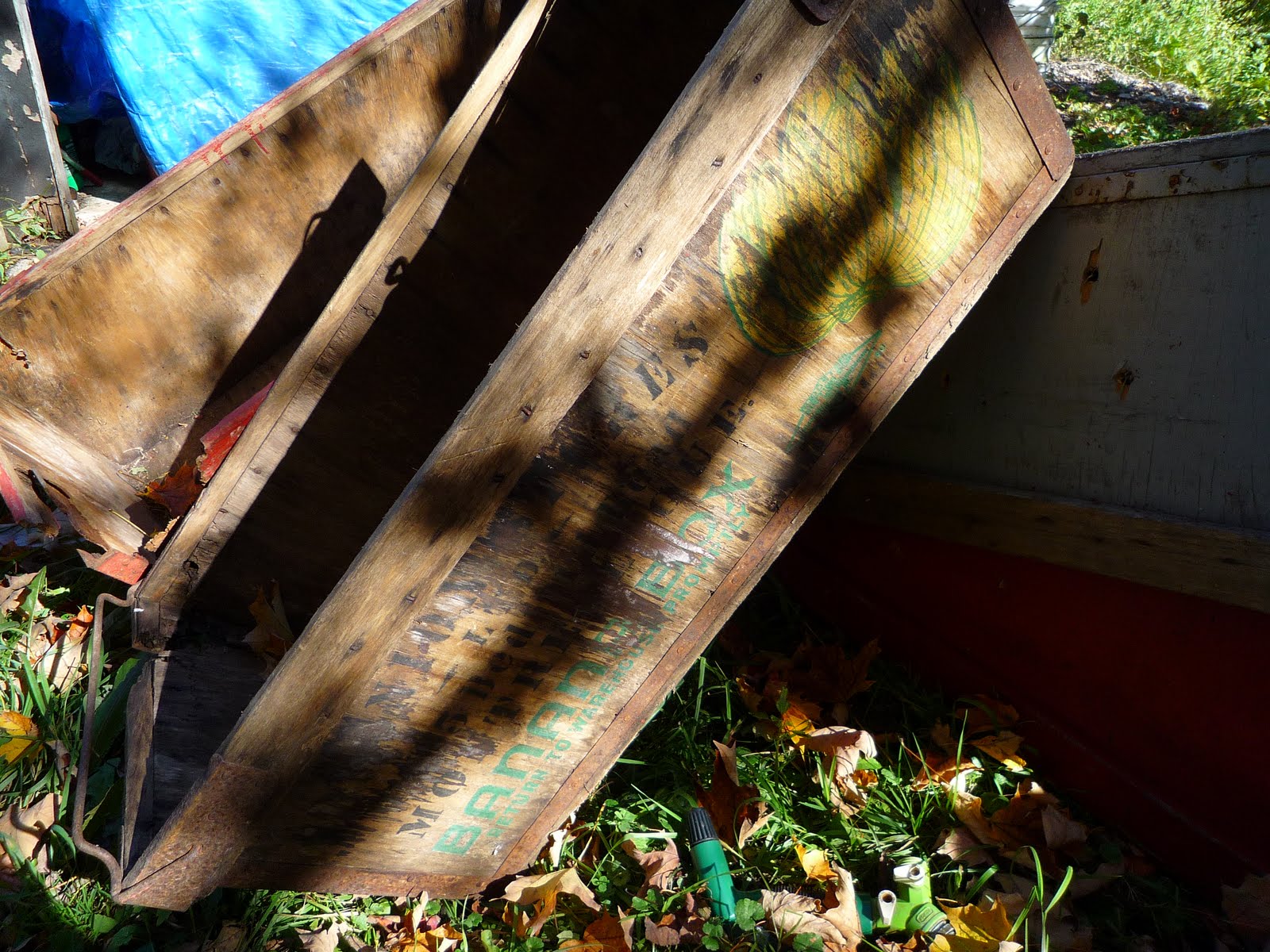
fig. b: banana box

Visit M. Safian, and past the beaten-up old banana crates (?)

fig. c: this old barn

and the decrepit old barn

fig. d: Ida Reds, ripe for the picking

you'll find that his trees are still chock-full of perfectly formed, unusually sweet apples (it's been a good year).

fig. e: Ida Reds, up-close and in-person

You might need to borrow a ladder to get at some of the prize specimens, but the trees are so overloaded, so ripe for the picking, that you can easily fill 4 or 5 buckets in a matter of about 15-20 minutes. If you have plans to do a lot of seasonal baking or cooking with apples, or you enjoy eating about 4 or 5 apples a day (the way I usually do this time a year), there really is no better way to get the very best apples at the very best price. Throw in some fresh country air and possibly some sunshine, and you can't ask for a more pleasant, more satisfying outing.

We got ourselves a nice mix of apples, but we picked a whole bunch of Ida Reds (like the ones you see above), which have a lovely blush when cooked,

fig. f: Northern Spys

and we positively loaded up on Spys, which have a tartness that we absolutely love and that makes them ideal for apple desserts.

m. safian vous offre... fig. g: M. Safian vous offre...

For directions to the Hemmingford/Covey Hill/Franklin apple-growing region (including directions to M. Safian's), look here and here.

For a recipe for Poulet à la Normande (with apples and Calvados), look here.

For a recipe for Tarte Tatin (with lots of apples), look here.

For a recipe for Huguenot Torte (with a couple of apples), look here.

For a recipe for Squash & Apple Soup, look here.

For a couple of recipes for Ketchup aux fruits (with apples), look here and here.

And if you need a recipe for the Brady Bunch Special, pork chops & apple sauce, look no further:

Pork Chops & Apple Sauce

4 meaty pork chops
extra-virgin olive oil
kosher salt
freshly ground black pepper
1/4 cup Calvados, Cognac, or Bourbon

brine:
2 tbsp kosher salt
1 tbsp sugar
2 lemons, sliced in half
4 cups water

apple sauce:
4 apples, cored, peeled, and roughly chopped
1 tbsp fresh squeezed lemon juice
1/4 vanilla bean, split and scraped
1/4 cup Calvados, Cognac, or Bourbon
1/4-1/2 cup sugar
1/2 cup water

In a bowl, squeeze the lemons, throwing the four halves in when you're done, then add 2 tablespoons of salt and 1 tablespoon of sugar, and 4 cups of water, and stir until the sugar and salt are fully dissolved, making a basic brine. Add the pork chops, cover, and refrigerate for at least 2 hours.

Meanwhile, make your apple sauce. Add the apples, the lemon juice, the vanilla bean, the sugar (the amount will depend on how sweet your tooth is and how tart your apples are), the Calvados/Cognac/Bourbon, and the water to a medium saucepan. Bring to a boil, then simmer gently for 45 minutes.

30 minutes before you intend to cook your pork chops, remove them from the refrigerator, pat them dry, rub them lightly with just a bit of olive oil, and salt and pepper them. Set them out on a plate to come to room temperature.

Preheat your oven to 300º F. When the 30 minutes is up, heat a large skillet over medium-high heat till the pan begins to smoke. Put the pork chops in the pan and sear for 2 minutes on each side, using tongs or a spatula to flip them (not a fork). When you've seared the chops on both sides, place the entire skillet in the oven and roast the chops for another 4-6 minutes, depending on their thickness.

Place the chops on plates. Meanwhile, deglaze the skillet with some more Calvados/Cognac/Bourbon. Pour a little of the resultant pan juices over each of the chops. Place a dollop of the apple sauce on top of the pan juices and serve. We recommend accompanying the pork chops & apple sauce with your favorite mashed potatoes and some braised cabbage (green, red, Savoy), but if you've got other ideas/plans, go for it.

You'll most likely have some leftover apple sauce. Don't worry, it'll be delicious. It won't go to waste.

Serves 4.


aj

Tuesday, October 12, 2010

The Trouble With Vermont

It had been weeks, possibly even months, since we'd spent any real time in Vermont, so we were overdue for a visit. It was also just about fall, so when it came time to pick a movie one night, I chose Alfred Hitchcock's The Trouble With Harry,

fig. a: poor Harry

his bizarre and underappreciated dark comedy from 1955, which happens to be set in a small Vermont town at the height of autumn.

fig. b: Hitchcock's Vermont 1

fig. c: Hitchcock's Vermont 2

I could tell you all about the peculiar charms of Hitchcock's film, but others have done it much better already. Suffice to say that although the narrative has quite a bit in common with your average episode of Murder, She Wrote, Hitch's take on murder and mystery in a small New England town is a much cheekier affair. Plus, Shirley Maclaine (in her first appearance on the silver screen) positively shines, and Jerry "the Beaver" Mathers steals virtually every scene he's in. Vermontophiles are in for a special treat, however, because The Trouble With Harry's portrait of The Green Mountain state at its quaint and quirky best has held up remarkably well (even if its mid-1950s setting means that there's a distinct absence of fleece apparel and bumper stickers).

You see, the trouble with Vermont isn't that there's anything terribly wrong with it, the trouble with Vermont is that we love it so. The landscape, the mountains, the towns, the food, the beer. Apparently we're so addicted that when we can't actually be there, we watch films that are set there just to tide us over until our next visit. Sad, perhaps, but true.

Anyway, if you go there right now, you'll find that the Green Mountains are actually pretty multicolored. You'll also find that the colors are quite bright. Not Technicolor + Vistavision bright,

fall colors 1 fig. d: AEB's Vermont 1

but bright nonetheless.

fall colors 2 fig. e: AEB's Vermont 2

And with those colors the way they are, and temperatures at their autumnal best, now's also the great time for a Vermont hike. We're particularly fond of the Camel's Hump, but one that's a little easier and offers up some similarly impressive views is the Stowe Pinnacle hike.

You get the great views you see above, plus about 2 hours (round-trip) of lush forest

touch wood fig. f: touch wood

along a trail that ranges from easy to moderately difficult,

graffiti fig. g: VT graffiti

allowing you plenty of opportunities to look around and take in the details.

VT heirlooms fig. h: VT heirlooms

A few hours later, after a number of pilgrimages to pick up essentials (coffee, bread, beer) from some of our favorite Waterbury-area haunts, we found ourselves at the City Market/Onion River Co-op in Burlington, admiring the apples. Michelle couldn't believe the selection of heirloom apples, most of which came from Scott Farm. And she was especially happy to see that Scott Farm was growing the infamous Fameuse apple, the original heirloom apple of New France, and an apple that was the most important Quebec variety before the arrival of the McIntosh, but one that has since faded into near obscurity and is now terribly hard to find in la belle province. Which brings me back to the trouble with Vermont--they're awfully good at showing us up.

Michelle recommends using a mix of apples for most of your classic fall apple desserts (pies, crumbles, tarts, galettes). If you can locate a mix of heirloom apples (like the one you see above), all the better. If your mix includes some Fameuses, better still. Trust me.

For directions to the Stowe Pinnacle trail and other hikes in the Waterbury/Stowe region, look here. If you're not the hiking kind, but you'd still like to take in some prime scenery, try the 108 between Jeffersonville and Stowe (via Smugglers Notch), or pretty much the entire length of the 100.

City Market/Onion River Co-op, 82 South Winooski Ave., Burlington, VT, (802) 861-9700

aj

p.s. Thanks to 1,000 Frames of Hitchcock for the screen captures from The Trouble With Harry, and thanks to Tiny Banquet Committee for turning us on to 1,000 Frames of Hitchcock in the first place.

Friday, October 12, 2007

"God bless Covey Hill, apple pie, and Calvados!"

It was still unusually warm out, but somehow September was now a thing of the past, October was here, and she was beckoning us to embrace the fall in spite of all the ominous signs that the summer of 2007 might actually prove to be endless (yellowjackets, terraces continuing to do booming business, people parading around in various states of undress, etc.). So Michelle put away her beach towel and her flip-flops, dusted off her fall attire, and got down to business, organizing a crack team of seasoned apple pickers to head down to Covey Hill and do some serious apple picking.*

"Covey Hill again?" Yes, Covey Hill again**. Go ahead and write us off as a bunch of tired, old cultural conservatives if you must (a veritable Covey Hill Preservation Society), but we here at "...an endless banquet" know a good thing when we see one.

brought to you by the Apple Board of Quebec fig. a: S. presents one of Mr. Safian's finest

We also know a prince when we see one. And, sure enough, as he does every year, Mr. Safian turned up not on a white steed, not on a unicorn, but on his trusty, rusty Harvester International.

Mr. Safian fig. b: Mr. Safian

Michelle was thrilled to get a chance to introduce Mr. Safian to the apple picking team, and everyone was already pretty good and fired up about fanning out into the orchard to carry out the task at hand, when, suddenly, Susie appeared out of the blue like a little angel and gave the team her blessing.

Susie! fig. c: "That's a good girl!"

Mr. Safian's hard work and Susie's blessing paid off: the trees were healthy and heavy with fruit and the apple picking team cleaned up--literally--amassing bushels and bushels of cortlands, empires, and russets, and a bushel of Flemish beauty pears to boot.

the haul, early October, 2007 fig. d: the haul

When you get back home from such an outing, the "problem" is always along these lines: how do you get through four bushels of apples when you're a two-person, two-cat household (especially when you're planning on going back and picking up at least another 3-4 bushels)? Well, developing an 8-apple-a-day per person apple-eating habit certainly helps, but without a proper cellar of any kind, even that kind of pace wasn't going to eliminate our stockpile. Good thing Michelle has plenty of professional expertise in how to work through bushels upon bushels of apples. Plus, she'd taken the time to hone her skills again right prior to leading the apple-picking expedition on things like apple-caramel preserve, so it's safe to say she was up to the challenge.

apple-caramel preserve fig. e: apple-caramel preserve

So this is what you do: you make lots of preserves (butters, jellies, chutneys, etc.), you make lots of pies and tarts (double-crust pies, open-faced galettes, Huguenot tortes, tartes tatins, etc.),

tarte tatin fig. f: tarte tatin

and when you've made as many preserves and pies as you, your family, and your friends can handle, and you can't possibly handle any more sweets, you turn to Alice Waters & co. and you make the following:

Poulet à la Normande

3 1/2 lbs chicken pieces, especially thighs and drumsticks
salt and pepper
2 onions, peeled and diced
2 carrots, peeled and diced
2 tbsp unsalted butter
2 tbsp pure olive oil
3 sprigs thyme
1 bay leaf
1/2 cup Calvados
1 cup hard dry cider
1 cup chicken stock
1 cup crème fraîche

garnish:
30 pearl onions
4 tbsp unsalted butter
salt and pepper
2 or 3 medium apples, peeled and cored and sliced into 8 wedges

In a heavy-bottomed pan, melt the butter with the olive oil over medium heat. When hot, add the chicken pieces, skin side down, and brown well on all sides. Do this in batches, if necessary. When all the chicken pieces are golden brown, remove from the pan and set aside.

Pour off most of the fat left in the pan, add the diced carrots and onions and the thyme sprig and bay leaf, and cook until the onion is translucent, about 5 minutes. Pour in the Calvados and warm before igniting carefully--it will flame up [no joke!], so stand back while doing this. When the Calvados has finished burning, add the cider, stirring and scraping up any brown bits still sticking to the pan. Bring to a boil and reduce by half. Pour in the chicken stock, return the chicken pieces to the pan, and turn down the heat. Simmer, covered, for 15 minutes. When the chicken pieces are done, remove them to a dish and keep covered in a warm place while you finish the sauce.

While the chicken is cooking, start to prepare the garnish. Soak the pearl onions in warm water for a few minutes before peeling them--this makes their skins easier to remove.

Melt 2 tbsp of the butter in a heavy-bottomed pan and add the peeled onions with a pinch of salt. Cook over low heat, tightly covered, until tender and translucent, about 20 minutes. Shake or stir them now and then and add a touch of water if they are threatening to burn.

Melt the rest of the butter in a sauté pan over medium-high heat. Add the apples, season with salt and pepper, and cook for about 10 minutes, tossing them now and then, until they are golden and tender.

Strain the Calvados sauce, pressing on the vegetables to extract all the liquid, and pour it back in the pan. Skim well and bring to a boil. Pour in the juices that have collected in the dish holding the chicken pieces; stir in the crème fraîche. Reduce the heat and simmer until the sauce is reduced by a third or until it coats the spoon. Taste and adjust the seasoning as needed. Return the chicken to the sauce to warm through.

Serve the chicken in its sauce, garnished with the apples and onions--reheated, if necessary, either together or separately.

Serves 4.

[adapted slightly from Chez Panisse Fruit by Alice Waters]


We'd been wanting to make this for some time now, but we decided to save it for apple season. With locally raised organic chicken, farm-fresh vegetables and herbs from the market, Michel Jodoin's brandy de pommes from Rougemont, and Mr. Safian's ultra-crisp apples, not only was this a particularly seasonal affair, it was an all-Quebec one too, and a delicious one at that.

For directions to Mr. Safian's stand in Covey Hill please look here and here.

aj

* I'm sorry to say I was AWOL for this expedition. However, I was with the crack team of apple pickers in spirit, as they say, which explains the startling verisimilitude of what, in truth, is nothing more than a second-hand account.

** Please note: there are not one, not two, but three hypertext links here!

Thanks to T., J., and S. for making the trip a hit and for all the great photos.

Thursday, January 11, 2007

The Land of Milk and Honey and Bacon and Cheese and...

The Goods

vt goods map

1. Shelburne Farms maple-cured, cob-smoked bacon
2. Dakin Farm maple-cured, cob-smoked bacon
3. Shelburne Farms honey
4. Flag Hill Farm Cyder
5. Amish butter
6. Ayinger Ur-Weisse Dünkel Weizen
7. Stratford Organic Creamery whole milk
8. Celebrator Doppelbock
9. Dakin Farm cob-smoked bacon odds and ends
10. Dakin Farm Maine blueberries, packed in water
11. Shelburne Farms smoked cheddar
12. Dakin Farm yellow-eye beans
13. Lazy Lady Farm "O My Heart"
14. Orb Weaver cave-aged farmhouse cheese
15. Orb Weaver Vermont farmhouse cheese
16. Bee Haven Honey Farm pure Vermont honey
17. Dakin Farm buckwheat pancake mix
18. Vermont Common Cheddar Crackers
19. King Arthur unbleached all-purpose flour
20. Jasper Hill Bayley Hazen blue cheese
21. Gore Dawn Zola blue cheese
22. Jasper Hill Constant Bliss cheese
23. Black Gilliflower apples, a.k.a. Sheep's Nose apples
24. Stevens Lady apples
25. Cabot Creamery salted butter

Yep, you guessed it. We just made another one of our famous cross-border shopping expeditions to Vermont. Actually, we went down on a weekend getaway, to get out of the city, go for walks, and have another nice meal at American Flatbread, but one thing led to another. "...An endless banquet" is digital proof that we've found Montreal to be nothing if not rich (in at least two senses of the word) when it comes to its food culture, but there's something about our friends to the south and the landscape they call home that never fails to impress us. And somehow this admiration of ours has a way of turning into a lot of little food expenditures. The reason for this has something to do with our weakness for dairy. Good dairy, that is. And what, exactly, is so special about Vermont's dairy? Well, that has something to do with the kind of pasture land you find in Vermont, with the fact that Vermonters, to a degree that's almost unheard of these days, continue to hold on to their farms, and with the fact that the number of people who keep cows in Vermont (even just one) is so much higher than the average. Noel Perrin said so much back in 1978 in First Person Rural: Essays of a Sometime Farmer, his account of small-time farming, and life among small-time farmers, in Vermont, and this situation has continued to hold until now. In fact, in Perrin's mind these factors helped explain why Vermont was better looking than its neighbor to the east, New Hampshire.

QUESTION: Why is Vermont more beautiful than New Hampshire? ANSWER: Because of Vermont farmers. Remove the farmers, and within ten years New Hampshire would surge ahead.

This is a serious argument. If you just consider natural endowment, the two states are both fortunate, but New Hampshire is more fortunate. It has taller mountains, it has a seacoast, it even owns the whole northern reach of the Connecticut River, except a little strip of mud on the Vermont side.

But New Hampshire's farmers mostly quit one to two generations ago and started running motels or selling real estate. The result is that most of New Hampshire is now scrub woods without views. Dotted, of course, with motels and real estate offices.

A lot of Vermont farmers, however, are holding on. Almost every farmer has cows, and almost every cow works night and day keeping the state beautiful. Valleys stay open and green, to contrast with the wooded hills behind them. Stone walls stay visible, because the cows eat right up to them. Hill pastures still have views, because the cows are up there meditatively chewing the brush, where no man with a tractor would dare to mow. (That's the other argument for butter besides its taste. I once figured that every pound of butter or gallon of milk someone buys means that another ten square yards of pasture is safe for another year.)


Sure, Vermont is suffering from sprawl and free-market economics these days in a way that it wasn't 30 years ago, but not nearly to the extent that most every other corner of North America is. And some things may have even improved over the last three decades, like the farmstead cheese scene. And the strength of the farmstead cheese scene has everything to do with the fact that Vermont has so many cows, and especially so many cows raised on small farms. And there is something to be said about Perrin's argument. I mean, as much as we love mountains and forest and that kind of thing, there's something to be said for pasture land and the views it affords. So maybe it all does boil down to this: four legs good.

You'll notice that we brought back a lot of Vermont dairy: organic milk, artisanal butter, and lots of farmstead cheese. We've hardly worked our way through our treasure trove of cheeses yet, but so far standouts include Lazy Lady's O My Heart, which is as creamy and as delicate as they get, and Orb Weaver Farm's cave-aged cheese, which has a wonderful caramel side to it. And let's not forget those Vermont Common Cheddar Crackers, made with real Grafton Village cheddar. Who needs Smartfood when you've got something as classic and as versatile as your Vermont Common Cheddar Cracker. Plus, who can argue with 175 years of experience? So cheese and cheese-based products were a hit.

But the other major discovery was Vermont bacon. Now, as much as I like bacon, I'm certainly not an all-out bacon fetishist, not the kind of person who left vegetarianism behind for bacon, not someone who'll take bacon any way they can get it. I've got some standards. Luckily, it's easy to get very good, high-quality bacon around these parts. Even our two local grocery stores--Sa & Fils and P.A.--have truly excellent bacon available behind their counters--throw in some of the city's premium boucheries/charcuteries, like La Maison du Roti or La Boucherie du Marché, or the city's amazing Eastern European charcuteries, like Charcuterie Hongroise or Slovenia, and you're laughing. But, believe me, you've never had anything like the bacon we found down in Vermont. Cob-smoked (as in corn cob-smoked), maple-cured bacon. Thick-cut, succulent, smoked and cured beyond perfection. I still can't get over it. We bought a couple of packs for our own personal, breakfast-time consumption--one pack of Shelburne Farms, one pack of Dakin Farm--and then we bought a couple of 1-lb. packages of Dakin Farm cob-smoked "odds and ends" just to cook with. We're talkin' heaven.

The next best discovery was beans, real New England baking beans, yellow-eyes and soldier beans. 2006 harvest. I know. You're thinking to yourself, "Beans?" You wouldn't believe what a difference it makes. They cooked to perfection in a fraction of the time the last batch I made did, and instead of being a characterless vehicle for the baked beans' other ingredients, they had a real flavor of their own, and cooking them created a rich pot liquor, just like it's supposed to. I can tell you one thing: I'll never use supermarket-bought navy beans ever again. That's it. It's over. Why would I ever go back? Together with a 1/4-pound of those Dakin Farm "odds and ends," I made the best damn batch of beans I've ever made. Seriously. Forget about "world-class." These were otherworldly.

Then there's the honey. Fantastic stuff, and at a fraction of what honey costs here in Quebec. I've still never quite understood the Great Price Hike of 2002 (or was it 2003?), the one that jacked up the price of honey by at least 60-80%. Whatever the cause, it doesn't seem to have affected Vermont's beekeepers.

And if that wasn't enough, we found apples, too. Somewhat rare stuff. Stevens Lady Apples, a tiny, perfectly colored, perfectly formed, slightly flattish variety, that, it's said, was kept tucked away in ladies' bosoms for safe-keeping until needed as a breath freshener. And Black Gilliflowers, a.k.a. Sheep's Nose apples, a cooking variety prized for its slightly spicy flavor.

Some people go on a trip and buy t-shirts and snoglobes and keychains, and that's cool. Other people go on a trip and buy milk and honey and bacon and cheese and beans and apples, and that's cool too. Trust me.

aj

[You can find out all about Shelburne Farms and Dakin Farm, etc. via the miracle of the Internet, and you can even order some of this stuff online, but wouldn't you rather go for a nice drive?]

Monday, October 23, 2006

Return to Covey Hill, rev. ed.

Mr. Safian's fig. a: Mr. Safian's stand, Rte. 202

For some reason we were slow to return to Covey Hill even though we’d had such a great experience there last year. Weather? Puces Pop? We were never sure why exactly, but it most certainly had something to do with the endless summer of 2005, when a warm summer stretched into a lengthy Indian summer. By the time we were done we’d been out to collect apples (and on some occasions pears) three times, the last time in early November. As some of you may remember, we discovered the man we now call our apple guy on our very first trip out last year—a trip prompted by an almost Wellesian search for the origins of an apple crate.* Yes, that was the trip where we explored Covey Hill for the first time. It was also the trip where we met Mr. Eugene Safian.

Mr. Safian's, just west of Stevenson Rd. fig. b: approximate location of Mr. Safian's stand

Of course, last year we took to calling him Monsieur Safian because we were absolutely convinced he was a b’en bon Québecois--so much so that we’d spoken to him exclusively in French in all our dealings with him. This year we found out that although he does speak French with a perfect rural Quebecois accent, he also speaks English perfectly fluently (again, with a rural accent) and that he identifies himself primarily as an “Anglo” even though his mother tongue was yet another language.

We’d had suspicions that M. Safian had Eastern European blood from the start—there was something about that family name that struck us as not exactly pure laine and maybe Hungarian or Romanian or something. When he quizzed us, those were our first two guesses, and when both of those came up short we guessed Armenian. He told us, “Yeah, everyone thinks it’s Armenian.” In fact, his parents came from the Ukraine, as it turns out, and young Eugene grew up speaking Ukrainian at home. His father had moved to Canada sometime in the 1920s, and like many other immigrants at that time (my grandfather being one of them), he bounced around the country in search of work, even making it as far as British Columbia before eventually returning east and settling in southwestern Quebec, where he established himself as an orchardist and started a family. It was Eugene’s mother who changed the family name to Safian in an attempt to create something that would seem more familiar to outsiders. The name has been mistaken for Armenian ever since.

Anyway, maybe it was all due to that shared Eastern European heritage or something, but we clicked with Mr. Safian from the first time we met him—we definitely had some kind of connection. Usually these things manifest themselves in a knowing look, a twinkle in the eye, a hesitant question about family background--like when The Capitan/Le Capitaine, the venerable Jean-Talon egg merchant, gave Michelle one of those looks one time and then asked, "Are you Czech?", completely out of the blue (we've been loyal ever since). With Mr. Safian it was different. The last time we went to visit him last year, that Monday morning in early November, we showed up and his stand was disassembled, his parking lot was cordoned off.

parking, Mr. Safian's fig. c: parking lot, Mr. Safian's

We parked the car along the side of Rte. 202 and took a look around. No sign of Mr. Safian, no sign of Susie, his faithful Doberman mix. Michelle wandered down along the 202 to the end of the slip of an orchard that makes up Mr. Safian’s southern plot. I wandered in the other direction and knocked at his front door. No luck. A few minutes later we regrouped and tried to figure out what to do. We’d just decided that we would head towards Franklin centre and hit another apple stand or two, before coming back to see if we’d have better luck the second time around, when who should appear miraculously out of the dense forest on the south side of the road but Mr. Safian himself. Sure enough he opened up his operation for us, and a half an hour later we were on our way again with a trunkload of late autumn apples.

This year we had a similar experience. We’d just been telling our friends K and S about the charms of Mr. Safian and the stroke of good luck we’d had with him the year before. Once again, it was a Monday morning. Once again, we pulled up and his stand was closed up, the parking lot was roped off, and there was no sign of Mr. Safian. Once again, we fanned out to see if we could spot him. Once again, we came up empty. We were in the process of trying to figure out what our next step would be, especially seeing as none of the apple trees we’d seen along the way were showing apples, when, once again, Mr. Safian appeared out of the blue, this time in a car. It seemed like happy days were here again, but the first thing he told us was that not only were his trees clean, but he was completely out of apples. It had been an early season this year and the trees hadn’t produced quite as many as they had in other years. We said, “Completely?," and he said, “Well, I may have a few apples left—some Macs, some Cortlands—but don’t get your hopes up.” He opened up his shed, and—he was right—there wasn’t much left, but there was plenty enough for the likes of us, and much more than he’d been letting on. Not only did he still have Russets and Spys, two of our absolute favorites, but we had lots of Macs left and some very impressive-looking (and tasting) Cortlands. We didn’t get to pick them this year, but otherwise we couldn’t have been happier.

We ended up going to see Mr. Safian twice in the course of one week, the second time to pick up a 66-lb crate of phenomenal Flemish Beauty pears, and on this second trip he filled us in on some of the vagaries of the apple trade. Yes, it had been a short growing season this year, and, yes, apple trees in southwestern Quebec hadn’t produced nearly as many apples as they were capable of producing, but there were other factors at play that had led to the present apple shortage. You see, Mr. Safian explained to us, upper upstate New York has a couple of growing regions that produce apples, and especially Macs, on a massive scale that absolutely dwarfs the output of an area like the Franklin-Covey Hill-Hemmingford corridor. These operations are “huge,” he told us, “huge.” One of the biggest of these apple orchard regions is the one that surrounds the town of Chazy, right alongside Lake Champlain some 15 miles or so south of the Canadian border. One orchard alone measures about 25 square miles of territory and produces an astronomical number of apples per annum, he claimed. Well, it seems that Chazy suffered a devastating hailstorm this summer, one that wiped out the majority of the town’s apple crop in one fell swoop. Usually, hailstorms are pretty localized and they might take out a strip of agricultural land. This one had been different: it ravaged a much larger area, including most if not all of that massive mega-orchard Mr. Safian had described to us. Just how big a hailstorm are we talking about? One eyewitness reported five to ten minutes of sustained 3/4” hail, enough to cover the ground with a thick layer. This had the effect of throwing the balance in the Northeastern apple market completely out of whack. And it meant that the demand for Quebec apples from south of the border was enormous.

There was yet another factor affecting Mr. Safian’s supply, though. He’d picked up a new client last year when a fellow apple grower/friend of his decided to get out of the orchard business after some tough seasons, handing over a prized client in the process. And just who/what was this new client? Not some big apple juice or apple sauce conglomerate, not some big bakery, not some local cidrerie. No, it was a nunnery situated in the whimsically named Salaberry-de-Valleyfield nearby, a town otherwise famous for its hydroelectric projects and its notorious traffic cops (you’ve been warned). Last year, the good sisters [he wouldn’t tell us which order] placed an order for an entire bin of apples—Cortlands only!—20 bushels to the bin.

cortland apples, Mr. Safian's fig. d: "Cortlands, only Cortlands!"

Apparently they’d been pleased with Mr. Safian’s Cortlands, because this year they doubled their order. Two weeks later they called again and asked if they could top up their order with another half a bin. By that time Mr. Safian was already running low, but he reluctantly said yes—what else could he do?—and somehow he managed to cobble together another 10 bushels of premium Cortlands. As he told us, “I’ve got no idea what those nuns do with all those apples, but when the nuns ask, you listen.” The deal had apparently been beneficial to both parties. The nuns had apparently been impressed with their bushels upon bushels; Mr. Safian had made out well. “Let’s just say I was smiling all the way to the bank,” as he put it, presumably because he’d sold so many apples in one go and managed to get a good price, but, then, you never know, he might very well had had something else in mind.

So there you have it. Last year, Quebec’s apple growers had a long growing season, one that allowed us to go a collect our last load of apples in early November, but the apples never really reached their full potential and a lack of early frost left them a bit fragile. This year there’d been a short growing season with low-production and unusually high demand, resulting in a serious shortage of apples, but three early frosts had made those apples that were available particularly sweet and unusually hardy. As the character of Roberto once put it in the film Down By Law, "It is a strange and beautiful world."

crates, sign, Mr. Safian's fig. e: "The orchardist is IN"

Oh, and Susie? We didn’t see her this year due to some rather serious health problems. Apparently she was still coming out occasionally to see people on weekends—she always had been a social dog—but mostly she’d been taking it easy, resting in the warmth and safety of home.

aj

*Okay, it really wasn’t "Wellesian" in the least, but the term has a nice ring to it.

Monday, November 07, 2005

First Birthday

It's hard to believe, but "...an endless banquet" has already been "on the air" for a year now. We weren't sure how long it would last or just how frequently we'd be posting when we started out. We were just looking for someplace to channel some of our food-related energy. We took a while to find the right name, then took our first hesitant steps. Within a few days we'd both gotten the bug pretty bad. That bug hasn't subsided yet.

We were planning on throwing a big shindig to celebrate. We had something like this in mind:


proposed anniversary party
Originally uploaded by michelle1975.


But plans didn't exactly come together the way we thought they might, so instead we celebrated our first anniversary by taking a little jaunt back down to Franklin to visit our friend M. Safian. We weren't sure if his stand would still be in operation, but we needed some more apples, and the day had turned into a lovely one, so we threw all caution into the wind and set out. When we got to his stand things looked pretty grim. His premises were fenced off and although there were some large crates full of apples still in view, there were no signs of life. I made a slow pass-by, then made a u-turn, and parked the car right in front. I tried to convince Michelle to go up and ring the doorbell, but she said the last thing she wanted to do was disturb a man on what might be his day off. We were trying to decide what to do next when, out of the blue, I caught a glimpse of M. Safian crossing the road in the rear-view mirror. What luck! We got out of the car, said 'hello,' and got ourselves let in.


chez Safian
Originally uploaded by ajkinik.


M. Safian, didn't have too too much left, he mostly had apples he'd set aside for making apple cider, but he had plenty enough for us. We picked out a few big baskets of empires, spys, and russetts, spent some quality time with his 9-year old doberman, "Susie,"


"Susie"
Originally uploaded by ajkinik.


talked about the merits of blending apple varieties when it comes to baking, cooking, and juicing, and tried to determine M. Safian's schedule over the next couple of weeks in case we need to come back for a third helping. Then we set out in search of artisanal apple cider vinegar.

We didn't find any apple cider vinegar, but we did come across Cidrerie du Minot in Hemmingford, one of the first artisanal cider makers to have been established in Quebec. There we had a dégustation of their superior line of ciders, including low-alcohol, sparkling, and ice cider. We were so impressed that we bought two bottles.

Tonight we celebrated our anniversary with some sparkling cider, some cheese, some wine, some steaks from Maison du Roti, and a selection of vegetables we bought from Patrice on Saturday.

Hello, Year 2.

And many thanks to all of you out there for reading.

Cidrerie du Minot, 376 Covey Hill Road, Hemmingford, (450) 247-3111

aj

Sunday, October 30, 2005

pommes/pommes de terre


heirloom apples
Originally uploaded by michelle1975.


As indicated in our last post, and as confirmed by the photo above, our apple kick definitely isn't over. Hell, we're even contemplating going back to Franklin for Round 2.

Anyway, today we had a conversation with Adam about why we got in this food blog racket in the first place. We're just about to hit our first anniversary, so this is something we've been giving some thought to over the last little while, and something I'm sure we'll be writing about when we hit that milestone. What I can tell you at present, though, is that there've been a number of surprises (pleasant ones) that have fallen into our laps over the last 12 months because of "...an endless banquet," and our friend Adam's visit today was representative of just how pleasant these surprises can be. We knew Adam was heading down to New York and possibly even New Hampshire to do some research on a book he's been working on on the topic of fruit, and we knew he was planning on hitting a couple of very interesting sounding apple orchards. We'd even put in a request for a few prime specimens, but we had no idea if he'd actually be able to come back with anything, and what he'd be able to come back with if he managed to bring anything back. Needless to say, we were pretty excited when we got a phone call from Adam announcing that he'd come back to Montreal with treats for us, excited to see just what he had in store for us. You see, Adam had an appointment to visit the U.S. germplasm repository for apples in Geneva, NY. This wasn't just any old orchard, it wasn't even a first-rate orchard like Red Jacket (also in Geneva), this was a "living museum" of the apple, an apple "library," a collection of apple trees that numbered 5,000 and that encompassed some 2,500 varieties. The germplasm depository had been created in the mid-19th century as a kind of Noachian attempt to preserve and document the 1,800-odd varieties of apple available in the U.S. at the time, as well as to ensure the future development of apple varieties. It's an endeavor that appears to have succeeded. Adam biked over this afternoon, we sat down at our kitchen table, and he told us about his tour of the repository and everything he'd seen. Then he gave us the assortment of apples, mostly heirlooms, that he'd brought back for us: two court-pendus, a rare French variety, a russett-golden delicious hybrid, a Cox's orange pippin, a Monroe, a big, firm variety developed in the more recent past, a jonah gold, and--get this--an Esopus Spitzenberg, another rare variety native to the U.S. that dates back to at least the early 19th century. As I'm sure you've been able to tell over the last few weeks, dear readers, we love our apples. Few things make us happier than an assortment of rare apples, especially when they're as beautiful as these ones. We've been warned that most of them might not necessarily be the best eating apples, but there's also a magic to just coming across strange types of apple you never would have imagined existed (like the court-pendus).

Similarly, a week ago we got a completely unexpected visit from our friend Patrice Fortier, the gardener/farmer who runs the wondrous La Société des Plantes in Kamouraska. We knew he was in town, because he'd emailed me to let me know he was going to be around and that he was going to try to stage one of his informal vegetable & herb street sales, but then we didn't hear back from him. The last thing we were expecting was that he would show up at our doorstep, bearing freshly dug up heirloom fingerling potatoes no less.


fingerling potatoes
Originally uploaded by michelle1975.


It was a Friday evening and I was just getting home from work. We sat in the dining room, had a beer and some Haldiram's All In One, caught up, talked about life at La Société des Plantes, picked out our potatoes, traded some pear-vanilla-bourbon butter for some of Patrice's delicious persillade, a pesto made with parsley, garlic, and sunflower seeds, and generally got the weekend started right. After a couple of hours, Patrice headed out the door to meet up with another friend, and we rolled up our sleeves and prepared our dinner. We turned up the music and found ourselves in the best mood. It's hard enough to get fingerling potatoes in Montreal (although there are signs that that situation is improving). Getting them delivered to your door and turning their delivery into an excuse for an impromptu Happy Hour is beyond ideal. Patrice is due back in town in the next week or so, and he's promised to come laden with white carrots, white beets, Brussels sprouts, potatoes, herbs, and other specialties. If he organizes a street sale, we'll be sure to let you know.

Like I said, these little surprises aren't the reason we started "...an endless banquet," but they're certainly one of the reasons we've enjoyed working on "...an endless banquet" over the last year and are looking forward to year 2.

aj

Wednesday, October 12, 2005

In Search of... Covey Hill and "Unsurpassed Flavour"


apples!
Originally uploaded by michelle1975.


This year, not only did we want to avoid those big, touristy apple orchard/amusement parks, but we actually wanted to go some place different, some area we'd never visited before to pick our crop of apples. We'd been excited to go apple picking ever since we'd paid a visit to Red Jacket in New York at the beginning of September--after all, Quebec is a premier apple growing region, too--but we really wanted to go some place new. That's why we went to Covey Hill.

We'd owned this vintage apple crate for a couple of years,


vintage apple crate
Originally uploaded by michelle1975.


but it was only a couple of weeks ago, when I started to think about where I might like to go apple picking this time around, that I took a close look at it and thought to myself, "Hmm, Covey Hill..." You see, we'd been using the crate for storage, and we'd stupidly placed the side you see in the photo out of view. The sides that read "Unsurpassed Flavour" and "Saveur Insurpassable" had always been in view, but we'd only just turned the crate around so you could see the "Covey Hill" side.

As quests go, this wasn't exactly a search for Rosebud, but it was something. Covey Hill doesn't appear on most maps these days, and the first two internet mapping services that I consulted didn't turn it up either. But I found other references to Covey Hill, and what I read--the fact that Covey Hill is the only part of the Adirondack chain that sits on Canadian territory, the fact that's its known for its unusual transitional ecosystem, etc.--got me further interested. When I finally pinpointed its location--in the southwestern corner of Quebec, just above the New York border, west of Hemmingford along the 202 just before Franklin--and found out that the area was still heavily dotted with apple orchards, I was sold.

So on Monday, we took advantage of Canadian Thanksgiving--a holiday which is awkwardly placed after a weekend and which is low on mythology and obligations (in other words, a holiday perfect for apple picking)--to make our way to the countryside. We zipped down the 15 towards the New York state line, then cut across the 219 to Hemmingford, a town that holds a place in Michelle's pantheon because of its celebrated yarn fair. We took a quick look around for any signs of a yarn fair or a Thanksgiving Day méchoui, then veered off on the 202 along a route that became more and more sparsely populated, and more and more scenic, as we headed west. Only the occasional farm, horse stable, and orchard broke up the landscape, which was getting more and more forested the further we went, and around Havelock we suddenly began to see a somewhat imposing, if low, hill that could only have been Covey Hill.

Covey Hill proper only contains a couple of apple orchards today, and we weren't able to figure out whether the apple orchard that produced our apple crate is still in existence, but we still got a kick out of locating a number of Covey Hill-related signs, Covey Hill's abandoned 1869 Zion Church,


Zion Church, Covey Hill
Originally uploaded by ajkinik.


a few spooky, mist-enshrouded farms, and some other landmarks. Then we turned our attention to neighboring Franklin, which is just a few kilometers further along the 202, and has at least a dozen apple orchards of all sizes.

We toured the area to try to get a sense of what the different orchards were like and which ones we'd be interested in picking our apples from. For the most part, they all looked pretty amazing, their trees heavy with dark red fruit, and I was relieved to see even the biggest of the orchards in that area were not all that tourist-oriented. Sure, the larger ones--like Hillspring Farm, one of the region's bigger apple cider producers--had added attractions like pony rides and whatnot, but these weren't the kind of full-on three-ring circuses that you find in some parts of Quebec. For the most part, apple orchards, like cabanes à sucre, have gone so crass in recent years, you really have to dig a little to find places that don't turn your stomach. Anyway, we were mostly interested in finding selection, because we had some harder to find apples like russets in mind, and if we could find a smaller, quieter orchard and support a small farmer, all the better.

We saw a couple of orchards that looked promising right in the heart of Franklin, but Michelle had spotted a couple of smaller orchards outside of Franklin centre, towards Havelock and Covey Hill, so after making a stop to pick up some wonderful honey crisps from one stand, we headed back towards Covey Hill. A few minutes later, we pulled into Eugene Safian's orchard, and as soon as we got out of the truck, took a look around, and talked to M. Safian we were sure we'd made the right choice. M. Safian had about 8 varieties ripe for the picking, including russets, spys, empires, cortlands, red delicious, and golden delicious, he had wonderful-looking pears for sale, his prices were right, and he was a real sweetheart of a guy.


red, delicious Cortland
Originally uploaded by michelle1975.


M. Safian took us out into his orchard and showed us where we could find what and which trees he recommended, then we sampled a couple of apples and got to work. Within a half an hour we'd filled our two big buckets with as wide a selection of apples as we could get our hands on.


Then we went back to M. Safian's stand, talked him up about his selection of homemade preserves, honeys (including his hearty buckwheat honey, which he insisted was rich in vitamin C, and therefore the perfect antidote to the common cold), and pears, made some selections, and paid up. A good-sized bucket of pears came to $10.00. Our buckwheat honey came to $4.25, with the 25¢ rebate we got for being good customers. And those two big buckets of apples came to a mere $6.00 each, about $4.00 less that most of his competitors. When we'd gone out into the orchard with him, we talked about how 2005 had proven to be a poor year for apples, with a late summer and early fall that had been too hot and too humid to make for a good apple crop. All I can say is that when we tried M. Safian's apples we sure couldn't tell it had been a bad year. His apples were as good as any apples I've ever had, crisp, juicy, and full of flavor.


the haul, pt. 1
Originally uploaded by michelle1975.


When we got home, we laid the apples out on our dining room table so that they could air dry (it had been raining in Franklin/Covey Hill). Then Michelle took a few gems from our haul, peeled them and diced them, and whipped up an apple crumble for our afternoon snack. We sat down, had a cup of "autumn blend" tea, ate our crumble, and basked in the glow of our fresh-picked apples.


the haul, pt. 2
Originally uploaded by michelle1975.


Covey Hill and Franklin are located on the 202, about 20 km west of Hemmingford, just north of the U.S. border.

M. Eugene Safian's orchard is just east of Franklin, between Franklin and Havelock, on the north side of the 202 near the point where it intersects with the 201. As his handmade business card reads, he has apples, pears, and honey for sale and you can reach him at (450) 827-2423 after 9 p.m. Sorry, he doesn't have a website.

Oh, and, by the way, M. Safian estimates that he should have apples available for about another 4 weeks.

aj